
Contextualizing Period 1 in two minutes
- Ancestors of Native Americans came from Asia, probably across a land bridge into Alaska; footprints at White Sands, New Mexico, show people lived in North America over 20,000 years ago.
- By 1491, tens of millions of people lived in the Americas, and maize and potato farming supported the Aztec capital Tenochtitlán in Mexico and the Inca empire in the Andes.
- North of Mexico, hundreds of separate nations speaking hundreds of languages lived across deserts, grasslands, forests, and coasts, and each people's food supply shaped whether it moved or settled.
- Columbus sailed for Spain in 1492 and reached the Bahamas on October 12, beginning lasting contact between Europe and the Americas and the Columbian Exchange of plants, animals, and diseases.
- Over the next century, Spain conquered the Aztec and Inca empires, built a colonial system on forced labor, and imported enslaved Africans, while disease killed millions of Native people.
- Rivals followed: England sent John Cabot in 1497, France sent Jacques Cartier in the 1530s, and England's Roanoke colonies of the 1580s failed before the English founded Jamestown in 1607.
- On the exam: contextualization questions ask what the Americas looked like before 1492 and how contact changed them, which sets up continuity and change questions in Periods 2 and 3.
Topic 1.1 key terms
- Land bridge (Beringia)
Land that joined Siberia and Alaska during the last Ice Age, when the sea was lower. Many scholars think the first Americans crossed it or followed its coast.
Transcript
Quotes are from the historical record and name their source. Lines marked Dramatized are reconstructions.
Autumn, 1491
Key terms: Land bridge (Beringia)
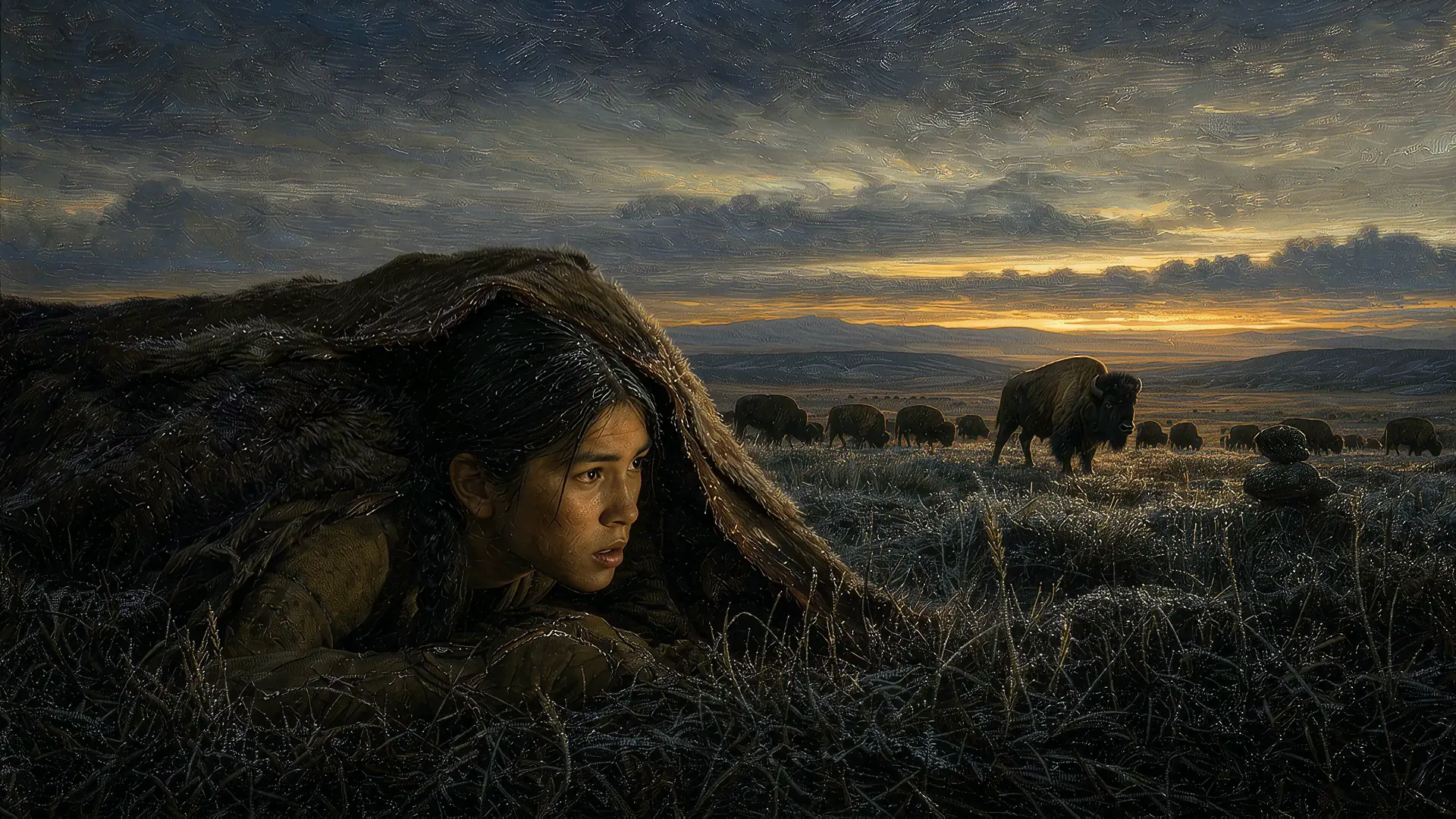
One autumn morning in 1491, on the northern Great Plains, a young hunter lay in the frosty grass under a bison calf's hide.
The RunnerDramatized
Come on, grandmother. Your baby's lost.
He was calling to the herd's lead cow, crying like a lost calf so that she would follow him.
Behind him, two long lines of stone piles ran toward a cliff, and dozens of people crouched out of sight beside them.
The UncleDramatized
Let her come.
The UncleDramatized
NOW! UP! UP!
Everyone jumped up, shouting and waving robes, and the frightened herd stampeded down the stone lanes toward the edge.
The lead animals plunged over the cliff, and the band got meat and fat, hides for robes and tents, and bone for tools.
The MotherDramatized
He's alive. Good. Everyone get a knife.
At one such cliff, in what is now southern Alberta, Canada, hunters drove bison this way for nearly 6,000 years.
Footprints at White Sands, in what is now New Mexico, show that people lived in North America more than 20,000 years before 1491.
Their ancestors had come from Asia, probably across a land bridge from Siberia to Alaska that now lies under the Bering Sea. Over thousands of years, their descendants spread across two continents and became hundreds of different peoples, speaking hundreds of languages.
In 1491, between 50 and 100 million people lived in the Americas, most of them in Mexico, Central America and the Andes. Maize, which English speakers call corn, fed Maya cities and the Aztec capital, Tenochtitlán, home to about 200,000 people. In the Andes of South America, the Inca ruled the largest empire in the Americas, and its mountain farmers grew potatoes. In 1492, Christopher Columbus sailed west from Spain, and his voyage began lasting contact between Europe and the Americas.
North of Mexico, far fewer people lived in hundreds of separate nations, spread across deserts, grasslands, forests and coasts. What each people ate shaped whether they moved or stayed, and how they divided their work. In the autumn of 1491, a year before Columbus arrived, families across North America were getting ready for winter.