
Native American Societies Before European Contact in two minutes
- Native peoples adapted to their environments and also changed them, digging canals in the desert and burning forest for fields, and the food supply shaped whether a people moved or settled.
- In the Southwest, maize from Mexico spread north; Hohokam farmers dug canals, and Pueblo farmers stored surplus corn, which freed some people to work as potters, traders, and religious leaders.
- Plains hunters followed bison on foot with dogs and traded meat and hides to Pueblo farmers for corn, while Great Basin bands moved with seasonal harvests.
- In the Northeast, the Haudenosaunee lived in longhouse towns, traced descent through mothers, farmed corn, beans, and squash, and hunted and fished; historians debate when their five-nation league began.
- Near today's St. Louis, Cahokia's leaders organized workers to build Monks Mound, a center of Mississippian culture, but most of its people had left by the late 1300s.
- In the Northwest, salmon fed settled plank-house towns without farming and chiefs won followers by giving feasts, while California peoples ground and stored acorns to support villages.
- On the exam: questions ask you to link each region to its economy and society and to show how peoples adapted to and reshaped land, a baseline for later change.
Topic 1.2 key terms
- Largely mobile lifestyles
Moving camp with the seasons to reach food. Bison hunters on the western Great Plains and foragers in the dry Great Basin both lived this way.
- Pueblo communities
Farming towns of the Southwest, built of stone or adobe and often several stories high. Pueblo is Spanish for town; Cicuye, later called Pecos, was one of many.
- Surplus
Food beyond what people need right away. Stored, traded or shared, it carried people through bad years and freed some of them for other work.
- Maize (corn)
A grain first bred from a wild grass in southern Mexico. It spread north over thousands of years and became the main crop of many North American farming peoples.
- Irrigation
Bringing water to dry fields through canals or ditches, as Hohokam farmers did along the Salt River in today's Arizona.
- Social diversification
A society dividing into more kinds of work and more levels of rank. In the Southwest, maize surpluses and canal work made room for builders, traders, leaders and religious specialists.
- Trade networks before contact
Native peoples traded over long distances before Europeans arrived. Pueblo towns swapped corn, cloth and pottery for the bison meat, fat and hides of Plains bands.
- Matrilineal
Tracing family and clan through the mother's line. Among the Haudenosaunee, related women and their families shared a longhouse, and clan mothers chose the chiefs.
- Haudenosaunee (Iroquois Confederacy)
A league of five nations in what is now New York: the Seneca, Cayuga, Onondaga, Oneida and Mohawk, later joined by the Tuscarora. Its council met at Onondaga.
- Three Sisters
Maize, beans and squash planted together. Cornstalks hold up the beans, beans enrich the soil, and squash leaves shade out weeds.
- Mixed agricultural and hunter-gatherer economy
Farming plus hunting, fishing and gathering. In the Northeast, the Mississippi Valley and along the Atlantic coast, this mix supported villages that lasted for years.
- Cahokia (Mississippian culture)
The largest Mississippian town, near present-day St. Louis, at its height around 1100. Its farmers grew maize, and its people built huge earthen mounds. Most had left by about 1400.
- Plank houses
Large houses of split cedar planks, each home to several related families. On the Northwest coast and the lower Columbia, rich fisheries let people live in such towns all year without farming.
Transcript
Quotes are from the historical record and name their source. Lines marked Dramatized are reconstructions.
What the Dogs Can Carry
Late autumn 1491
Key terms: Largely mobile lifestyles
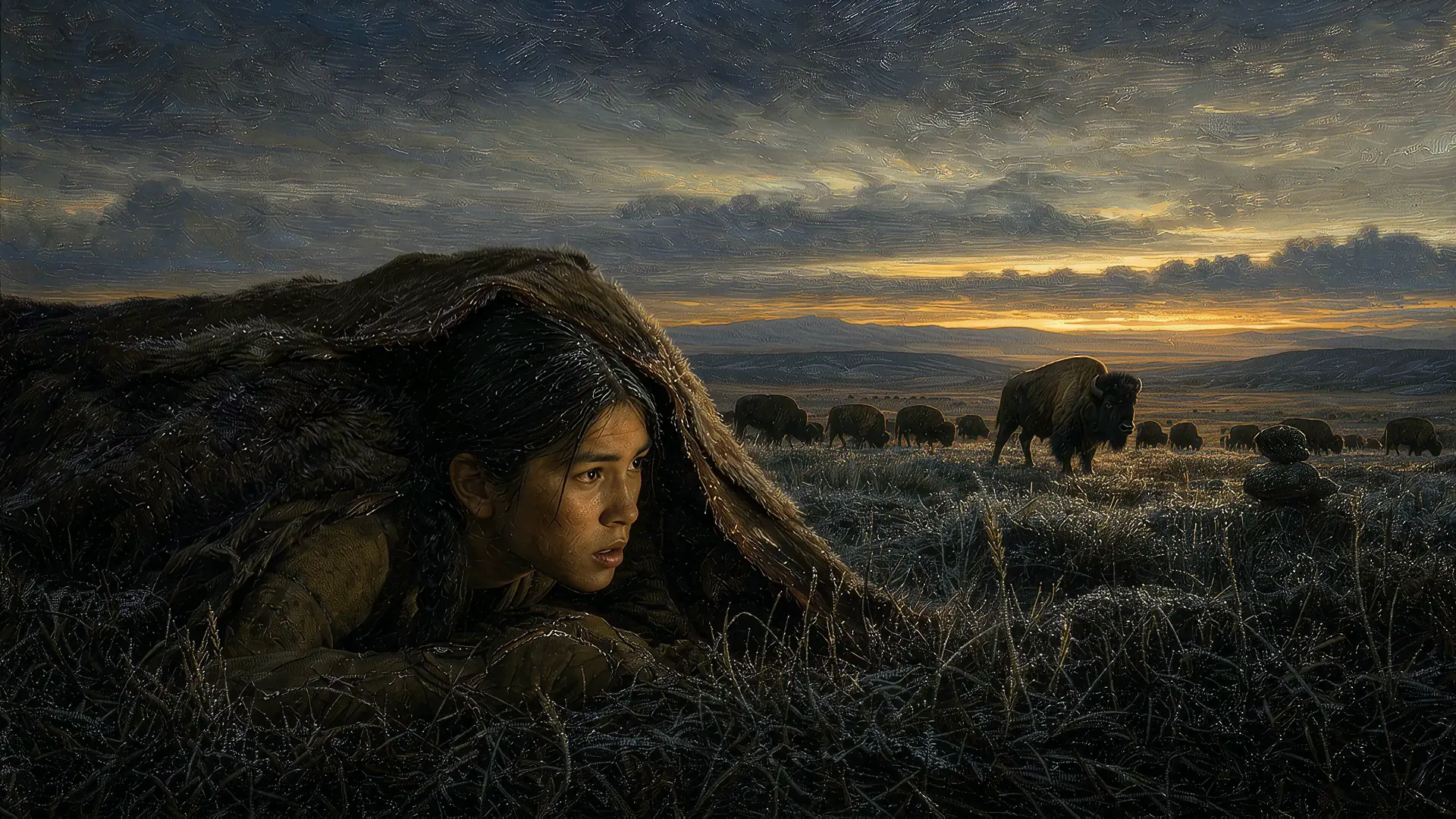
When the first snow came, the bison hunters took down their tipis and packed the poles and hide covers to move. On the western Great Plains, many peoples moved with the bison herds as the seasons changed.
There were no horses in North America in 1491, so dogs dragged each family's belongings on a travois, a frame of two poles.
In 1541, a Spanish soldier named Pedro de Castañeda saw Plains hunters traveling this way, and he later wrote:
Pedro de Castañeda
“They travel like the Arabs, with their tents and troops of dogs loaded with poles … When the load gets disarranged, the dogs howl, calling some one to fix them right.”
A strong dog could pull about fifty pounds, so every robe a family packed meant less meat on the trail.
The RunnerDramatized
I painted that myself.
The MotherDramatized
Then you carry it. The dog carries meat.
He hid the robe under a rock, planning to collect it when the band came back to hunt the next fall.
The RunnerDramatized
I'll be back for you.
West of the Rocky Mountains, the Great Basin was a dry land where rivers ended in desert lakes and never reached the sea. Food there was scattered and seasonal, so small groups moved from marsh to hillside to valley as each harvest ripened.
The Net-holderDramatized
Close it! Close it now!
Each fall, several families joined forces to drive rabbits into long nets, then split up again to follow the harvests.
Some Shoshone bands took their names from what they ate, so a band that moved into pine-nut country became the Pine-Nut Eaters.
Farther east, along the Missouri River, other Plains peoples farmed corn, beans and squash and lived all year in earth lodges.
The hunting bands planned their moves, because they knew where to find shelter, game and ripe plants in each season.
The Year It Doesn’t Rain
Harvest and late autumn 1491
Key terms: Pueblo communities, Surplus, Maize (corn), Irrigation, Social diversification
Far to the south, in what is now New Mexico, the farmers of Cicuye, later called Pecos, stayed put all year.
Its houses stood four stories high, and people across the region feared its warriors.
The KeeperDramatized
Twenty-nine, thirty, thirty-one. These are for the year it doesn't rain.
Pueblo families stored corn from good years in back rooms, so that a drought or a failed crop would not starve them.
In the late 1200s, after years of drought, hunger and violence, the people of Mesa Verde, in what is now Colorado, left their villages. Many moved to the Rio Grande valley in New Mexico, where their descendants still live in Pueblo towns.
Farmers in Mexico's Balsas valley bred maize from a wild grass around 7000 BCE.
Drag through the corn clock to follow maize north from Mexico, and see what changed for the people who grew it.
In the dry Salt River valley of Arizona, Hohokam farmers dug hundreds of miles of canals to water their corn.
In 1903, an Akimel O'odham elder named Thin Buckskin told a story about those canal builders.
Thin Buckskin · as told in 1903
“And those who lived where the mound now is between Phoenix and Tempe were the first to use a canal to irrigate their land.”
Canals took crews to dig them, planners to lay them out, and leaders to decide whose fields got water first. Surplus corn also let some people work as potters, traders or religious leaders, and that kind of change is called social diversification.
Under the Wings
Late autumn 1491
Key terms: Trade networks before contact
Back in the fall of 1491, bands from the southern Plains walked to Cicuye, and their dogs dragged dried meat, fat and hides.
The Dog-Train WomanDramatized
Hey, up there! We brought your winter fat!
The Dog-Train WomanDramatized
Your corn got my children through last winter.
Sort the trade goods by who made them, the Pueblo farmers or the Plains hunters.
Plains hunters needed corn, and Pueblo farmers needed meat, fat and hides. Pueblo towns also traded cotton cloth and pottery, so each side got what it could not easily make at home.
In 1541, Castañeda also watched Plains traders at the pueblos, and twenty years later he wrote that their welcome had a limit:
Pedro de Castañeda
“they do not stay in the villages over night, but outside under the wings.”
The two peoples traded, but each kept its own leaders, and the traders slept outside the town walls.
The Last Winter Here
Winter 1491–1492
Key terms: Matrilineal, Haudenosaunee (Iroquois Confederacy)
Far to the northeast, in what is now upstate New York, an Onondaga town spent that winter in its longhouses.
The Clan MotherDramatized
This is our last winter here.
Towns like this moved every ten to thirty years, once the soil wore out and women had to walk farther for firewood. They were still settled farming towns, where families lived for years and rebuilt nearby when they moved.
To move, they had to build every longhouse again, and the chief of her clan argued against it.
The ChiefDramatized
And if I say no?
The Clan MotherDramatized
I named you. I can name someone else.
Among the Onondaga, the senior women of each clan chose its chiefs, and they could remove a chief who failed his people. Clan membership passed through mothers, and related women and their families shared one longhouse.
The Onondaga were one of five nations in what is now New York, and the five formed a league to keep peace among themselves. They called themselves the Haudenosaunee, the People of the Longhouse, and Europeans later called them the Iroquois Confederacy. Historians still argue about when the league formed, some dating it before 1491 and some after.
The Clan MotherDramatized
I don't want to leave either.
New Ground
Spring 1492
Key terms: Three Sisters, Mixed agricultural and hunter-gatherer economy, Cahokia (Mississippian culture)
In the spring of 1492, the town moved a few miles to fresh ground and began to clear new fields.
Men killed the big trees by cutting a ring through their bark, then burned them to open sunny fields.
In the ashes, women planted corn, beans and squash together, the crops the Haudenosaunee call the Three Sisters. Men also hunted deer and fished, and families gathered nuts and berries, so wild foods fed the town along with the crops.
The same mix of crops, hunting and fishing fed towns along the Mississippi River and across the Southeast.
Centuries earlier, Cahokia, the greatest of these towns, stood beside the Mississippi River near today's St. Louis.
Its leaders organized workers, fed by stored corn, to build Monks Mound about 100 feet high, one basket of earth at a time. Around 1100, Cahokia was about as large as London was then.
By the late 1300s, most of Cahokia's people had left.
Other mound towns carried on, and in 1540 Spanish soldiers found Coosa, in what is now north Georgia, crowded with towns and fields.
Back in Onondaga country, explore the valley to find where this town's food came from.
Eastern peoples adapted to the forest and also changed it, burning clearings for their fields and thinning the woods for hunting.
Salmon Country
Spring–summer 1492
Key terms: Plank houses
The House ChiefDramatized
Get that end up!
At Cathlapotle, a Chinookan town on the lower Columbia River in what is now Washington State, people grew no corn at all. Salmon runs and wapato, a starchy marsh root, fed families who lived all year in big houses of split cedar planks.
In the spring of 1492, the salmon run filled the house, and the chief's wife wanted to dry the extra for a bad year.
His WifeDramatized
A dry year, and we eat bark.
The House ChiefDramatized
Feed everyone.
Chiefs who gave generous feasts won respect and followers, turning surplus food into power.
Chinookan households also enslaved captives taken in war, and the captives' children were born into slavery.
Slide between a Pueblo storeroom and a Northwest plank house.
Corn at Cicuye and salmon at Cathlapotle did the same job, giving each town enough stored food to stay in one place all year.
In California, women ground acorns into flour, washed out the bitter taste with water, and cooked it with hot stones. Families stored acorns in granaries for months, and with fish and game the nuts fed villages that did not farm.
On the Klamath River in northern California, Yurok towns built a great fish dam together at Kepel, and in 1902 an elder explained one rule:
A Yurok elder · told 1902
“When they have made the dam, right in the middle they leave it open for about three days.”
For those three days, salmon swam through the gap and on up the river.
First Harvest
Autumn 1492
In the fall of 1492, in the new Onondaga town, women pounded corn from the first harvest on the fresh ground.
The Clan MotherDramatized
I'll get the wood. It's close enough now.
That same fall, the Plains band came back to the cliff where it had hunted the year before, just as it had planned.
On the Atlantic coast, in what is now North Carolina, Algonquian towns lined the shallow sounds behind the Outer Banks. In July 1585, an English expedition visited several of them, and its artist, John White, painted the town of Secota.
His watercolor shows bark-covered houses, corn at three stages of growth, and a raised hut where someone sat to guard the crop. In a caption printed in 1590, Thomas Harriot wrote that birds and animals would eat the corn unless someone kept watch:
Thomas Harriot
“For which cause the watcheman maketh continual cryes and noyse.”
Farming towns like Secota had stood on this coast long before White came, and their people fished as well as farmed. They built weirs, fences of stakes or stones that steered fish into traps.
In the dry Southwest, maize and canals fed large farming towns where people did many kinds of work. In the Great Basin and on the western Plains, scattered plants and wandering herds kept small groups on the move. In the Northeast, the Mississippi Valley and along the Atlantic coast, crops plus hunting and fishing supported lasting villages. In the Northwest, salmon fed settled towns without farming, and in California, stored acorns did the same. Across North America, people adapted to their environments and also changed them, digging canals in the desert and burning clearings in the forest.
October 1492
October 11, 1492
On the night of October 11, 1492, families slept at Cathlapotle, at Cicuye, in the Plains camps and in the new Onondaga town.
On a small island in the Bahamas, Lucayan families fished the reefs and grew manioc, a starchy root.
That night, three ships from Spain, led by Christopher Columbus, were sailing toward the island.
Columbus came ashore the next morning, October 12, 1492. Over the next century, Europeans brought trade, conquest and deadly epidemics to peoples whose ancestors had lived in the Americas for thousands of years. Pueblo, Haudenosaunee, Chinook and Yurok people still live in or near their homelands today. The people Columbus met, and millions more across the Americas, were already home, with their own foods, towns and leaders.