
Topic 2.10 key terms
- product rule
- For differentiable and : . Each factor takes a turn changing while the other holds still.
- quotient rule
- For differentiable and , wherever : , the product rule run backward on .
- derivative of tan x
- , from and (radians).
- derivative of sec x
- , from .
- derivative of cot x
- , from .
- derivative of csc x
- , from .
Transcript
806 words · 3 parts
Four more trig derivatives
Now we finally have the tool we came for. Tan theta is sine theta over cosine theta, so let’s run it through the quotient rule. Low d-high is cosine times cosine, minus high d-low, which is sine times negative sine, all over cosine squared. The two minus signs make a plus, so the top is cosine squared plus sine squared, and you already know what that adds up to. It’s one.
The derivative of tan theta is one over cosine squared, which is secant squared theta. Watch what that means on the graph. As this tangent line slides along tan x, its slope draws secant squared underneath, and that slope never drops below one and shoots up near the edges. Since secant squared is positive everywhere tan is defined, tan x is increasing on every interval of its domain, and you can write exactly that reason on the exam.
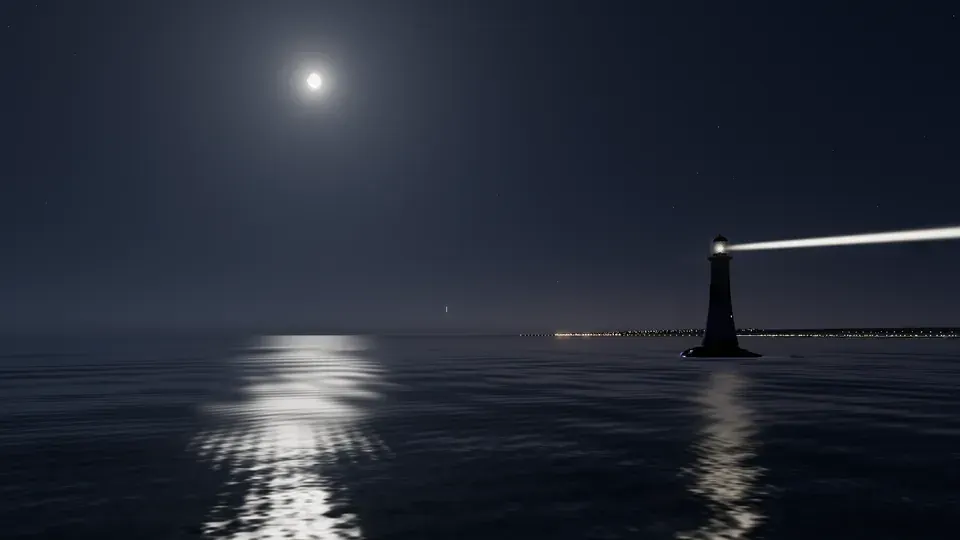
Back on our beach, the spot sits at a thousand tan theta, so it moves a thousand secant squared theta meters for every radian the lamp turns. The lamp turns one radian every second, so that’s meters per second too. Straight ahead, secant of zero is one, so the spot crosses in front of the lighthouse at a thousand meters a second, about three times the speed of sound.
Each ghost spot is one equal turn of the lamp, and the gaps between them keep getting wider. The beam itself gets longer as it turns, a thousand secant theta meters from the lamp to the spot, so to know how fast it stretches we need the derivative of secant.
Secant is one over cosine. Low d-high is cosine times zero, because the top is just one. Subtract high d-low, one times negative sine, and the two minuses leave sine over cosine squared, which splits into secant theta times tan theta. That means the beam stretches at a thousand secant theta tan theta meters a second, and straight ahead that’s zero, right where the beam is at its shortest.
Now you try one. Cotangent is cosine over sine, so what’s its derivative? Cosecant is one over sine, and the constant one has derivative zero, so the quotient rule leaves negative cosine over sine squared. Split that into negative one over sine, times cosine over sine, and it’s negative cosecant cotangent. Here are all six together, the three plain ones on the left and the three co-functions on the right.
There’s a pattern in them that saves people on the exam, because the three whose names start with co, cosine, cotangent and cosecant, are exactly the ones with a minus sign. One warning before we head back outside. These formulas only work in radians, and only where the function itself is defined, so tan has no derivative wherever cosine is zero.
Faster than light
Let’s go back to the beach and put that formula to work. Aim the beam so the spot runs exactly four times as fast as it does straight ahead. I’ve hidden the speed, so work out the angle first, then aim and let go.
Now let the beam keep turning. The closer it gets to running along the sand, the bigger secant squared gets, and in our formula the speed has no limit at all. By one and a half radians, the spot is covering two hundred kilometers every second. For a spot that really outruns light, look up. The Moon is about three hundred eighty-four thousand kilometers away, so imagine flicking a laser across it at one radian per second.
It’s our beach rule with the Moon’s distance in place of a thousand meters, and straight on, secant squared is one. So as it crosses the middle of the Moon, the spot moves at the Moon’s distance times your flick rate, about three hundred eighty-four thousand kilometers every second at one radian a second.
That’s faster than light already, so how lazy can your wrist be? Set the slowest flick that still makes the spot outrun light, then flick it.
Nothing breaks, because nothing is actually traveling along the beach or across the Moon. The laser sends different light toward each point at a different moment, so nothing travels sideways from one point to the next. That’s why the moving spot carries no object and no message faster than light.
What we climbed
Let’s look back at everything we climbed today. When two things multiply, each one takes a turn changing while the other holds still, and that’s the product rule. A quotient is a product run backward, which gave us the quotient rule and its minus sign, and four quotients of sine and cosine gave us the other four trig derivatives. Now you can tell anyone exactly how fast that spot of light is running at any angle, and how a spot swung across the Moon can outrun light.