
Topic 2.5 key terms
- power rule
- For any real number r, d/dx xʳ = r·xʳ⁻¹ wherever the derivative exists: bring the exponent down in front, then subtract one from the exponent.
- rewrite as a power
- Before using the power rule, write roots and reciprocals as powers of x: √x = x^(1/2), 1/x³ = x⁻³, x√x = x^(3/2).
- constant rule
- The derivative of a constant function is 0: its graph is a horizontal line with slope 0 everywhere.
- constant multiple rule
- d/dx [k·f(x)] = k·f′(x): multiplying a function by k stretches every rise, so every slope is multiplied by k.
- sum and difference rules
- d/dx [f(x) ± g(x)] = f′(x) ± g′(x): differentiate term by term.
- derivative of a polynomial
- Apply the power rule to each term, keep each coefficient, and drop the constant term: d/dx (4x³ − 5x² + 7x − 2) = 12x² − 10x + 7.
Transcript
1,476 words · 5 parts
One millimeter of gold
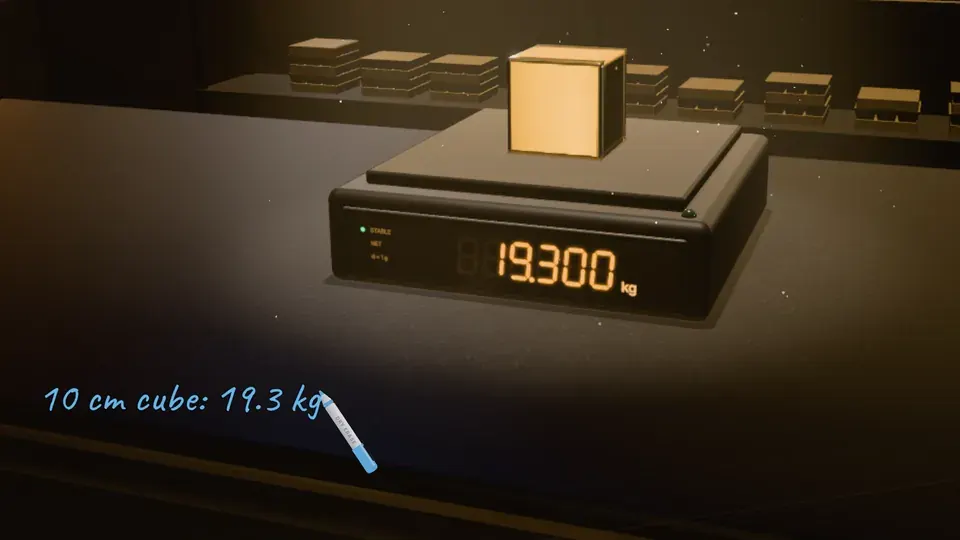
This is a solid gold cube, ten centimeters along every edge, and the scale says it weighs just over nineteen kilograms, about as much as a fully packed suitcase. Let’s make every edge one millimeter longer and keep an eye on the scale while the new gold goes on. That skin is thinner than a coin, and it just added about five hundred eighty-five grams, more than half a kilogram of gold.
Next to it I’ve put its big brother, twice as wide on every edge, and this one weighs about a hundred fifty-four kilograms, which is about as heavy as two grown adults. Before we give the big cube that same extra millimeter, I want you to guess how much gold it takes. Take a guess for the big cube, and don’t overthink it, because we’re going to work out the real answer together.
By the end of this lesson you’ll be able to answer that in your head. You’ll take a polynomial that used to need a page of limit work and find its derivative in a few seconds. You’ll know why the shortcut works, because we’ll build it from the pieces of this cube. Let’s start with something flatter than a cube, a square, because a square hides the whole idea in just two dimensions.
The growing square
Take a square whose sides are x long, so its area is x squared. A couple of lessons ago the limit told us that the derivative of x squared is two x, and now we’re going to see where that two x comes from. Let’s stretch both sides by a little bit, delta x. The new area arrives in three pieces, a strip along the top and a strip down the side, each x long and delta x thin, plus a tiny square in the corner.
Adding the pieces, that’s x delta x plus x delta x plus delta x squared, which is two x delta x, plus delta x squared. A derivative asks how fast the area grows for each bit of x, so let’s divide by delta x. That leaves two x from the strips and one leftover delta x from the corner.
Let delta x shrink toward zero and that leftover goes with it, so the derivative of x squared is two x. I want to be honest about the corner, because it never really disappears. At x equals ten with delta x equal to one, the strips give twenty and the corner gives one, so the ratio is twenty-one. As delta x shrinks it goes to twenty point one, then twenty point zero one, closing in on twenty.
Three slabs
Let’s do the same thing with the gold cube. I’ve pinned one of its corners into this steel jig, so when the cube grows, it can only grow away from that corner. We’ll start with a huge growth, a whole centimeter, and then pull the new gold apart so we can count it. There are three big flat slabs, one on each face that moved, and each one is ten by ten by one, a hundred cubic centimeters apiece.
Where two slabs meet there’s a thin rod, three of them at ten cubic centimeters each. Then there’s one little corner cube of just one cubic centimeter, so altogether the cube gained three hundred thirty-one cubic centimeters. Now let’s shrink the growth to one millimeter. The three slabs now hold thirty cubic centimeters between them, but the rods are down to three tenths and the corner is a single thousandth, a speck you need this loupe to see.
Now you get to drive. Drag the growth handle down toward zero a few times, and watch your own measurements pile up next to delta V over delta x. Look at the measurements. What number is delta V over delta x heading for?
Look where that three hundred comes from. It’s three slabs that are each ten by ten, so three times ten squared. With letters, each slab is x by x by delta x, each rod is x by delta x by delta x, and the corner is delta x cubed. That makes the change in volume three x squared delta x, plus three x delta x squared, plus delta x cubed.
When we divide by delta x, every leftover piece still has a delta x in it, so as delta x goes to zero only the slabs survive. The derivative of x cubed is three x squared.
Bring the power down
Let’s line up what we’ve found. The line y equals x has slope one, x squared gives two x, and x cubed gives three x squared. Every time, the old exponent shows up in front while the new exponent is one smaller.
A four-dimensional cube would grow four slabs. I can’t draw that, but if you multiply out x plus delta x to the fourth, the only piece with a single delta x is four x cubed delta x. We call this the power rule, and it says the derivative of x to the n is n times x to the n minus one. You bring the exponent down in front, and then you take one away from the exponent.
The rule works for every real power, and you’ve already seen it work twice. From the definition, one over x gave negative one over x squared, and root x gave one over two root x. Write one over x as x to the negative one, and the power rule gives negative one times x to the negative two.
Root x is x to the one half, so the rule gives one half times x to the negative one half. Rewrite that as one over two root x, and we’ve recovered the answer we found with the limit.
Now we can settle the gold bet. At ten centimeters the volume grows at three times ten squared, three hundred cubic centimeters for every centimeter of edge, so one millimeter adds about thirty. Every cubic centimeter of gold weighs nineteen point three grams, so that’s about five hundred seventy-nine grams.
The scale said about five hundred eighty-five grams, and the missing six grams or so sit in the rods and the corner. The derivative counts only the slabs, so a real millimeter always comes out a little heavier.
Now you settle the bet. At twenty centimeters, how fast is the cube’s volume growing, in cubic centimeters per centimeter of edge? One millimeter on the big cube then adds about a hundred twenty cubic centimeters, and at nineteen point three grams each the slabs come to about two thousand three hundred sixteen grams, four times the small cube’s five hundred seventy-nine.
Twice the edge makes every face four times bigger, and the new gold is a skin over those faces, so the big scale climbs about four times as far, plus a few grams for the rods and the corner. If you guessed four times back at the start, you were right. The whole cube weighs eight times as much, but a skin grows like its faces.
Powers in disguise
I want to use the power rule, so first I’ll write this fraction as a power of x. One over x cubed is x to the negative three. Bring the negative three down in front and take one away from the exponent. Negative three minus one is negative four, not negative two, and that’s the most common slip with negative powers, so I always write that subtraction out.
Root x is x to the one half, so its derivative is one half x to the negative one half, or one over two root x. At four that’s a quarter, and if we zoom in on the graph of root x at four, the tangent line’s slope reads exactly a quarter. If we slide the point along, its slope traces out one over two root x, which shoots up near zero, and that’s why this derivative needs x bigger than zero.
Let’s do one together. x squared times root x looks like a product, but both pieces are powers of x, so we can add the exponents. Before I write it, what’s two plus a half? It’s five halves, so this is x to the five halves. Bring the five halves down, take one away, and the derivative is five halves x to the three halves.
Before you try one, look at where the x sits in these two expressions. In two to the x, the variable is the exponent, so we need a different derivative rule, and we’ll meet that rule next lesson.
Okay, now you try one, and remember to rewrite first. What’s the derivative of one over x to the fourth? Let’s add a number at the end this time. If f of x equals x times root x, what is f prime of nine?