
Topic 2.6 key terms
- power rule
- For any real number r, d/dx xʳ = r·xʳ⁻¹ wherever the derivative exists: bring the exponent down in front, then subtract one from the exponent.
- rewrite as a power
- Before using the power rule, write roots and reciprocals as powers of x: √x = x^(1/2), 1/x³ = x⁻³, x√x = x^(3/2).
- constant rule
- The derivative of a constant function is 0: its graph is a horizontal line with slope 0 everywhere.
- constant multiple rule
- d/dx [k·f(x)] = k·f′(x): multiplying a function by k stretches every rise, so every slope is multiplied by k.
- sum and difference rules
- d/dx [f(x) ± g(x)] = f′(x) ± g′(x): differentiate term by term.
- derivative of a polynomial
- Apply the power rule to each term, keep each coefficient, and drop the constant term: d/dx (4x³ − 5x² + 7x − 2) = 12x² − 10x + 7.
Transcript
1,174 words · 5 parts
Three pieces of one flight
Let’s take these rules somewhere with a little more gunpowder. This galleon’s cannonball has a height, in feet, of sixteen plus a hundred sixty t minus sixteen t squared, t seconds after the shot. Every piece of that formula is something real. The sixteen is the deck the ball starts from, and a hundred sixty t is the straight line it would fly with no gravity. Sixteen t squared is how far gravity has pulled it below that line.
Now let’s watch rates instead of heights. The ghost on the straight line climbs at a steady hundred sixty feet per second. Gravity’s gap is sixteen t squared, so by the power rule it opens at sixteen times two t, thirty-two t feet per second. The real ball’s vertical velocity is the difference, so at two seconds it’s a hundred sixty minus sixty-four, which is ninety-six feet per second.
Let’s fire a second gun at the same instant, forty feet higher up the ship, with exactly the same powder. Its ball flies the same arc, shifted up, and at every instant its arrow matches the first ball’s. The higher deck changes where the ball is but never how fast it’s climbing, and that’s the constant rule, something you can actually see.
The linear rules
Back on the board, a constant function like y equals seven is a flat line, so its slope is zero everywhere, and the derivative of any constant is zero. Now take x cubed. In precalc, adding seven to a function slid its graph up by seven. Sliding a hill up doesn’t make it any steeper, so x cubed plus seven still has the derivative three x squared. Multiplying by seven is different, because it stretches every height seven times taller.
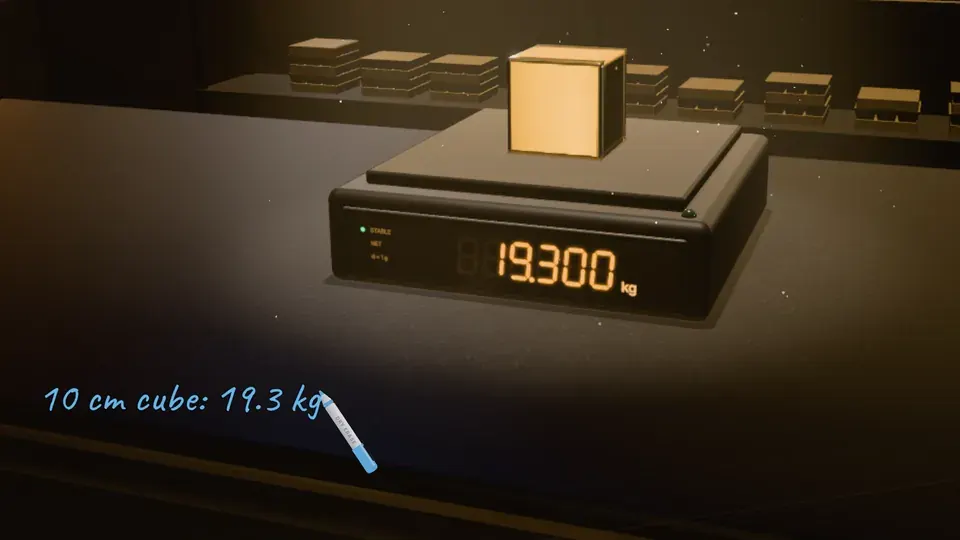
Every rise gets seven times bigger, so every slope does too, and seven x cubed has the derivative twenty-one x squared. That’s exactly what the gold’s nineteen point three did when we turned cubic centimeters into grams.
For a sum, let’s collect the two f terms together and the two g terms together. Dividing each change by the same step, delta x, gives two average rates, and as delta x goes to zero they become f prime and g prime, and differences work the same way. Products don’t split like that, though. x squared times x cubed is x to the fifth, whose derivative is five x to the fourth, but multiplying the two derivatives gives six x cubed. Products get their own rule a couple of lessons from now.
Let’s try a famous formula. The area of a circle is pi r squared, so what is d A over d r, the rate the area grows as the radius grows?
Wait, two pi r is the circumference! It makes sense when you picture it, because growing the radius by a sliver adds a thin ring around the outside, and that ring is about as long as the circumference.
A ball does the same thing. Its volume is four thirds pi r cubed, the power rule turns that into four pi r squared, and that’s exactly the surface area of the ball. Our cube’s three x squared covers only three of its six faces, because it grew from a pinned corner.
With all four rules in hand, we can finally do the cannonball properly, term by term. The sixteen is a constant, so it gives zero, a hundred sixty t gives a hundred sixty, and minus sixteen t squared gives minus thirty-two t. That makes h prime of t a hundred sixty minus thirty-two t, in feet per second.
The ball stops climbing when its vertical velocity is zero, so we set a hundred sixty minus thirty-two t equal to zero, and that happens at five seconds. At that instant gravity’s arrow has grown to exactly a hundred sixty, it cancels the powder’s arrow, and the ball hangs at the top for a moment while it keeps sailing sideways.
The AP exam likes to ask whether the ball is rising or falling at six seconds, with a reason. We start with h prime of six, a hundred sixty minus a hundred ninety-two, which is negative thirty-two feet per second. A full-credit answer ties that number to the conclusion. Because h prime of six is negative, the ball’s height is decreasing at six seconds, so the ball is falling.
Your gun
Now the gun is yours, and that ship on the horizon is your target. From the main deck, a ball that’s still climbing at a hundred twenty-eight feet per second two seconds after the shot lands right on her. You’ve got two knobs, the deck height and the launch speed straight up, so set them to make h prime of two exactly a hundred twenty-eight.
A launch speed of a hundred ninety-two works from any deck, so let’s fire it from two decks at once, the main deck and one higher up. At two seconds, both balls are climbing at exactly a hundred twenty-eight feet per second. The two balls had the same vertical velocity but not the same height, so they landed in different places, and the one from the main deck is a direct hit, found this time with one line of calculus.
How the exam asks it
We’ll warm up with the three-second version. Take P of x equals four x cubed minus five x squared plus seven x minus two. Every coefficient rides along with the power rule and the constant drops out, so P prime of x is twelve x squared minus ten x plus seven. The AP exam also loves to hand you a table instead of formulas. This one is a new problem, with the values of two functions f and g and their derivatives at x equals two.
If h of x is three f of x minus two g of x plus x cubed, what is h prime of two? Everything you need is in the table. For this last problem, find where the graph of x cubed minus twelve x plus five has a horizontal tangent line, for a positive x.
Four times the gold
Let’s pull it together. The power rule brings the exponent down and takes one away, and it works for any real power once you’ve rewritten roots and fractions as powers of x. Added constants vanish, constant multiples ride along, and sums and differences split apart, which is why any polynomial falls to pieces term by term. When the exam asks whether something is rising or falling at a moment, give the derivative’s value there and connect its sign to your answer.
Now you can do the gold in your head. Twice the edge makes every face four times bigger, and a skin grows with its faces. Four times five hundred eighty-five grams is about two point three kilograms. What derivative do you get for x to the fifth minus three x squared plus seven? I get five x to the fourth minus six x, in about three seconds, and every term follows the rule we built from the growing cube.