
Topic 3.2 key terms
- implicit relation
- A curve given by an equation in x and y, like x² + y² = 25, instead of y = f(x). It may fail the vertical line test as a whole, yet near most of its points (like (3, 4)) a small piece of it is the graph of a function.
- implicit differentiation
- Finding dy/dx by differentiating both sides of the equation with respect to x, treating y as a function of x: the chain rule puts a factor dy/dx on every function of y (and mixed terms like xy also need the product rule). Then solve for dy/dx.
- differentiate both sides
- If an equation holds at every point of a curve, the derivatives of its two sides with respect to x are equal too; a constant side gives 0. Write the differentiated equation in full, = 0 and all, before solving for dy/dx.
- dy/dx on an implicit curve
- The slope of the curve at a point. It usually depends on both x and y, because the same x can sit on different pieces of the curve with different slopes.
- tangent line
- The line through a point of the curve with the curve's slope there: y − y₁ = (dy/dx)(x − x₁), using the point's own coordinates.
Transcript
2,409 words · 8 parts
The table that can’t miss
This is a strange pool table, an oval with exactly one pocket and a single dot painted on the cloth. Put the ball on the dot and hit it cleanly in any direction you like. Unless you aim straight at the pocket, it bounces once off the rail, and then it rolls straight in.
Hit it the other way and it goes in again, and again. The math writer Alex Bellos designed a real table like this in 2015 and called it Loop, and on a perfect table, every clean shot from the dot does exactly this. Try to beat it yourself. Pick the spot on the rail where you think a shot from the dot will miss, and let it go.
Every one of these paths starts at the dot and ends in the pocket, and the whole secret lives in the shape of the rail. When the ball hits, what decides where it goes next is the direction the rail points at that exact spot, and that direction is a slope. The catch is that this rail is a closed loop, and no function y equals f of x can draw one, because most x’s on this table have two y’s, one on each side.
By the end of this lesson, you’ll be able to find the slope of a curve like this rail at any point, straight from its equation, and you’ll use it to call a bank shot before the ball even moves. Let’s start with the friendliest closed curve there is, and turn our table into a perfect circle.
Not a function, still a slope
Let’s look straight down and lay a grid on the cloth, in feet, with the origin at the center. Every point on this round rail sits five feet from the center, so its equation is x squared plus y squared equals twenty-five. Draw the vertical line x equals three, and it hits the rail twice, at three comma four and at three comma negative four, so this rail fails the vertical line test.
Now zoom in on three comma four and keep on zooming, and watch the rail get straighter and straighter. Up close it’s practically a straight line, the tangent, and if we measure its slope, it’s negative three-quarters, so this rail has a perfectly good slope here even though it isn’t a function.
That works because a small piece of rail near three comma four is part of the top half of the circle, and the top half on its own is a function. Down at three comma negative four we’re on a different piece, the bottom half, which is a different function.
Before we work anything out, I want your gut call. The slope at three comma four is negative three-quarters, so what do you think it is down at three comma negative four, with the very same x?
Now let’s find where these slopes come from. As the point slides along the rail, x squared plus y squared has to stay twenty-five. Here it is as a bar that’s always twenty-five tall, x squared in blue and y squared in orange.
Slide the point a little to the right and x squared grows, so y squared has to shrink by exactly the same amount, which is why y goes down as x goes up here. If we can say exactly how fast each one changes, we’ll have the slope, so let’s take that to the board.
Differentiate both sides
This is our rail on the board, and the equation x squared plus y squared equals twenty-five is true at every single point on it. As the point moves, the left side stays stuck at twenty-five, so we can take the derivative of both sides with respect to x, and the two derivatives have to match.
The x squared part is easy, its derivative is two x. The y squared part is where people get stuck, so let’s slow down. On this little piece of rail, y really is a function of x, so let me write it as y of x, and now y squared is a function inside a function.
That’s the chain rule from last lesson. The outside is the squaring, which gives two y. The inside is y of x, whose derivative is dy dx, so y squared has the derivative two y times dy dx.
We call this implicit differentiation, because the equation tells us how x and y move together without handing us y equals f of x. It sounds like a scary new technique, but honestly, it’s just the chain rule, used wherever y shows up. The most common mistake is writing two y and stopping. That’s the derivative with respect to y, but we’re differentiating with respect to x, and y changes when x changes, so it needs the dy dx.
Twenty-five is a constant, so its derivative is zero, and now we have an equation, two x plus two y dy dx equals zero. It’s the bar we watched on the table, where two x is how fast x squared changes and two y dy dx is how fast y squared changes, and together they add up to zero. Don’t drop that equals zero, because this equation is exactly what we’re going to solve. From here it’s ordinary algebra. Subtract two x, divide by two y, and the slope is dy dx equals negative x over y.
Look, there’s a y in the answer, just like your prediction said there had to be. At three comma four it gives negative three-quarters, and at three comma negative four, positive three-quarters, one formula for both halves. There’s one catch. At five comma zero, y is zero, and the formula would divide by zero, because the rail there runs straight up and down, and a vertical line has no slope.
Geometry agrees, too. The radius out to three comma four has slope four-thirds, and four-thirds times negative three-quarters is negative one, so the tangent is perpendicular to the radius, as it should be on a circle. Now you try one. What’s the slope of the rail at the point negative four comma three?
Squash the table
Now let’s squash the round table into an oval, and keep your eye on the spot in the middle. It splits in two, and the halves slide apart to four feet either side of the center.
Those two points are the foci of the ellipse, its two special points. They’re the dot and the pocket from the start, and the new rail is x squared over twenty-five plus y squared over nine equals one.
Fractions make the algebra messier, so I’ll multiply both sides by two hundred twenty-five first, which gives nine x squared plus twenty-five y squared equals two hundred twenty-five. Let’s differentiate both sides, starting with nine x squared, which gives eighteen x. For twenty-five y squared, the chain rule gives fifty y times dy dx, and the constant on the right gives zero. Solving for dy dx gives negative eighteen x over fifty y, which simplifies to negative nine x over twenty-five y.
Say the ball from the dot is headed for the rail at x equals three, on the top side. The formula needs y too, so let’s put x equals three into the rail’s equation. Three squared is nine, and nine times nine is eighty-one, which leaves twenty-five y squared equals a hundred forty-four. That makes y plus or minus twelve-fifths, and on the top side it’s twelve-fifths, or two point four.
Now plug x equals three and y equals twelve-fifths into the slope formula. The top is negative nine times three, which is negative twenty-seven. The bottom is twenty-five times twelve-fifths, and the fives cancel to leave sixty. That’s negative twenty-seven over sixty, which reduces to negative nine over twenty, about negative zero point four five. The rail tilts gently down to the right. That makes the tangent line y minus twelve-fifths equals negative nine over twenty, times x minus three.
Let’s use it. At the instant it hits, the ball can’t tell the curved rail from a straight cushion along the tangent. A straight cushion with exactly the right slope will send it into the pocket. Drag the end of the cushion to set its slope, and when you let go, the ball takes the shot.
When x and y are tangled
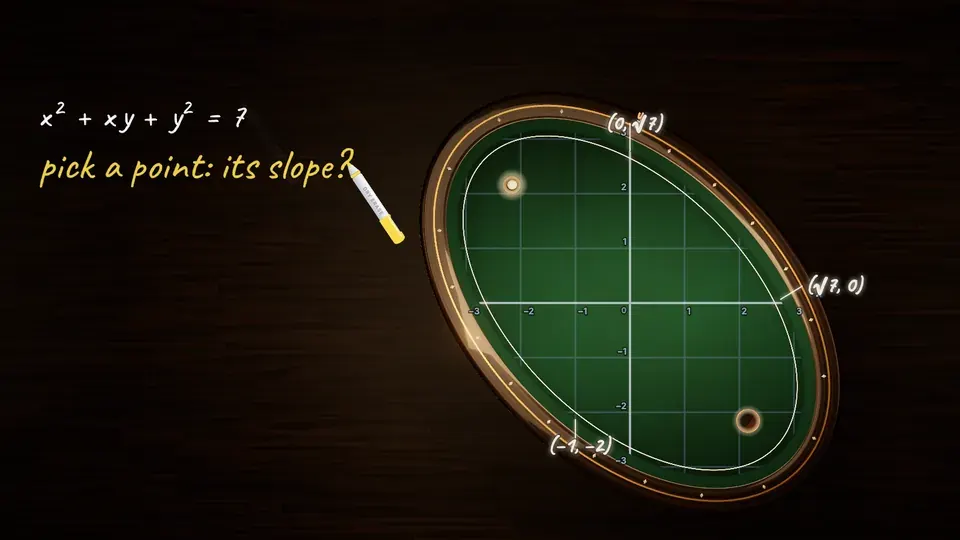
Now let’s swap in a smaller table and turn it at an angle to our grid. The rail is still an ellipse, but its equation picks up a new kind of term, x squared plus x y plus y squared equals seven, with x and y multiplied together.
We’ll differentiate both sides again, starting with x squared and then taking a careful look at the product x y. X squared gives two x. The x y term is a product of two things that are both changing, so it takes the product rule, x times dy dx, plus y times one. A common slip is writing just x dy dx here, as if x were a fixed number, but x is changing too, and y times one is what accounts for it.
Y squared gives two y dy dx and seven gives zero, so the whole line is two x, plus x dy dx, plus y, plus two y dy dx, equals zero. Two of those terms have a dy dx, so let’s collect them on one side and move everything else to the other. Factor out the dy dx, divide by what’s left, and the slope of the turned rail is the opposite of two x plus y, all over x plus two y.
Let’s try the point two comma one. It’s on the rail, since four plus two plus one is seven, and the slope there is negative five-fourths. This is how the AP exam asks it. They give you the formula and say show that dy dx equals this. One point is for the differentiated equation, equals zero and all. The other is for the algebra that lands on their formula.
Part b of a question like this would ask for the tangent line at two comma one. Which line is it? Exams love a trap like this one, too. A student claims the tangent is horizontal at the point one, negative two, since a horizontal tangent has slope zero and the top of the fraction, two x plus y, is zero there. But put that point into the rail’s equation, and you get three, not seven.
That point isn’t even on the rail, and the slope formula only means something at points on the curve. Write exactly that, with the check and the number that fails it, and you’ve earned the credit. Now find the slope yourself at the point one, two, and check that the point is on the rail first.
Curves you can’t solve
The chain rule works the same way for any function of y. Take the derivative of the outside as if y were x, then multiply by dy dx. Y cubed gives three y squared dy dx, sine y gives cosine y dy dx, and e to the y and the natural log of y work exactly the same way. That matters most for a curve like e to the y plus x y equals e. You can’t solve this one for y with any algebra you know, and implicit differentiation doesn’t care.
Differentiate both sides, and pick the line that gets every piece right. Near the point zero, one, the curve is a gentle branch running downhill, and the tangent with slope negative one over e hugs it right at that point, so the slope we found makes sense.
The visitor, right now
Some of you met this comet in precalc. It’s three-I Atlas, only the third object ever seen visiting from another star, and it swept past the Sun in 2025. Turn the picture so the comet falls straight down, and a model of its path is y equals zero point two one minus two point nine five x squared, all over x. You could differentiate that form directly, but multiply both sides by x, and the path reads two point nine five x squared plus x y equals zero point two one. That’s tangled, like the turned table.
In late October 2025 it passed closest to the Sun, right at this mark on its path. In precalc we found where it was headed in the long run, and now we can ask which way it was heading right then.
That one’s yours. Differentiate both sides and find dy dx at that point, using the numbers on the card, with the calculator if you want it. Now point its heading arrow along that slope, and let it go.
Draw the line from the comet to the Sun, which sits at about one point six, zero point two six in this picture. That line’s slope is about zero point one six five, and times our slope of about negative six, that’s about negative one, the same perpendicular test we used on the circle’s radius. At its closest point, the comet was moving exactly sideways to the Sun. As it leaves, the heading swings round toward a slope of negative two point nine five, the exit line you found in precalc, which is where this heading ends up.
Call the shot
The whole method fits on one board. Treat y as a function of x, and differentiate both sides. Every function of y picks up a dy dx from the chain rule, and a mixed term like x y needs the product rule too. Then collect, factor and divide. The slope usually needs both x and y, because it has to know which piece of the curve you’re on.
Now for the shot I promised you’d call. On the table we turned, the ball from the dot can hit the rail at any of these three points, and this time you choose, and nobody’s going to tell you the slope. Pick a point, work out the slope there, lay the straight cushion with it, and the ball will tell you if you’re right.
That’s what this table does with every shot, and you just called one yourself, straight from the rail’s equation. Now you can do the same with any curve, a circle, a turned oval, even a comet’s path, however tangled its equation is. Next time, this same trick of differentiating both sides is how we’ll find the derivatives of inverse functions, like arcsine.