
Topic 3.5 key terms
- second derivative
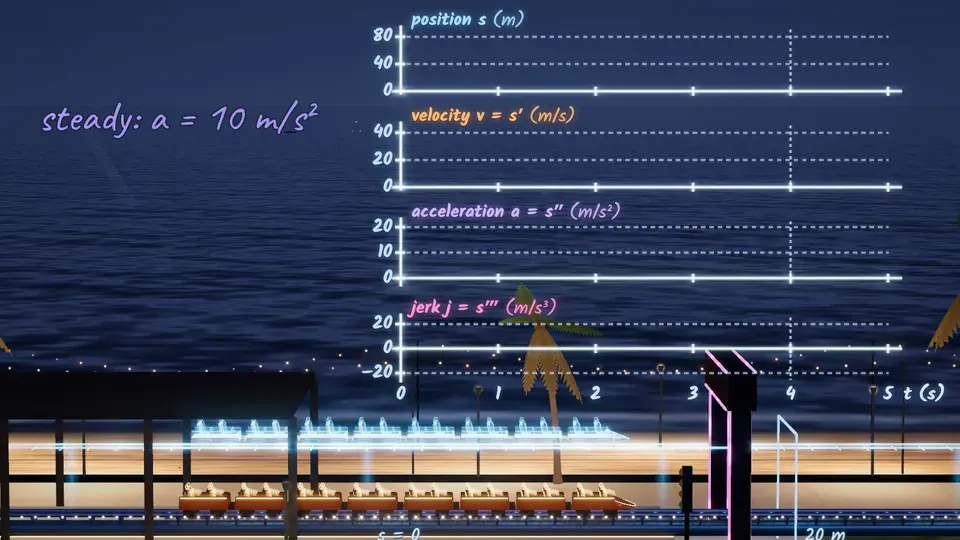
- The derivative of the derivative: , also written or , provided is differentiable there. For position , is the acceleration.
- higher-order derivatives
- Keep differentiating: , then , …, . The number in parentheses counts derivatives; it is not a power.
- jerk
- The third derivative of position, : how fast the acceleration (the push you feel) is changing, in m/s³.
- the last operation
- To choose a derivative rule, ask what the last step would be if you evaluated the expression for a number: a product (product rule), a quotient (quotient rule, or rewrite first), a function of something (chain rule), or an equation in x and y not solved for y (implicit). Ask again after every derivative.
- f″ need not exist
- A function can have a first derivative everywhere and still have no second derivative at a point: has , whose corner at 0 means does not exist.
Transcript
1,712 words · 4 parts
What’s the last thing that happens to x?
So far every function was a polynomial, the easy case, where the power rule climbs every rung. Most functions aren’t like that. The real skill is reading how a function is built, because that tells you which rule to grab first. The question I ask myself every single time is what’s the last thing that happens to x? Picture plugging a number into the function, and notice the very last step your calculator would do, because that last step picks the rule.
In sine of x squared, you square x first and take the sine last, so the outside is a sine of something, and that’s the chain rule. In x squared times sine x, you work out x squared and sine x separately and multiply them at the very end, so it’s the product rule. A fraction like x squared plus one over x ends with a division, so the quotient rule works.
But I’d rather split it first, into x plus x to the negative one, as long as x isn’t zero. Then the power rule finishes it in one line, one minus x to the negative two.
Arctangent of two x ends with an arctangent, so it’s the inverse tangent rule with a chain inside. When x and y stay tangled together, like x squared plus y squared equals twenty-five, we differentiate both sides and treat y as a function of x. Let’s see if the question works for you. What’s the first rule you’d use on x times sine x, all squared?
Now let’s put the two halves of this lesson together and take a second derivative of sine of x squared. The first derivative is the chain rule, cosine of x squared times two x, which we’ll write as two x times cosine of x squared. Before we differentiate again, ask the question one more time, because this is a new function. The last thing that happens in two x times cosine of x squared is a multiplication, so the product rule leads this time, with the chain rule inside it.
First we differentiate two x and keep cosine of x squared, which gives two cosine of x squared. Then we keep two x and differentiate cosine of x squared, which needs the chain rule again. That derivative is negative sine of x squared times two x, so everything cleans up to two cosine of x squared minus four x squared times sine of x squared. Every rung you climb hands you a new function, and you ask the question again.
A student tried this same second derivative and got negative four x times sine of x squared. Find the first line where their work goes wrong.
Bass you can see
Second derivatives aren’t only for roller coasters. We’re watching a big subwoofer lying on its back with drops of water on its cone. It plays a note so low you’d feel it more than hear it, and slow motion lets us follow the drops.
The cone only moves about six millimeters up and down, and yet it flings the water into the air like popcorn. How does such a tiny wiggle throw anything? Let’s work out how fast that tiny motion changes the cone’s velocity, because that tells us what happens to the water.
The cone’s position is A sine of a hundred t millimeters, where A is how far it swings from the middle, and the hundred sets how fast it swings, about sixteen times every second. What’s the last thing that happens to t? We multiply by a hundred and then take the sine, so it’s the chain rule, and the chain rule pulls the hundred out in front.
That makes the velocity a hundred A cosine of a hundred t. Differentiate again and the chain rule pulls out another hundred, so the acceleration is negative ten thousand A sine of a hundred t millimeters per second squared. A meter is a thousand millimeters, so that’s negative ten A sine of a hundred t meters per second squared.
A cone that swings just one millimeter peaks at ten meters per second squared, just about as hard as gravity, and at six millimeters it’s six times gravity. In our model the water doesn’t stick. The cone can push a drop up, but it can’t pull it down. Only gravity pulls the drop down. If the cone accelerates downward harder than gravity does, it leaves the drop behind.
Now turn the volume down to a gentler swing of about one point two millimeters, where the drops only just hop. At which point in the swing do you think the drops leave the cone? Now find the quietest note that still makes the drops jump. Turn the volume up from zero until the drops just start to leave the cone.
Swinging harder isn’t the only way to make water fly. That hundred is how fast the cone vibrates, called omega, and every derivative pulls one omega out by the chain rule. Keep the swing at a quarter of a millimeter, and change only how fast the cone vibrates until the drops leave.
Keep going and sine turns into cosine, then negative sine, then negative cosine, and the fourth derivative comes all the way back to sine, with a hundred to the fourth in front. A vibration’s ladder never ends, it goes around in circles and grows.
On the exam
The AP exam loves to test both of today’s ideas at once, with functions you only know from a table. This table gives f, f prime, g and g prime at x equals one and x equals two.
Let H of x be f of g of x. The last thing that happens is f, so it’s the chain rule, and H prime of x is f prime of g of x, times g prime of x.
At x equals one, g of one is two, so we need f prime of two, which is four, times g prime of one, which is negative one. That makes H prime of one negative four. We used f prime at two, not at one, and that’s exactly where the exam sets its trap. Suppose the problem gives us K prime of x as the square of f of x, times g of x. We want K double prime, so we’ll need both of today’s ideas.
We already have K prime, so one more derivative gets us K double prime. The last thing that happens is a multiplication, so it’s the product rule, and the first factor, the square of f of x, needs the chain rule inside it. That makes K double prime of x equal to two f of x times f prime of x, times g of x, plus the square of f of x times g prime of x.
Put in one, and two times three times two times two is twenty-four, and three squared times negative one is negative nine, so K double prime of one is fifteen. Say the exam asks whether K prime is increasing at x equals one, and why. K double prime is how fast K prime changes.
This is the sentence that earns the point, K prime is increasing at x equals one because K double prime of one is fifteen, which is positive. Two slips cost students this point. Writing K double prime of x equals fifteen mixes up the formula with its value at one, and saying it’s positive without naming which derivative and where doesn’t count as a reason. Use the same table to find K double prime of two.
There’s a small if in the definition of the second derivative, and it matters a lot, because f double prime only exists where f prime has a derivative of its own. Take f of x equals x times the absolute value of x. To the right of zero it’s x squared, and to the left it’s negative x squared, so its slope is two x on the right and negative two x on the left.
Both of those slopes shrink to zero at zero, so f prime of zero is zero. Together that’s two times the absolute value of x, and f prime exists everywhere. Now look at the graph of f prime. It has a sharp corner at zero, with slope negative two on the left and positive two on the right.
So does f double prime of zero exist? Our smooth launch’s push bends like this at the start, so its jerk jumps from zero to fifteen and isn’t defined right at the join. The steady launch’s push doesn’t bend. It jumps, so right at that instant its jerk doesn’t exist. Squeeze a jump like that into a split second, and your neck feels the smack.
Your launch
Now you know everything you need to design a launch. In the launch lab, this slider sets how long the push takes to build up, and the train still has to reach forty meters per second in four seconds.
If the push builds up too fast, the jerk is huge and heads whip back, and if it builds too slowly, the push in the middle has to be enormous to make up the speed. Design a launch whose jerk on the ramps is never more than sixteen meters per second cubed, and whose push never goes above one point eight g.
Before you ride it, let’s race your design against the launch you started with, side by side. Watch the riders’ heads and the two readouts. The launch you started with snaps heads back, and yours lets the push build, but they still reach forty meters per second at the very same spot. Let’s ride the launch you just designed, all the way up into the night.
The push builds up the way you designed it, and every rider still reaches forty meters per second, with no smack. You went all the way up the ladder, from where the train is, to how fast it goes, to the push, to how fast the push changes. Whenever a function got harder, one question picked the rule, what’s the last thing that happens to x? Derivatives let you shape the push, and then you rode the launch you designed.