
Topic 3.6 key terms
- second derivative
- The derivative of the derivative: , also written or , provided is differentiable there. For position , is the acceleration.
- higher-order derivatives
- Keep differentiating: , then , …, . The number in parentheses counts derivatives; it is not a power.
- jerk
- The third derivative of position, : how fast the acceleration (the push you feel) is changing, in m/s³.
- the last operation
- To choose a derivative rule, ask what the last step would be if you evaluated the expression for a number: a product (product rule), a quotient (quotient rule, or rewrite first), a function of something (chain rule), or an equation in x and y not solved for y (implicit). Ask again after every derivative.
- f″ need not exist
- A function can have a first derivative everywhere and still have no second derivative at a point: has , whose corner at 0 means does not exist.
Transcript
1,187 words · 3 parts
Zero to 144 in four seconds
It’s ten o’clock at night on the boardwalk, and down by the water a train is waiting at the start of its launch track. Four seconds after that last light turns green, it’ll be doing a hundred and forty-four kilometers an hour. Zero to a hundred and forty-four in four seconds, and every rider just felt the seat shove them forward, like a giant hand at their back.
The strange thing is that the speed isn’t what they felt. A plane cruising at nine hundred kilometers an hour feels like nothing at all. What your body feels is the push, and you can build it from where you are. Your position changes, how fast it changes is your velocity, and how fast your velocity changes is your acceleration, the push.
But a push can arrive smoothly, or it can slam in all at once, and that’s the difference between a shove and a smack in the back of the head. How fast the push itself changes is a derivative of a derivative of a derivative.
By the end of this lesson, you’ll be able to take the engineers’ formula for a launch like this one and climb that whole ladder. Then you’ll design your own launch, with a strong push that builds up smoothly, so there’s no smack. Every rung is one more derivative, and each one means choosing a rule. Let’s start with the gentlest launch I can think of.
A derivative of a derivative
Imagine a launch so gentle that for the first two seconds, the distance the train has covered is t cubed meters, so after one second it has gone one meter and after two seconds it has gone eight. You already know how to get the velocity, because velocity is the derivative of position, and the power rule gives three t squared meters per second. Watch the slope of the top graph become the height of the one underneath it.
Velocity is a function too, so it has its own derivative, the acceleration, the push you feel. Three t squared gives six t, and because we differentiated position twice, we call it the second derivative.
The push is changing, so let’s go one rung higher, to the jerk, which is the derivative of the acceleration. Before we work it out, take a guess at what the jerk does as this launch goes on.
Look at the units as we climb, because every derivative divides by one more second. Meters become meters per second, then meters per second squared, and the jerk comes out in meters per second cubed. One more derivative, and the fourth derivative, s with a four in parentheses, is zero, so for t cubed the ladder simply ends. That always happens with a polynomial, because every derivative knocks the power down by one until there’s nothing left.
You’ll see the second derivative written a few different ways on the exam. With primes it’s s double prime of t, and in Leibniz notation it’s d squared s over d t squared, which really means d over d t, done twice. With y and x, the same idea is y double prime, f double prime of x, or d squared y over d x squared.
After three primes it gets silly to keep adding marks, so the fourth derivative gets a little four in parentheses, like the s four of t we wrote a minute ago. The nth derivative is f with an n in parentheses, or d to the n y over d x to the n.
Two primes mean differentiate twice, and those parentheses count derivatives too, they never mean square it. For x cubed, the second derivative is six x, but the first derivative squared is nine x to the fourth, a completely different function. Physicists really do call the third derivative of position the jerk, and people call the next three snap, crackle and pop.
Let’s see you climb two rungs on your own. For y equals x to the fourth minus two x cubed plus seven x, find the second derivative when x is two.
The engineers’ launch
A real launch has to stop pushing at some point, so let’s go back to our coaster, where the engineers’ launch lasts exactly four seconds and follows this formula. As it launches in slow motion, the position climbs and the velocity rises toward forty meters per second. The push swells and then fades, while the jerk slides steadily down the whole time.
Let’s freeze it at two seconds, right in the middle. This is the hardest push of the whole launch, and look at the jerk, because at this exact instant it’s zero. Let’s work out the derivatives and see whether the algebra matches the ride.
Every term is a power of t, so the power rule is all we need. Three times five halves is fifteen halves, and four times five sixteenths is five fourths, so the velocity is fifteen halves t squared minus five fourths t cubed. A formula should always earn our trust, so let’s check it. At four seconds that’s a hundred and twenty minus eighty, forty meters per second, and forty meters per second is exactly a hundred and forty-four kilometers an hour.
Two times fifteen halves is fifteen, and three times five fourths is fifteen fourths, so one more rung gives the acceleration, fifteen t minus fifteen fourths t squared. On the graph it’s an arch that starts at zero, rises, and comes back down to zero at four seconds, when the push lets go. At two seconds that’s thirty minus fifteen, so the hardest push of the launch is fifteen meters per second squared, about one and a half times the pull of gravity.
Climb one more rung on your own. What’s the jerk one second into the launch, in meters per second cubed? Look at two seconds, where fifteen minus fifteen is zero, exactly what the ride showed us, because the top of the arch is where the push stops growing and starts to fade. Keep going and the fourth derivative is negative fifteen halves and the fifth is zero, so this ladder ends too, five rungs up.
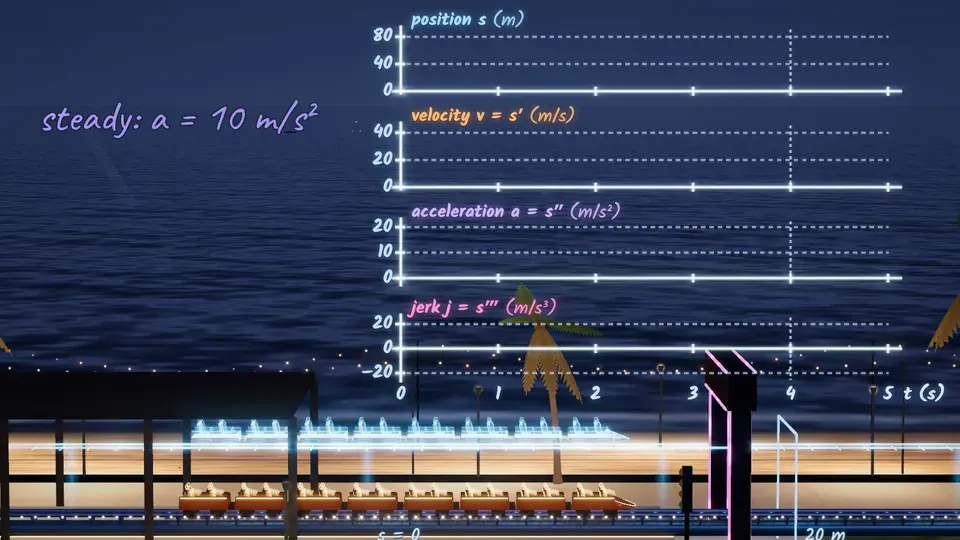
Now let’s race it against the simplest launch you could build, one that switches on a steady push of ten meters per second squared and holds it for the full four seconds. The steady one pulls ahead early, but both hit forty meters per second at the same moment, eighty meters down the track.
Inside the train it’s different. When the steady launch starts, its push jumps from nothing to ten in no time at all. If a real motor built that jump over a tenth of a second, the jerk would average a hundred. Over a thousandth of a second, ten thousand. At the ideal jump itself, the jerk doesn’t exist, because no slope fits a jump.
Your neck can tell the difference. The push that arrives all at once throws the riders’ heads back and bounces them. The smooth launch presses them back without the bob, even though its strongest push is actually bigger, fifteen instead of ten.