
Topic 4.1 key terms
- derivative in context
- f′(a) is the instantaneous rate of change of the quantity f measures, with respect to its input, at the input value a. M′(30) = −2,700 kg/s: at 30 s the propellant mass is decreasing at 2,700 kg per second.
- units of a derivative
- The unit of f′(x) is the unit of f divided by the unit of x: output units per one unit of input (kg/s, °C/m, dollars per hoodie).
- interpreting a derivative
- At [the input value, with units], [the quantity, named] is increasing or decreasing at [the size of the derivative] [output units per input unit]. Say the direction once: never 'decreasing at −2,700'.
- independent variable
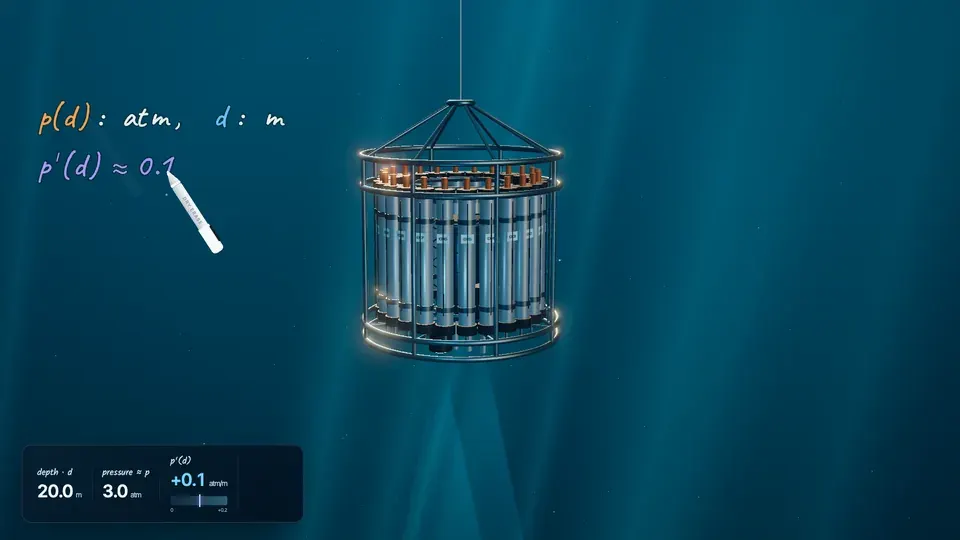
- The input a derivative is taken with respect to. It need not be time: depth (°C per meter), a count of items (dollars per item), altitude (°C per kilometer).
- thermocline
- The layer of the ocean where the water temperature drops fastest with depth: where T′(d) is most negative.
- rate of change of a rate
- The derivative of a function that is already a rate, or the second derivative: units of the rate per input unit (kg/s per s = kg/s², (L/min)/min). Its sign says whether the rate is increasing or decreasing, not the quantity.
- justify (AP)
- A conclusion plus the reason, naming the function: 'The rate at which water flows in is decreasing at t = 3 because q′(3) = −2 < 0.'
Transcript
787 words · 3 parts
More than a pickup truck, every second
It’s the middle of the night at Kennedy Space Center, and this Falcon 9 is about to light nine engines under about four hundred eleven thousand kilograms of kerosene and liquid oxygen. Let’s give that number something you can picture. Every second, these engines burn more propellant than a whole pickup truck weighs, and the gauge with the question mark reads negative two thousand seven hundred kilograms per second.
Keep your eye on that needle, because about forty-four seconds after liftoff it starts to climb, even though the tanks are very clearly still draining. If that number is going up, is the rocket somehow refilling its tanks in the middle of the sky? By the end of this lesson, you’ll be able to read every number on a screen like this the way engineers in mission control do, knowing what it measures, which way it’s heading, how fast, and in what units.
You’ll also know exactly why this needle climbs while the propellant keeps pouring out, which happens to be one of the AP exam’s favorite traps. Let’s rewind to thirty seconds and freeze it there, because the two numbers on this console tell very different stories.
Two numbers on one screen
Let’s call the mass of propellant in the tanks M of t, in kilograms, t seconds after liftoff. The first number says M of thirty is three hundred thirty thousand kilograms. The second number tells you how fast that amount is changing at this instant. That makes it a derivative, M prime of thirty, and it equals negative two thousand seven hundred kilograms per second.
Watch both numbers from ten seconds to forty. The amount drops by about eighty thousand kilograms while the derivative doesn’t move at all. You might have seen this rate written as negative two point seven tonnes per second, and since a tonne is a thousand kilograms, it’s the same rate in different units.
Let’s put that derivative to work. The engines hold this exact setting until forty seconds after liftoff, so how many kilograms of propellant leave the tanks between thirty seconds and forty seconds? Units like kilograms per second come straight out of the slope of this graph, so let’s see how.
Between thirty and forty seconds, the mass changes by negative twenty-seven thousand kilograms while the time changes by ten seconds. A slope is always the change in the output over the change in the input. The kilograms come from the output and the seconds from the input, so the slope is negative twenty-seven thousand kilograms over ten seconds, negative two thousand seven hundred kilograms per second.
Now shrink the window toward a single instant. Every quotient is still kilograms over seconds, so the derivative keeps exactly those units. Whenever we find a derivative, we take a limit of quotients like these, so the units of f prime are always the units of f divided by the units of x.
Let’s try that on something new. A of t is the area of an algae bloom on a lake, in square meters, t days after someone first spots it. What are the units of A prime of t?
Say it like an engineer
On the exam a number like this is never enough by itself, because they’ll ask what it means in context, and that takes a whole sentence. I’d write it like this. At t equals thirty seconds, the mass of propellant in the tanks is decreasing at a rate of two thousand seven hundred kilograms per second.
Every piece comes out of the notation. The thirty is the time, M tells you the quantity, the minus sign becomes the word decreasing, and two thousand seven hundred kilograms per second gives you the size and the units.
Watch out for the trap from precalc. Decreasing at negative two thousand seven hundred says the direction twice, so say decreasing at two thousand seven hundred, or changing at negative two thousand seven hundred, but never both.
The sentence also leaves things out. It says nothing about how much propellant is left, because that’s M of thirty, a completely different number. It doesn’t promise exactly two thousand seven hundred kilograms in the next second, either. At forty-four seconds the derivative is still negative two thousand seven hundred, but the engines are already easing off, so only about two thousand five hundred sixty-seven kilograms leave before forty-five. A derivative describes one instant, like a speedometer reading, and it’s a good estimate for the next short stretch when the rate changes very little during it.
Try one in a new setting. P of t is a pizza’s temperature in degrees Celsius, t minutes after it leaves the oven, and P prime of four is negative twelve. Which sentence says what that means?