
Topic 4.4 key terms
- related rates
- Rates of change of quantities that are tied together by an equation. Differentiating the equation with respect to time ties their rates together, so a known rate gives an unknown one.
- the chain rule's inside derivative
- Every changing quantity is a function of , so differentiating it with respect to brings out its own rate: .
- snapshot values
- Measurements true only at one instant (like cm). Substitute them only after differentiating; constants that never change (like the glass's size) can go in at any time.
- product rule in related rates
- When two changing quantities multiply, both change: .
- the five steps
- Draw and name what changes; relate the quantities with an equation true at every instant; differentiate with respect to ; plug in the instant's values; interpret with units.
- radians in calculus
- holds only with in radians, so angular rates must be in radians per unit time (2 rev/min rad/s).
Transcript
1,652 words · 5 parts
Faster than a bullet
This lamp stands at the end of a stone jetty, a hundred meters from a long sea wall. It turns at one perfectly steady speed, about twice as fast as the second hand on a clock.
Keep your eye on the spot of light it throws on the wall. Right here, straight across from the lamp, the spot is already sliding along about as fast as a car. The lamp never speeds up, but the spot does, and a couple of hundred meters along, it’s as fast as a bullet train.
Soon after that, it passes the speed of sound. A little farther along, it’s as fast as a rifle bullet. By the end of the stones, two kilometers away, it’s moving faster than the International Space Station flies around the Earth. The whole time, the lamp kept turning at the same easy pace. How does a slow, steady turn make something that fast?
By the end of this lesson, you’ll be able to clock that spot anywhere on the wall from just one number, how fast the lamp turns. Then you’ll take the lamp yourself and keep a speeding boat in its light. The angle controls where the spot lands, so the two have to change together. I want to show you that idea somewhere slower first, and a lot warmer.
Same tap, different speed
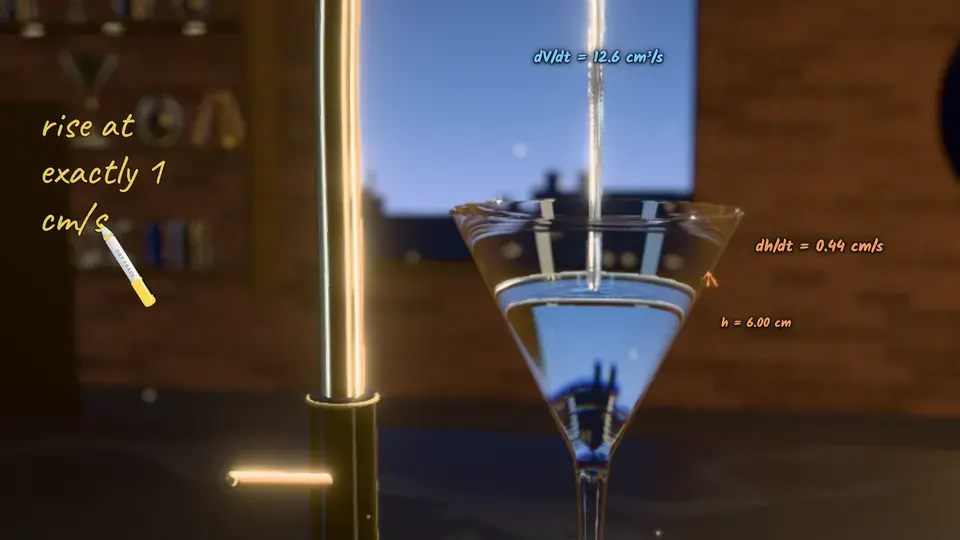
This is a glassblower’s shop at night, and that glass just came out of the furnace. It’s a perfect cone, eight centimeters deep and eight centimeters across the top. Let’s fill it from a tap that pours at a perfectly steady rate, four pi cubic centimeters every second. That’s about twelve point six milliliters every second.
Watch the orange arrow, which shows how fast the level is rising. The tap never changes, and yet by the rim the water is barely creeping. Compare two moments of that same pour, one when the water is two centimeters deep and one when it’s six. The level rises faster at two centimeters, you just watched it happen. How many times faster do you think it’s rising there?
Grab the water that pours in during one tenth of a second, and see where it ends up at each depth. It’s exactly the same amount of water every time. Down at two centimeters it piles up into a thick little puck, and up at six it spreads into a film so thin you can barely see it.
A thin sheet of water is basically a flat disk, so its volume is about its area times its thickness. Now divide both sides by that tiny slice of time. Volume over time is the tap’s rate, and thickness over time is about how fast the level rises.
As that slice of time shrinks toward zero, the approximation becomes exact. The rate the volume grows equals the surface’s area times the rate the level rises. We call an equation like this, one that ties two rates together, a related-rates equation. The tap holds the volume rate steady, so when the area is nine times bigger, the level has to rise nine times slower to keep both sides equal.
Let time into the equation
Now turn that picture into calculus. I’ll start by drawing the glass from the side and naming the pieces. The glass is eight centimeters deep with a rim radius of four, and those numbers never change. The water inside is a smaller cone with depth h and radius r, and both of those change as it fills.
The walls force the water to keep the glass’s shape, though, so r over h is always four over eight. That means r is always half of h. The volume of a cone is a third pi r squared h. Since r is half of h, I can swap it out and get the whole volume in terms of the depth, pi h cubed over twelve.
This equation hides one thing, and that’s time. The volume and the depth are both changing every second, so what it really says is V of t equals pi times h of t, cubed, over twelve.
Take the derivative of both sides with respect to time. The left side is just dV dt. On the right, h of t cubed is a function inside a function, so the chain rule gives three h squared times the inside’s derivative, dh dt. That little dh dt at the end is the rate we want, and it only shows up because the depth changes with time.
Three twelfths is a quarter, so that tidies up to pi over four h squared, times dh dt. Now look at pi over four h squared. It’s pi times h over two, squared, which is pi r squared, the area of the water’s surface. The chain rule just found the glowing sheet.
How fast is the level rising at the moment the water is four centimeters deep? That depth is only true at this instant, so it goes in a box of its own, next to the tap’s steady four pi.
Plug them in, and four pi equals pi over four, times sixteen, times dh dt. That’s four pi times dh dt, so the depth is rising at exactly one centimeter per second. Does that make sense? At four centimeters deep the surface is a circle of radius two, with an area of four pi square centimeters. Four pi cubic centimeters per second spread over that surface lifts it at one centimeter per second, right at that instant.
On the exam, finish with a sentence that has the moment, the quantity and the units in it. When the water is four centimeters deep, the depth is increasing at one centimeter per second. A classmate tried the same question and decided the water isn’t rising at all. Which step do you think went wrong?
Your hand on the tap
Keep the same glass and the same tap, and let the water reach six centimeters. How fast is the level rising then, in centimeters per second, to three decimal places?
Back in the shop, I want you to run the tap. The water is six centimeters deep, and I’d like it rising at exactly one centimeter per second. Drag the tap handle until the level is rising at exactly one centimeter per second, and watch both readouts as you go.
Watch the gold ring climb at one centimeter a second. Right at six centimeters the water keeps pace, but then it starts to slip behind, because the glass keeps getting wider. Now build the whole schedule. Set the tap’s flow at two, four and six centimeters so the water keeps pace with the ring all the way up, then test it.
Written as one formula, the schedule that works says the tap has to follow pi over four h squared to keep the water on the ring. It keeps opening wider, and by the rim it’s pouring sixteen times what it poured at two centimeters.
Stretching glass
Over by the furnace, two steel rods grab a hot gather of glass at both ends and pull apart, stretching it into a long, thin rod called a cane. The length grows at a steady forty centimeters per second, and the radius shrinks as it stretches. The amount of glass never changes, though, forty pi cubic centimeters the whole time.
Notice there’s no glass wall here forcing a shape, the way the cone forced r to be half of h. The ratio of the radius to the length keeps changing, so there’s no simple swap like r equals h over two. You could solve for r, but keeping both letters and letting the product rule do the work gets there faster.
The volume of a cylinder is pi r squared times L, and when two changing things multiply, the derivative needs the product rule. That’s the derivative of r squared times L, plus r squared times the derivative of L, and the chain rule turns the first one into two r, dr dt. The left side is zero, because the volume isn’t changing at all. That zero is a piece of information the problem hands you without ever saying it out loud.
Watch out for one shortcut, because it shows up on real exams. You can’t just multiply the two derivatives together. The correct derivative has two terms with a plus sign between them. At the moment the cane is forty centimeters long, its radius is one centimeter, since pi times one squared times forty is forty pi. Put those in with the forty centimeters per second, divide away the pi, and we get zero equals eighty dr dt plus forty.
So dr dt is negative one half, and the radius is shrinking at half a centimeter per second. If the exam asks whether the radius is increasing or decreasing at that instant, this is the sentence that earns the point. The radius is decreasing at that instant, because dr dt is negative one half centimeter per second, which is less than zero.
The exam also sets a trap with a cone that no glass is holding. Water in a cone-shaped glass has to keep the glass’s shape, but a cone of ice melting by the furnace door has no wall around it. Its radius and its height shrink at their own rates.
Right now the ice cone has a radius of four centimeters and a height of six. The radius is shrinking at a tenth of a centimeter per second, and the height at two tenths. How fast is the volume changing, to three decimal places?
When a formula divides one changing quantity by another, the quotient rule steps in the same way. Take the cane’s thinness, r over L, which keeps shrinking as it stretches. At our instant that’s forty times negative one half, minus one times forty, over sixteen hundred, which is negative three eightieths per second, so the cane keeps getting thinner.