
Topic 4.3 key terms
- derivative in context
- f′(a) is the instantaneous rate of change of the quantity f measures, with respect to its input, at the input value a. M′(30) = −2,700 kg/s: at 30 s the propellant mass is decreasing at 2,700 kg per second.
- units of a derivative
- The unit of f′(x) is the unit of f divided by the unit of x: output units per one unit of input (kg/s, °C/m, dollars per hoodie).
- interpreting a derivative
- At [the input value, with units], [the quantity, named] is increasing or decreasing at [the size of the derivative] [output units per input unit]. Say the direction once: never 'decreasing at −2,700'.
- independent variable
- The input a derivative is taken with respect to. It need not be time: depth (°C per meter), a count of items (dollars per item), altitude (°C per kilometer).
- thermocline
- The layer of the ocean where the water temperature drops fastest with depth: where T′(d) is most negative.
- rate of change of a rate
- The derivative of a function that is already a rate, or the second derivative: units of the rate per input unit (kg/s per s = kg/s², (L/min)/min). Its sign says whether the rate is increasing or decreasing, not the quantity.
- justify (AP)
- A conclusion plus the reason, naming the function: 'The rate at which water flows in is decreasing at t = 3 because q′(3) = −2 < 0.'
Transcript
1,348 words · 5 parts
No clock needed
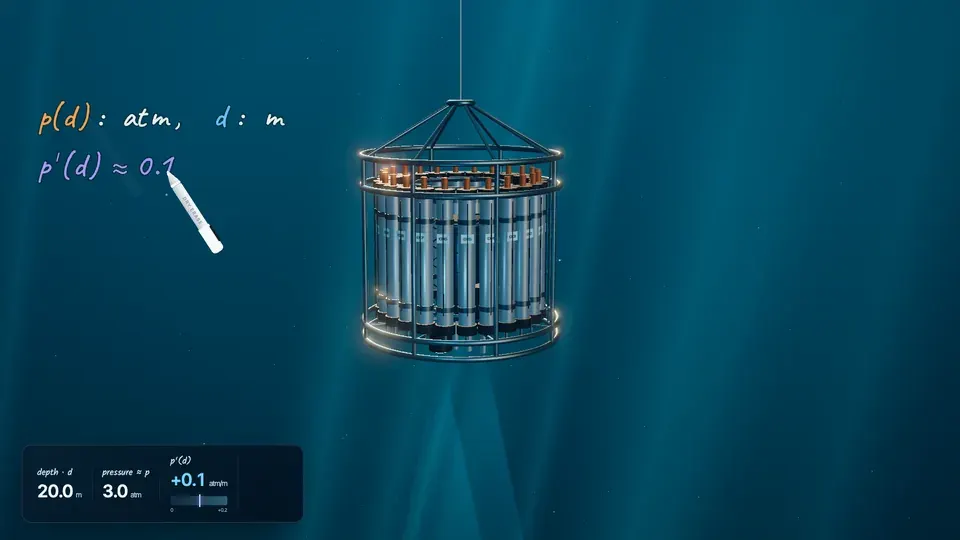
Every input so far has been a time, in seconds, minutes or days, but it doesn’t have to be, and the ocean is a beautiful place to see that. Research ships lower this instrument, called a CTD, on a cable, sometimes thousands of meters down. It measures the water’s conductivity, temperature and pressure, and from those it works out saltiness and depth.
For every ten meters it sinks, the water above adds about one more atmosphere of pressure, so the pressure climbs about a tenth of an atmosphere per meter. Let’s call the pressure p of d, in atmospheres, at d meters deep. Then p prime of d is about zero point one atmospheres per meter, because it compares the pressure here with the pressure one meter deeper. Now let’s stop the winch at twenty meters and start a stopwatch.
The clock keeps running, but the CTD isn’t moving at all. What do you think happens to p prime of twenty? Time keeps passing and nothing changes, and p prime of twenty is still a tenth of an atmosphere per meter, because this derivative was never about time. To get pressure per second, you’d also need to know how fast the CTD sinks, and that’s a job for related rates.
Let’s watch the temperature now, and call it T of d. The water stays near twenty-six degrees for the first fifty meters or so, and then, somewhere past a hundred meters, it falls off a cliff.
Oceanographers call that layer the thermocline. Sound bends where the temperature changes fastest, so a submarine sitting just below this layer is much harder to hear from above. Now you take the cable. Drag the CTD to the depth where the water is getting colder fastest, for each meter you go down. Let’s bring that onto the board.
At a depth of a hundred thirty meters, the water temperature is decreasing at about zero point one three six degrees Celsius per meter of depth, because depth is the input here. Degrees per second would describe something else entirely, how fast it cools for someone riding the CTD down, and that depends on how fast they’re sinking. On the exam you’ll usually get readings in a table instead of a formula, like these five readings from our CTD.
Use the readings at one hundred twenty meters and one hundred forty meters to estimate T prime of one hundred thirty. Give your answer in degrees Celsius per meter, to three decimal places.
Same sentence, any world
Put the rocket and the ocean side by side. The nouns and the units are different, but the sentence has exactly the same shape, and that’s the whole point of this lesson. The input can even be a count. Suppose C of n is our total cost in dollars for making n hoodies. At a hundred hoodies, C prime equals seven, so the cost is increasing at seven dollars per hoodie.
On Mauna Loa in Hawaii, carbon dioxide rose about three point three parts per million during 2024, one of the biggest jumps on record. That’s an average rate for the whole year, not a reading at one instant.
My favorite is the world’s population. The UN projects it will peak in the 2080s at about ten point three billion people. Right at the top of that smooth curve, when there are more of us than ever, the derivative will be zero people per year. Before you interpret any prime, ask what the function itself measures, and the units and the sentence almost write themselves.
The gauge that climbs
Now we have everything we need to solve the mystery from the start. Forty-four seconds in, the rocket is heading into the part of the climb where the air pushes hardest, so the flight computer throttles the engines down. Over the next three seconds the needle climbs from negative two thousand seven hundred to negative nineteen hundred. While that needle climbs, what’s happening to the propellant in the tanks?
In slow motion, with both graphs, you can see the mass falling the whole time. The only thing going up is the rate, which climbs toward zero as the engines ease off. We can measure how fast this rate changes too, and we write that as M double prime. Here the rate rises by eight hundred kilograms per second over three seconds, so M double prime is about positive two hundred sixty-seven. Its units follow the same rule, kilograms per second, per second, which we write as kilograms per second squared.
Now you’re flying it. Take the throttle and set the engines so the propellant mass is decreasing at about two thousand kilograms per second. Let’s lay the whole story out on the board.
One time axis, three graphs, with the mass on top, its rate of change in the middle, and the rate of that rate at the bottom. At forty-five seconds, M prime is negative, so the mass is decreasing, and M double prime is positive, so the rate of change of the mass is increasing.
On the exam, you’d write that at forty-five seconds, the rate of change of the propellant mass is increasing at about two hundred sixty-seven kilograms per second per second. In plain English, the tanks are still emptying, just a little less quickly each second. That solves our mystery. The needle shows the rate, not the amount, and when the engines eased off, the rate rose toward zero. The tanks drain more slowly, but they never refill.
On the exam
Let’s try the exam version, where the function you start with is already a rate, like the needle on our console. Water flows into a tank at q of t equals twelve minus two t liters per minute, and nothing flows out. At three minutes, q of three is six liters per minute, and since q is a line with slope negative two, q prime of three is negative two liters per minute, per minute.
The first question you might get is whether the amount of water in the tank is increasing at t equals three. It is, because nothing leaves, so q is the rate of change of the amount, and q of three is positive. The second question asks about the inflow rate itself, which is the bottom dial’s question. That’s about q, so look at q prime. q prime is negative, so the inflow is slowing down, even though the tank is still filling.
When a question says justify, give the conclusion and the reason in one sentence that names the function. The rate at which water flows into the tank is decreasing at t equals three, because q prime of three is negative two, less than zero. Four students answered whether the inflow rate is increasing or decreasing at t equals three. Which answer earns the point?
Let’s finish with one in the style of the calculator section. During a storm, rainwater flows into a drain at R of t cubic feet per hour, and we measure that rate every few hours. Use the table to estimate R prime of five. Think about which two readings to use, and what the units of your answer will be.
Read the whole console
One last look at the rocket, because now you can read every number on that console. Sixty seconds in, about two hundred sixty thousand kilograms are left, and the mass is decreasing at nineteen hundred kilograms per second.
A few seconds later the engines throttle back up, and the needle swings the other way. At seventy seconds the bottom dial reads about negative two hundred sixty-seven kilograms per second squared. What’s happening to the propellant right then?
About two and a half minutes after liftoff, with only about three thousand six hundred kilograms left in our model, the engines cut off, and the first stage falls away. Now you can do what I promised. You can read any derivative as a sentence, what it measures, which way it’s heading, how fast and in what units. That needle climbed because it shows a rate, and a rate can rise while the tanks keep draining.