
Topic 6.8 key terms
- antiderivative
- A function whose derivative is : . For , is one, and so is .
- Fundamental Theorem of Calculus (evaluation part)
- If is continuous on and , then . Some books call it Part 2, some Part 1.
- bracket notation
- means : plug in the top limit, plug in the bottom limit, subtract.
- accumulation function
- for continuous : an antiderivative of with (lesson 6.4).
- indefinite integral
- , where and is any constant: the whole family of antiderivatives.
- constant of integration,
- Differentiating erases a constant, so undoing a derivative leaves one unknown constant. One known value (a starting height, a starting reading) fixes it.
- reverse power rule
- for ; for , .
- no closed-form antiderivative
- Many continuous functions, like , have antiderivatives (their accumulation functions) that no elementary formula can write; definite integrals of them are found numerically.
Transcript
1,543 words · 5 parts
A whole family
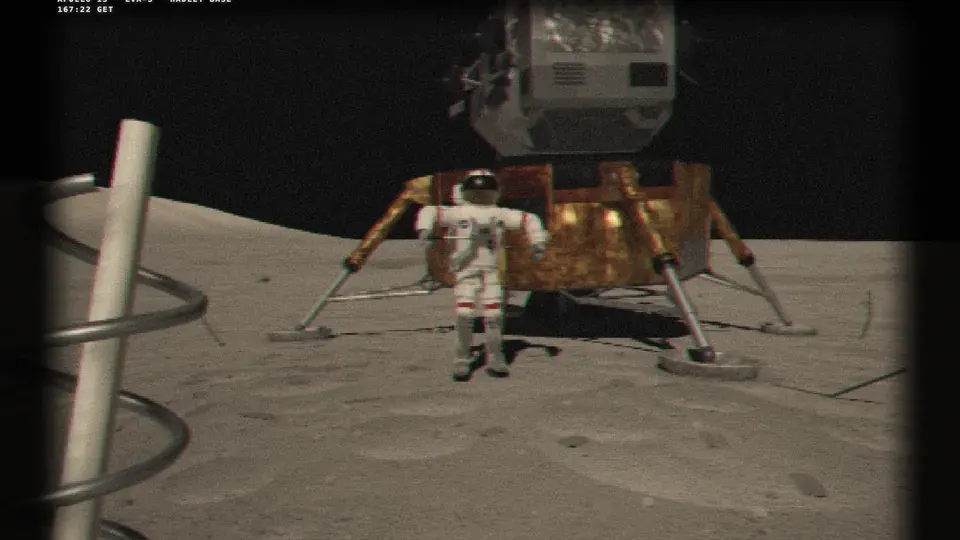
Back at Hadley, that plus C has a real meaning. Picture four hammers dropped at the same instant from four different heights. On the Moon every hammer speeds up by one point six two meters per second, every second, so while they’re falling, all four share one velocity, negative one point six two t.
Their velocity graphs sit right on top of each other, and their position graphs are one curve slid up and down. Which t squared term has derivative negative one point six two t? Differentiating k t squared gives two k t, so k must be negative zero point eight one. Each position is that plus a constant, the height it started from.
Now you take the hammer. Drag the release height until you think it will hit the dust exactly one second after he lets go, then drop it to test your height.
When you want the whole family at once, you write the integral without limits, an indefinite integral, so the integral of f of x d x is F of x plus C. The integral of two t is t squared plus C, this whole stack of parabolas, and one known point, like the hammer’s one-second landing, picks out a single curve. Through the point one, four, one plus C is four, so C is three.
Keep the two straight, because a definite integral is a number, like our eight meters, and an indefinite integral is a family. Leaving the plus C off a family costs points, and adding one to a number is just as wrong.
Every derivative, backward
Finding antiderivatives is just reading the derivative rules backward, so let’s build a table where every row comes from a rule you know. Differentiating x to the n plus one brings down an n plus one, so to undo it, we raise the power by one and divide by the new power. The integral of x to the fourth is x to the fifth over five, plus C.
That breaks for x to the negative one, because we’d be dividing by zero. Luckily, the natural log has derivative one over x, so the integral of one over x is the natural log of the absolute value of x, plus C. The absolute value is there so it works for negative x too.
Sums and constant multiples come along for the ride, so a polynomial integrates one term at a time. Products don’t, so to integrate x times x you integrate x squared, which gives x cubed over three.
The integral of e to the x is just e to the x, and since the derivative of sine is cosine, cosine integrates to sine. Sine needs care, because the derivative of cosine is negative sine, so the integral of sine is negative cosine. If you’re ever unsure, differentiate your answer and see if sine comes back.
Every other row works the same way. Tangent’s derivative is secant squared, so secant squared integrates to tangent. From the inverse trig derivatives in Unit 3, one over one plus x squared integrates to arctangent, and one over the square root of one minus x squared integrates to arcsine.
Let’s do one together, four x cubed minus six over x squared plus five. First I’ll rewrite six over x squared as six x to the negative two, so the power rule can see it. Each piece goes up one power, so four x cubed gives four x to the fourth over four, which is just x to the fourth.
Minus six x to the negative two gives minus six x to the negative one over negative one, and the two negatives make that plus six over x. Then five, which is five x to the zero, gives five x, plus C. Differentiate that, and you get four x cubed minus six over x squared plus five, exactly where we started.
Now one with limits. Find the integral of three x squared minus four x plus two, from one to two. This hump is the sine curve from zero to pi. Using the cosine fact up on the board, find the integral of sine of x from zero to pi.
One more for you, with a square root this time. Find the integral of the square root of x from one to four, to two decimal places.
How far did it fall?
Now we can solve the mystery. On the Moon, gravity gives us one thing, the acceleration, negative one point six two meters per second squared, the same all the way down. Velocity is an antiderivative of acceleration, so v of t is negative one point six two t plus a constant. He let go from rest, so that constant is zero.
Position is an antiderivative of velocity, so y of t is negative zero point eight one t squared plus a second constant, because half of one point six two is zero point eight one. That constant is h, the height the hammer started from. If you’ve taken physics, that’s the one half g t squared formula, and now you know where it comes from, two antiderivatives of a constant.
Thirty-six frames is one point two seconds, so the change in height over the fall is the integral of v from zero to one point two. That’s negative zero point eight one times one point two squared, minus zero.
The hammer ends on the ground, at height zero. Use that to find how high the hammer was when Scott let go, to the nearest hundredth of a meter.
An AP question might ask you to justify that the report’s height is wrong. If the hammer had started at one point six meters, then at one point two seconds the hammer would still be about zero point four three meters up, forty-three centimeters. The full-credit sentence says the hammer would still be above the ground at one point two seconds, which means a one point six meter release is not consistent with a one point two second fall.
Now let’s watch the theorem happen inside the fall. We’ll cut the area under the velocity graph into six slices, two tenths of a second each, and drop each one into the gap the hammer falls in that time.
Every slice fits its gap exactly, three point two four centimeters, then nine point seven two, then sixteen point two and on up, and stacked together they make the whole drop. The area sits below the axis, so the change in y is negative, and its size is how far the hammer fell.
Now test the report yourself. First set the frame dial to where you think a one point six meter drop will land, then set the height to one point six meters and drop it beside the real 1971 footage.
Now repair the report. Drag the starting height until your hammer lands on the film’s frame thirty-six, then drop it beside the footage. The frame-by-frame study behind that count of thirty-six puts the hammer’s starting height between about one point one three and one point two meters, right where your answer landed.
On the exam
AP questions love to ask for a value instead of a change, and the move is always the same, the value you know plus the change, like the rover’s four point three kilometers plus the drive. Here f is the amount and f prime is its rate, so f of b is f of a plus the integral from a to b of f prime. Sometimes the rate is something like e to the negative x squared, the shape of the bell curve, and you’ll hit a wall, because no formula you know has it as its derivative.
Mathematicians have proved that the usual elementary functions can’t write this antiderivative, but we can still build it by accumulating area. The area from zero to x, A of x, draws itself perfectly smoothly, and its derivative is e to the negative x squared. Lots of functions have no closed-form antiderivative, and that’s where your calculator earns its place, because it finds the area numerically even when nobody can write the formula down.
Try one the way the calculator section asks it. The derivative of f is e to the negative x squared, and f of zero is five. Find f of two, to three decimal places. Write it just like that on the exam, the known value plus the integral with its limits, because on questions like this the setup earns points of its own.
One number on the Moon
Look at what you just did. You started with one number, the Moon’s gravity of one point six two meters per second squared, took two antiderivatives, and pinned down the constants with two facts, rest at the start and the ground at the end. All those slices of area add up to the change in one function, so reading that function at the two ends gives the whole sum, which is exactly what the rover’s counter was doing for us.
You used the Moon’s gravity, a release from rest and thirty-six frames of old TV to work out how far that hammer fell in 1971, and you tested the first official report against the footage. Next time, we’ll integrate functions with something more complicated inside.