
Topic 4.2 key terms
- position
- Where an object is on a line, x(t), measured from a chosen origin with a chosen positive direction (meters).
- velocity
- v(t) = x′(t). Its sign gives the direction of motion: positive means moving in the positive direction, negative the negative direction (m/s).
- acceleration
- a(t) = v′(t) = x″(t): how fast the velocity is changing (m/s², meters per second per second). Its sign alone does not tell you whether the object speeds up.
- speed
- The absolute value of velocity, |v(t)|: how fast, whichever way. Never negative. On a velocity graph it is the distance from the graph to the t-axis.
- speeding up
- The speed is increasing when v and a have the same sign (both positive or both negative).
- slowing down
- The speed is decreasing when v and a have opposite signs.
- at rest
- An object is at rest at t = c when v(c) = 0.
- changes direction
- An object changes direction at t = c when v changes sign at c. A zero of v without a sign change (like v = 3(t − 4)²/32) is a stop, not a turnaround.
- particle
- The AP exam's word for an object moving along a line, treated as a single point.
Transcript
2,495 words · 8 parts
Still falling, slowing down
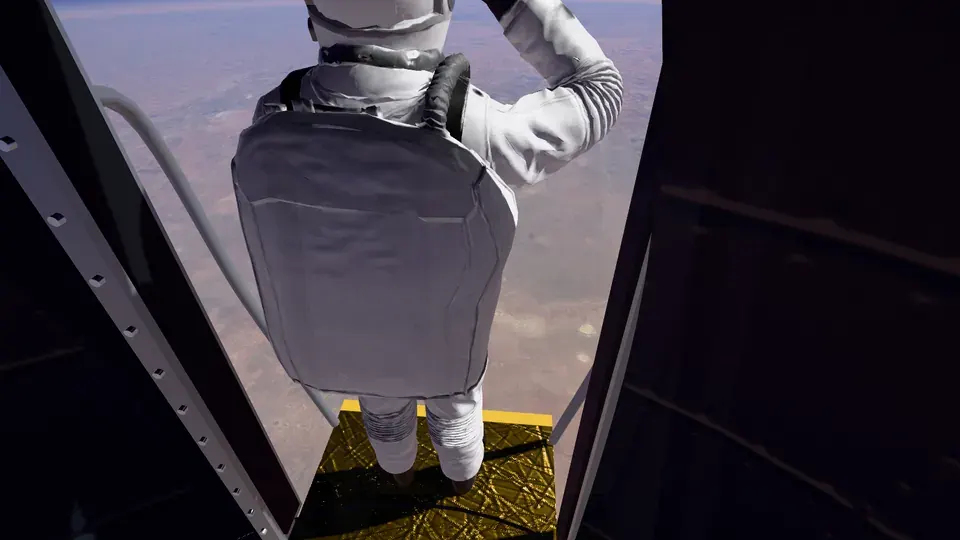
On the fourteenth of October, 2012, Felix Baumgartner stood on a narrow step outside his capsule, thirty-nine kilometers above sea level, high over New Mexico. Then he leaned forward and let go. Thirty-four seconds later he reached the speed of sound, with nothing around him but a pressure suit, and he kept on speeding up. Less than a minute in, he hit about thirteen hundred and sixty kilometers an hour, and then something strange started to happen.
He’s still falling, and the ground is still rushing up at him. But his acceleration has flipped around and points up, because the air down here is thick enough to push up on him harder than gravity pulls him down. Which way is he moving now, and is he speeding up or slowing down? It sounds like one question, but it’s really two, and calculus answers them with two different derivatives.
By the end of this lesson, you’ll be able to look at the equation for any motion. At any instant, you’ll say which way it’s going and whether it’s speeding up or slowing down. You’ll also find when Felix hit his top speed, using a model fitted to his flight data, and you’ll be able to write the one sentence that explains it. Felix moves along one straight line, straight down, so let’s start on a straight line we can control completely, a cart on a track.
One cart, three readings
This is a cart on a track that’s tilted up just a little. It’s sitting on a machine that draws its motion while it moves. We’ll measure the cart’s position x, in meters, from this purple mark, and we’ll count going up the track as positive.
Let’s give it a push up the track and let the pen write its position as time goes by. It climbs two meters in four seconds, slowing down the whole way, and right at four seconds it stops. Its position follows x of t equals t minus t squared over eight, which is exactly the curve the pen just drew.
Velocity is the derivative of position, so at any instant it’s the slope of this curve. At two seconds the slope is one half, which means the cart is moving up the track at half a meter every second.
If we slide that tangent along the curve, the second pen draws the velocity. The power rule gives v of t equals one minus t over four, and you can see it falling the whole time.
Acceleration is the derivative of velocity, the slope of this blue line. It’s a steady negative one quarter of a meter per second, every second, because gravity keeps pulling the cart back down the slope. Right now, at four seconds, the cart is stopped and its velocity is zero, and yet the acceleration still isn’t zero, because the velocity is still changing.
The acceleration stays at negative one quarter for the rest of the trip. Over the next four seconds, what do you think happens to the cart’s speed? Let’s look straight down at the paper, because these three traces are exactly the graphs an AP question hands you.
Let’s write the whole trip in symbols. We measure x of t in meters. Its derivative is the velocity, in meters per second, and one more derivative gives the acceleration, the second derivative of position, in meters per second squared. The sign of the velocity tells you which way the cart is moving. While v is positive, from zero to four seconds, it moves up the track, and once v turns negative it moves back down.
Notice that the acceleration is negative on the way up and on the way down, so the sign of a can’t tell you the direction. On its own, it can’t tell you about the speed either.
Speed is how far from zero
Speed is the size of the velocity, how fast you’re going no matter which way, so the speed is the absolute value of v. On the graph, that means we take every piece of the velocity that sits below the axis and fold it up. Now you can watch the speed drop all the way to zero and climb right back up.
The speed is the distance from the velocity graph to the axis. At two seconds and at six seconds the cart has the same speed, half a meter per second, just heading in opposite directions.
That leaves us with two separate questions about any motion, and the first one is which way it’s going, which the sign of the velocity answers all by itself. The second question is whether it’s speeding up, and I like to think of the acceleration as a push on the velocity. If the push points the same way you’re already moving, you go faster, and if it pushes against your motion, you slow down.
That means you need both derivatives. The speed grows when v and a have the same sign, and it shrinks when their signs are opposite, as long as neither one is zero. Our cart on the way up had a positive velocity and a negative acceleration, so it slowed down. On the way back both were negative, so it sped up. Felix after his record is this case, because with up as positive he’s falling while his acceleration points up, and a car pulling away from a red light is the last one.
A negative acceleration on its own doesn’t mean slowing down, and it’s the mistake the people who grade the AP exam keep seeing on motion questions. Okay, let’s see if you can do one on your own. A particle, which is just a dot moving along a line, moves along the x-axis. At t equals five its velocity is negative three meters per second and its acceleration is positive two meters per second squared. How is it moving at that moment?
Stopped isn’t turned around
Let’s put a second cart next to ours, a little motor cart that runs its own program. Both carts start at the bottom together, and at exactly four seconds both of them are two meters up the track, and both are stopped, with a velocity of zero. Cart A’s velocity is the one we already know, one minus t over four. Cart B’s velocity is a positive number times t minus four, squared.
Both velocities are zero at four seconds. Which of these carts is about to turn around and head back down the track? That gives us two different ideas with two different tests. An object is at rest at an instant when its velocity is zero, and it changes direction only where its velocity changes sign.
A sign line makes it easy to see, because cart A’s velocity is positive before four and negative after, while cart B’s is positive on both sides. On the exam, the sentence that earns the point names the sign change, so we’d write that cart A changes direction at t equals four because its velocity changes from positive to negative there.
Now it’s your turn to design a motion. On this sheet, draw a velocity that makes the cart stop twice but turn around only once, and the machine will drive the cart with your graph so you can see if it works. Draw your velocity from left to right. Then let go, and watch what the cart does.
The particle problem
Let’s do a full AP-style problem. This particle moves along the x-axis, and its position is x of t equals two t cubed minus fifteen t squared plus twenty-four t plus five, for t from zero to five seconds.
The velocity is the derivative, six t squared minus thirty t plus twenty-four. If we pull out a six, what’s left factors into t minus one, times t minus four. The acceleration is the derivative of that, twelve t minus thirty. The particle is at rest whenever its velocity is zero, and that happens at t equals one and at t equals four.
To find the direction we test one point in each piece. At t equals two, v is six times one times negative two, which is negative. At zero it’s twenty-four, so it’s positive before one, it’s negative between one and four, and after four both factors are positive again, so the particle moves right, then left, then right. Both zeros are real turnarounds, because v changes sign at each of them, so the particle changes direction at t equals one and again at t equals four.
Now let’s ask what the particle is doing at t equals two. The velocity is six times one times negative two, negative twelve meters per second, and the acceleration is twenty-four minus thirty, negative six meters per second squared.
A full-credit answer says it in two sentences, each with its reason. At t equals two the particle is moving left because v of two is negative, and its speed is increasing because v of two and a of two are both negative. Notice how each claim comes with its reason. The negative velocity explains the direction, and the two matching signs explain the growing speed, which is exactly what an AP reader gives credit for.
At t equals three the velocity comes out to negative twelve again, exactly what it was at two. What’s the particle’s speed doing at t equals three?
Let’s find every stretch where the particle speeds up. We already have the signs of v, and a is zero at two and a half, negative before and positive after, so the middle piece splits at two and a half, with v negative on both halves. On each piece we compare the two signs. Between zero and one, v is positive and a is negative, opposite signs, so the particle is slowing down there.
Use those two rows to finish the job. On which intervals is the particle speeding up? Look at what happens at two and a half, where the acceleration switches sign. The particle stops speeding up and starts slowing down. Its velocity there is negative thirteen and a half, so that’s its top speed while it’s moving left, thirteen and a half meters per second.
Felix’s flight data
The same thing happened to Felix. This is his velocity for the first two minutes of the fall, from a smooth model fitted to his flight data, with up as positive, so the whole graph sits below the axis while he drops. The slope of this graph is his acceleration. For the first part of the fall the graph runs downhill, so a is negative, and v is negative too, the same sign, so he’s speeding up.
Somewhere near the bottom the tangent goes flat, and after that the graph climbs, so a turns positive while v stays negative, and he slows down. Fold the valley up and his speed turns into a mountain. The very top of that mountain is his record, about three hundred seventy-seven meters every second.
On the AP exam, data like this usually comes as a table, so let’s write down his velocity every five seconds around the record. We can’t take an exact derivative of a table, but we can estimate one. For forty-five seconds, let’s use the readings on either side of it, at forty and at fifty.
The velocity changes by negative twenty-eight meters per second over those ten seconds, so a of forty-five is about negative two point eight meters per second squared. Both of those are negative at forty-five seconds, so the estimate says he’s still speeding up there.
Now it’s your turn to estimate his acceleration at fifty-five seconds, using the readings at fifty seconds and at sixty seconds, negative three seventy-seven and negative three twenty-nine. These estimates suggest a top speed somewhere between forty-five and fifty-five seconds, so let’s find it on the smooth curve fitted to his data.
Drag the cursor along his velocity graph. See if you can find the instant Felix stops speeding up. That’s the second the model stops speeding up, fifty seconds, right when his record speed was measured. At that fastest moment, the model’s acceleration is zero.
A zero acceleration on its own won’t earn the point on the exam, though. Which of these sentences proves that the model’s speed is greatest at fifty seconds?
We chose up as the positive direction, and nothing forced us to. If we call down positive instead, every sign flips, so v turns positive and a turns negative. They still disagree, and the lamp still says he’s slowing down.
Your foot on the pedal
Now you get to drive. It’s the same machine with the track laid flat, and instead of a push you get an acceleration pedal that pushes the cart left or right. There are four lamps, one for each combination of signs, and every time you hold the cart in one of those states, its lamp lights up. Use the pedal to make the cart speed up and slow down in both directions. See if you can light all four lamps.
Look at the run on the paper. Every green stretch is a time the velocity and acceleration matched, so the cart sped up, and every red one is a time their signs disagreed, so it slowed down.
On the exam
On the calculator part of the exam, the calculator does the arithmetic and you supply the reasoning. Here a particle’s velocity is t times the cosine of t, plus one half, for t from zero to four seconds. We want the acceleration at two and a half seconds, which is the derivative of velocity at two point five, and we write that setup down first so a grader can follow us. Then we let the calculator take the derivative, in radian mode.
Use your calculator to decide this one. At t equals two point five, is the particle’s speed increasing or decreasing, and why? The graph shows the one place this particle turns around. Its velocity crosses zero at about one point eight four five seconds, going from positive to negative, so that’s where it changes direction.
Let’s put the whole lesson on one board. The sign of v tells you which way it’s going, a zero of v means it’s at rest, and a change of sign in v means it changes direction. The speed question needs both derivatives. When v and a share a sign the speed grows, when they disagree it shrinks, and that stays true whichever way the axis points.
Four minutes and twenty seconds into his fall, Felix opened his parachute. His acceleration swung hard upward while he kept on falling, just slower and slower. Now you can read that moment like a calculus student. His velocity is negative, his acceleration is positive, the signs disagree, and his speed drops. At the start I promised you’d be able to say which way anything is moving and whether it’s speeding up, and you can, right down to finding when Felix hit his top speed.