
Topic 4.7 key terms
- locally linear
- A function is locally linear at a point when its graph, zoomed in far enough around that point, is indistinguishable from a straight line: its tangent line. Differentiable functions are locally linear; a corner is not.
- tangent line approximation (linearization)
- L(x) = f(a) + f′(a)(x − a): start at the known value f(a) and add the slope f′(a) times the step x − a. Near a, f(x) ≈ L(x).
- overestimate / underestimate
- If the graph of f is concave down on the interval between a and x (f″ < 0), the tangent line lies above the graph and L(x) overestimates f(x); if concave up (f″ > 0), it lies below and L(x) underestimates.
- indeterminate form
- A limit of a quotient whose top and bottom both approach 0 (0/0) or both grow without bound (∞/∞). The form alone does not determine the limit.
- L'Hospital's Rule
- If lim f(x) and lim g(x) are both 0 or both ±∞, f and g are differentiable near a with g′(x) ≠ 0 for x near a (except possibly at a itself), and lim f′(x)/g′(x) exists (or is ±∞), then lim f(x)/g(x) = lim f′(x)/g′(x).
Transcript
1,407 words · 3 parts
Zero over zero
There’s one more thing hiding at T plus sixty. Picture a different ghost that climbs at one steady speed from liftoff, eight thousand ninety-one meters over sixty seconds, about a hundred thirty-five meters per second. The rocket started slow, so this ghost has been ahead the whole way up. They both reach eight thousand ninety-one meters at exactly T plus sixty. One second before that, the rocket still has about two hundred seventy-six meters to go, and the ghost about a hundred thirty-five.
Both distances hit zero at the same instant, so right at the tie their ratio would be zero over zero, which isn’t a number at all. Watch their ratio as both distances disappear, from before the tie and from after it. It locks onto about two point zero seven, even though both distances are vanishing. Let’s zoom in on the tie. The rocket’s curve straightens into its tangent line, so near the tie each distance to go is just its speed times the time left.
The time left is the same for both, so it cancels. That turns the ratio of the distances into the ratio of the speeds, two seventy-nine point five over one thirty-four point eight five, about two point zero seven. Now you get to make one. Here’s a ghost of your own that also reaches the line at exactly T plus sixty, and you choose how fast it climbs.
Set your ghost’s speed so the ratio of the distances heads for one as you close in on T plus sixty from both sides. One more try. Now make the ratio head for two.
This works for lots of pairs of functions that hit zero at the same place. Take e to the three x minus one on top and sine of x on the bottom. At zero, their ratio looks like zero over zero. Zoom in, and both curves turn into their tangent lines. By the chain rule the top’s slope at zero is three, and the bottom’s is one.
Near zero the top is about three x and the bottom about one x, the x’s cancel, and the ratio heads for three. When two things vanish together, the slopes tell you how fast each one is vanishing.
That’s why we call zero over zero an indeterminate form. These four limits all have that form, and they come out to one, two, zero and no limit at all, so the form alone can’t tell you the answer. Infinity over infinity works the same way, like x squared over e to the x, where both blow up. Those are the two indeterminate forms the exam asks about.
L’Hospital’s rule turns the picture into a tool, because when the top and bottom both go to zero, or both to infinity, you can replace them with their derivatives. The limit of f over g equals the limit of f prime over g prime, as long as that new limit exists. Both functions have to be differentiable near the point, and the bottom’s derivative can’t be zero anywhere close to it, except maybe at the point itself.
Funny thing, the marquis it’s named after didn’t discover it. He paid Johann Bernoulli three hundred livres a year for his discoveries, and in 1696 the rule came out in the marquis’s own book, so it got his name.
Using the rule
Let’s use it on the limit we just pictured. Step one, every time, is to check the form. The top, e to the zero minus one, is zero, and the bottom, sine of zero, is zero too.
Both are zero, so L’Hospital’s rule applies. Notice I never write that the limit equals zero over zero, because that’s not a value, and on the exam it costs you the point. Step two, differentiate the top and bottom separately, so the top becomes three e to the three x, by the chain rule, and the bottom becomes cosine of x. Step three, take the new limit, three over one, which is three, and a table of values closing in on zero agrees.
Let’s do one together, the limit of e to the x minus one minus x, over x squared, as x goes to zero. Both the top and the bottom go to zero, so the rule applies.
Differentiating gives e to the x minus one over two x, and if we check the form again, at zero it’s still zero over zero. Here both tangents were flat, so the slope picture can’t decide, but the rule can. That’s fine, because we can use the rule again, as long as we check first. Apply L’Hospital’s rule one more time, and tell me the limit.
The rule handles infinity over infinity too. As x goes to infinity, x squared and e to the x both blow up, so x squared over e to the x has that form. Two rounds, checking the form before each one, give two over e to the x, which goes to zero, because the exponential grows so much faster than x squared.
I have two warnings for you. The first is that the rule only works on indeterminate forms. Cosine x over x plus one at zero is just one, and using the rule anyway would give you zero, which is wrong. The second is that you differentiate the top and the bottom on their own, so the quotient rule has nothing to do with it. Find the one limit here where the rule doesn’t apply, because it isn’t an indeterminate form.
On the exam you’ll often get values instead of formulas. Say f has a continuous derivative, f of three is zero, and f prime of three is four. We want the limit of f of x over x squared minus nine as x goes to three.
Graders want this check in writing. f is differentiable, so it’s continuous, and the top heads to f of three, which is zero. The bottom, x squared minus nine, heads to zero too, so now the rule applies. Now finish it, and tell me the limit.
Seven point eight five centimeters per km²
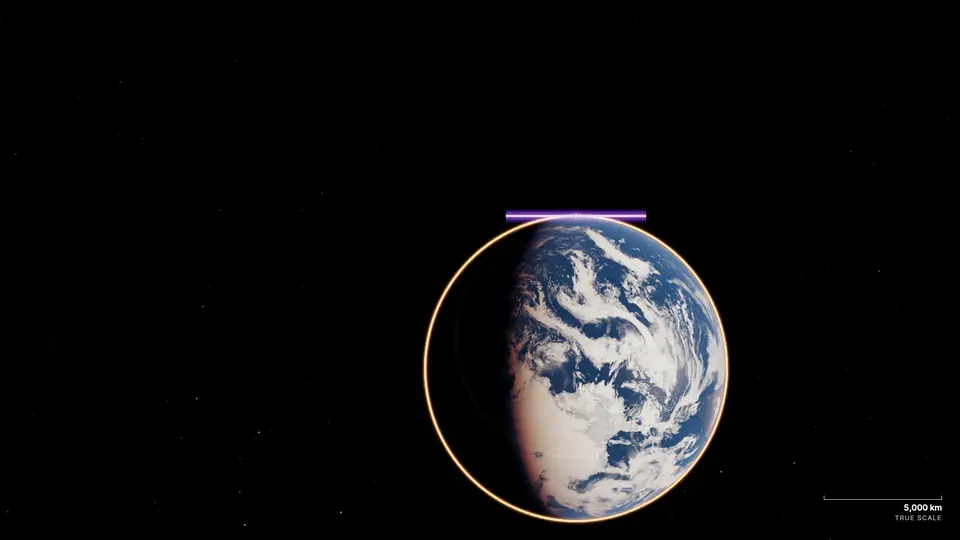
Let’s go back to the ocean, because I promised you something. The gap followed a rule, about seven point eight five centimeters times the distance squared, and now we can find out where that number comes from.
Let’s draw a right triangle from the center of the Earth to the water, x kilometers out along the line. Its long side is the radius R and one leg is x, so by the Pythagorean theorem the other leg is the square root of R squared minus x squared.
The line sits a full R above the center, so the water is R minus that square root below the line. Our readings said the drop is about seven point eight five centimeters times x squared. That means the drop over x squared should settle on one number as x shrinks, and at zero that ratio has the form zero over zero.
By the chain rule, the drop’s derivative is minus one half, times one over root R squared minus x squared, times minus two x. The two minus signs cancel, and so do the half and the two, which leaves x over root R squared minus x squared. The top becomes x over root R squared minus x squared, and the bottom’s derivative is two x. The x’s cancel, leaving one over two root R squared minus x squared, and as x goes to zero, that’s one over two R.
With R at six thousand three hundred seventy-one kilometers, one over two R is one over twelve thousand seven hundred forty-two. A kilometer is a hundred thousand centimeters, so one kilometer out, that drop is seven point eight five centimeters, the first rung of our ladder. In miles, it’s the famous eight inches per mile squared.
Watch the world draw x squared over two R right on top of the real sea, where out to ten kilometers you can’t tell them apart. Now you know why the ocean looks flat. Zoom in on any smooth curve and it turns into its tangent line. One value and one slope make an estimate, and the bend tells you high or low.
When two things vanish together, compare their slopes. Next time someone tells you the Earth looks flat, you can tell them they’re right, to within about eight centimeters per kilometer squared, and then prove it.