
Topic 4.6 key terms
- locally linear
- A function is locally linear at a point when its graph, zoomed in far enough around that point, is indistinguishable from a straight line: its tangent line. Differentiable functions are locally linear; a corner is not.
- tangent line approximation (linearization)
- L(x) = f(a) + f′(a)(x − a): start at the known value f(a) and add the slope f′(a) times the step x − a. Near a, f(x) ≈ L(x).
- overestimate / underestimate
- If the graph of f is concave down on the interval between a and x (f″ < 0), the tangent line lies above the graph and L(x) overestimates f(x); if concave up (f″ > 0), it lies below and L(x) underestimates.
- indeterminate form
- A limit of a quotient whose top and bottom both approach 0 (0/0) or both grow without bound (∞/∞). The form alone does not determine the limit.
- L'Hospital's Rule
- If lim f(x) and lim g(x) are both 0 or both ±∞, f and g are differentiable near a with g′(x) ≠ 0 for x near a (except possibly at a itself), and lim f′(x)/g′(x) exists (or is ±∞), then lim f(x)/g(x) = lim f′(x)/g′(x).
Transcript
1,334 words · 5 parts
Flat
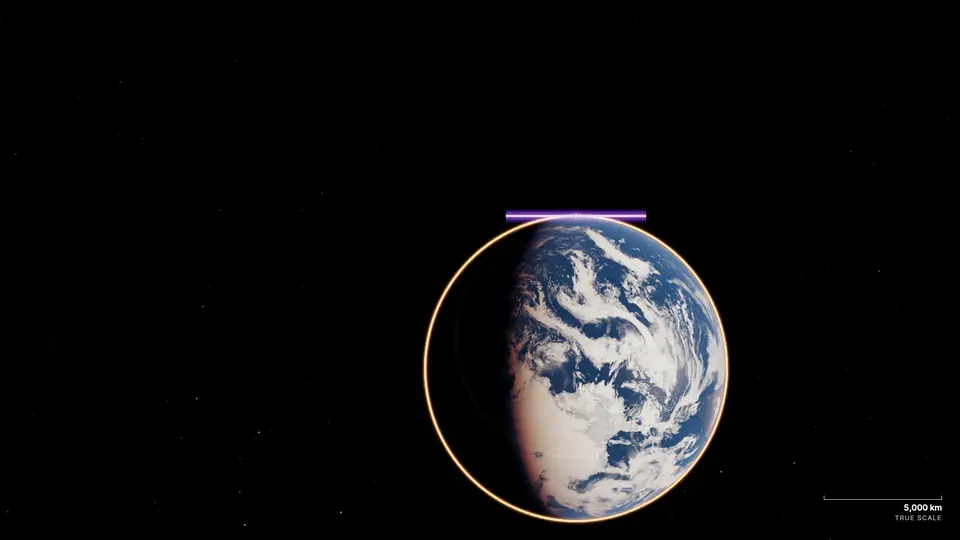
From out here in space, nobody has to tell you our planet is round, because you can see the curve of it glowing along the edge where the sun is coming up. Let’s lay one perfectly straight line against it, touching the ocean at exactly one point in the middle of the Pacific.
From up here the planet curves away from the line on both sides, so watch what happens to that gap as we fall toward the point where they touch. Keep your eye on the two ends of the line.
Down at the surface, you honestly can’t tell the curve from the line. The ocean looks as flat as a table, and flat-Earth videos love this picture. It isn’t flat, of course. I’ve stretched the heights five hundred times here so you can see the gap, and one kilometer out, the sea is about eight centimeters below the line.
How far below the line do you think it is ten kilometers out? Hang on to your guess, because we’re coming back for it. By the end of this lesson, you’ll know why every smooth curve does what this ocean does. You’ll use that straight line to predict numbers nobody gave you, and to tell whether your guess is too high or too low.
Then at the very end, you’ll prove exactly how fast our planet curves away from flat, with a limit that starts out looking like zero over zero. Let’s start with a curve that’s a lot smaller than a planet.
Zoom in until it’s straight
This is the graph of y equals the square root of x, with a point at x equals four, where the height is two, and its tangent line. Let’s zoom in on that point ten times, and already the curve looks a lot like the line. At a hundred times, and then a thousand, the curve and its tangent line lie right on top of each other.
We call a function that does this locally linear, because close enough to the point it behaves like a straight line, and that line is its tangent line. Near the point of tangency, the curve and its tangent line are almost the same. The line doesn’t have to be flat, either, and this one tilts up. A corner never does this, though, because it stays a corner however far you zoom, so there’s no tangent line to use there.
Our planet is smooth, so the sea is locally linear too, and that flat-looking ocean is just the sea behaving like its own tangent line. One kilometer out, the sea is about eight centimeters below the line, two kilometers out it’s about thirty-one, and five kilometers out it’s almost two meters.
Make a guess before I show you. If the gap is about eight centimeters one kilometer out, how far below the line is the sea ten kilometers out? That’s why the tangent line works so well up close, because when you cut the distance by ten, the error shrinks by a hundred.
Now you decide how flat is flat enough. Pick an error budget, then drag the yellow gauge out along the beam as far as you can while the flat line stays inside it.
One point and one slope
If a straight line is that good up close, let’s write down its equation so we can use it. The tangent line at x equals a starts at the height you know, f of a, and adds the slope there, f prime of a, times how far you step, x minus a. We call it the linearization of f at a, L of x. It’s the tangent-line equation you already know, solved for y, and near a, f of x is approximately L of x.
Let’s estimate the square root of four point one without a calculator. The first question is always where we know the curve exactly, and that’s at four, because the square root of four is two. The derivative of root x is one over two root x, so at four the slope is one quarter. We step a tenth, from four to four point one, so the estimate is two plus a quarter of a tenth, two point zero two five.
The calculator says two point zero two four eight five, so we’re off by about one and a half ten-thousandths. Out at nine, though, the same line says three point two five instead of three, which is why we call it a local approximation. Why bother, when a calculator does square roots in a second? Because most of the time, nobody gives you the formula at all.
Say you pour a cup of hot chocolate, and H of t is its temperature in degrees Celsius t minutes later. Nobody has a formula, but at ten minutes it’s sixty-two degrees and falling at one and a half degrees per minute.
That’s all a tangent line needs. Start at sixty-two degrees, then change it by minus one and a half degrees for every minute you step, t minus ten. That makes H of t about sixty-two, plus negative one and a half times t minus ten. The units work, because degrees per minute times minutes is degrees.
Use that tangent line to estimate H of twelve, the temperature at twelve minutes. That’s exactly how the exam asks it, with one value and one slope from a table.
Too high or too low?
Every estimate comes with a question, too high or too low, and the answer comes from the way the curve bends. A concave down curve bends away below its tangent, so the line sits above the curve and the estimate is too high, an overestimate. A concave up curve bends above its tangent, so the line runs underneath and the estimate is too low, an underestimate.
The ocean is concave down, curving below the flat line on both sides, so the flat line always puts the sea a little too high. The square root bends the same way. Its slope, one over two root x, shrinks as x grows, and its second derivative, minus one over four x to the three halves, is negative. Our two point zero two five is an overestimate, just as the calculator said.
On the exam you’ll say it in a full sentence, and this is the one that earns the point. Because f double prime of x is negative for every x from four to four point one, the graph of f is concave down on that interval, so the tangent line lies above the graph there, and the estimate two point zero two five is an overestimate. Notice the interval, because what matters is how the curve bends all the way from the point you know to the point you’re estimating.
Back to the hot chocolate. A hot drink cools fast at first and then slower and slower, so its graph bends upward, and H double prime is positive. Which way is fifty-nine degrees off? Pick the answer with the right reason.
The rocket’s next second
Now let’s try something a lot faster than hot chocolate, the Falcon 9 that launched the first Crew Dragon in 2019, frozen one minute after liftoff. In our model of the flight, it’s about eight thousand ninety-one meters up right now, and climbing at two hundred seventy-nine and a half meters per second. Let’s launch a ghost from this exact spot, a ghost that keeps climbing at exactly that speed forever, never faster and never slower.
That ghost is the tangent line come to life, because it starts at h of sixty and climbs at exactly h prime of sixty. Use the ghost to forecast the rocket’s altitude one second later, at T plus sixty-one.
The real rocket keeps speeding up, though, so its altitude graph is concave up. At T plus sixty-one, where do you think the real rocket will be compared with the ghost? Forecast ten seconds ahead and the gap grows to about three hundred forty-six meters, roughly a hundred times bigger, just like the ocean.