
Slavery in the British Colonies in two minutes
- Africans arrived at Point Comfort in 1619 and status stayed unsettled: John Punch got lifetime service in 1640, while Elizabeth Key won freedom in 1656 as a free man's daughter.
- Virginia's laws made slavery racial and hereditary: children took the mother's status (1662), baptism did not free (1667), interracial marriage brought banishment (1691), and enslaved people became real estate (1705).
- In 1671 Virginia's governor estimated 2,000 enslaved people and 6,000 servants, but fewer English servants arrived, Bacon's Rebellion frightened planters in 1676, and enslaved Africans replaced servants by about 1700.
- New England used few enslaved workers, Chesapeake planters drove gangs on tobacco, Carolina rice planters used the task system, and most Africans sent to British America went to Caribbean sugar islands.
- Enslaved people resisted daily by working slowly, breaking tools, and running away, and on the Carolina coast they kept African traditions alive in Gullah culture.
- On September 9, 1739, about twenty men led by Jemmy seized guns at the Stono River and marched toward Spanish Florida; South Carolina answered with the harsher Negro Act of 1740.
- On the exam: questions ask why slavery grew, how colonial laws made it hereditary and racial, how regions differed, and how enslaved people resisted; compare Spanish systems in Topic 1.5.
Topic 2.6 key terms
- Indentured servitude
A contract to work for a master for a set term, usually four to seven years, in return for passage to America, food and lodging. At the end, the servant went free.
- Headright system
Virginia's offer of 50 acres for each person brought to the colony, granted to whoever paid that person's passage. Planters who imported workers gained land too.
- Chattel slavery
Slavery in which people are treated as property that can be bought, sold and inherited, and their children are born into it.
- Hereditary slavery
Under Virginia's law of December 1662 (some textbooks date it 1661) and others like it, a child's status followed the mother's. A child born to an enslaved woman was enslaved for life, whoever the father was.
- Slave codes
Colonial laws that defined who could be enslaved and controlled enslaved people's lives, such as Virginia's code of 1705 and South Carolina's Negro Act of 1740.
- Atlantic slave trade
The forced shipment of about 12.5 million Africans across the Atlantic from the 1500s to the 1860s. About 10.7 million survived the voyage, and most landed in the Caribbean and Brazil.
- Bacon's Rebellion (1676)
A Virginia uprising led by Nathaniel Bacon. Landless settlers, servants and some enslaved people fought Native nations and then Governor Berkeley, and burned Jamestown.
- Cash crops
Crops grown to sell overseas, such as Chesapeake tobacco, Lowcountry rice and indigo, and Caribbean sugar. Growing them took many workers.
- Gang and task systems
Gang system: enslaved people worked in supervised groups all day, common on Chesapeake tobacco farms. Task system: each person had a set job for the day, common on Lowcountry rice plantations.
- Gullah
A creole language that grew up among enslaved Africans on the South Carolina and Georgia coast, blending English with African languages. People there still speak it.
- Covert resistance
Hidden, everyday resistance, such as working slowly, breaking tools, faking illness or running away for a few days.
- Middle Passage
The forced voyage of captive Africans across the Atlantic to the Americas. Crowding and disease killed many on board.
- Natural increase
Population growth from births outnumbering deaths. In the 1700s, the enslaved population of the mainland colonies grew this way, unlike the Caribbean's.
- Stono Rebellion (1739)
An armed uprising of enslaved people near the Stono River, South Carolina, in September 1739. The rebels marched toward Spanish Florida before militia crushed them.
- Overt resistance
Open defiance of slavery, such as armed revolt, an openly refused order or a group escape like the march from Stono.
- Negro Act of 1740
South Carolina's slave code passed after Stono. It made slavery hereditary through the mother, limited enslaved people's travel and gatherings, banned their drums and fined anyone who taught them to write.
- Manumission
An enslaver's legal release of a person from slavery. Some enslaved people, like Venture Smith, bought their own freedom, but only when an enslaver agreed.
Transcript
Quotes are from the historical record and name their source. Lines marked Dramatized are reconstructions.
Forty Pounds
c. 1773 / December 1662
Around 1773, near Long Island Sound, a free Black man named Venture Smith came to buy his wife, Meg.
Venture Smith, in his own words (1798)
“I gave forty pounds for her.”
Venture had bought his own freedom years before, and he made sure to buy Meg before their baby was born.
The reason went back to a rule that Virginia's assembly wrote in 1662 and other colonies later adopted:
Henry Randolph
“All children borne in this country shalbe held bond or free only according to the condition of the mother.”
Condition meant legal status, so a child of an enslaved woman was born enslaved, whoever the father was.
The rule answered a question that a woman named Elizabeth Key had taken to court, and it lasted until slavery ended in 1865.
Mr. Key's Daughter
1619–1656
Key terms: Indentured servitude, Headright system
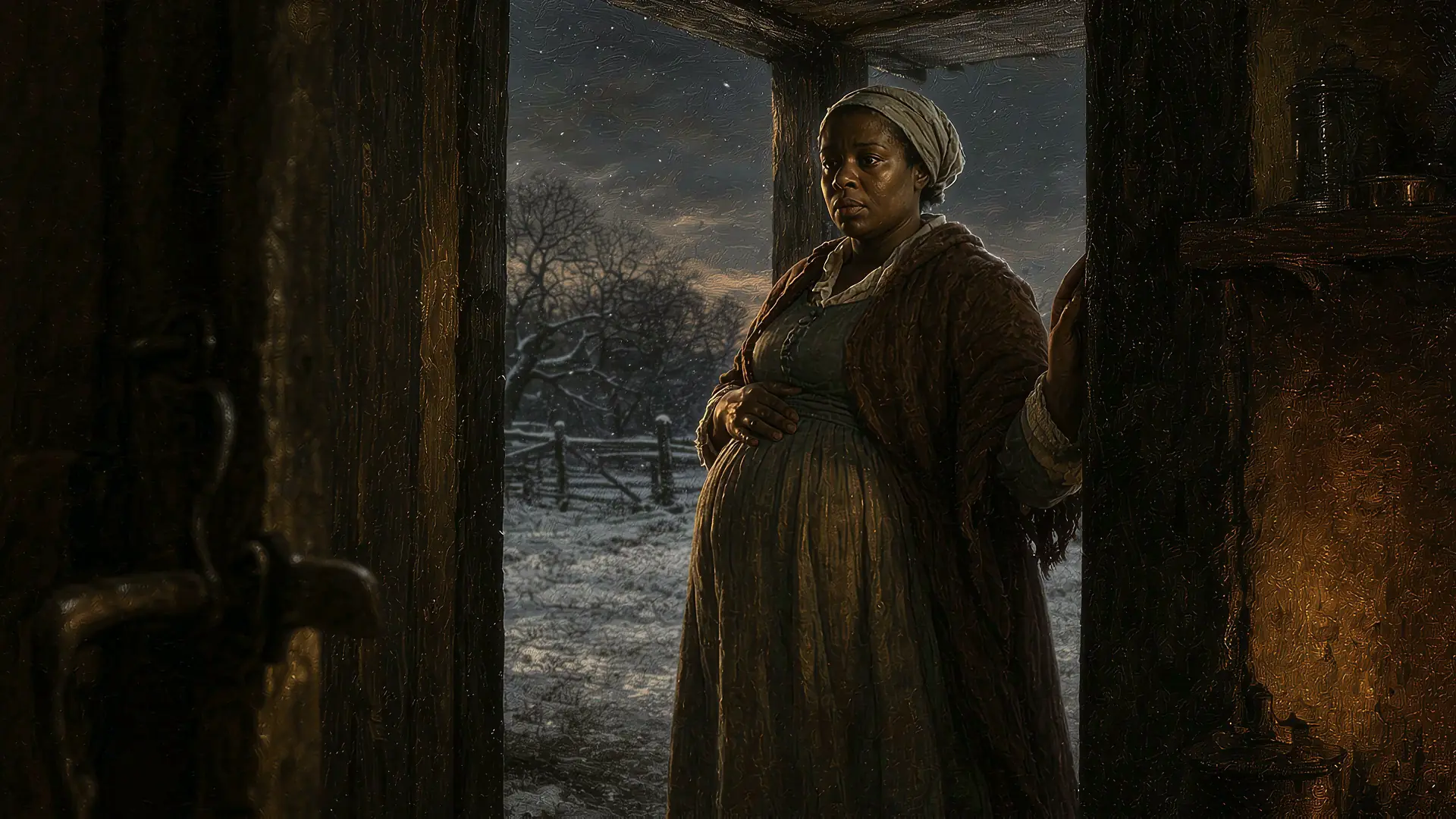
Around 1630, an enslaved African woman in Virginia gave birth to a daughter named Elizabeth, and no record kept the mother's name.
The mother said the father was Thomas Key, a free English planter, and in 1656 a witness named Alice Larrett swore:
Alice Larrett
“I heard her mother Say that shee was mr. Keyes daughter”
Africans had lived in Virginia since 1619, when an English ship landed about twenty captives at Point Comfort. For decades, their status varied: planters held some of them for life, while others became free and owned land.
By the 1630s, Virginia's planters were making money from tobacco and needed far more workers than they had. Most were young English servants who signed indentures, trading four to seven years of work for the voyage, food and lodging. Under the headright system, a planter received fifty acres for every person whose passage he paid.
In 1636, Thomas Key bound Elizabeth, then about six, as a servant to a planter named Humphrey Higginson for nine years.
In 1640, three servants ran away from their master together: a Dutchman, a Scot and an African named John Punch.
After their capture, Virginia's General Court added four years to each European's service, and for Punch it ruled:
General Court clerk, 1640
“the third being a negro named John Punch shall serve his said master or his assigns for the time of his natural Life here or elsewhere.”
The court made race the difference between four years and a lifetime, decades before Virginia wrote slavery into law.
When Higginson returned to England, Colonel John Mottrom took over Elizabeth's service and kept her working long after the nine years ended.
When Mottrom died in 1655, the men who listed his property counted Elizabeth and her young son among his goods:
Estate appraiser
“Elizabeth the Negro woman & her sonne”
In January 1656, Elizabeth sued for her freedom, and her attorney was William Greensted, the Englishman she named as her son's father. She argued that her father was free, that she was baptized, and that her nine years of service were long over. Twelve men of Northumberland County, Virginia, heard her case, and you can sit with them.
Twelve Men
January–July 1656
The jury found her free, but in March, the colony's General Court overturned the verdict. Elizabeth then petitioned Virginia's assembly, and a committee there cited English common law:
Charles Norwood
“…by the Comon Law the Child of a Woman slave begott by a freeman ought to bee free…”
In July 1656, the county court declared her free and ordered the estate to give her corn and clothes, a freed servant's due.
Elizabeth Key married William Greensted that summer, and their family lived free. She won partly because her father was free, and six years later, Virginia made sure no one could win that way again.
The Mother, Not the Father
1662–1705
Key terms: Chattel slavery, Hereditary slavery, Slave codes
Henry Randolph
“WHEREAS some doubts have arrisen whether children got by any Englishman upon a negro woman should be slave or ffree…”
The lawmakers decided that the mother's status would rule, so a free English father could no longer make his child free. Virginia was building chattel slavery, in which owners could buy, sell and pass down enslaved people and their children as property.
Elizabeth Key kept her freedom, but no child born to an enslaved mother after 1662 could win it the way she had.
Imagine Elizabeth born in a later year, and see which of her three arguments would still work. In 1667, Virginia declared that baptism did not free an enslaved person. In 1691, it banished any free white person who married someone Black, Native American or, like Elizabeth, of mixed race. And in 1705, Virginia gathered its rules into one slave code, and the same assembly passed:
The clerk of the House of Burgesses
“An act declaring the Negro, Mulatto, and Indian slaves within this dominion, to be real estate”
Six Parts of Seven
1671–1750
Key terms: Atlantic slave trade, Bacon's Rebellion (1676), Cash crops, Gang and task systems
In 1671, Virginia's governor, Sir William Berkeley, sent London an estimate of the colony's bound workers:
Sir William Berkeley
“there are two thousand black slaves, six thousand christian servants, for a short time”
Servants outnumbered enslaved people three to one, but over the next thirty years, planters turned to enslaved Africans.
Colonists had taken plenty of land from Native nations, and Europe kept buying more tobacco, so planters wanted more workers. Fewer English servants came as wages rose in England, while English slave traders carried more Africans across the Atlantic. An enslaved African cost more than a servant's contract, but the planter owned that person for life, along with any children an enslaved woman bore.
In 1676, Nathaniel Bacon led poor frontier settlers against Native nations, then against Governor Berkeley, who had refused to back their war.
Sir William Berkeley
“How miserable that man is that Governs a People when Six parts of Seaven at least are Poore Endebted Discontented and Armed”
In January 1677, about eighty enslaved Black men and twenty Englishmen were among the last rebels to surrender, at West Point, on Virginia's York River.
Many of Bacon's men were servants or landless former servants, and the rebellion frightened the planters who ran Virginia. Afterward, many of them saw enslaved Africans as safer workers, who would never finish a term or demand land. By about 1700, Virginia's tobacco planters had replaced English servants with enslaved Africans as their main workers.
The more labor a colony's crops needed, the more people its colonists enslaved. New England's small family farms used few enslaved workers, but by 1741, about one person in five in New York City was enslaved. On the mainland, most enslaved people worked on plantations, growing tobacco in the Chesapeake and rice and indigo in the Lowcountry of South Carolina. But the great majority of Africans brought to British America went to the sugar islands of the Caribbean, such as Jamaica and Barbados.
Northern merchants profited too: Rhode Island distillers turned Caribbean molasses into rum, and Newport ships traded the rum in Africa for captives.
On Chesapeake tobacco farms, overseers drove gangs of enslaved workers from sunrise to sunset. On Lowcountry rice plantations, many enslaved people had a set task each day and could sometimes use the time left over for themselves.
My Name Is Secrett
1723–1774
Key terms: Gullah, Covert resistance
By the 1720s, enslaved Africans outnumbered white colonists in South Carolina, and many lived in large groups on rice plantations. There, people kept and reshaped African customs, and on the coast they created Gullah, a mix of English and African languages still spoken today.
Every child on those plantations was enslaved from birth, but parents passed down names, songs, stories and skills of their own. Some enslaved people became Christians while keeping African beliefs, and families kept up ties even after owners sold relatives to other plantations.
Many also resisted in quieter ways: they worked slowly, broke tools, pretended to be sick or slipped away for a few days.
In 1723, an enslaved Virginian wrote to the Bishop of London, who oversaw the Church of England in the colonies. The writer spoke for baptized Christians, some with white fathers and some with white mothers, and protested a Virginia law:
The Writer of 1723
“there is in this Land a Law or act which keeps and makes them and there seed SLaves forever”
The writer of 1723
“as for mee my selfe I am my brothers SLave but my name is Secrett”
The letter went unsigned, and it explained why: its authors could hang if their masters found out.
Others resisted by running away, and enslavers placed notices in newspapers to get them back. In October 1773, a Virginia girl of about fourteen named Fanny ran away from her enslaver, John Lewis of Williamsburg. Let's read his notice twice: once the way Lewis meant it, and once for what it tells us about Fanny.
Liberty, Marching South
c.1739–1740
Key terms: Middle Passage, Natural increase, Stono Rebellion (1739), Overt resistance, Negro Act of 1740
Venture Smith, the man who bought Meg, was born around 1729 in West Africa, where his name was Broteer. An army captured him as a boy, and around 1739 a trader took him out to a slave ship at Anomabu, on the Gold Coast.
A steward on the Rhode Island ship bought him for four gallons of rum and a piece of calico, and named him Venture.
The ship then sailed the Middle Passage, the forced voyage across the Atlantic, and smallpox broke out on board.
The ship reached Barbados, an English sugar island, and nearly sixty years later Venture remembered:
Venture Smith, in his own words (1798)
“There were found out of the two hundred and sixty that sailed from Africa, not more than two hundred alive.”
Venture Smith, in his own words (1798)
“These were all sold, except myself and three more, to the planters there.”
Most captives in the Atlantic trade ended up like his shipmates: about 95 percent landed in the Caribbean and South America. Fewer than 5 percent reached mainland North America, yet by 1750, one person in five in the thirteen colonies was Black. Put those two numbers side by side, and ask what could explain the gap.
In the 1700s, the mainland's enslaved population grew from children born in the colonies, not only from new arrivals. On the sugar islands, deaths outnumbered births, so planters kept buying new captives from Africa.
Spain, Britain's rival, also enslaved people, but it promised freedom in Florida to anyone who fled the British colonies, became Catholic and served Spain. In 1738, the Spanish governor founded Fort Mose, a town where free Black militiamen and their families guarded St. Augustine against the British.
On Sunday, September 9, 1739, about twenty enslaved men led by Jemmy seized guns and powder from a store near South Carolina's Stono River.
They marched south toward Spanish Florida, killing white colonists and burning houses along the road.
Others joined them as they marched, beating two drums and shouting one word:
Stono marchers · word reported in the colonial account
“Liberty!”
About ten miles on, more than sixty marchers stopped in a field, where they danced and beat drums to draw others to join them.
That afternoon, the militia caught up with the marchers, and by October, more than forty rebels and about twenty white colonists were dead.
In May 1740, South Carolina passed a new slave code, the Negro Act, which said of enslaved people:
William Bull · staged reading of the 1740 act
“all their issue and offspring, born or to be born, shall … remain forever hereafter, absolute slaves, and shall follow the condition of the mother”
It also limited where enslaved people could travel and gather, and it set a hundred-pound fine for teaching them to write.
The act banned the drums that had called others to join the march:
William Bull · staged reading of the 1740 act
“using or keeping of drums, horns, or other loud instruments”
Freedom in Installments
1754–c.1775
Key terms: Manumission
Through the 1740s, Venture grew up enslaved on Fishers Island, in colonial New York, and later married Meg, who was also enslaved on the island. Around 1754, their daughter Hannah was born, and because Meg was enslaved, a New York law of 1706 made Hannah a slave too.
Venture
“At the close of that year I was sold to a Thomas Stanton, and had to be separated from my wife and one daughter, who was about one month old.”
Stanton lived at Stonington Point, in Connecticut, and about a year and a half later he bought Meg and Hannah too.
One day, Stanton's wife beat Meg, then turned on Venture with a horsewhip.
Venture
“Then I immediately committed the whip to the devouring fire.”
Days later, Stanton clubbed him on the head, and Venture took the club to a justice of the peace.
Venture
“He finally advised me to return to my master, and live contented with him till he abused me again, and then complain.”
Soon after, Stanton locked an ox chain on Venture's legs and later asked whether he would rather be unchained and go to work.
Venture
“No.”
Venture was sold twice more, and his last owner, Oliver Smith, agreed to let him buy his own freedom.
In 1765, at about thirty-six, Venture paid the last of the money and was free.
By about 1769, he had bought his two sons, but Meg and Hannah were still enslaved.
In 1798, at Haddam Neck in Connecticut, Venture dictated his life story, and he explained why he bought Meg when he did:
Venture Smith, 1798
“I purchased my wife Meg, and thereby prevented having another child to buy, as she was then pregnant.”
Because a child's status followed its mother's, a baby born while Meg was enslaved would have belonged to her owner.
Soon after Venture bought her, Meg had a son who was born free, and two years later Venture bought Hannah too.
Mother to Child
by the 1750s
By the 1750s, slavery was legal in every British colony, and colonial laws had made it racial, lifelong and hereditary through the mother. Planters turned to it because land was plentiful, Europe wanted tobacco, rice and sugar, and English servants were growing scarce.
Enslaved people resisted slavery in fields, courts, letters and open revolt, and they kept their families and cultures alive.
Her name is in no record.