
Colonial Society and Culture in two minutes
- The First Great Awakening (1730s–1740s) stressed personal conversion: George Whitefield drew crowds of thousands, and Jonathan Edwards delivered "Sinners in the Hands of an Angry God" in 1741.
- Revivals split churches into New Lights and Old Lights, weakened ministers' authority, and spread Baptist and Separate congregations, though Connecticut and Massachusetts still taxed people for the established church.
- The Enlightenment stressed reason and natural rights; John Locke argued that governments rest on consent, Benjamin Franklin tested ideas by experiment, and like the Awakening it taught colonists to question authority.
- In 1735 a New York jury acquitted printer John Peter Zenger of seditious libel after Andrew Hamilton argued that truth was a defense, and printers grew bolder.
- Colonies copied English government: the king or colony owners appointed most governors, property-owning men elected assemblies that held the power of the purse, and enforcement stayed loose, later called salutary neglect.
- Large families, German and Scots-Irish immigrants, and enslaved Africans grew the population more than fourfold from 1700 to 1750, while Anglicization made colonists more British through imported goods and Georgian houses.
- On the exam: questions ask how the Awakening and the Enlightenment challenged authority and how self-government, Zenger, and the power of the purse prepared colonists for the Revolution.
Topic 2.7 key terms
- First Great Awakening (1730s–1740s)
Protestant revivals that swept the British colonies in the 1730s and 1740s. Itinerant (traveling) preachers such as George Whitefield and printed sermons spread a message of personal conversion. Not the Second Great Awakening of the 1800s.
- Established church
A church that the colony's government officially supported, usually with taxes everyone had to pay. Connecticut and Massachusetts supported Congregational churches; Virginia supported the Church of England.
- Protestant evangelicalism
Protestant preaching that called each person to a personal conversion, a "new birth" felt in the heart, and spread it through traveling preachers and print. The Great Awakening carried it through the colonies.
- Enlightenment
Using reason, observation and experiment to explain nature and government, as Franklin did here. Many educated colonists followed it.
- Pluralism
Many ethnic and religious groups living side by side, as in Pennsylvania: English Quakers, German Lutherans and Mennonites, Scots-Irish Presbyterians. Living together did not mean equal rights.
- Transatlantic print culture
Books, newspapers, sermons and pamphlets moving between Britain and the colonies, and from colony to colony, through printers, post riders and merchant ships. It spread both the Great Awakening and Enlightenment ideas.
- Jonathan Edwards
Massachusetts minister and a leader of the Great Awakening. His 1741 sermon Sinners in the Hands of an Angry God warned listeners of hell to drive them toward conversion.
- New Lights / Old Lights
New Lights supported the revivals and their emotional preaching; Old Lights opposed them. Their quarrels split Congregational and Presbyterian churches and produced new, separate congregations.
- Religious toleration
Letting people of different faiths worship freely. It varied by colony: Rhode Island and Pennsylvania went furthest, while Massachusetts and Connecticut kept tax-supported churches. Toleration did not mean equal political rights.
- Great Awakening and Enlightenment compared
Difference: revivalists sought truth through faith and a felt conversion; Enlightenment thinkers used reason and observation. Similarity: both encouraged colonists to question authority, and both spread through Atlantic print.
- John Locke and natural rights
English philosopher (1632–1704). People are born with natural rights to life, liberty and property. Government rests on the consent of the governed and may be resisted if it violates those rights.
- Deism
Belief in a creator who made a universe that runs by natural laws, which people can discover through reason. Many deists doubted miracles. Deism is not atheism.
- Seditious libel
Under English law of the time, printing criticism that damaged the government's reputation was a crime, even if the criticism was true.
- Zenger trial (1735)
A New York jury acquitted the printer John Peter Zenger of seditious libel after his lawyer argued that he had printed the truth. The law did not change, but the case encouraged a freer press.
- Colonial assembly
The elected lower house of a colony's legislature, modeled on England's House of Commons. It voted on taxes and spending. Only men who owned property could vote for it.
- Salutary neglect
A later name (Edmund Burke, 1775) for Britain's loose enforcement of its trade laws and instructions before 1763. Colonial assemblies grew used to running their own affairs.
- Power of the purse
An assembly's control over taxes and spending. Governors needed the assembly's votes for money, even for their own salaries, so the assembly could bargain with them.
- Anglicization
The colonies' growing likeness to Britain: British goods and fashions, London books and news, English churches, and governments built on English models. It grew alongside the colonies' ethnic and religious diversity.
Transcript
Quotes are from the historical record and name their source. Lines marked Dramatized are reconstructions.
THE DUST
23 October 1740
Key terms: First Great Awakening (1730s–1740s), Established church
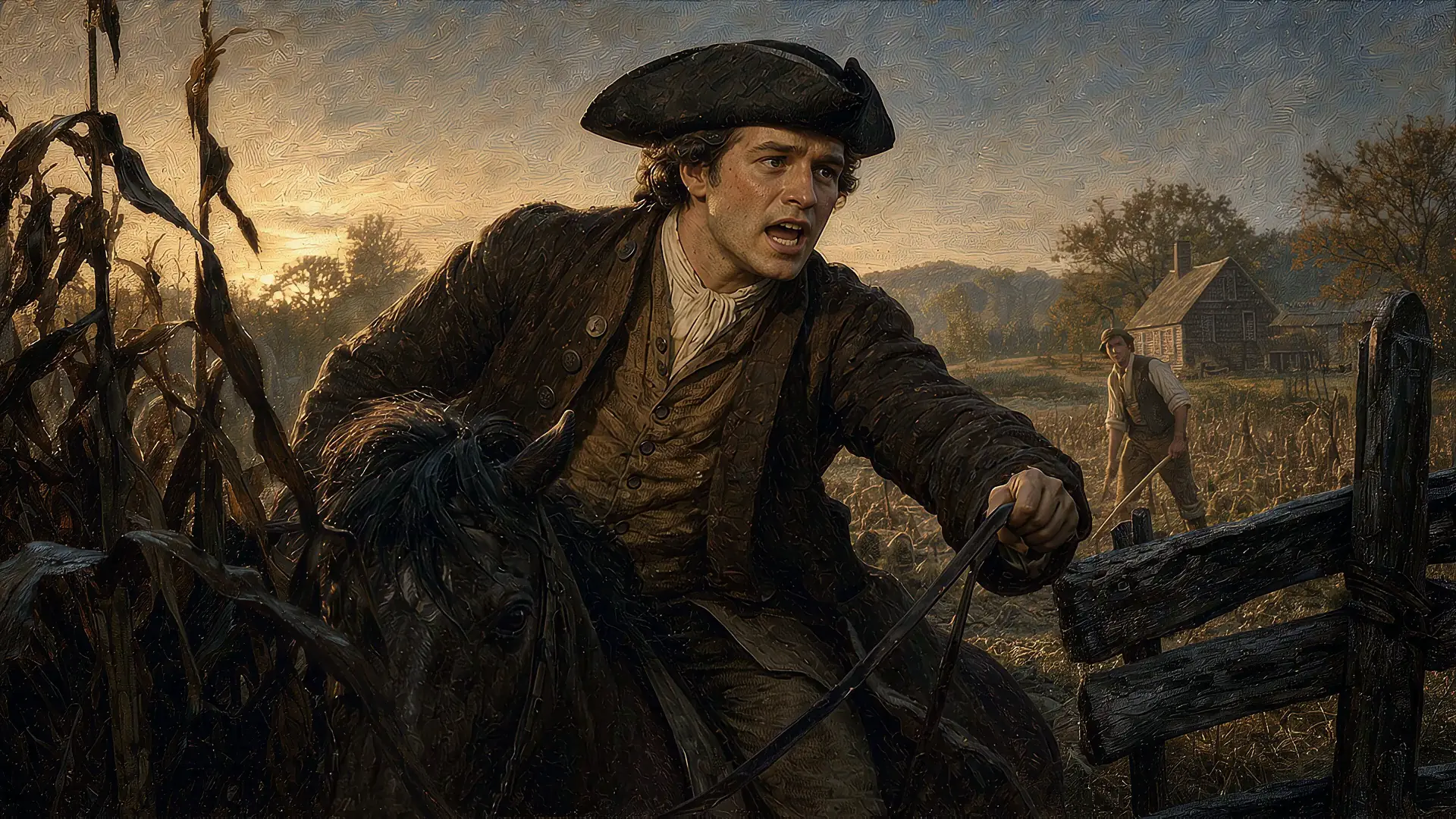
On the morning of October 23, 1740, a messenger rode up to Nathan Cole's farm in Kensington, Connecticut, with news. George Whitefield, a young English preacher whom crowds followed from town to town, would preach at Middletown that morning at ten.
Nathan Cole
“I dropt my tool … and ran home to my wife.”
Cole and his wife rode double on one horse and had little more than an hour to cover the twelve miles. Near Middletown, they joined a stream of riders so thick that their dust hung over the hills like a cloud.
Several thousand people gathered at Middletown, some crossing the river by ferry, and Whitefield, only twenty-five, preached from a raised wooden platform.
Nathan Cole
“my hearing him preach, gave me a heart wound.”
Whitefield was the best-known preacher of the First Great Awakening, the Protestant revivals that spread through the colonies in the 1730s and 1740s. Back home, Connecticut law made Cole pay taxes to his parish's established church, whether or not he trusted its minister.
GOLD AND ALL
November 1739 – May 1740
Key terms: Protestant evangelicalism, Enlightenment, Pluralism, Transatlantic print culture
A year earlier, in November 1739, Whitefield, a young priest of the Church of England, had brought his preaching tour to Philadelphia.
George Whitefield
“However you may think of yourselves, I know that by Nature I am but half a Devil, and half a Beast.”
Revival preachers told listeners they were sinners who needed a personal conversion, a new birth they would feel in their own hearts.
Benjamin Franklin, a 33-year-old Philadelphia printer, stood at the back of the crowd and wondered how far one voice could carry.
Walk Franklin backward toward the river to test the preacher's voice the way he did.
Benjamin Franklin
“I computed that he might well be heard by more than thirty thousand. This reconcil’d me to the newspaper accounts…”
Newspapers had reported crowds of twenty-five thousand, and Franklin's test showed that a crowd that big really could hear one voice. That habit of testing claims with observation and reason came from the Enlightenment, a European movement many educated colonists followed.
Between 1700 and 1750, the population of the mainland colonies grew more than fourfold, mostly because families were large. Pennsylvania's cheap land and religious freedom drew tens of thousands of German-speaking immigrants, who landed at Philadelphia and farmed the rich country to the west. Scots-Irish families, Presbyterians from northern Ireland, pushed farther west and then south along the Great Wagon Road into Virginia and the Carolinas. Pennsylvania's mix of peoples and churches living side by side was a clear case of pluralism.
At another sermon, Whitefield asked for money for Bethesda, his new orphanage in Georgia, and Franklin decided to give nothing.
Benjamin Franklin
“…and he finish'd so admirably, that I empty'd my pocket wholly into the collector's dish, gold and all.”
In the 1700s, Africans whom slave traders carried across the Atlantic were the largest group of newcomers to the mainland colonies. In May 1740, a group of Black Philadelphians came to Whitefield's lodging to thank him, and they gave small sums for his orphans.
Franklin printed Whitefield's journals and sermons and sold them across the colonies, so the preacher gained readers and the printer gained customers.
Colonial newspapers copied each other's stories, and post riders carried papers and letters along a road from New England to Virginia. Ships brought London newspapers, books and sermons across the Atlantic, so readers in different colonies took in the same news and arguments. That network spread the revival to people who never heard Whitefield in person.
DEAD MEN
1739–1747 · consequence in 1765
Key terms: Jonathan Edwards, New Lights / Old Lights, Religious toleration
Nathan Cole had heard him in person, and he spent most of the next year sure that he was damned.
Whitefield's tour ran from Georgia to New England, and other itinerant preachers followed him from town to town. They warned that many churches had grown cold and that many ministers had never been converted themselves.
In 1740, at Nottingham, Pennsylvania, the Presbyterian minister Gilbert Tennent preached a sermon called The Danger of an Unconverted Ministry, and Franklin printed it.
Gilbert Tennent
“Is a blind Man fit to be a Guide in a very dangerous Way? Is a dead Man fit to bring others to Life?”
Tennent was telling ordinary believers that they could judge their own ministers and leave any minister who had never been converted.
In July 1741, Jonathan Edwards, a minister from Northampton, Massachusetts, preached at Enfield, then a Massachusetts town on the Connecticut River.
Jonathan Edwards
“The God that holds you over the Pit of Hell, much as one holds a Spider, or some loathsome Insect, over the Fire, abhors you”
Listeners moaned and cried out so loudly that Edwards had to stop before he finished. Preachers like Edwards used the terror of hell to push people toward conversion, and emotional services became a mark of the revival.
The revival also reached the Mohegan, a Native nation in eastern Connecticut, where a teenager named Samson Occom heard about it.
Young Samson Occom
“…we heard a Strange Rumor among the English, that there were Extraordinary Ministers Preaching from Place to Place and a Strange Concern among the white People…”
In 1743, Occom went to study with Eleazar Wheelock, a revival minister in Lebanon, Connecticut, and stayed four years, learning English, Latin and Greek.
The revival split many churches between New Lights, who supported it, and Old Lights, who opposed it. In 1743, Charles Chauncy, an Old Light minister in Boston, complained in print:
Charles Chauncy
“Religion, of late, has been more a Commotion in the Passions, than a Change in the Temper of the Mind.”
Charles Chauncy
“Nay, Women and Girls; yea, Negroes, have taken upon them to do the Business of Preachers.”
Many New Lights left their parish churches to form congregations of their own, called Separates. Baptist churches, which baptized adult believers, grew fast too. Ministers lost some of their old authority, because believers now chose which preacher to follow.
Nathan Cole
“I was born Feb 15th 1711 and born again octo 1741.”
Cole came to believe that his parish church accepted unconverted people as members, and he argued for years to change it.
Choose what Cole should do in 1747: stay in his parish church, leave with the Separates, or stay and keep arguing. Cole left to worship with the Separates, but Connecticut still taxed him for the parish minister, and in 1765 collectors seized some of his property. Believers could now choose their own church, yet Connecticut and Massachusetts still taxed most people to pay for the established one. Rhode Island and Pennsylvania went furthest toward religious freedom, with no established church, though even Pennsylvania let only Christians hold office.
TWO WAYS OF KNOWING
1732–1752
Key terms: Great Awakening and Enlightenment compared, John Locke and natural rights, Deism
Franklin, meanwhile, had become famous in Europe for his experiments with electricity, and in 1752 Whitefield wrote to him from London:
George WhitefieldAdapted
As you have made a pretty considerable progress in the mysteries of electricity, I would now humbly recommend to your diligent unprejudiced pursuit and study the mystery of the new-birth.
Franklin never had the new birth that Whitefield hoped for him.
Revivalists said people found truth through faith and a conversion they could feel, while Enlightenment thinkers trusted reason and observation. Yet both movements taught colonists to question authority, since a believer could judge a minister and a reader could judge a government. Both also crossed the Atlantic the same way, in books, sermons, newspapers and letters.
Colonial readers also studied John Locke, an English philosopher who wrote that people were born with natural rights to life, liberty and property. Locke argued that a government rested on the consent of the governed, and that people could resist one that violated their rights. Some Enlightenment thinkers, Franklin among them in his youth, were deists, who believed a creator had made a universe that ran by natural laws.
By 1732, Franklin's Philadelphia club of tradesmen, the Junto, asked the same questions at every meeting, including this one:
Benjamin Franklin
“Have you lately observed any encroachment on the just liberties of the people?”
In 1734, officials in New York jailed a printer for criticizing the governor in his newspaper.
THE HOLE IN THE DOOR
1734–1735
Key terms: Seditious libel, Zenger trial (1735)
The printer was John Peter Zenger, a German immigrant whose New-York Weekly Journal mocked New York's royal governor, William Cosby. Cosby's political enemies wrote the attacks without signing them, but Zenger's name appeared on every issue as the printer. In November 1734, the governor's council had Zenger jailed for seditious libel, with bail set far beyond what he could pay.
For more than eight months, his wife, Anna, kept the Journal coming out, taking his instructions through a hole in his cell door. Like many colonial women, she worked in the family business, though as a married woman she had few legal rights and no vote.
Zenger's trial opened in August 1735 before a chief justice whom Governor Cosby had appointed. Andrew Hamilton, a famous Philadelphia lawyer and no relation to the later Alexander Hamilton, came to defend him. Now take a seat on the jury and hear the case.
Richard Bradley
“…you Gentlemen of the Jury… is an Information for printing and publishing a false, scandalous, and seditious Libel…”
Richard Bradley
“…I think the Jury must find a Verdict for the King… the Law says, their being true is an Aggravation of the Crime.”
Andrew Hamilton
“Then Gentlemen of the Jury, it is to you we must now appeal…”
Andrew Hamilton
“…It is the Cause of Liberty… the Liberty—both of exposing and opposing arbitrary Power (in these Parts of the World, at least) by speaking and writing Truth.”
Thomas Hunt
“Not Guilty.”
New Yorkers held a dinner for Hamilton at the Black Horse tavern, but the law of seditious libel stayed exactly as it was. Still, the jury had refused to convict a printer whose defense was that he had printed the truth. In 1738, printers in London and Boston reprinted the account of the trial, and colonial printers grew bolder about criticizing officials.
THE SAME ROOM
1740–1761
Six years later, after a series of fires in 1741, white New Yorkers became convinced that enslaved people were plotting a revolt. In the city hall where Zenger had been tried, courts sent thirty Black men and four white people to their deaths on weak evidence.
Revival preachers welcomed enslaved listeners, but few of them questioned slavery itself. In 1740, writing from Savannah, Georgia, Whitefield published an open letter to the slaveholders of the southern colonies:
George Whitefield · open letter, 1740
“I think God has a Quarrel with you for your Abuse of and Cruelty to the poor Negroes.”
He condemned their cruelty but stopped short of condemning slavery. Franklin printed that letter, and his newspaper also ran ads for the sale of enslaved people.
Georgia's trustees had banned slavery, and in 1748 Whitefield wrote to ask them to allow it:
George Whitefield · to the Georgia Trustees
“Had a negroe been allowed, I should now have had a sufficiency to support a great many orphans, without expending above half the sum which hath been laid out.”
He already owned a South Carolina plantation where enslaved people worked, and after Georgia allowed slavery in 1751, enslaved people worked at Bethesda too. The revival taught that every soul was equal before God, but an enslaved convert stayed enslaved.
In 1749, Samson Occom, the Mohegan convert, became a teacher and preacher among the Montaukett people on eastern Long Island. In 1768, he wrote that his sponsors had paid him 180 pounds for twelve years of that work. The same sponsors had spent that much on a single year of another mission.
Samson Occom · 1768
“I believe, it is, because I am poor Indian.”
MORE BRITISH THAN EVER
1728–1751
Key terms: Colonial assembly, Salutary neglect, Power of the purse, Anglicization
Long before 1754, free white colonists had governed themselves on an English model, and they were proud of it. Each colony had a governor, most of them appointed by the king or by the family that owned the colony. Nearly every colony also had an elected assembly, modeled on England's House of Commons, that voted on taxes. Only men who owned property could vote, so women, enslaved people, most free Black men and many poor white men had no say.
In New England, townsmen also voted on local questions at town meetings, while in the South, sheriffs and county courts ran local affairs. Britain enforced its trade laws loosely in these years, a policy later called salutary neglect, and the assemblies grew used to getting their way.
In 1728, the king told Governor William Burnet to get a permanent salary from the Massachusetts House. Choose how the House should vote. The House offered Burnet his pay one year at a time, but he refused it on the king's orders, and the House never gave in. That control over taxes and spending was called the power of the purse.
Colonists were also proud to be British, and they fought for Britain against France in King George's War. In 1745, about four thousand New England volunteers and a Royal Navy squadron captured Louisbourg, France's fortress on Cape Breton Island.
When New England asked Pennsylvania for gunpowder, the colony's assembly, led by Quakers who opposed war, refused to buy any. Instead, it voted money to buy bread, flour, wheat or other grain.
George Thomas
“I shall take the money, for I understand very well their meaning; other grain is gunpowder.”
In daily life, too, colonists grew more British over time, a change called Anglicization. Prosperous families built brick houses in London's Georgian style, drank tea from imported china and read books and newspapers shipped from London.
In a 1751 essay, Franklin cheered the fast growth of England's colonies and attacked the Germans who had settled in Pennsylvania:
Benjamin Franklin · 1751
“Why should Pennsylvania, founded by the English, become a Colony of Aliens, who will shortly be so numerous as to Germanize us instead of our Anglifying them,”
Benjamin Franklin · 1751
“and will never adopt our Language or Customs, any more than they can acquire our Complexion.”
Pennsylvania's Germans kept their own language, churches and newspapers while obeying colonial law, so pluralism and Anglicization grew side by side. Colonists who argued with their ministers and governors still thought of themselves as loyal Britons, and almost none of them wanted independence.
CODA
1754
By 1754, Nathan Cole had walked out of his tax-supported church, and Franklin had spent years testing claims for himself. Colonists like them still called themselves Britons, and they checked their rulers with English tools like trial by jury and the power of the purse. But the vote still belonged mostly to white men with property, and even a minister like Samson Occom could not win equal pay.