
Comparison in Period 2 in two minutes
- Labor differed: Chesapeake planters used indentured servants and then enslaved Africans, New England's family farms used few enslaved workers, and South Carolina's rice colony had a Black majority around 1750.
- Religion differed: Massachusetts and Virginia taxed people for an official church, while Rhode Island and Pennsylvania allowed wider worship, though Pennsylvania reserved public office for Christians.
- Government differed: New England towns used town meetings, Virginia's wealthy planters controlled county courts and the House of Burgesses, and everywhere women, enslaved people, and men without property could not vote.
- Empires differed: Spain used missions and forced labor, and its colonies had many people of mixed ancestry; France and the Dutch relied on Native trading partners; English settlers wanted Native land.
- At Lancaster in 1744, Six Nations leaders such as Canassatego bargained with Pennsylvania, Maryland, and Virginia over land and urged the colonies to unite.
- Colonies also shared a king, Atlantic trade, British goods, new religious and political ideas, and the taking of Native land, yet none adopted the Albany Plan of Union in 1754.
- On the exam: comparison questions ask for a similarity and a difference between regions or empires, with evidence on labor, religion, government, or Native relations, and a thesis that explains why.
Topic 2.8 key terms
- Quakers
Members of the Society of Friends, a Protestant group that rejected war. William Penn, a Quaker, founded Pennsylvania in 1681 as a refuge open to many faiths.
- Haudenosaunee (Six Nations)
A confederacy of six Native nations in today's upstate New York: Mohawk, Oneida, Onondaga, Cayuga, Seneca and Tuscarora. Britain and France both sought them as allies.
- Cash crop
A cash crop was grown to sell, often overseas, rather than to eat. Examples included tobacco in the Chesapeake, rice and indigo in South Carolina, and sugar in the Caribbean.
- Indentured servitude
A contract to work for a master for a set number of years, usually four to seven, in exchange for passage to America. Most early Chesapeake migrants came this way.
- Puritans
English Protestants who wanted to purify the Church of England. About 20,000 came to New England in the 1630s, most of them in family groups.
- Chattel slavery
Slavery in which a person is legal property for life and the status passes to the children. Virginia made slavery hereditary through the mother in 1662.
- Bacon's Rebellion (1676)
An uprising of Virginia frontier settlers, servants and some enslaved people against the governor, led by Nathaniel Bacon. They burned Jamestown.
- Covenant Chain
The long alliance between the Six Nations and the British colonies, renewed again and again at treaty councils with speeches and gifts.
- Middle colonies
New York, New Jersey, Pennsylvania and Delaware made up the Middle colonies. They featured fertile grain farms, river ports like Philadelphia and New York, and a varied mix of peoples and faiths.
- Religious pluralism
Religious pluralism means many faiths living side by side. Pennsylvania, with no official church, drew Quakers, Lutherans, Presbyterians, Catholics, Jews and others.
- Established church
A church supported by taxes and the law: the Congregational churches in Massachusetts, the Anglican church in Virginia and South Carolina.
- Town meetings · House of Burgesses
New England towns governed themselves in meetings of qualified men. Virginia's elected assembly, first held in 1619, was run by wealthy planters.
- Spanish missions
Religious settlements where Catholic friars worked to convert Native people, often using their forced labor to build churches and farm.
- Middle Passage
The forced voyage of enslaved Africans across the Atlantic to the Americas. Crowding and disease killed many captives before they landed.
- Salutary neglect
Britain's loose enforcement of its trade laws, which let colonists largely run their own affairs.
- Stono Rebellion (1739)
The largest uprising of enslaved people in the British mainland colonies. About twenty men near Charleston seized guns and marched toward Spanish Florida.
- Slave codes
Colonial laws that defined enslaved people as property and controlled their movement, gatherings and schooling. South Carolina passed a harsher code in 1740, after Stono.
- Anglicization
Colonists' growing taste for British goods, books and manners in the 1700s. It tied the colonies to Britain even while they differed from one another.
- First Great Awakening
A wave of emotional Protestant revivals in the 1730s and 1740s. Preachers like George Whitefield urged personal conversion, and many congregations split.
- Enlightenment
A European movement that stressed reason and science. Writers like John Locke argued that people have natural rights and that government rests on consent.
- Albany Plan of Union (1754)
Franklin's plan for a council of the colonies, led by a president-general appointed by the king, to manage defense, Native relations and taxes for them. No colony adopted it.
Transcript
Quotes are from the historical record and name their source. Lines marked Dramatized are reconstructions.
A Musket and a Drum
June 11, 1744
Key terms: Quakers, Haudenosaunee (Six Nations)
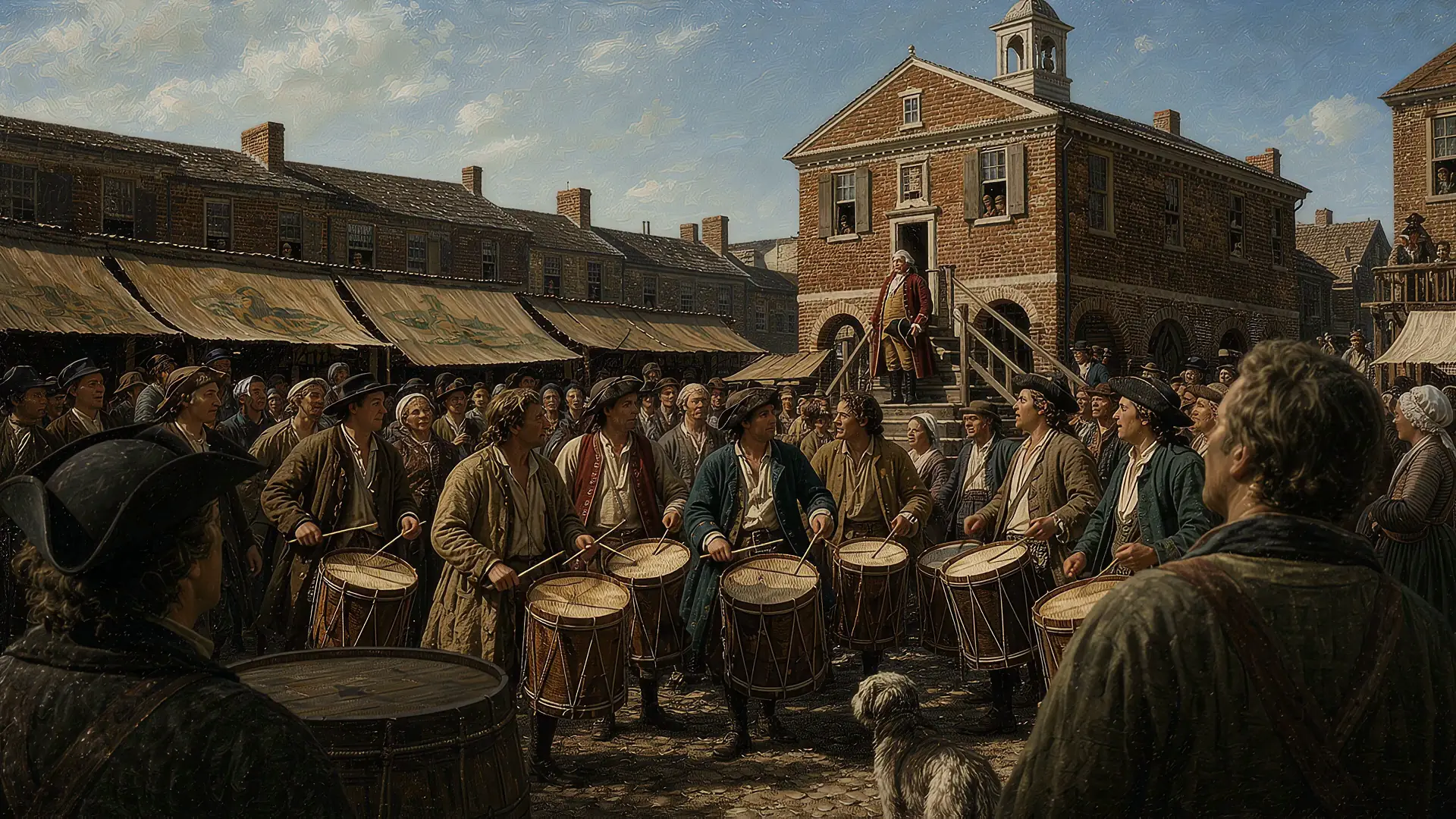
On June 11, 1744, a Philadelphia crowd heard that Britain had entered King George's War against France. Governor George Thomas told the men to arm themselves, and one man in the crowd called back:
The bold fellow
“Please your Honour, what you say is right, but I and many others here, poor men, have neither money nor credit to procure a musket or the third part of a musket”
The governor made no reply, but smiled. Pennsylvania had no militia law to arm men like him, because Quakers, whose faith rejected war, controlled its elected assembly.
Dr. Alexander Hamilton of Annapolis, Maryland, not the later Founding Father, watched the scene. He was riding north for his health with Dromo, a man he enslaved, and he wrote down nearly everything he saw. Dromo left no written record of his own.
In South Carolina, a 1740 slave law fined any master who let an enslaved person beat a drum. Pennsylvania would not arm its poor men, and South Carolina wrote its drum law to control enslaved people.
Meanwhile, diplomats of the Six Nations, a league of Native nations in today's upstate New York, were heading for a treaty council in Pennsylvania. Britain's mainland colonies stretched from New England to Georgia, with French colonies to the north and west and Spanish Florida to the south. They shared a king and a war, but they disagreed about who should fight, who should do the work, and whose land it was.
Tobacco and Families
1600s → May 1744
Key terms: Cash crop, Indentured servitude, Puritans, Chattel slavery, Bacon's Rebellion (1676), Covenant Chain
Twelve days earlier, Hamilton and Dromo had ridden out of Annapolis, Maryland, where ships loaded tobacco for London. Maryland and Virginia, the colonies around Chesapeake Bay, made up the Chesapeake region, and tobacco was their cash crop.
In the 1600s, most English migrants to the Chesapeake were young men who paid for the voyage with four to seven years as indentured servants.
New England's settlers came differently: in the 1630s, Puritans crossed the Atlantic in whole families to build towns around their churches.
Rocky soil and long winters kept New England's farms small, so families also fished, cut timber and built ships to sell across the Atlantic.
Move through the century to see how the Chesapeake's Black population grew. As fewer English servants arrived and tobacco kept spreading, planters bought more and more enslaved Africans. In 1662, Virginia ruled that children took the status of their mother, so the children of enslaved women were born enslaved. Bacon's Rebellion in 1676, when armed frontier farmers and servants burned Jamestown, gave planters another reason to prefer enslaved workers.
Tobacco wore out the soil, so Virginians kept moving west, onto backcountry land that the Six Nations and other Native peoples claimed.
The Six Nations met in council at Onondaga, near today's Syracuse, New York, and their speaker, Canassatego, wanted the new war kept off their land.
The Six Nations had warned New France's governor to keep his war off their land, as Canassatego told the British at Lancaster:
Canassatego
“there was Room enough at Sea to fight, there he might do what he pleased, but he should not come upon our Land to do any Damage to our Brethren.”
At Lancaster, the Six Nations also used their old alliance with the British, the Covenant Chain, to demand payment for land colonists had taken.
Four Rulebooks
June 6–10, 1744
Key terms: Middle colonies, Religious pluralism, Established church, Town meetings · House of Burgesses
On June 6, Hamilton reached Philadelphia, Pennsylvania's capital and busiest port. Farmers in Pennsylvania's rich interior sent wheat by river and wagon to the city, and merchants shipped it as flour to the Caribbean sugar islands. Ships also brought German families who could not pay their fare, so they sold years of their labor to whoever paid it.
Two days later, Hamilton dined at a crowded tavern table and wrote down who sat there:
Dr. Alexander Hamilton
“There were Scots, English, Dutch, Germans, and Irish; there were Roman Catholicks, Churchmen, Presbyterians, Quakers, Newlightmen, Methodists, Seventhdaymen, Moravians, Anabaptists, and one Jew.”
That Sunday, Dromo walked into a Lutheran church to hear a sermon in German.
Under South Carolina's 1740 law, an enslaved man traveling alone needed a written pass, or any white person could stop him and whip him.
Click each colony to compare its church, voters and workers. Massachusetts and Virginia used taxes to support an official church, while Quaker Pennsylvania let believers in God worship but reserved public office for Christians. New England towns governed themselves in town meetings, while wealthy planters ran Virginia's county courts and its elected assembly, the House of Burgesses. In every colony, women and enslaved people could not vote, and neither could men without enough property.
Since We Came Out of This Ground
June 21–July 4, 1744
Key terms: Spanish missions
On June 21, Hamilton sailed up the Hudson River toward Albany and wrote about his fellow passengers:
Dr. Alexander Hamilton
“They all could talk Dutch but myself and Dromo”
New York had been the Dutch colony of New Netherland until the English took it in 1664, and many Dutch families stayed.
At Albany, Dutch merchants still bought beaver furs from Mohawk traders, as they had for more than a century. The Dutch, like the French in Canada, had sent few settlers, so their fur trade depended on Native hunters and allies.
In Florida and New Mexico, Spanish friars had built missions to make Native people Catholic, and Spaniards forced them to work. Many Spanish colonists married Native people or had children with them, so people of mixed ancestry became common in Spanish America.
English settlers came to farm, so they wanted Native land more than Native labor, and they mostly lived apart from Native people. In late June, Six Nations leaders and their families came into Lancaster, Pennsylvania, to meet officials from Pennsylvania, Maryland and Virginia.
Maryland's commissioners argued that Maryland had held its land for more than a hundred years, and on June 26, Canassatego answered them through an interpreter:
Canassatego
“what is One Hundred Years in Comparison of the Length of Time since our Claim began? since we came out of this Ground?”
Canassatego
“We are now straiten'd, and sometimes in want of Deer, and liable to many other Inconveniencies since the English came among us, and particularly from that Pen-and-Ink Work that is going on at the Table.”
As he said it, he pointed at the secretary, who was writing the minutes in English.
Virginia's commissioners wanted the backcountry its settlers were already farming, and Tachanoontia answered them for the Six Nations:
Tachanoontia
“that Land, if the Virginians ever get a good Right to it, it must be by us.”
On July 2, for goods and gold, the chiefs gave up their claim to all land in Virginia, now or 'hereafter.' Shawnee, Delaware and other Native peoples lived on parts of that land, and they had no part in the deal.
On July 4, as the council closed, Canassatego gave the three colonies some advice:
Canassatego
“We heartily recommend Union and a good Agreement between you our Brethren.”
Canassatego
“Our wise Forefathers established Union and Amity between the Five Nations; this has made us formidable; this has given us great Weight and Authority with our neighbouring Nations.”
The Tuscarora had joined the original Five Nations around 1722. After more than a week of bargaining with three colonies one at a time, Canassatego told them that united colonies would grow stronger.
Four Gallons of Rum
July 1744 · remembered in 1798
Key terms: Middle Passage, Mercantilism · Navigation Acts, Salutary neglect
In July, Hamilton traveled on to Newport, Rhode Island, a colony where people of many faiths could worship freely. Newport's distillers turned Caribbean molasses into rum, and some of its merchants sent the rum to West Africa to buy captives.
In 1798, Venture Smith, a free man near seventy, recalled how a ship's steward bought him as a boy off West Africa:
Venture Smith
“I was bought on board by one Robertson Mumford, steward of said vessel, for four gallons of rum, and a piece of calico”
Many captives died on the crossing, called the Middle Passage.
Click each route to see how New England's trade depended on slavery. Under mercantilism, Britain expected its colonies to make the empire richer, and its Navigation Acts sent crops like tobacco and sugar only to British ports. Newport merchants smuggled French molasses past a 1733 tax, and Britain's loose enforcement, called salutary neglect, let colonists largely run their own affairs.
Rhode Island held far fewer enslaved people than Virginia. Its ships carried captives from Africa, and Newport merchants kept the profits. Enslaved people also worked in Newport's houses, shops and docks.
Two Drums
1739–1750
Key terms: Stono Rebellion (1739), Slave codes
In September 1739, five years before Hamilton's trip, about twenty enslaved men seized guns from a store near the Stono River in South Carolina. A man named Jemmy led them south toward Spanish Florida, and a colonial report described the scene:
Reader · anonymous account, 1739
“Several Negroes joyned them, they calling out Liberty, marched on with Colours displayed, and two Drums beating,”
When they stopped in a field and beat their drums to call others to join them, the colony's militia attacked. By the report's count, about twenty colonists and forty rebels died, and the militia shot many prisoners on the spot.
In Florida, Spain promised freedom to British runaways who became Catholic and served in its militia. Near St. Augustine, earlier runaways had already settled Fort Mose, a free Black town with its own militia.
Its captain, Francisco Menéndez, had escaped from slavery in Carolina himself. Spain still allowed slavery in Florida, but freeing British runaways weakened a rival colony and gave Spain soldiers to guard its border.
After the march, South Carolina's lawmakers saw drums as a way for enslaved people to signal one another. In 1740, the colony passed a harsher slave code, the Negro Act, which fined masters who let enslaved people beat drums or blow horns. It also fined anyone who taught an enslaved person to write.
Around 1750, South Carolina was the only mainland colony where most people were Black. Switch to the number of people: Virginia, with its much larger population, had the most Black residents.
Enslaved people grew South Carolina's rice and made its indigo dye, and the planters grew rich from both. Like the sugar planters of Barbados, a British island in the Caribbean, South Carolina's planters used enslaved Africans to grow export crops on large plantations.
The Doctor's Verdict
July–September 1744
Key terms: Anglicization, First Great Awakening, Enlightenment
On July 24, 1744, at a Boston auction, Hamilton watched buyers snap up London novels, a Roman poem about seduction and a Puritan theology book. From Boston to Charleston, colonists bought the same British books, clothes and teacups, a trend historians call Anglicization.
In Connecticut, men with enough property elected their own governor and ran their towns in town meetings. Enlightenment writers such as John Locke argued that people had natural rights and that government needed their consent. Preachers of the Great Awakening revived personal faith, split churches and questioned old authority, and Hamilton mocked the revivals.
On August 29, at a tavern in Connecticut, Hamilton compared the workers there with those at home in Maryland:
Dr. Alexander Hamilton
“Slaves are not so much in use as with us, their servants being chiefly bound or indentured Indians.”
That night in Norwalk, Hamilton wrote, half the town crowded around Dromo to ask about his master. If anyone asked Dromo about Dromo, Hamilton didn't write it down.
Back home in Annapolis that September, Hamilton summed up his trip:
Dr. Alexander Hamilton
“I found but little difference in the manners and character of the people in the different Provinces I passed thro’.”
Sort the summer's evidence into what made the colonies alike and what made them different, and decide how far he was right.
Albany, 1754
1744 → 1754
Key terms: Albany Plan of Union (1754)
Virginia read the Lancaster deed's word 'hereafter' as a claim to land west to the Ohio River, where Shawnee, Delaware and Mingo people lived. By the spring of 1754, French troops had seized the Forks of the Ohio, where Pittsburgh stands today.
That summer, delegates from seven colonies met the Six Nations at Albany, New York, to plan a common defense. Benjamin Franklin, whose shop had printed the Lancaster treaty, proposed the Albany Plan of Union. A council chosen by the colonial assemblies, under a president-general appointed by the king, could raise troops and collect taxes for defense.
The Mohawk leader Hendrick warned the colonists that they had neglected the Six Nations:
Hendrick at Albany, 1754
“you have thus thrown us behind your back, and disregarded us, whereas the French are a subtle and vigilant people, ever using their utmost endeavours to seduce and bring our people over to them.”
The congress approved the plan, but no colonial government put it into effect. The assemblies would not give up their power to tax, and London thought the plan gave colonists too much power of their own.
At Albany in 1754, the colonies still would not agree to defend themselves, raise taxes or deal with Native nations as one. Their workers, churches and governments differed, yet they shared a king, Atlantic trade, British goods and ideas, and they kept taking Native land.