
Developing an American Identity in two minutes
- In Letters from an American Farmer (1782), Crèvecoeur described the American as a "new man" made as Europeans of many nations melted into one people. He had only Europeans in mind.
- Noah Webster's spelling book of 1783 and his Dissertations on the English Language of 1789 called for "a system of our own, in language as well as government."
- Neoclassical architecture borrowed Roman forms, as in Jefferson's Virginia Capitol, modeled on a Roman temple. Pierre L'Enfant planned the new capital, and Gilbert Stuart and Charles Willson Peale painted the founders.
- Disestablishment ended tax support for official churches in most states, Virginia going furthest in 1786, and the First Amendment barred a national church. Massachusetts kept its established church until 1833.
- After the 1793 yellow fever epidemic, Absalom Jones and Richard Allen answered charges against Black nurses, and Allen's Bethel Church grew into the independent African Methodist Episcopal Church in 1816.
- Exclusion limited the new identity: the Naturalization Act of 1790 offered naturalization only to "a free white person," and Benjamin Banneker's 1791 letter reminded Jefferson that slavery contradicted the Declaration's equality.
- On the exam: Questions ask how art, language, religion and literature expressed a national culture and how race and citizenship limited it (continuity and change). Links to Period 4's cultural movements.
Topic 3.11 key terms
- Disestablishment
- 1776–1833; First Amendment ratified December 15, 1791
State laws that ended tax support for an official church. Virginia went furthest with Jefferson's Statute for Religious Freedom (1786), which barred forcing anyone to attend or pay for a church.
Virginia's statute became a model for the First Amendment, which barred Congress from setting up a national church.
- *Letters from an American Farmer*
- Published in London, 1782
J. Hector St. John de Crèvecoeur's essays on American life. Letter III asks, "What then is the American, this new man?" and answers that Europeans of many nations melt into one people.
Crèvecoeur pictured Americans as a new people, separate from Europe, just as the United States won its independence.
- Noah Webster
- 1758–1843; speller 1783; *Dissertations* 1789
A Connecticut teacher whose spelling book (1783) taught generations of children to read. His Dissertations on the English Language (1789) called for an American standard of English.
Webster wanted "a system of our own, in language as well as government," yet his American English stayed close to Britain's.
- Neoclassical architecture (Federal style)
- 1780s–1790s; Virginia Capitol begun 1785; First Bank finished 1797
A building style that borrowed the columns of ancient Greece and Rome. Jefferson modeled Virginia's Capitol on a Roman temple, and Philadelphia's First Bank used the lighter Federal style.
Leaders copied ancient Rome to present the United States as a republic, so a new national identity took an old European form.
- Naturalization Act of 1790
- Passed March 26, 1790
Congress's first rule for making immigrants citizens. It let any alien who was a "free white person" become a citizen after two years' residence by proving good character in court.
From the start, Congress made whiteness a test for naturalized citizenship, so European immigrants could become citizens and others could not.
- African Methodist Episcopal Church (AME Church)
- Bethel dedicated July 29, 1794; AME Church founded 1816
Richard Allen's Bethel Church in Philadelphia and the national denomination it formed with other Black congregations in 1816. Allen, a formerly enslaved preacher, opened Bethel after white Methodists segregated worship.
Free Black Americans answered discrimination by building institutions of their own, with churches at the center of community life.
Big questions
Explain the continuities and changes in American culture from 1754 to 1800.
After 1776 Americans set out to build a national culture, yet much of it reworked British and classical models, and the regions stayed different. Letters from an American Farmer hailed a "new man," but Noah Webster's American English was still English and Neoclassical architecture copied Rome. Disestablishment came fast in Virginia and took until 1833 in Massachusetts.
Transcript
Quotes are from the historical record and name their source. Lines marked Dramatized are reconstructions.
His Nation
Undated recollection · published 1819
Key terms: Letters from an American Farmer (1782)
On the Wabash River, in what is now Indiana, a hunter shot a bear. Then he stood over it and scolded it in the language of the Miami, a Native nation.
Later he explained that if the bear had won,
William Wells
“I would not have disgraced my nation as he did”
The hunter was William Wells, and the nation he meant was the Miami. Wells was born in Pennsylvania, the son of white settlers. He fought for the Miami against the United States, and later for the United States against the Miami.
In 1782, a French-born farmer named Crèvecoeur asked a famous question:
J. Hector St. John de Crèvecoeur
“What then is the American, this new man?”
J. Hector St. John de Crèvecoeur
“Here individuals of all nations are melted into a new race of men,”
All the nations he had in mind were European. William Wells went the other way: he became Miami.
Apekonit
1779 onward · return undated
Key terms: Frontier cultures
In March 1784, William, about thirteen, was out hunting with three other boys near his family's farm in Kentucky, then part of Virginia. A war party captured them and took them north across the Ohio River.
Miami families adopted captives to take the place of relatives they had lost, and a Miami family adopted William.
He grew up Miami, in towns full of cornfields, relatives and traders.
Years later, his older brother tracked him down and brought him back to Kentucky. Within days, Wells chose to go back to the Miami.
J. Hector St. John de Crèvecoeur
“thousands of Europeans are Indians, and we have no examples of even one of those Aborigines having from choice become Europeans!”
A System of Our Own
1787–1791
Key terms: Separation of church and state, National culture, Neoclassical style, Pierre L'Enfant, Stuart · Peale · Brockden Brown
The Revolution changed life at home, too. The Constitution banned titles of nobility, and most states stopped taxing people to pay for an official church. Armies were one way to build a nation. Noah Webster thought spelling was another.
Noah Webster
“As an independent nation, our honor requires us to have a system of our own, in language as well as government.”
In France, Thomas Jefferson had fallen in love with an ancient Roman temple.
Back home, he used it as the model for Virginia's new Capitol.
Pierre L'Enfant designed a new federal capital on the Potomac River, the future Washington, D.C. One of the men who surveyed it was Benjamin Banneker, a free Black farmer who had taught himself astronomy.
August 19, 1791 Near Ellicott’s Mills, Maryland
In 1791, Banneker sent Jefferson an almanac he had calculated himself, along with a letter.
He quoted the Declaration of Independence back to Jefferson, then wrote:
Benjamin Banneker
“in detaining by fraud and violence so numerous a part of my brethren under groaning captivity and cruel oppression, that you should at the Same time be found guilty of that most criminal act, which you professedly detested in others”
Thomas Jefferson
“No body wishes more than I do to see such proofs as you exhibit, that nature has given to our black brethren, talents equal to those of the other colours of men”
Other Americans were building a national culture, too. Gilbert Stuart painted the founders, and Charles Willson Peale opened a museum of American art and nature in Philadelphia. Charles Brockden Brown wrote some of the first American novels.
Praising Banneker did not lead Jefferson to free the people he enslaved.
Benjamin Banneker
“Put your Souls in their Souls stead,”
A Return / Those Who Stayed
1792–1794
Key terms: African Methodist Episcopal (AME) Church, Naturalization Act of 1790
In 1792, Wells's Miami family was still held prisoner at Fort Washington, today's Cincinnati. He went to work for the United States to get them back.
In July 1792, he got them back.
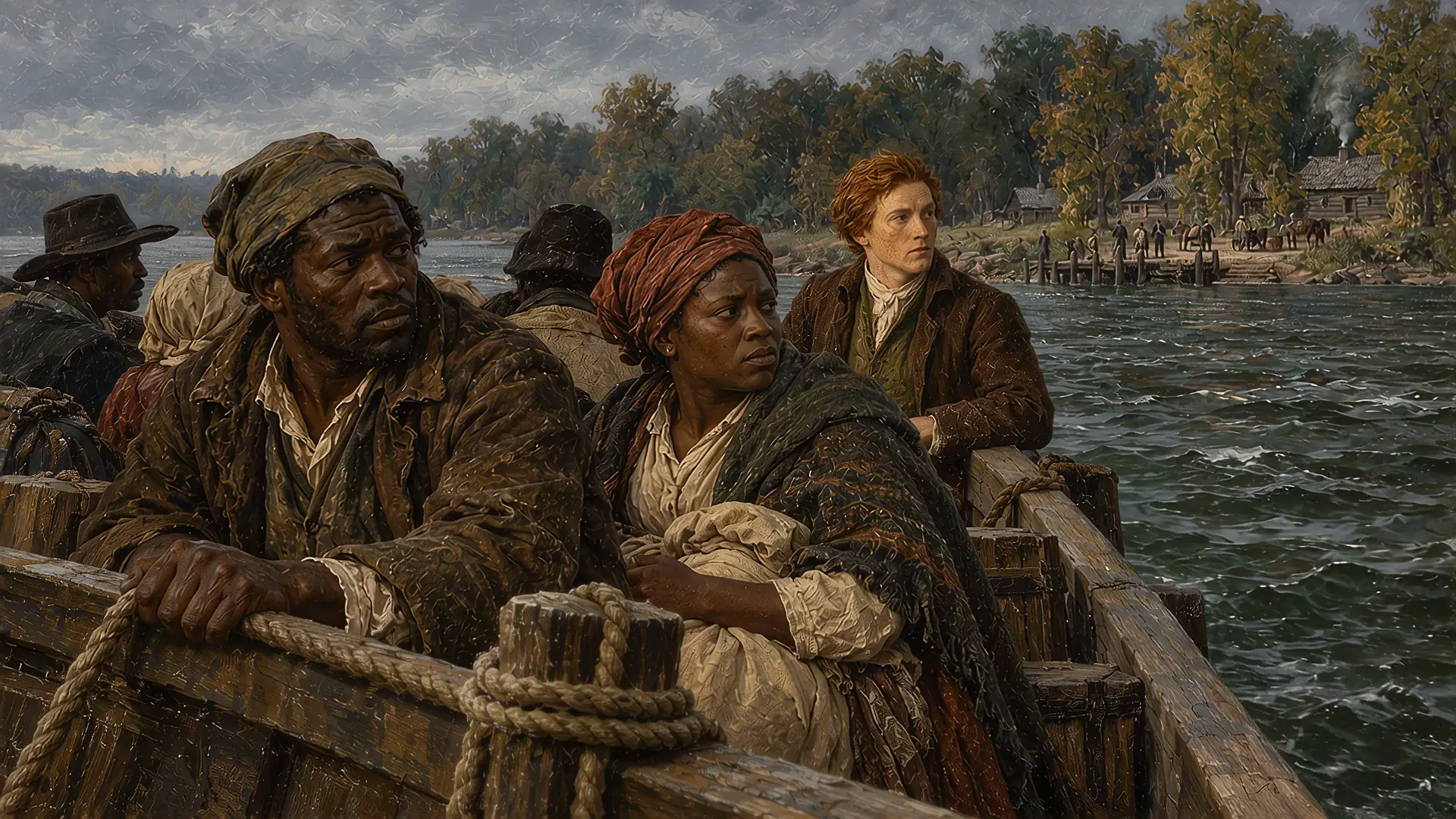
In 1793, yellow fever broke out in Philadelphia, then the nation's capital, and the government and thousands of residents fled. Two Black ministers, Absalom Jones and Richard Allen, stayed to help.
They nursed the sick and buried the dead.
Afterward, the Philadelphia publisher Mathew Carey accused Black nurses of overcharging and stealing. Jones and Allen answered in print:
Absalom Jones · words coauthored with Richard Allen
“Is it a greater crime for a black to pilfer, than, for a white to privateer ?”
In 1793, Allen bought an old blacksmith shop and made it the start of his own church, Bethel. It grew into the African Methodist Episcopal Church, the first independent Black denomination in the country.
Black Philadelphians built their own places to belong. But Congress had already limited who could become a citizen. The Naturalization Act of 1790 offered citizenship only to an immigrant who was 'a free white person.'
This New Man
1797–1798 · retrospective coda
Crèvecoeur had seen Europeans melting into one new people. Little Turtle saw his own people melting away.
Little Turtle · as reported and translated
“They spread like oil on a blanket ; we melt like snow before the sun.”
Within fifteen years, a Shawnee leader named Tecumseh would try to rebuild the confederacy.
By 1800, Americans were building a national culture: Webster's spelling books, Allen's church, Jefferson's temple. But laws, slavery, regional differences and the hunger for land decided who got to belong.
William Wells chose his nation twice. Most of the people in this story never got to choose at all.