
The Constitution in two minutes
- The Constitution addressed the Articles' weaknesses: Article I gave Congress enumerated powers to tax, regulate trade, coin money, raise armies and declare war, and the national government could act directly on citizens.
- The Necessary and Proper Clause let Congress make laws to carry out its powers, and broad readings of it fueled the loose versus strict construction fight over Hamilton's bank in 1791.
- Federalism divided power between nation and states: the Supremacy Clause made the Constitution and federal law outrank state law, and the Tenth Amendment reserved other powers to the states or the people.
- Drawing on Montesquieu, the framers split government into legislative, executive and judicial branches, and Madison wrote in Federalist No. 51 that "Ambition must be made to counteract ambition."
- Checks included the president's veto, a two-thirds override and Senate approval of appointments. The Electoral College gave each state as many electors as its House seats plus its two senators.
- The Convention voted ten states to none against a bill of rights in September 1787. The First Congress proposed twelve amendments, and the states ratified ten, the Bill of Rights, in 1791.
- On the exam: Questions ask how the Constitution answered the Articles' weaknesses (comparison), how Enlightenment ideas shaped it, and why the Bill of Rights limited only the federal government.
Topic 3.9 key terms
- Electoral College
- Proposed Sept. 4, adopted Sept. 6, 1787 (Art. II)
A body of electors that chooses the president. Each state gets as many electors as it has House and Senate seats, and its legislature decides how to pick them.
Electors let the framers keep the president independent of Congress without a national popular vote, which most delegations opposed.
- Enumerated powers
- Article I, Section 8, 1787
The powers the Constitution lists for Congress, mostly in Article I, Section 8, including the power to tax, regulate trade, coin money, raise armies, and declare war.
The powers to tax and regulate trade fixed the worst weaknesses of Congress under the Articles.
- Necessary and Proper Clause
- Article I, Section 8, 1787
The last power in Article I, Section 8, which lets Congress make all laws "necessary and proper" for carrying out the government's powers.
Read broadly, the clause let Congress claim implied powers beyond the list, which started the fight between loose and strict construction.
- Federalism
- Built into the Constitution, 1787
The division of power between the national government and the states. The national government handled defense, foreign affairs, and interstate trade, while local matters stayed with the states.
Unlike the Articles' league of states, the new national government could tax and govern citizens directly.
- Separation of powers
- Written into the Constitution, 1787
The Constitution's split of government into three branches, giving lawmaking to Congress, enforcement to the president, and judging to the federal courts.
The framers followed Montesquieu, who taught that liberty could not survive if one body made, enforced, and judged the law.
- Checks and balances
- Written into the Constitution, 1787
Tools such as the president's veto, Congress's two-thirds override, Senate approval of appointments, and impeachment, which let each branch block the others.
Where the Articles and early state constitutions trusted a strong legislature, the Constitution gave the president a veto over Congress.
- Bill of Rights
- Congress proposed Sept. 25, 1789; states ratified Dec. 15, 1791
The first 10 amendments to the Constitution, which Madison steered through the First Congress. They protected freedom of religion, speech, and the press, the right to a jury trial, and other rights.
Congress kept the Federalists' ratification promise, but until the 1900s the amendments limited only the federal government.
Big questions
Briefly explain one way the Constitution addressed a criticism of the Articles of Confederation.
Critics said the Articles left Congress too weak to collect taxes, regulate trade, or stop Shays's Rebellion. The Constitution gave Congress enumerated powers over taxes and trade, added the Necessary and Proper Clause to carry them out, and through federalism let the national government act directly on citizens.
Analyze the ways in which Enlightenment ideas contributed to constitutional government in the United States.
Enlightenment writers warned that concentrated power leads to tyranny, so the framers divided it. Following Montesquieu, they created a separation of powers with checks and balances such as the veto and impeachment. In Federalist No. 10, Madison argued that a large republic, full of competing factions, would protect rights better than a small one.
Common mistakes
MistakeThe Constitutional Convention wrote the Bill of Rights.
In factThe Convention voted ten states to none against drafting a bill of rights, and the First Congress proposed the amendments in 1789.
MistakeJefferson read the Constitution loosely, and Hamilton read it strictly.
In factHamilton read the Necessary and Proper Clause loosely to justify a national bank in 1791, and Jefferson's strict reading found no such power.
Transcript
Quotes are from the historical record and name their source. Lines marked Dramatized are reconstructions.
Rising or Setting
September 4–19, 1787
Key terms: Electoral College, Enumerated powers, Necessary and Proper Clause, Bill of rights, Supremacy Clause, Federalism
Everyone expected George Washington to become the first president. The harder question was how to choose the presidents after him.
Some delegates wanted Congress to choose, while others wanted the people to elect the president directly.
Adapted
George Mason argued that letting the people choose would be like asking “a blind man” to judge colors.
The delegates settled on an Electoral College. Each state got electors equal to its House seats plus its two senators. Because the three-fifths rule added to Southern House seats, it also added to the South's votes for president.
The new Congress got real powers: to tax, to regulate trade, and to declare war. It could also make all laws “necessary and proper” for carrying out those powers.
Sort these features into the Articles of Confederation and the new Constitution.
On September 12, Mason called for a bill of rights, a list of freedoms the government could not violate.
Roger Sherman
“The State Declarations of Rights are not repealed by this Constitution; and being in force are sufficient.”
The delegates agreed with Sherman and voted the idea down, ten states to none. In his written objections, Mason answered that
George Mason
“the Declarations of Rights in the separate States are no security.”
Mason had a point. Under the Supremacy Clause, the Constitution and federal laws outranked state laws, even state bills of rights. The Constitution divided power between the national government and the states, a system called federalism.
On September 17, thirty-nine delegates signed the Constitution. Three refused: George Mason, Elbridge Gerry of Massachusetts, and Edmund Randolph.
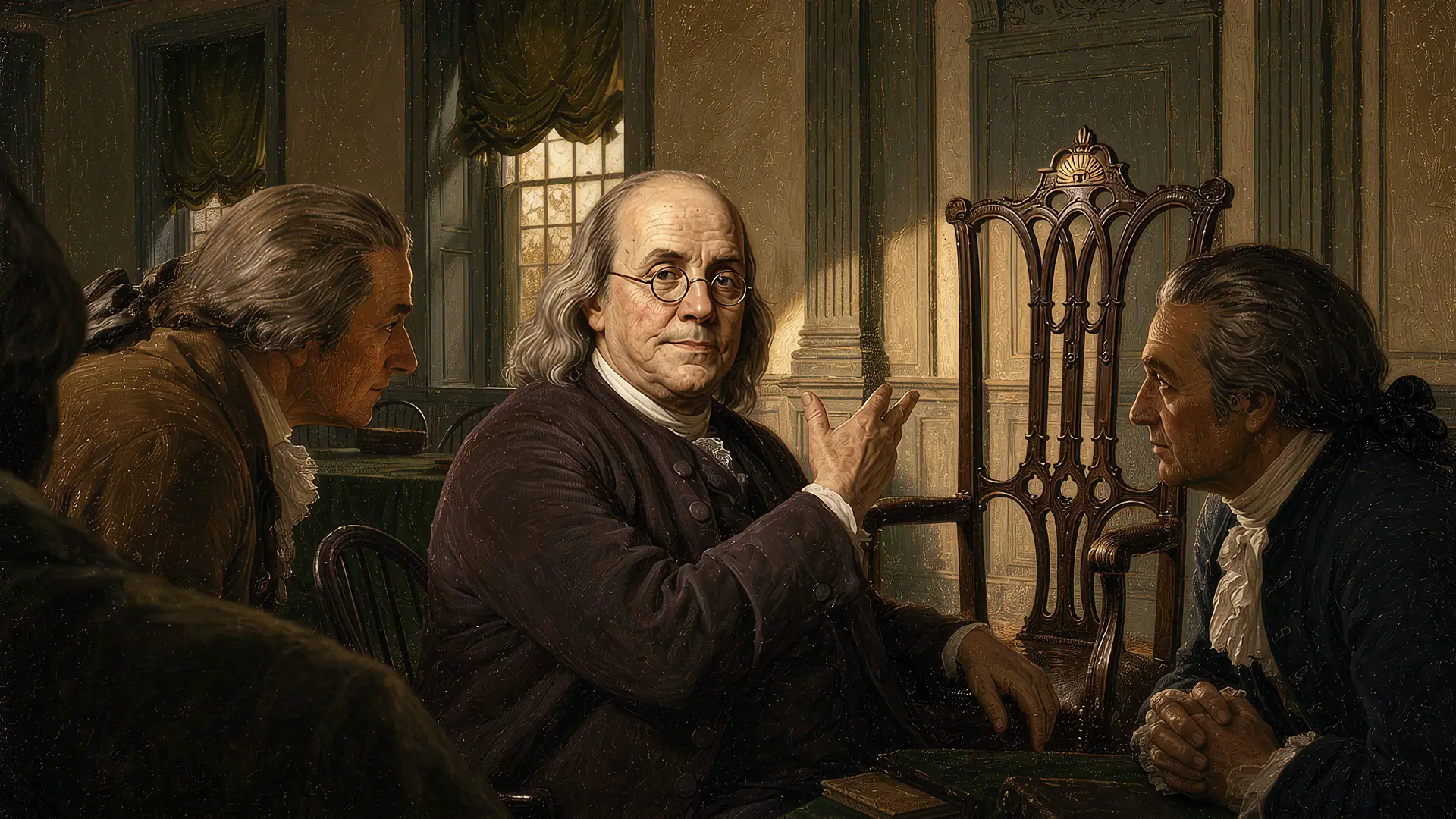
As the last delegates signed, Benjamin Franklin spoke about the sun painted on the back of Washington's chair. Many times that summer, he said, he had looked at it
Benjamin Franklin
“without being able to tell whether it was rising or setting:”
Two days later, Philadelphia's newspapers printed the Constitution, and the secret was out.
Brother Plough Joggers
January–February 1788
Key terms: Separation of powers, Checks and balances, Federalist No. 51
To win over doubters, Governor John Hancock, the convention's president, offered a list of recommended amendments.
John Hancock
“I give my assent to the Constitution, in full confidence that the amendments proposed will soon become a part of the system.”
On February 6, Massachusetts ratified, one hundred eighty-seven to one hundred sixty-eight.
The convention ratified first and trusted that the amendments would follow. This became the Federalists' bargain: ratify now and add a bill of rights later. It helped carry Virginia and New York too.
Meanwhile, in Federalist No. 51, Madison explained how to build one government out of people who did not trust each other.
James Madison
“If men were angels, no government would be necessary.”
James Madison
“Ambition must be made to counteract ambition.”
Each branch could check the others. The president could veto bills, and two-thirds of both houses could override him. The president named federal judges, including Supreme Court justices, with the Senate's approval, and judges could serve for life. Voters elected only the House directly. State legislatures chose senators, and electors chose the president. Historians still argue over whether this design mainly protected liberty or mainly held back democracy. Open each part of the machine to see who chose it and what it could stop.
Expressly
October 1788 – December 15, 1791
Key terms: Ninth Amendment, Implied powers, Tenth Amendment, Strict vs. loose construction, Bill of Rights, Amendment process (Article V)
From Paris, Thomas Jefferson, the American minister to France, wrote to Madison:
Thomas Jefferson
“a bill of rights is what the people are entitled to against every government on earth”
Madison agreed, but he doubted that “parchment barriers” could stop a determined majority. Other Federalists warned that listing some rights might suggest the government could violate the rest. The Ninth Amendment would answer that worry.
Running for the House in 1789, in a Virginia district with many Baptists, Madison promised amendments to protect religious freedom and other rights.
On June 8, 1789, Madison proposed amendments to keep the Federalists' promise and head off the second convention New York wanted.
“He later wrote that “as an honest man” he felt bound by that promise.”
The Articles had reserved to the states every power not “expressly” delegated. Anti-Federalists wanted that word in the new amendments.
James Madison · adapted from the AnnalsAdapted
It is impossible to confine a Government to the exercise of express powers;
A government needed implied powers, he argued, beyond the ones the Constitution listed.
On August 21, the House voted the word down again, and the Tenth Amendment left it out. In 1791, Alexander Hamilton would use implied powers to justify a national bank, and Madison would argue that the Constitution gave no such power.
In September 1789, Congress sent twelve amendments to the states, and by 1791 the states had ratified ten of them. Sort these Anti-Federalist demands into the ones that made it into the Bill of Rights and the ones that did not.
The Anti-Federalists lost the ratification fight, but their demands for religious freedom, a free press and jury trials entered the Constitution. Under Article V, an amendment needed two-thirds of both houses of Congress and the approval of three-fourths of the states. On December 15, 1791, Virginia became the last state needed, and the Bill of Rights took effect.
These first ten amendments limited only the federal government, and they left the Constitution's protections for slavery in place. Not until the twentieth century did courts use the Fourteenth Amendment of 1868 to apply most of them to the states.
His will freed no one.
Benjamin Franklin
“But now at length I have the happiness to know that it is a rising and not a setting Sun.”