
Movement in the Early Republic in two minutes
- After the 1783 Treaty of Paris set the border at the Mississippi, settlers crossed the Appalachians in search of cheap land. Kentucky became a state in 1792 and Tennessee in 1796.
- The Northwest Ordinance of 1787 organized the land north of the Ohio for equal statehood and banned slavery there. In 1794 Washington called out about 13,000 militia against the Whiskey Rebellion.
- The Western Confederacy, supplied by Britain, beat two American armies, including Arthur St. Clair's on November 4, 1791, before Anthony Wayne defeated it at Fallen Timbers on August 20, 1794.
- Jay's Treaty (1794) promised that Britain would leave its western forts, twelve Native nations ceded most of present-day Ohio at Greenville (1795), and Pinckney's Treaty (1795) opened the Mississippi to American shipping.
- Slavery shrank in the North after Pennsylvania's 1780 law but grew in the South and West, where the cotton gin and sales of enslaved people from Virginia and Maryland expanded it.
- In 1800 an enslaved blacksmith named Gabriel planned an uprising near Richmond. A storm and informers stopped it, and Virginia executed Gabriel and 25 other men.
- On the exam: Questions ask about causes and effects of westward settlement, Native resistance and treaties, and the growing regional split over slavery. Do not confuse Jay's Treaty with Pinckney's Treaty.
Topic 3.12 key terms
- Pennsylvania Gradual Abolition Act (Act for the Gradual Abolition of Slavery)
- Passed March 1, 1780
The first state law to end slavery gradually. It freed no one already enslaved, and children later born to enslaved mothers had to serve their mothers' enslavers until age 28.
Northern states began ending slavery by slow legal steps, while slavery in the South and West kept growing.
- Western Confederacy
- c. 1785–1795; council address to Congress, December 18, 1786
An alliance of the Shawnee, Miami, Delaware, and other nations that fought U.S. settlement north of the Ohio River. With British guns, it beat U.S. armies in 1790 and 1791.
Its rout of Arthur St. Clair's army, the U.S. Army's worst defeat by Native nations, pushed Congress to raise a bigger one.
- Northwest Ordinance
- Passed July 13, 1787
The law that set up the Northwest Territory, with an elected assembly at 5,000 free adult men and statehood on equal terms at 60,000 free inhabitants. It banned slavery and encouraged schools.
Its slavery ban made the Ohio River a line between free and slave soil, though enslavers could reclaim people who fled north.
- Westward migration
- 1780s–1790s; Kentucky a state June 1, 1792; Tennessee June 1, 1796
The rush of settlers across the Appalachians after 1783, by Daniel Boone's Wilderness Road and down the Ohio River, into Kentucky and Tennessee. Most came for cheap land.
Kentucky's population nearly tripled in the 1790s, and settlers pressing onto Native hunting grounds fed war north of the Ohio.
- Fugitive Slave Act of 1793
- Signed February 12, 1793
A federal law that let an enslaver seize a person who had escaped to another state and, after a brief hearing with no jury, take that person back.
Congress put federal power behind slavery in its first years, and the Fugitive Slave Act of 1850 later toughened that support.
- Cotton gin
- Built 1793; patented March 14, 1794
Eli Whitney's machine for pulling the seeds from short-staple cotton. It made upland cotton profitable, first in inland South Carolina and Georgia and after 1800 farther west.
Heavy British demand for cotton tied the South's future to slavery just as northern states were ending it.
- Whiskey Rebellion
- Excise March 1791; armed rising July 1794; militia marched October 1794
An uprising of western Pennsylvania farmers against Hamilton's 1791 whiskey tax, which they had to pay in scarce cash. Rebels burned the house of the federal tax inspector, John Neville.
Like Shays's Rebellion, it pitted backcountry farmers against eastern-made taxes, but this time a stronger national government enforced its tax.
- Battle of Fallen Timbers
- August 20, 1794
Anthony Wayne's victory over the Western Confederacy near present-day Toledo, Ohio, in a campaign that used Chickasaw and Choctaw scouts. Retreating warriors found the gates of nearby British Fort Miamis shut.
Wayne then burned Native towns and cornfields, and the confederacy, short of food and without British support, could not keep fighting.
- Jay's Treaty (Jay Treaty)
- Signed November 19, 1794; Senate approved June 24, 1795
Chief Justice John Jay's treaty with Britain. Britain agreed to leave its forts in the Northwest by 1796 but said nothing about impressment, and the Senate approved it by exactly two-thirds.
Britain had armed Native nations from its western forts since 1783, and its promise to leave weakened Native resistance in the Northwest.
- Domestic slave trade (internal slave trade)
- Grew from the 1790s; much larger after 1808
The sale of enslaved people from Virginia and Maryland to cotton lands farther south and west, which often split families. It was underway by the 1790s and grew much larger after 1808.
When Congress banned slave imports in 1808, Chesapeake enslavers supplied the cotton frontier by selling people they already held.
- Treaty of Greenville
- Signed August 3, 1795
The treaty in which 12 Native nations gave up most of present-day Ohio for $20,000 in goods and yearly payments. They also agreed to sell other land only to the United States.
The United States turned a battlefield win into a land cession, a pattern of war and treaty that Tecumseh later rose against.
- Pinckney's Treaty
- Signed October 27, 1795
Thomas Pinckney's treaty with Spain, which opened the Mississippi to American shipping, granted a three-year right of deposit (duty-free storage) at New Orleans, and set Florida's northern border at the 31st parallel.
Opening the river settled western farmers' main complaint against Spain and tied the West more firmly to the Union.
- Gabriel's Rebellion
- Planned for August 30, 1800; Gabriel hanged October 10, 1800
A plan by Gabriel, an enslaved blacksmith, to lead enslaved men in seizing Richmond, Virginia's capital, in August 1800. A storm and two informers stopped it before it began.
Gabriel's men turned the Revolution's own words against slavery, and one witness said they planned a flag reading "death or Liberty."
Big questions
Evaluate the extent to which settler expansion influenced North America from 1754 to 1800.
Settler expansion drove many of the period's conflicts, because settlers moved west faster than any government could control them. Colonists defied Britain's Proclamation of 1763 line, and after 1783 westward migration for cheap land set off war with the Western Confederacy. Frontier farmers also rose against a federal tax in the Whiskey Rebellion until Washington sent militia.
Describe one change in relations between American Indians and the United States from 1776 to 1815.
In the 1790s Native nations north of the Ohio went from winning battles to signing away their land. The Western Confederacy beat two U.S. armies with British guns. Then Anthony Wayne won at Fallen Timbers, Britain agreed in Jay's Treaty to leave its forts, and the nations gave up most of Ohio in the Treaty of Greenville.
Explain how attitudes toward slavery in the North and South diverged from 1776 to 1800.
After 1776 slavery began to shrink in the North and grow in the South. The Pennsylvania Gradual Abolition Act started a northern pattern of slow emancipation, and the Northwest Ordinance banned slavery north of the Ohio. In the South the cotton gin made slavery more profitable after 1793, and slavery spread with cotton across inland Georgia and South Carolina.
Common mistakes
MistakeSettlers crossed the Appalachians mainly to escape crowded coastal cities.
In factCheap, plentiful land drew them west, since most were farm families who wanted land of their own.
MistakeJay's Treaty opened the Mississippi River and New Orleans to western farmers.
In factPinckney's Treaty with Spain did that in 1795, while Jay's Treaty with Britain got British troops out of their forts on U.S. soil.
MistakeThe cotton gin reduced the South's need for enslaved workers.
In factThe gin only pulled seeds from cotton, so it made upland cotton profitable and raised demand for enslaved people to plant and pick it.
Transcript
Quotes are from the historical record and name their source. Lines marked Dramatized are reconstructions.
The Guns
1783–1792
Key terms: Western Confederacy, Northwest Ordinance (1787), Indian Intercourse Act (1790)
When the Revolution ended in 1783, Britain signed the Ohio country, the land north of the Ohio River, over to the United States. But the Native nations who lived there hadn't signed anything. And Britain kept its forts around the Great Lakes, and kept arming them. Congress called it the Northwest Territory. It planned to sell the land to settlers, then admit it as new states. A 1790 law said only the federal government could buy Native land. Settlers crossed the Ohio anyway. The Miami, Shawnee, Delaware and their allies joined together as the Western Confederacy, and fought back.
In 1791, Kentucky militia burned Miami towns on the Eel River and took captives, among them, by later accounts, Wells's own Miami family. Three months later, an American army under Arthur St. Clair marched north, and Wells went out to fight it.
The Native army was led by Blue Jacket of the Shawnee and Little Turtle of the Miami, the war chief whose daughter Wells married.
At dawn on November 4, 1791, the Western Confederacy attacked and overran the American camp. It was the second American army they had beaten in two years, and the worst defeat Native nations ever dealt the U.S. Army. Wells later said he fought at the cannon.
About six hundred thirty American soldiers were killed and about two hundred sixty wounded.
In Boston, a printer sold a broadside covered with coffins, one for each officer who died. Americans everywhere mourned them as the nation's dead.
Congress, meeting in Philadelphia, answered with a bigger army, which soon became the Legion of the United States. Washington put it under General Anthony Wayne, known as Mad Anthony.
The Gate
1793–1794
Key terms: Whiskey Rebellion (1794), Shifting Native alliances, Battle of Fallen Timbers (1794), Jay's Treaty (1794)
By 1794, Wells was leading Wayne's scouts through the country he grew up in.
That same summer, farmers in western Pennsylvania rose up against a federal tax on whiskey. Washington led about thirteen thousand militiamen west, and the Whiskey Rebellion collapsed without a battle. The new government would use force on its frontier, against settlers as well as Native nations.
Not every Native nation joined the confederacy. Chickasaw and Choctaw men from the South scouted for Wayne.
According to American and British accounts, Little Turtle urged the confederacy to make peace. The others chose to fight.
On August 20, 1794, Wayne defeated the confederacy at the Battle of Fallen Timbers.
The warriors fell back to Fort Miamis, a British fort still standing on American land, but its commander shut the gates. Three months later, in Jay's Treaty, Britain agreed to leave its forts on American soil by 1796.
Three places decided this war. Open each one to see what happened there.
Six days before the battle, Wayne wrote:
Maj. Gen. Anthony Wayne
“nor have I ever before beheld such immense fields of corn, in any part of America, from Canada to Florida.”
After the battle, his army burned those cornfields and the houses around them for miles along the river. The confederacy had lost both the battle and its harvest. In 1795, its leaders came to Greenville to make peace.
The Print of the Houses
July–August 1795
Key terms: Treaty of Greenville (1795)
In the summer of 1795, more than a thousand people gathered at Fort Greenville, Wayne's headquarters in western Ohio. Wells was one of the interpreters, standing between the two sides.
“Little Turtle argued that the treaty line took land his people had always lived on:”
Mihšihkinaahkwa
“The print of my ancestors' houses are every where to be seen in this portion.”
Little Turtle also questioned whether other nations had the right to sell Miami land. Wayne pointed to earlier sales to Europeans:
Maj. Gen. Anthony Wayne
“The English and French both wore hats; and yet your forefathers sold them, at various times, portions of your lands;”
On August 2, the Shawnee war leader Blue Jacket gave up his command and deferred to the village chiefs.
Weyapiersenwah
“We must think of war no more.”
On August 3, leaders of twelve nations signed the Treaty of Greenville, giving up most of present-day Ohio.
Wells had helped translate a treaty that gave away land his adopted people had fought to keep.
Land, Have You Any?
1790–1800
Key terms: Westward migration, Pinckney's Treaty (1795), Regional variation, Pennsylvania Gradual Abolition Act (1780), Cotton gin (1793), Domestic slave trade
In 1796, the traveler Moses Austin met crowds of settlers on the Wilderness Road, which Daniel Boone had cut through the Cumberland Gap into Kentucky.
Moses Austin
“Ask these Pilgrims what they expect when they git to Kentuckey the Answer is Land.”
“Most of them had no money and had never seen the place, but they were sure they could get some.”
Kentucky became a state in 1792, and Tennessee in 1796. Western farmers could only ship their crops down the Mississippi, through Spanish New Orleans. In 1795, Pinckney's Treaty opened the river to them.
The nation was splitting by region. Slavery was shrinking in the North, and growing in the South and West. Switch the census from 1790 to 1800 to see how Pennsylvania, Kentucky and South Carolina changed.
Pushed by Quakers and by the Revolution's own words, Pennsylvania passed a law in 1780 to end slavery gradually. Children born to enslaved mothers after it passed still had to serve until age twenty-eight. Even so, Philadelphia's free Black community kept growing, around churches like Allen's.
In South Carolina, the cotton gin made upland cotton profitable, and slavery spread with it, south and west. Planters in Virginia and Maryland began selling enslaved people south and west, to the new cotton lands.
In 1797, Little Turtle came to Philadelphia, with Wells as his interpreter.
By now, Wells spoke of the Americans as 'us.'
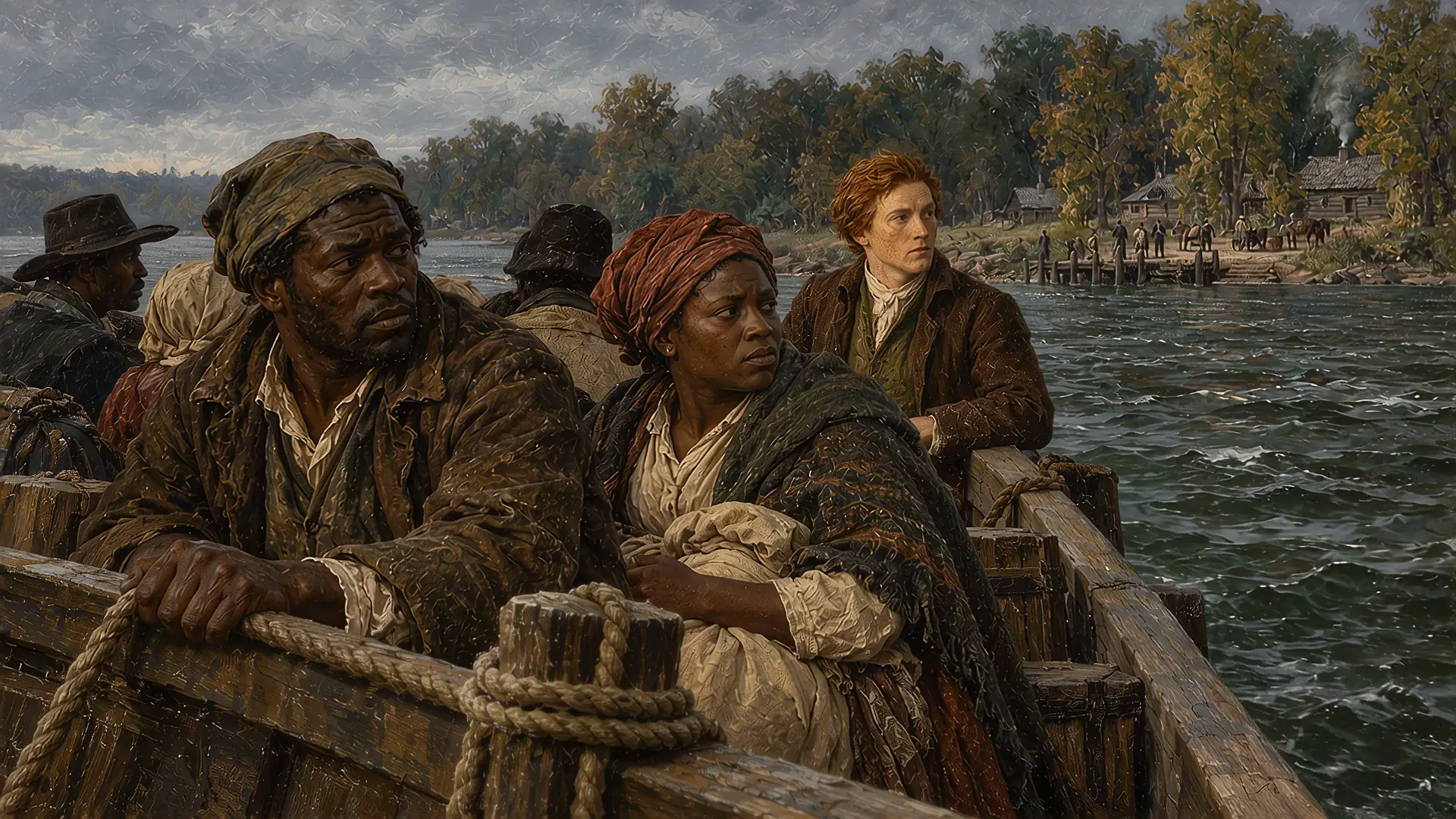
On the way home, Wells stopped in Louisville, Kentucky, a slave state. When he crossed the Ohio again, he brought enslaved people with him, to work his farm at Fort Wayne, the American fort built on the Miami's main town. Fourteen years earlier, near this same town, he had been carried across the same river as a captive.
The Northwest Ordinance had banned slavery in that territory. The ban did nothing for the people Wells enslaved.
Death or Liberty
1800
Key terms: Gabriel’s conspiracy (1800), Haitian Revolution (1791–1804)
Match each rule to what it was meant to do.
In the summer of 1800, near Richmond, Virginia's capital, an enslaved blacksmith named Gabriel was recruiting men for an uprising. The plan was to seize Virginia's Capitol, Jefferson's Roman temple, where the state kept its weapons. Nine years earlier, enslaved people in French Saint-Domingue had risen up and begun winning their freedom.
On August 30, the night of the uprising, a storm flooded the creeks, and the men couldn't cross. Officials had already been warned, and arrests followed.
Jefferson advised Governor James Monroe not to execute too many of the rebels. But he added:
Thomas Jefferson
“I doubt whether these people can ever be permitted to go at large among us with safety.”
Ben Woolfolk, one of the recruits, testified against the others to save his own life. He said they had planned a silk flag,
Ben Woolfolk · testimony as recorded
“on which they would have written "death or Liberty,"”
The slogan echoed Patrick Henry's famous cry from the Revolution.
Gabriel was hanged on October 10, one of twenty-six men Virginia executed.