
Topic 5.11 key terms
- optimization problem
- A problem that asks for the input that makes a quantity as small or as large as possible on an interval of allowed inputs (the entry point that makes Elvis's trip fastest).
- objective function
- The quantity you want to make smallest or largest, written as a function of the one thing you choose: T(x) = (12 − x)/5 + √(x² + 16)/3 seconds.
- interval of allowed inputs
- The choices that make physical sense; its endpoints are always candidates (0 ≤ x ≤ 12 on the beach, 0 ≤ θ ≤ π/2 for the gun).
- critical point
- An input inside the interval where the derivative is zero or undefined. It is only a candidate for a maximum or minimum.
- candidates test
- For a continuous function on a closed interval: compare its values at every interior critical point and at both endpoints; the largest is the absolute maximum, the smallest the absolute minimum.
- justifying an absolute minimum
- Name the test and the evidence: a candidates comparison on a closed interval, or f′ < 0 on the whole interval before the only critical point and f′ > 0 on the whole interval after it.
- best choice vs. best value
- The input that does best (3 m before C) and the value it gives (52/15 ≈ 3.467 s) answer different questions. Read which one is asked, and give units.
- endpoint extremum
- When no critical point lies in the interval (or the endpoints win the comparison), the maximum or minimum is at an endpoint: the close throw where Elvis should jump straight in.
Transcript
1,166 words · 3 parts
How far can it reach?
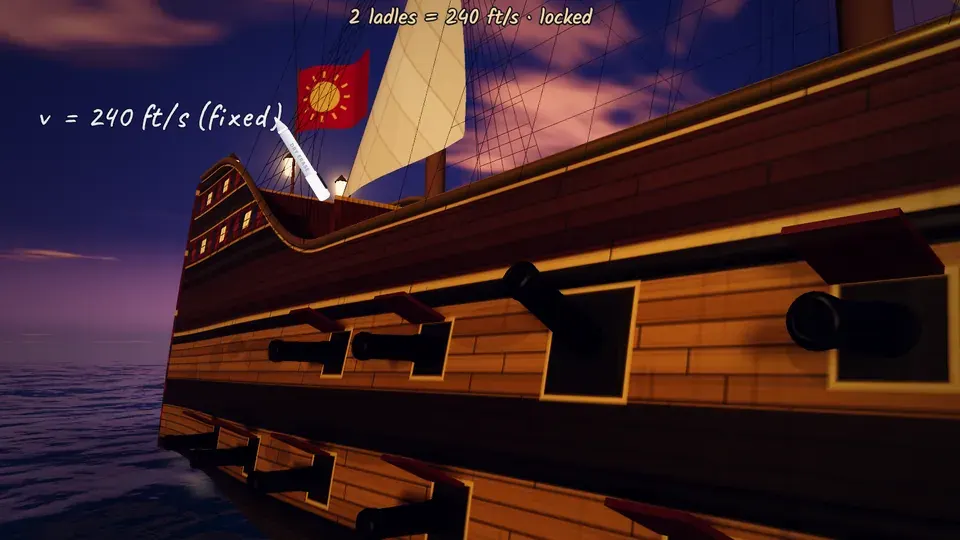
Let’s take the same idea out to sea. If you took precalc with us, you’ve met this gun, back when the question was whether one shot would hit. This time we lock the powder at two ladles. Every ball leaves at two hundred forty feet per second.
All we can change is the barrel’s angle. We’ll measure each shot where it falls back to deck height, sixteen feet up, the same height as her deck. Say we fire one shot at thirty degrees and one at sixty. How will their landing spots compare?
Two shots and two completely different flights, and they come down on exactly the same spot, about fifteen hundred sixty feet away. Here’s why there has to be a best angle. Raise the barrel and the ball stays up longer, but it loses sideways speed. The range is those two multiplied together, and we want the angle where a little more tilt stops improving the product.
She’s sitting at seventeen hundred ninety feet, near the edge of our reach, and the powder’s locked. Tilt the gun and keep firing until you reach her deck, and watch where each shot lands on the range graph.
Your dots and a whole fan of shots agree. Fifteen and seventy-five tie at nine hundred feet, and the longest shot of all is right in the middle, at forty-five degrees. Your shots trace a curve of range against angle, and its top is flat at forty-five degrees. Flat means a zero derivative, so let’s prove it.
The ball leaves the barrel climbing at two forty sine theta feet per second. Gravity takes thirty-two off that every second, so it climbs for two forty sine theta over thirty-two seconds, then falls just as long. That’s fifteen sine theta seconds in the air. Sideways, it moves at two forty cosine theta the whole time.
Multiply them and the range is thirty-six hundred sine theta cosine theta feet, for theta from zero up to pi over two, in radians, because that’s what the derivatives of sine and cosine need. By the product rule the derivative is thirty-six hundred times cosine times cosine plus sine times minus sine, which is thirty-six hundred times cosine squared minus sine squared.
That’s zero when cosine squared equals sine squared. Both are positive inside our interval, so cosine equals sine, and that happens at pi over four, forty-five degrees. At the two ends the range is zero feet, and at pi over four it goes eighteen hundred, so the maximum range is eighteen hundred feet, at forty-five degrees. The thirty-sixty mystery makes sense now, too, because swapping theta for ninety degrees minus theta just swaps sine and cosine, and their product stays the same.
With two ladles of powder, no angle reaches past eighteen hundred feet. If she sails out to two thousand, even our best shot falls short. The only fix is more powder.
The same skeleton
Put the dog and the cannon side by side, and they’re the same problem underneath. Each has one thing we choose, a quantity to make as small or as large as possible, and an interval of sensible choices.
Then come the same moves every time: a critical point, a check of the ends, and an answer in context. The whole method fits on one card. Name what you choose and its interval, write the quantity in that one variable, find the critical points, prove the winner, and answer what was asked.
Now you do one. Take a square sheet of cardboard twenty-four centimeters on a side, cut a square out of each corner, and fold up the sides to make an open box. If you cut x centimeters from every corner, how wide is the base of the box?
The cuts become the height, so the box is x centimeters tall. Each side of the base loses x at both ends, which leaves twenty-four minus two x, and the volume is that square base times the height. Cut tiny squares and you get a flat tray, cut huge ones and the base disappears, and somewhere in between is the biggest box.
Find V prime, set it equal to zero, and tell me what size square gives the biggest box, in centimeters. Once more, the cut is four centimeters, but the most the box can hold is one thousand twenty-four cubic centimeters, so give whichever one the question asks for.
Did Elvis get it right?
Back to the real Elvis, with his real speeds, six point four meters a second on the sand and point nine one in the water. Say the ball lands ten meters out, with C fifteen meters down the beach, about how Pennings set things up.
The rule is the same, sideways over swim equals swim speed over run speed. For Elvis that’s only about point one four. He swims so slowly that his best swim points almost straight out, so the swim is barely longer than the ten meters, and the sideways part is about point one four of that.
Now it’s your throw. Drag the ball anywhere you like on the water, use the rule to place Elvis’s flag, and send him off to see how close you get.
Let’s race the best route for your throw against the other two. The straight swim is hopeless, and the best route beats running all the way to C, but only by a hair. Now look at what Pennings actually measured. Over three hours, on every throw that fit his setup, he raced after Elvis and stuck a screwdriver in the sand where he jumped in, and he kept thirty-five of them.
Each pink dot is one throw. How far across it sits is how far out the ball landed, and its height is how far before C Elvis jumped in. Now lay the calculus line over his choices. Most of them sit close to it, though four are noticeably farther away.
Even the misses hardly cost him anything. When we put his choices into the time model, his average penalty is about a hundredth of a second, and his worst choice adds less than a tenth. That’s T prime equals zero at work again. The curve is flat at the bottom, so being a little off barely changes the time.
Pennings was careful about what this proves. He wrote, “Elvis does not know calculus. In fact, he has trouble differentiating even simple polynomials.” Light does something similar. It’s slower in water than in air, and the path it takes into the lake is the fastest one, which is why it bends at the surface.
Now you can pick the one thing you control, write the quantity you care about in terms of it, find its critical points, check those points against the ends, and say what the answer means. You found the exact spot where Elvis should jump in, you proved that nothing beats it, and you checked a real dog against your answer. Not bad for one evening at the beach.