
Topic 5.4 key terms
- increasing on an interval
- f is increasing on an interval if, for any a < b in it, f(a) < f(b). If f′(x) > 0 for every x in an interval, f is increasing there.
- decreasing on an interval
- f is decreasing on an interval if, for any a < b in it, f(a) > f(b). If f′(x) < 0 for every x in an interval, f is decreasing there.
- critical point
- An input c in the domain of f where f′(c) = 0 or f′(c) does not exist. Critical points are the only candidates for relative extrema; not every critical point is one.
- relative (local) maximum
- f has a relative maximum at c if f(c) is greater than or equal to every value of f for x near c.
- relative (local) minimum
- f has a relative minimum at c if f(c) is less than or equal to every value of f for x near c.
- First Derivative Test
- For f continuous at a critical point c: if f′ changes from positive to negative at c, f has a relative maximum at c; from negative to positive, a relative minimum; if f′ is positive on both sides of c (or negative on both sides), f has no relative extremum at c.
- sign chart
- A number line for f′ cut at its zeros, undefined points and domain gaps, with the sign of f′ on each piece from one test value. It finds the answer; the written reason about f′ justifies it.
- location vs value
- A relative maximum happens AT x = c (the location); its value is f(c). For f(x) = x³ − 6x² + 9x + 1 the relative maximum is at x = 1 and its value is f(1) = 5.
Transcript
1,776 words · 5 parts
Three drones, one zero
Both of the probe’s turning points came exactly where its rate was zero. Last lesson, x cubed showed you that a zero slope is only a place to look. So let’s watch three drones reach the same height with zero vertical velocity, and see how much that reading really tells us.
Each of these three drones flies sideways at a steady five meters every second and leaves a light trail behind it. Because that sideways speed never changes, sideways distance works like a clock, so the trail is literally the graph of its height over time. Watch A and C climb while B comes down. At six seconds all three of them reach forty meters at the same moment, and every one of them reads a vertical velocity, h prime, of exactly zero.
All three readings say zero. Going only on what you’ve seen so far, which of these drones is at the very top of its flight?
So a zero tells you where to look, and the signs of h prime on either side tell you what you found. A goes from plus to minus, B goes from minus to plus, and C goes from plus to plus, with no change at all. Now it’s your call. Give drone C a different future after six seconds, so that its flat moment becomes a peak, and then fly it.
You met these moments last lesson. A critical point of f is an input c in the domain of f where f prime of c is zero, or where f prime of c doesn’t exist. These are our three drones’ graphs again. All three are flat at t equals six, so six is a critical point for every one of them, but only two of them actually turn around there.
A critical point can also be a place where f prime doesn’t exist, like the sharp point at the bottom of f of x equals x to the two-thirds. The curve has no single slope at that sharp point, but f prime goes from negative to positive, and that point is clearly the bottom.
All of that adds up to the first derivative test. For a function that’s continuous at a critical point c, so its graph has no jump there, if f prime changes from positive to negative, f has a relative maximum at c. When f prime changes from negative to positive at c, f falls toward c and climbs away from it, so f has a relative minimum there.
Quick one before the last case. Suppose f prime goes from minus to minus at a critical point c. What does f have there? Drone C kept a positive vertical velocity on both sides of six seconds, so it climbed straight through its flat moment, and in general, when f prime has the same sign on both sides of c, f has neither a maximum nor a minimum there.
The test, start to finish
Now let’s run the whole test, start to finish, on the cubic from our first graph, f of x equals x cubed minus six x squared plus nine x plus one. This time there’s no picture, so we’ll work it the way the exam does, from the formula alone. The first step is always the derivative, and the power rule gives us f prime of x equals three x squared minus twelve x plus nine.
To find where that’s zero, I’ll factor out the three, which leaves x squared minus four x plus three, and that factors into x minus one times x minus three. So f prime is zero at x equals one and at x equals three, and since f prime is a polynomial it exists everywhere, which means those are the only two critical points.
Those two points cut the number line into three intervals, and that’s our sign chart. f prime can only switch sign where it’s zero or undefined, the way its graph crossed the axis only at one and three, so one test point in each interval is enough. f prime of zero is nine, which is positive. f prime of two is three times one times negative one, so negative three, and f prime of four is nine again, positive.
That answers the first question. f is increasing on the interval from negative infinity to one and on the interval from three to infinity, because f prime is positive there. It’s decreasing on the interval from one to three, because f prime is negative there.
Let’s use the test. At x equals one, f prime goes from plus to minus. So what does f have at x equals one? And at three, f prime changes from negative to positive, so that’s a relative minimum.
Be careful with what a question asks for. The relative maximum happens at x equals one, but its value is f of one, which is one minus six plus nine plus one, so five. In the same way, the relative minimum value is f of three, which is one.
On the exam, the justification is one sentence. f has a relative maximum at x equals one because f prime changes from positive to negative at x equals one. Every piece of that sentence is doing a job. It names f prime, follows its change from positive to negative at x equals one, and that’s exactly what lets a grader see why f peaks there.
Let’s check it against the picture we started with. The graph peaks at x equals one with a height of five and bottoms out at three with a height of one, exactly where the algebra said it would.
Traps on the sign chart
Now let’s try a twistier one together, g of x equals x plus four over x. The derivative of x is one, and four over x is four x to the negative one, so its derivative is negative four over x squared. Writing the one as x squared over x squared and combining, that’s x squared minus four, all over x squared.
g prime is zero when x squared equals four, so at x equals two and negative two. It’s also undefined at zero, but zero isn’t in the domain of g, so zero is not a critical point.
Zero still goes on the sign chart as a break, though, because a function can switch sign across a gap, the way one over x jumps from minus to plus. Testing one point in each piece gives plus, minus, minus, plus, so this time g prime happens to stay negative on both sides of zero. So at what value of x does g have a relative maximum?
Now look at the values. The relative maximum is g of negative two, which is negative four, and the relative minimum is g of two, which is positive four, so the maximum is lower than the minimum.
That sounds broken, but it’s completely fine, because relative only means compared with the neighbors. Each one is the top or the bottom of its own little neighborhood, and those two neighborhoods sit on opposite sides of the asymptote.
On the AP exam you’ll very often get the graph of f prime instead of f, so we look above and below its horizontal axis to find where f rises and falls. This is the graph of f prime on the interval from negative three to five. At which value of x does f have a relative maximum?
And notice that between zero and two, f prime is going down but it’s still above the axis, so f is still going up. A falling derivative is not a falling function.
Program a drone
Now you get to program a drone yourself. Instead of a formula, you’ll give it a sign chart, a plus or a minus for its vertical velocity on each three-second stretch of the flight. Let me show you one first. If I give it minus, plus, minus, plus, it dives, climbs, dives and climbs, so its trail has valleys at three and nine seconds and a peak at six. Every boundary is a flat moment, because the drone always levels off between stretches, but only the ones where the sign flips are turning points.
Now I want you to set the signs so drone D’s trail has a relative maximum at six seconds and no other relative maximum or minimum anywhere. Then hit Fly and see what you built.
The closest pass
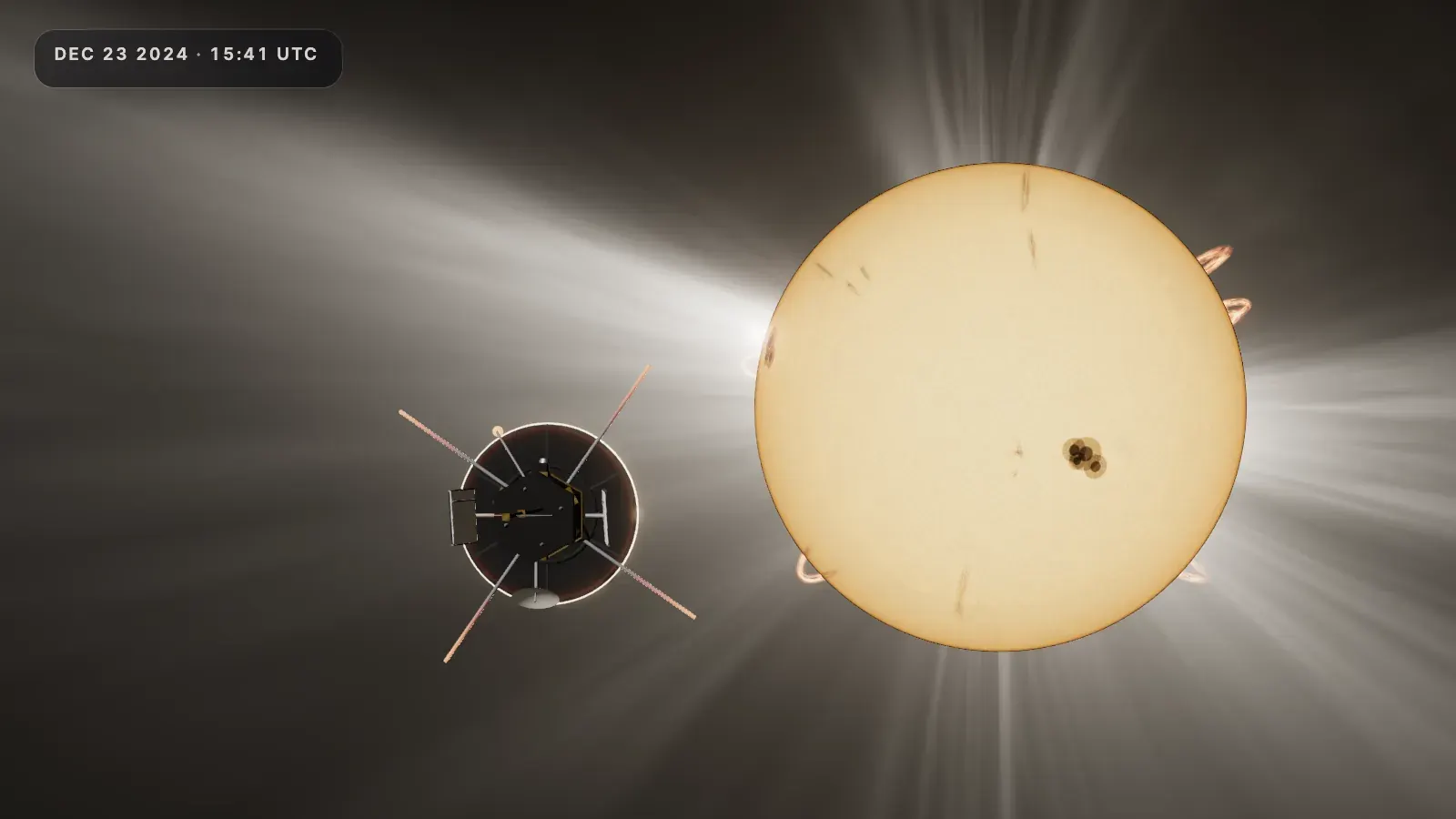
Now let’s go back to the Sun and keep the promise. I’ve hidden the distance readout, so the only numbers you get are the clock and r prime, the rate at which the distance is changing.
Now find it the way a mission engineer would. Put one marker where r prime is still negative and another where it’s already positive, then squeeze them together until the closest moment is trapped between them.
And notice that the distance was shrinking fastest a whole day before the closest pass. The steepest part of the fall isn’t the bottom, because the bottom is where r prime hits zero and changes sign.
These are real numbers from NASA’s reconstruction of Parker’s path that day, and they do exactly what you just did. At eleven that morning, r prime is negative six point three kilometers per second, but by noon it’s positive two point seven. So r prime changes from negative to positive somewhere between eleven and noon, and since this orbit has only one closest pass, that’s when Parker was closest to the Sun.
Suppose an exam question calls that moment t equals c and asks you to justify that r has a relative minimum there. Which reason earns the point?
You can now tell whether f is going up or down from the sign of f prime alone, even when you can’t see f itself. A critical point, an input in the domain of f where f prime is zero or doesn’t exist, is only a place to look. The change in sign decides what you found, plus to minus for a maximum, minus to plus for a minimum, and no change means neither. And when you justify it, name f prime and say how its sign changes at the place where f turns around.
You started this lesson with a spacecraft moving faster than anything people have ever built, at the one instant its distance from the Sun stopped changing. Now you can find that instant from the rate alone, and prove it in one sentence. NASA couldn’t hear from the probe during the pass, and two days later, on December twenty-sixth, a beacon tone reached Earth to say it had made it through.