
Topic 5.6 key terms
- concave up
- The graph of is concave up on an open interval where is increasing; it bends like a cup, whether it rises or falls.
- concave down
- The graph of is concave down on an open interval where is decreasing; it bends like a cap.
- second derivative
- , the derivative of : how fast the slope changes. on an interval means concave up there; means concave down. For height in meters against time in seconds, is in m/s².
- point of inflection
- A point on the graph where is continuous and the concavity changes. Candidates are where or is undefined; the sign of must actually change.
- second derivative test
- If and , has a relative maximum at ; if and , a relative minimum. If or does not exist, the test is inconclusive.
- inconclusive
- The second derivative test gives no answer when : the point may be a maximum (), a minimum () or neither (). Use the first derivative test.
- one critical point on an interval
- If is continuous on an interval and has exactly one critical point there, and it is a relative extremum, then it is the absolute extremum of on that interval.
Transcript
1,157 words · 4 parts
Two level moments
This coaster climbs ninety meters above the boardwalk, and you’re in the front seat, about to go over the top. I want you to do something strange and close your eyes. Here we go. At the bottom the seat slams into you with almost four times your weight, and a few seconds later the push drops away to nothing, and you’re floating.
Now open your eyes. Those two moments were the bottom of a trench and the top of a hill. At both of them the train was perfectly level, so the slope of its height graph was zero both times. It’s the same slope both times. Yet your body told them apart instantly, without seeing a thing, so it must feel something the slope can’t see.
By the end of this lesson, you’ll be able to do what your body just did, and tell a peak from a valley without looking. Then you’ll prove it the way the AP exam wants it proved. What is your body feeling that the slope can’t? Let’s go back to the bottom of that trench, where something strange is already happening on the way down.
Still falling, already pressed
This is the graph of the train’s height against time, and the orange line is its tangent. Its slope tells you how fast the train is rising or falling at each instant. Let’s watch that slope as we dive into the trench, negative thirty-one meters per second, then negative twenty-four, then negative thirteen.
We’re still falling the whole time, and yet the slopes keep going up toward zero. That makes the graph bend upward like a cup, and that bend is what shoves you harder into your seat. Let’s take that onto the board with friendlier numbers.
Picture a smaller drop, where the height is twelve minus six t plus t squared meters. The height falls from twelve meters to three, and its tangent slopes go from negative six to negative four to negative two, so the slope goes up by two every second. The height is decreasing, but its rate of change, h prime, is increasing, and that’s what it means for a graph to be concave up.
A graph is concave up on an open interval when its derivative is increasing there, and concave down on an open interval when its derivative is decreasing there. That gives four possible combinations, and the one that catches people out is falling and concave up. All concave up promises is that the slope is going up, just like our diving train.
Let’s try one. A drone’s climb rate is positive but shrinking, from eight meters per second to five to three, so what does the graph of its height do on that stretch?
The second derivative
Watching tangent slopes works, but there’s a faster way. You know a function rises where its derivative is positive, so h prime rises where its own derivative, h double prime, is positive. Wherever the second derivative is positive the graph is concave up, and wherever it’s negative the graph is concave down. For our coaster, we measure h double prime in meters per second per second.
In Unit 3 you met h double prime as vertical acceleration. The meter on the ride reads one plus h double prime over g, where g is gravity, about nine point eight, so it’s a second derivative meter, showing the seat’s upward push in units of your weight.
When h double prime is positive, like down in the trench, the meter reads more than one and you’re pressed in. At the top of the airtime hill, h double prime is about negative nine point eight. That cancels gravity, so the meter reads about zero and you float.
Let’s do one with algebra. For p of x equals x cubed minus six x squared plus nine x plus four, the derivative is three x squared minus twelve x plus nine. Differentiating again gives six x minus twelve, which is six times x minus two, so the second derivative is zero at x equals two.
At zero it’s negative twelve and at three it’s positive six, so p is concave down from negative infinity to two and concave up from two to infinity. On the exam, always write the reason with the answer, and the reason is the sign of p double prime on each interval.
Now you differentiate twice. Here’s q of x equals x cubed plus three x squared minus nine x plus two, and I want you to find where its graph is concave up.
The bend switch
Let’s go back to the climb out of the trench. The curve bends up like a cup at the bottom, and it bends down like a cap at the top of the next hill. Somewhere on the way up it has to switch, and you can see it in the tangent, which turns steeper and steeper and then starts to flatten out.
Now it’s your turn to find it. Drag the rider along the climb and stop at the moment the train is climbing fastest, where the tangent is steepest.
We call that point, where the graph switches from bending up to bending down, a point of inflection. The slope stops growing right here, so its own rate of change, h double prime, is zero.
Let’s try the opposite switch. On the dive from that hill into the next valley, drag the rider to the moment the train is falling fastest.
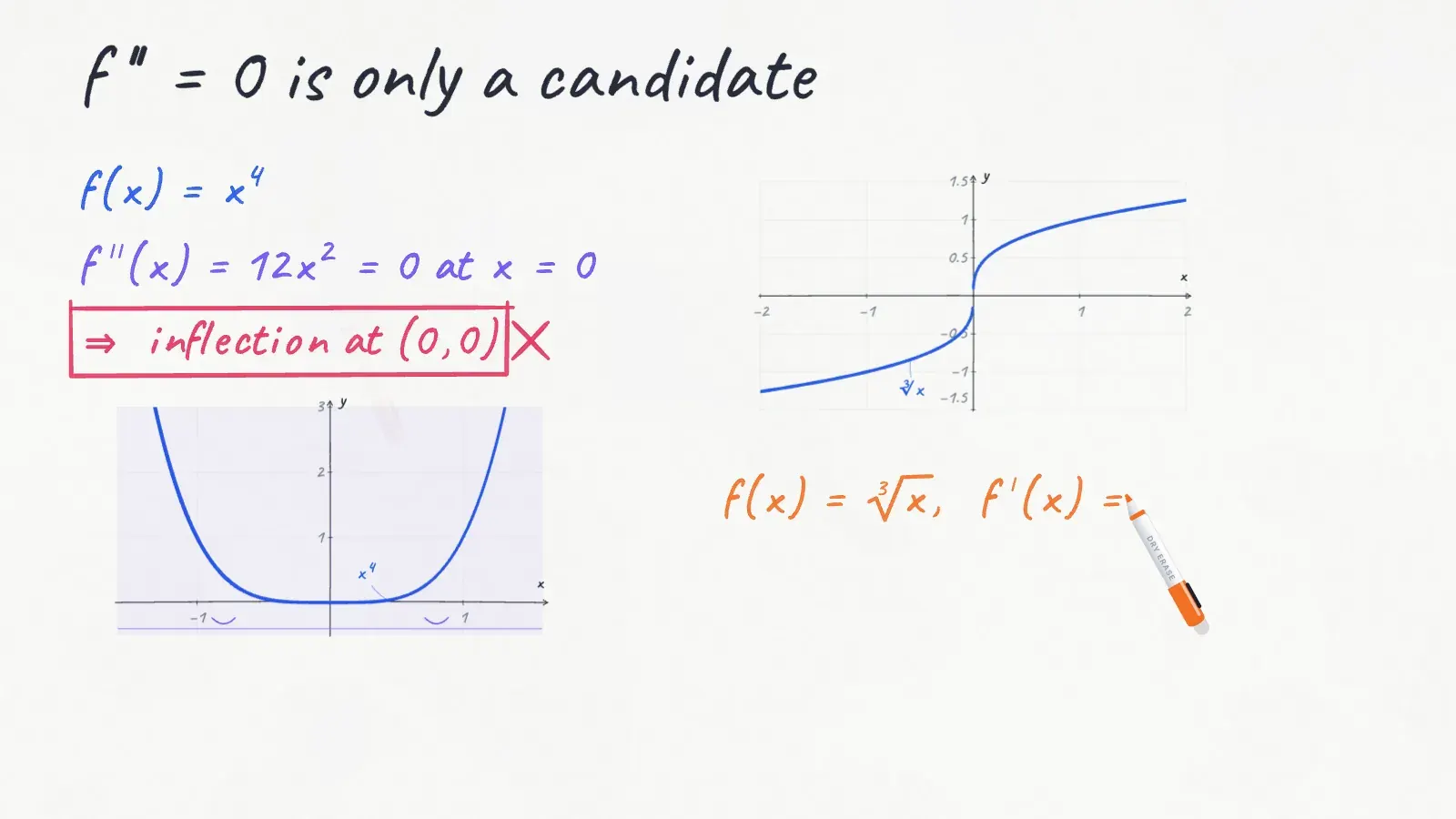
Let’s write it carefully. A point of inflection is a point on the graph where f is continuous and its concavity changes. To find one, list the candidates, where f double prime is zero or doesn’t exist, and then check that the sign of f double prime really changes there.
For our cubic, p double prime changes from negative to positive at x equals two, and p of two is six. That puts a point of inflection at the point two, six. That sign change is the reason you write down.
Now let me show you a mistake I see all the time. Someone takes x to the fourth, sees that its second derivative, twelve x squared, is zero at x equals zero, and announces a point of inflection. But twelve x squared is positive on both sides of zero, since a square never goes negative. The graph is concave up on the left and on the right, and it never switches.
The opposite surprise happens with the cube root of x. Its tangent is vertical at zero, so it has no derivative there, let alone a second one. Left of zero, f double prime is positive, a cup, and right of zero it’s negative, a cap, so the concavity really does change, and the origin is a point of inflection anyway. You already have f double prime in factored form, so let’s use its signs to find every x-value where the graph of f has a point of inflection.