
Topic 5.5 key terms
- absolute (global) maximum
- The greatest value a function takes on its whole interval (or domain). It can happen at more than one input, and on a closed interval it can be at an endpoint.
- relative (local) maximum
- A value that is at least as large as every value of at inputs near (in some open interval around ). A relative maximum can lose to a higher point elsewhere, like Everest's South Summit.
- value vs location
- The maximum VALUE is an output, ; its LOCATION is the input . Answer the one the question asks for (or give the point ).
- Extreme Value Theorem
- If is continuous on the closed interval , then has at least one maximum value and at least one minimum value on . If a condition fails there is no guarantee, but extrema may still exist.
- critical point
- A point on the graph of where or does not exist ( must be defined). Every relative extremum is at a critical point, but not every critical point is an extremum ( at ).
- candidates test
- For a continuous on : find the critical points inside the interval, evaluate at them and at both endpoints, and compare. The largest value is the absolute maximum and the smallest is the absolute minimum.
Transcript
1,146 words · 4 parts
The candidates test
Let’s put all three ideas together into one method, called the candidates test. We’ll find the absolute maximum and minimum of f of x equals x cubed minus three x plus three, on the closed interval from negative two to three. First comes the promise. f is a polynomial, so it’s continuous everywhere, and the interval is closed, so the Extreme Value Theorem tells us there’s a maximum and a minimum to find.
Next come the critical points. f prime is three x squared minus three, which factors into three, times x minus one, times x plus one. That’s zero at x equals one and x equals negative one, and since f prime is a polynomial, it exists everywhere. Our candidates are those two critical points plus the two endpoints, negative two and three, so out of infinitely many points, we only have to check four.
Plug each one into f itself, not f prime. f of negative two is negative eight plus six plus three, which is one. f of negative one is negative one plus three plus three, which is five, and f of one is one minus three plus three, which is one. Now you do the last one. What’s f of three?
Look at those four numbers. Twenty-one is the biggest by far, so the absolute maximum is twenty-one, at x equals three, an endpoint. The hilltop at negative one only reaches five, just like the South Summit.
The smallest value, one, shows up twice, so the absolute minimum is one, a single value at two locations, x equals negative two and x equals one. The graph agrees, with its highest point at the right end and two low points at the same height, one, and a quick look like that is always worth doing.
When an exam question says justify your answer, you need the whole argument, not just the numbers. Name the theorem, list every candidate with its value, and then say which value is the largest and which is the smallest, and where. A lot of students write that f prime changes from positive to negative at negative one, so that’s the maximum, and that loses the point. The function rises and then falls there, so it’s a hilltop, like the South Summit, and a hilltop can still lose. Here it loses to the endpoint.
The lowest point of a landing
Let’s take the method somewhere with real stakes. You might remember this booster from precalc, where we worked out exactly when to light its engine so it touches the pad at zero speed. Watch what happens when it lights too early, at six thousand meters. It slows down, stops in mid-air, and starts to climb again, because a booster can’t hover.
Let’s call s the number of seconds since the engine lit. For the first forty seconds, its height in meters is h of s equals six thousand minus three hundred s plus five s squared, and we want the lowest point it reached. h prime is its vertical velocity in meters per second, negative while it’s falling, so a critical point is the moment it stops falling.
Drag the probe along the flight and find the moment the booster’s vertical velocity is exactly zero. That gives us three candidates, the start, thirty seconds, and the end of the window at forty. Their heights are six thousand, fifteen hundred, and two thousand meters, so the lowest point is fifteen hundred meters, thirty seconds into the burn.
Now light it late, at four thousand meters. It reaches the pad twenty seconds into its burn, so this time the interval runs from zero to twenty. Only the starting height changed, so h prime is the same as before, and it’s still zero only at thirty, outside the interval. That leaves just the two ends as candidates.
The lowest point is the end, on the pad, at zero meters, but h prime there is negative one hundred meters per second. In plain language, that’s a crash at three hundred sixty kilometers an hour. The perfect plan lights at forty-five hundred meters, and it’s the one where the end of the flight and the critical point are the same moment. Its lowest point is on the pad, and its vertical velocity there is exactly zero.
Your turn
Now it’s your turn, and this function has a couple of traps in it. It’s f of x equals x minus three x to the two-thirds, on the closed interval from negative one to one. x to the two-thirds is the cube root of x, squared, and you can take the cube root of a negative number, so f is continuous on the whole interval and the theorem promises a max and a min.
To save time, I’ll give you the derivative, f prime of x equals one minus two over the cube root of x. Which x-values do you need to check? Now evaluate f at all three. What’s the absolute maximum value of f on this interval?
Look at the graph. The winner is a sharp point, right where f prime doesn’t exist, so if you only ever looked for f prime equals zero, you’d miss the highest point on the whole interval. One more, the way the exam asks it. Which sentence earns the justification point for the absolute minimum being negative four?
Certify the summit
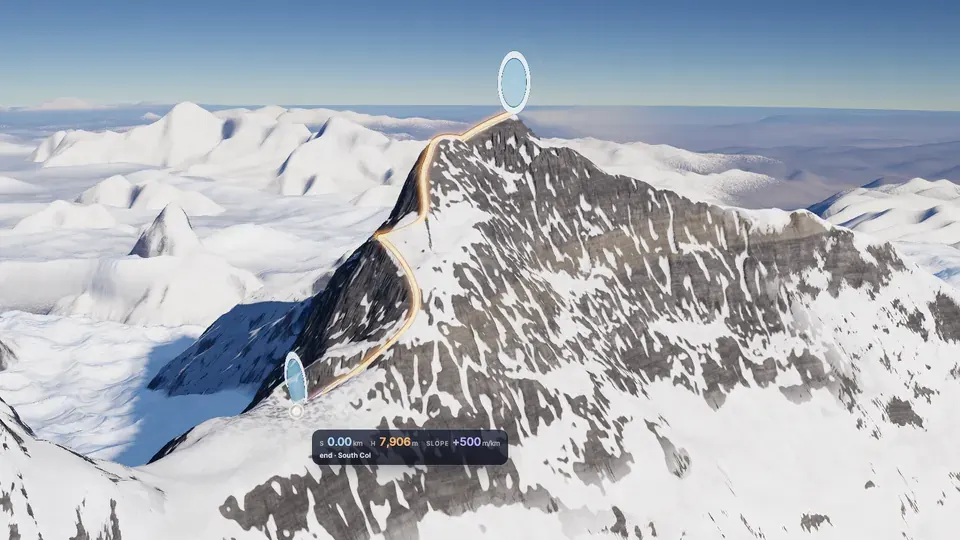
Let’s go back to Everest and finish what we started. You’re going to prove which point is the highest on the whole route, and which one is the lowest. Drag the probe along the route and plant a beacon at every candidate, every flat spot, every sharp spot, and both ends.
Let’s compare all five heights with a sheet of light. It rises out of the clouds and past the Balcony, and once it passes the height of K2, every other mountain on Earth is below it. It keeps going, past the South Summit, and comes to rest on the summit. The lowest point is where the route starts, the South Col, at seven thousand nine hundred six meters. Evans and Bourdillon’s climb ended at the South Summit.
Drag the summit gate back along the ridge to where they stopped, and let’s see which point wins on their route. On their route the only candidates are the South Col, the Balcony and the South Summit, so the highest point of their climb really was the South Summit, and they reached it. Change the interval and you change the winner, which is why every one of these questions tells you the interval.
That’s the whole idea. The Extreme Value Theorem promises there’s a winner, the slope tells you the only places it can hide, and comparing the heights tells you which one wins. Now you can check a handful of spots on a route with infinitely many points, and prove that nobody will ever find a higher one.