
Topic 8.10 key terms
- solid of revolution
- The solid swept out when a flat region spins a full turn around a line, the axis of rotation. A baseball bat, a cone and the inside of a martini glass are all solids of revolution.
- axis of rotation
- The line a region spins around. It can be the x-axis, the y-axis, or any horizontal or vertical line such as y = 4 or x = 2.
- disc
- A thin slice of a solid of revolution cut straight across the axis. Its face is a filled circle, and a short cylinder of radius r and thickness Δx, with volume π r² Δx, approximates the slice.
- disc method
- (or ): add up discs of radius r and thickness dx along the axis; the limit of the Riemann sum of disc volumes.
- radius of a disc
- The distance from the axis of rotation to the edge of the region at that slice, always bigger minus smaller: f(x) for a region above the x-axis, 4 − x² around y = 4, 2 − √y around x = 2.
- dx or dy
- Discs are perpendicular to the axis, so their thickness runs along it: dx for a horizontal axis, dy for a vertical axis, with the radius written in that same variable.
Transcript
944 words · 3 parts
Any line can be the axis
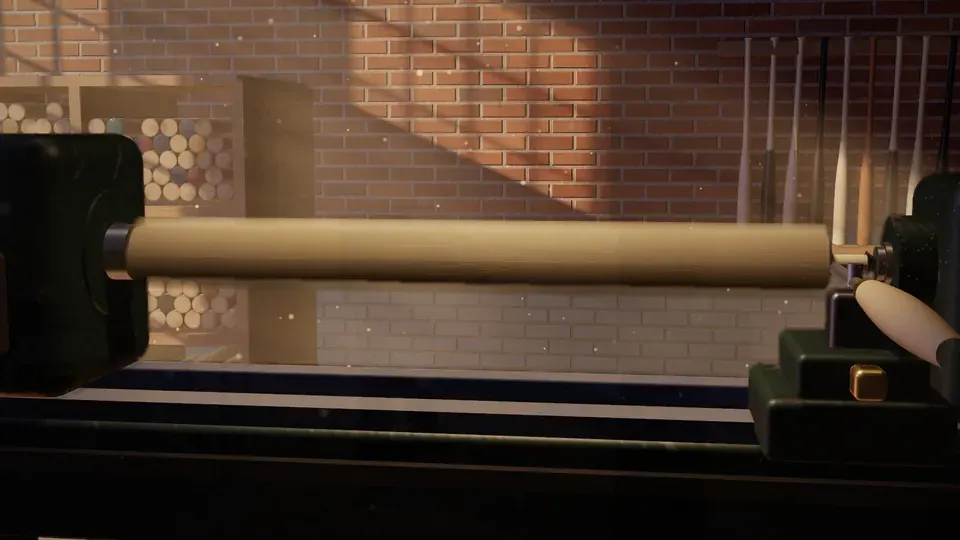
Back on the lathe, let’s mount the same region we just spun around the y-axis, the one between the curve y equals x squared and the line y equals four. This time we’ll spin it around the line y equals four, so I’m sliding the plate down until that line sits right on the lathe’s axis.
Watch what it makes. The solid is fattest at x equals zero, where the region is tallest, and it closes to a point at x equals two, where the curve touches the axis. At x equals one, the curve is at a height of one. How long is the radius of the disc there?
Measure from our axis at four down to the curve at x squared, and that distance is four minus x squared, the axis minus the curve, which is the radius we’ll square. If the axis sat below the region instead, the radius would be the curve minus the axis, because a distance is always the bigger value minus the smaller one.
That makes the volume pi times the integral from zero to two of four minus x squared, squared, and the parentheses matter, because we square the whole distance. Let’s expand the square first, so four minus x squared, squared, is sixteen minus eight x squared plus x to the fourth. The antiderivative is sixteen x minus eight x cubed over three plus x to the fifth over five, and plugging in two gives thirty-two minus sixty-four thirds plus thirty-two fifths.
Over a common denominator of fifteen, that’s two fifty-six over fifteen, so the volume is two fifty-six pi over fifteen, about fifty-three point six cubic inches on the lathe. That’s comfortably less than the cylinder of radius four around it, which holds about a hundred cubic inches. One trap to watch for is squaring the four and the x squared separately, because sixteen minus x to the fourth gives you a different solid entirely.
If we slide the axis up to y equals five, though, the region doesn’t touch the axis anymore, so every slice gets a hole in the middle. We call a slice like that a washer, and adding up washers is next lesson’s story.
Vertical lines work the same way. Take the region under y equals x squared from zero to two, and spin it around the line x equals two, its own right-hand edge. The axis is vertical, so the discs lie flat again and stack up along y, which means dy, and each radius runs sideways from the axis at x equals two back to the curve. Which of these integrals gives the volume of this solid?
On the exam, a question like this often says write, but do not evaluate. In the 2026 question, the integrand earned one point and the complete integral earned the other, so keep the pi, the bounds and the dy.
Thirty-two ounces
Now we’re ready for the bat. Take our model of a classic thirty-four-inch maple bat and slice it into thirty-four discs, each one an inch thick. A disc out in the barrel has a radius of about one and a quarter inches, so it holds almost five cubic inches of maple. The handle disc has a radius of about half an inch. We square that smaller radius, so a slice of the same thickness holds only about a sixth as much wood.
On the board, our bat’s radius in inches is this function of x, the distance from the knob, and it climbs from half an inch in the handle to one and a quarter in the barrel. Its volume is pi times the integral from zero to thirty-four of r of x, squared, and nobody wants that antiderivative by hand, so this is a job for the calculator.
Maple weighs about four tenths of an ounce for every cubic inch, so the bat’s weight is point four times its volume. Use the calculator to find the volume, and then the weight of the bat, to the nearest tenth of an ounce.
Your bat
Now it’s your turn to be the bat maker. Here’s a torpedo bat with the bulge moved down toward the hands, but it weighs about thirty-five ounces, three more than the classic we just weighed, and our hitter wants the same weight as before.
Before you start, look at these two cuts. Each one shaves the same tenth of an inch off the radius, along the same four inches of bat. Which one do you think takes off more wood?
Now drag the handles to reshape your torpedo until it weighs thirty-two ounces, give or take three tenths, and keep the fat part low. You just saw where a small shave takes off the most wood.
Let’s put the whole method in one place. First, sketch the region and the axis it spins around. Then slice straight across the axis, which means a horizontal axis gives you dx and a vertical axis gives you dy.
We always measure the radius from the axis out to the edge of the region. The volume is pi times the integral of the radius squared, with the bounds running along the axis. If the region touches the axis all the way along, you get discs, and if there’s a gap, the solid has a hole, which is exactly where we’ll pick up next time.
You designed that bat yourself, and the integral told you its weight before a single chip came off. Better still, you can take any flat shape that touches its axis all the way along, spin it around any horizontal or vertical line, and say exactly how much solid it makes.