
Topic 8.5 key terms
- area between curves
- The area of the region between y = f(x) and y = g(x) from x = a to x = b, where f(x) ≥ g(x): the integral from a to b of [f(x) − g(x)] dx. Each thin vertical slice is top minus bottom, times dx.
- top minus bottom
- The height of a vertical slice between two curves: the higher curve's y-value minus the lower curve's. It is positive wherever the slice is, even below the x-axis.
- points of intersection
- Where the two curves meet, found by solving f(x) = g(x). They give the limits of integration and the places where the curves can trade places.
- right minus left
- The width of a horizontal slice between x = R(y) on the right and x = L(y) on the left. The area is the integral from c to d of [R(y) − L(y)] dy, with c and d heights.
- functions of y
- Boundaries written as x = R(y) and x = L(y). Integrating with respect to y is the better choice when vertical slices would change their top or bottom boundary partway across.
- curves that cross
- When the curves intersect more than twice, split the interval at each crossing so each piece is top minus bottom, and add the pieces; or integrate |f(x) − g(x)|. The integral of f − g alone lets pieces cancel.
- lift per meter of wing
- In our small-angle model, the lift on each meter of wingspan is very nearly the integral of (p_under − p_over) dx along the chord, in pascals times meters, newtons per meter. When the pressure curves cross (as at zero lift), the signed integral and the geometric area between the curves differ.
Transcript
316 words · 1 parts
Turn the slices sideways
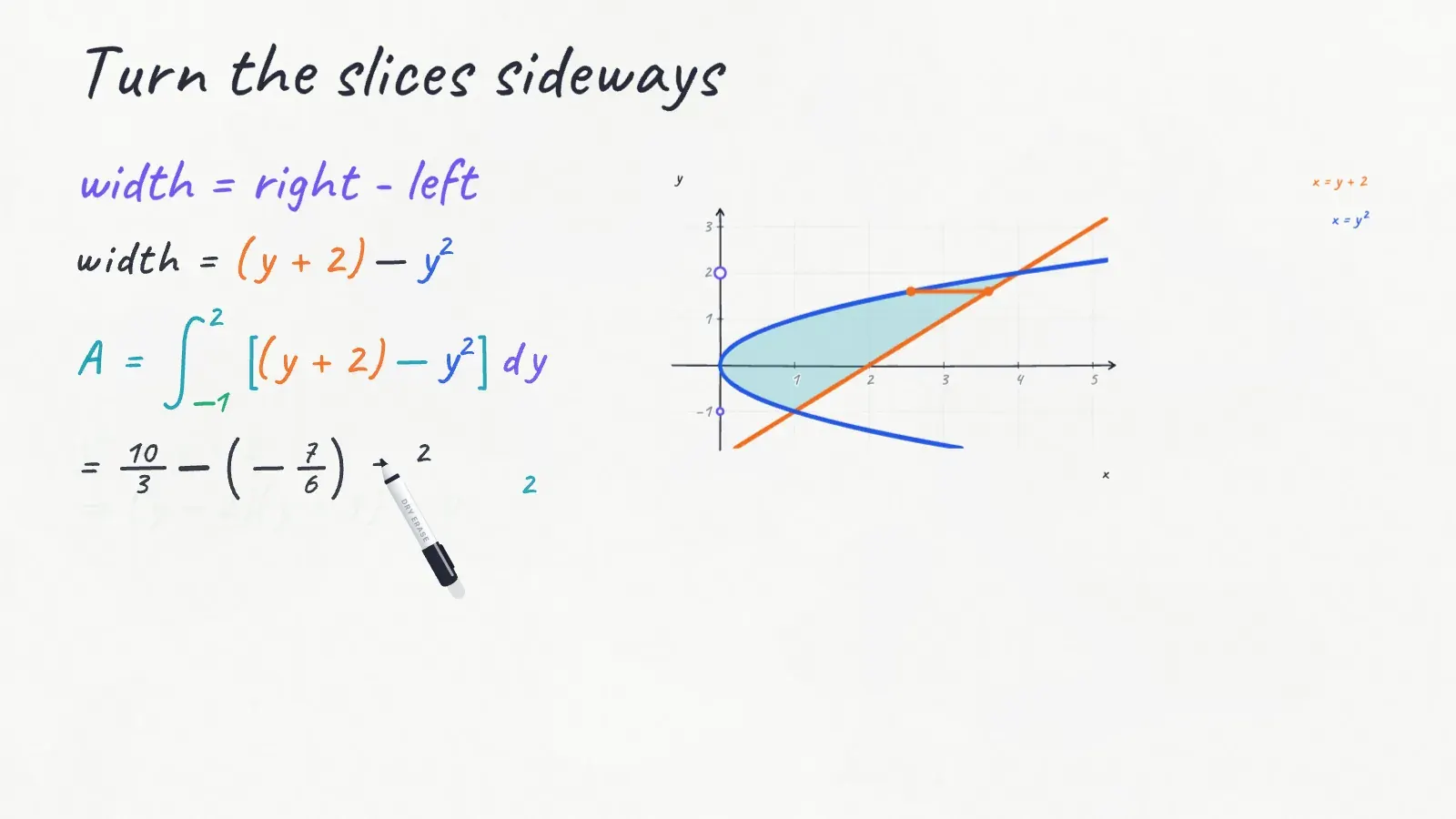
Let’s look at a region where vertical slices start to get annoying, the one between the sideways parabola x equals y squared and the line x equals y plus two. Watch the bottom of a vertical slice as it moves to the right. For a while it sits on the lower half of the parabola, y equals negative root x, and then at x equals one it switches onto the line. With vertical slices we’d need two separate integrals.
Let’s turn the slices sideways instead. A horizontal slice always starts on the parabola and ends on the line, so its width is right minus left, the line’s x minus the parabola’s x. At height y, that width is y plus two minus y squared. The slice is only dy thick, so this time we add the slices up with an integral in y.
These slices travel upward, so the bounds are heights, where y squared equals y plus two. That gives y minus two, times y plus one, equals zero, so y runs from negative one up to two.
The antiderivative is y squared over two plus two y minus y cubed over three. That’s ten thirds at the top and negative seven sixths at the bottom, so the area is nine halves, four and a half square units. Doing it the long way, with two vertical integrals, gives nine halves too, so turning the slices saved us a whole integral.
Let’s call the right boundary R of y and the left boundary L of y, so each slice has width R of y minus L of y. We add those widths with respect to y, from the bottom height c up to the top height d.
Now you set one up. This region sits between x equals two y and x equals y squared, so pick the integral that gives its area using horizontal slices.