
Topic 8.4 key terms
- area between curves
- The area of the region between y = f(x) and y = g(x) from x = a to x = b, where f(x) ≥ g(x): the integral from a to b of [f(x) − g(x)] dx. Each thin vertical slice is top minus bottom, times dx.
- top minus bottom
- The height of a vertical slice between two curves: the higher curve's y-value minus the lower curve's. It is positive wherever the slice is, even below the x-axis.
- points of intersection
- Where the two curves meet, found by solving f(x) = g(x). They give the limits of integration and the places where the curves can trade places.
- right minus left
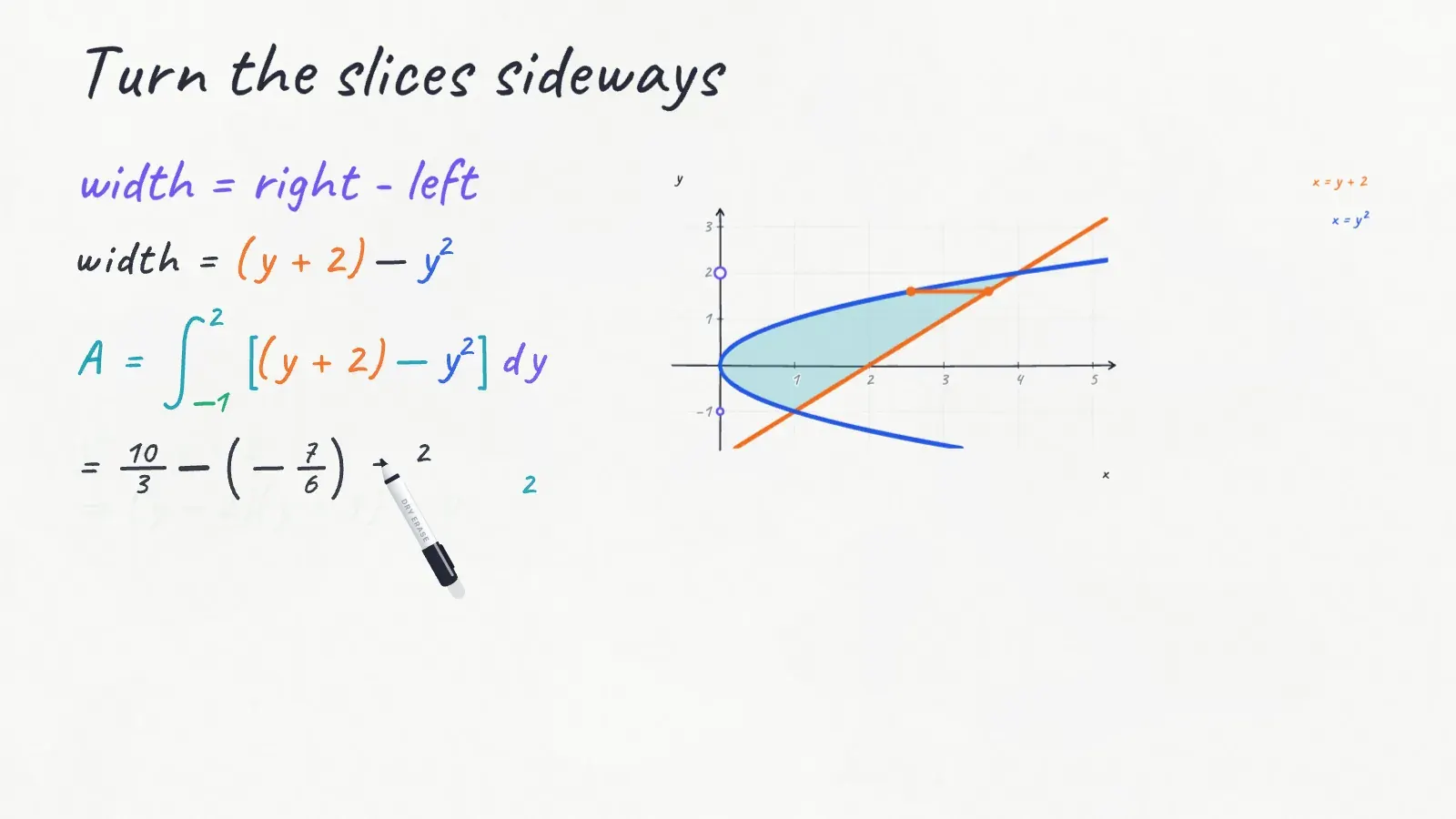
- The width of a horizontal slice between x = R(y) on the right and x = L(y) on the left. The area is the integral from c to d of [R(y) − L(y)] dy, with c and d heights.
- functions of y
- Boundaries written as x = R(y) and x = L(y). Integrating with respect to y is the better choice when vertical slices would change their top or bottom boundary partway across.
- curves that cross
- When the curves intersect more than twice, split the interval at each crossing so each piece is top minus bottom, and add the pieces; or integrate |f(x) − g(x)|. The integral of f − g alone lets pieces cancel.
- lift per meter of wing
- In our small-angle model, the lift on each meter of wingspan is very nearly the integral of (p_under − p_over) dx along the chord, in pascals times meters, newtons per meter. When the pressure curves cross (as at zero lift), the signed integral and the geometric area between the curves differ.
Transcript
1,470 words · 4 parts
Held up by almost nothing
This is a Cessna one seventy-two, the most-built airplane in history. This morning the pilot has loaded it right up to its maximum takeoff weight, eleven hundred and fifty-seven kilograms, as heavy as a small car. Full power, and here we go.
The only thing holding this plane up is the air pushing on its wings. How much harder do you think the air underneath has to push than the air on top? On average, it’s less than one percent. Let’s light up one slice of that wing so we can see the air. The air speeds up over the top and presses a little less there, and it presses a little more underneath.
That tiny difference, added up along the whole wing, carries every kilogram of this plane. By the end of this lesson, you’ll be able to read the pressures along the top and bottom of this wing, work out how much weight it can carry, and find the tilt that holds this plane up. All of that comes down to one picture, the area between two curves, so let’s draw two curves of our own.
Top minus bottom
Here are two curves, the line y equals two x and the parabola y equals x squared, and between them they close off a little lens-shaped region. We want the area of that lens, so let’s look at one thin slice of it, standing straight up. This slice starts on the parabola and ends on the line, so its height is the line’s y minus the parabola’s y. At x equals one, that’s two minus one, so the slice is one unit tall.
If we slide it somewhere else, the same rule works, because the height is always two x minus x squared, top minus bottom. Give the slice a tiny width dx, and its area is that height times dx.
Now let’s fill the lens with slices and make them thinner and thinner, until the staircase melts into the exact shape, and that sum of infinitely many thin slices is an integral. The slices start where the curves meet on the left and stop where they meet on the right, so let’s set them equal.
Two x equals x squared means x squared minus two x is zero, which factors into x times the quantity x minus two, so they meet at zero and at two. The antiderivative is x squared minus x cubed over three, which gives four minus eight thirds at two and nothing at zero, so the lens has an area of four thirds square units.
Does four thirds make sense? The triangle under the line has an area of four, the region under the parabola has eight thirds, and the lens is exactly what’s left when you take one away from the other.
Let’s make a prediction before we go on. Suppose I slide both curves down five units, so the whole lens sits below the x-axis. What do you think happens to its area?
Look at the slice at x equals one. Its top is at negative three and its bottom is at negative four, and negative three minus negative four is still one. Every slice keeps its height, so the area is still four thirds, because top minus bottom never cared where the x-axis was.
If f is on top and g is on the bottom from a to b, the area between them is the integral from a to b of f of x minus g of x, dx. This is exactly how you’ll see it written on the exam, with brackets around the difference.
On a free-response question, you also say why the line is the one on top. The curves only meet at zero and two. At x equals one, the line is at two while the parabola is at one, so the line stays on top the whole way across.
Now you try one. Find the area of the region between y equals three minus x squared and y equals two x, and give your answer to the nearest hundredth. Hold on to that picture, because an airplane wing does the same thing with air.
What holds up a wing
The same picture is hiding inside our slice of wing, lit by a sheet of laser light, with the air streaming past it from left to right. Each arrow shows how hard the air presses on that spot, compared with the still air far away. Underneath, the air presses a little harder, so those arrows push in. On top, the pressure drops below the outside air, so those arrows point outward, as if the air were pulling the wing up.
Let’s put the distance from the front of the wing on the horizontal axis and the pressure on the vertical axis. We measure pressure from the outside air, so the outside air’s own pressure sits at zero.
The pressure under the wing makes the higher curve, and careful, the top of the wing makes the lower curve, which dives way below zero near the front. Take a thin strip forty centimeters back from the front. Underneath, the air pushes forty-five pascals harder than the outside air, where a pascal is one newton on each square meter, and on top it pushes seven hundred fifty-five less.
The pressure difference on this strip is forty-five minus negative seven fifty-five, which is eight hundred pascals, pushing up. The air around us presses with just over a hundred thousand pascals, so that’s less than one percent.
That’s top minus bottom again, and just like our lens below the axis, the region crossing zero doesn’t matter at all. Before we add up all the strips, where do you think this wing gets most of its lift?
Picture this strip running one meter along the wing. It’s five centimeters wide, so it covers point zero five square meters, and eight hundred pascals on point zero five square meters is forty newtons. Add up all the strips from the nose to the tail, and the area between these curves is, very nearly, the lift on that one meter of wing.
Multiply by g, nine point eight one, and its eleven hundred and fifty-seven kilograms weigh about eleven thousand three hundred and fifty newtons. Spread over wings eleven meters across, each meter has to hold up about a thousand and thirty. At this angle the area only comes to about eight hundred eighty, so this plane would slowly sink.
You get to fly it this time. Pick how much the plane carries, tilt the front of the wing up until the area between the curves can hold it, and press flight test.
Let’s write the whole wing down the way an engineer would. The wing is one point four seven meters from nose to tail, so the lift on each meter is very nearly the integral from zero to one point four seven of p under minus p over, d x. Over eleven meters of wing, that comes to about eleven thousand three hundred and fifty newtons, the weight of the plane.
The energy a bow keeps
Area between two curves shows up anywhere two forces disagree. You might remember this compound bow from when we first added up a force curve, and today you get to work it yourself. Pull the string slowly back to full draw, then let it down slowly to where it started, and watch what the force does on the way back.
The area under the draw curve, seventy-three point seven joules, is the work it takes to pull the string back. On the way back, the bow pushed a little less at every point between brace and full draw, so the return curve sits just under the first one. The thin sliver between them is energy that never came back, because it turned into heat in the cams and limbs, and the inset stretches it ten times taller so we can see it.
At thirty centimeters, pulling takes about two hundred newtons, and on the way down the bow pushes back with about one ninety-three, a gap of seven newtons. Each strip is a force difference times a distance, newtons times meters, so the area of this sliver comes out in joules. Here are the two forces at the same six draw lengths we used before, D while drawing and U while letting down.
Use a trapezoidal sum of the difference between the two forces to estimate the energy lost in one slow draw and letdown, to the nearest tenth of a joule. Our six readings gave about two point four joules, and the careful lab measurement gives two point seven. The cams and limbs turn almost four percent of the work into heat on every slow draw. The seventy-one joules that do come back go into the arrow and the moving limbs.