
Topic 8.13 key terms
- arc length
- The length of a curve measured along the curve itself, as if you pulled it straight. It is the number the lengths of finer and finer chord chains settle on.
- chord
- A straight segment joining two points of a curve. Its length, √((Δx)² + (Δy)²), is never more than the length of the arc between those points.
- arc length of a graph
- For y = f(x) with f′ continuous on [a, b]: L = ∫ₐᵇ √(1 + [f′(x)]²) dx.
- arc length of a parametric curve
- For x(t), y(t) with continuous derivatives, traced once for a ≤ t ≤ b: L = ∫ₐᵇ √((dx/dt)² + (dy/dt)²) dt.
- speed (in the plane)
- √((dx/dt)² + (dy/dt)²): how fast a moving point covers length along its path. Integrating speed over a time interval gives the distance traveled.
- distance traveled
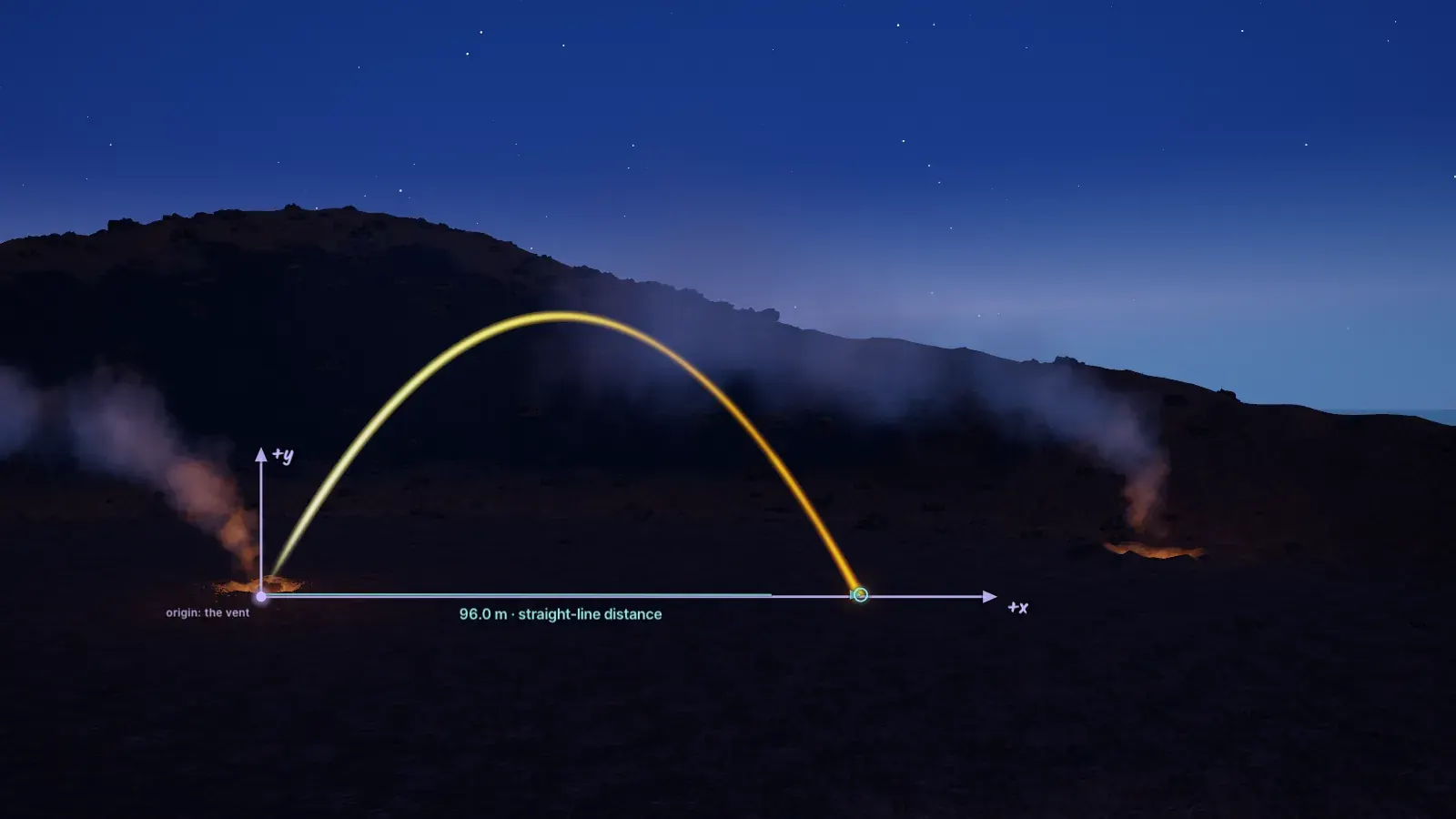
- The total length of path a moving point covers over a time interval, counting every pass. For motion in the plane it is ∫ √((x′(t))² + (y′(t))²) dt.
- displacement
- The straight-line change in position from the start to the end, ignoring the route. Its size is never more than the distance traveled.
- smooth curve
- For a graph y = f(x), a continuous f′ makes the graph smooth. For a parametric curve, x′ and y′ are continuous and never both zero inside the interval (vertical tangents are fine). The arc length formulas apply to smooth curves.
Transcript
1,088 words · 5 parts
One groove
This little diamond is riding the groove of a record, and most people never notice that a whole side of a record has only one groove in it. It starts out at the edge and spirals all the way in to the label without ever breaking, so all twenty-four minutes of music on this side live on one long curve.
I want to ask you a question that sounds simple. If we could lift that groove out of the record and pull it perfectly straight, how long would it be? Don’t do any math yet. Just go with your gut and pick the length that feels right for this one groove, pulled straight.
By the end of this lesson, you’ll be able to measure the length of a curve that no ruler could ever follow. You’ll use one integral and your calculator to find out exactly how much groove is hiding on this side of a record. A ruler only measures straight lines, though, so that’s where we’ll start.
A ruler that can’t bend
Here’s a curve, the graph of y equals two-thirds x to the three-halves, running from x equals zero to x equals three, and I’d like to know how long it is. Our ruler can only lie straight, so the best it can do at first is reach from one end of the curve to the other.
That straight piece is the long side of a right triangle that goes three across and about three point four six up. Pythagoras squares the three and the two root three, nine plus twelve, so this little length, delta s, is about four point five eight. That has to be too short, because the curve bows away from the ruler, and a bent path is always longer than the straight line between its ends.
Let’s give the ruler a joint. With two straight pieces the total comes to four point six three, with four pieces it’s four point six five, and every piece is its own little right triangle.
Before we add any more chords, what do you think happens to their total as the number of chords keeps going up? You might be wondering why we bother with square roots at all, when we could just walk three across and then three point four six up, for six point four six.
Watch what happens when we make the steps smaller. The staircase hugs the curve tighter and tighter, but every step still adds its whole run plus its whole rise, so the total stays stuck at six point four six forever. A step never tilts along the curve, however small it gets, while a chord always does, and that’s why the chords are the ones that find the real length.
Chords around the record
Let’s take that idea back to the record. Here’s the whole groove from straight above, riding along with the disc, and I’ve spread the turns a hundred times farther apart, so these eight turns stand in for all eight hundred. We’ll start with only four chords in every turn, and that chain cuts every corner and comes up about ten percent short.
Now you’re driving. Turn the chords up until the chain gets within one percent of the groove’s real length. If we zoom in on one of those chords, it’s the same little right triangle we had on the board, a step across, a step up, and the chord as its hypotenuse. Each little hypotenuse is a piece of the groove’s length, and adding up tiny pieces is exactly what an integral does.
From chords to an integral
Let’s turn one chord into a formula. On a piece of the graph that’s delta x wide, the curve rises delta y, and the chord across that piece, delta s, has length the square root of delta x squared plus delta y squared.
An integral slices along x, so I want a delta x standing outside the root. I’ll factor delta x squared out of both terms, and its square root comes out front as delta x. What’s left inside is delta y over delta x, which is just the slope of the chord. As the pieces get thinner, each chord’s slope becomes the slope of the curve itself, f prime.
As we make the pieces thinner, their total approaches this integral. It measures the length of the graph of f from x equals a to x equals b, as long as f prime is continuous on that interval. I read it as Pythagoras inside an integral, one step across and f prime up, with the root giving the length of each tiny slanted step.
We can test it on something we already know. The line y equals three-quarters x, from zero to four, goes four across and three up, so its length had better be five. Its slope is three-quarters, so inside the root we get one plus nine-sixteenths, twenty-five sixteenths, whose root is five-quarters. Five-quarters times a width of four is exactly five, so the formula knows Pythagoras.
Your turn with the formula
Now let’s measure our first curve for real, the one from the start. The first step is always the derivative, and the power rule gives f prime of x equals x to the one-half, the square root of x.
Squaring the square root of x just gives x, so the length is the integral from zero to three of the square root of one plus x, d x. That one we can do by hand. The antiderivative is two-thirds times one plus x to the three-halves.
At three that’s four to the three-halves, which is eight, and at zero it’s one, so we get two-thirds of the difference, eight minus one, which is fourteen-thirds, about four point six six seven. Look how well that fits, between the straight ruler’s four point five eight and the staircase’s six point four six, just above what our eight chords gave.
There are three mistakes I see all the time with this formula. People square f instead of f prime, or they forget to square the derivative at all, or they split the square root into one plus f prime. A square root of a sum never splits like that.
Let’s try one together, with y equals x cubed from x equals one to two. Which integral gives the length of the graph of y equals x cubed from x equals one to x equals two? This one has no friendly antiderivative, so grab the calculator, graph the integrand, and integrate from one to two. What’s the length, to three decimal places?