
Topic 9.3 key terms
- arc length
- The length of a curve measured along the curve itself, as if you pulled it straight. It is the number the lengths of finer and finer chord chains settle on.
- chord
- A straight segment joining two points of a curve. Its length, √((Δx)² + (Δy)²), is never more than the length of the arc between those points.
- arc length of a graph
- For y = f(x) with f′ continuous on [a, b]: L = ∫ₐᵇ √(1 + [f′(x)]²) dx.
- arc length of a parametric curve
- For x(t), y(t) with continuous derivatives, traced once for a ≤ t ≤ b: L = ∫ₐᵇ √((dx/dt)² + (dy/dt)²) dt.
- speed (in the plane)
- √((dx/dt)² + (dy/dt)²): how fast a moving point covers length along its path. Integrating speed over a time interval gives the distance traveled.
- distance traveled
- The total length of path a moving point covers over a time interval, counting every pass. For motion in the plane it is ∫ √((x′(t))² + (y′(t))²) dt.
- displacement
- The straight-line change in position from the start to the end, ignoring the route. Its size is never more than the distance traveled.
- smooth curve
- For a graph y = f(x), a continuous f′ makes the graph smooth. For a parametric curve, x′ and y′ are continuous and never both zero inside the interval (vertical tangents are fine). The arc length formulas apply to smooth curves.
Transcript
1,250 words · 4 parts
One clock, two directions
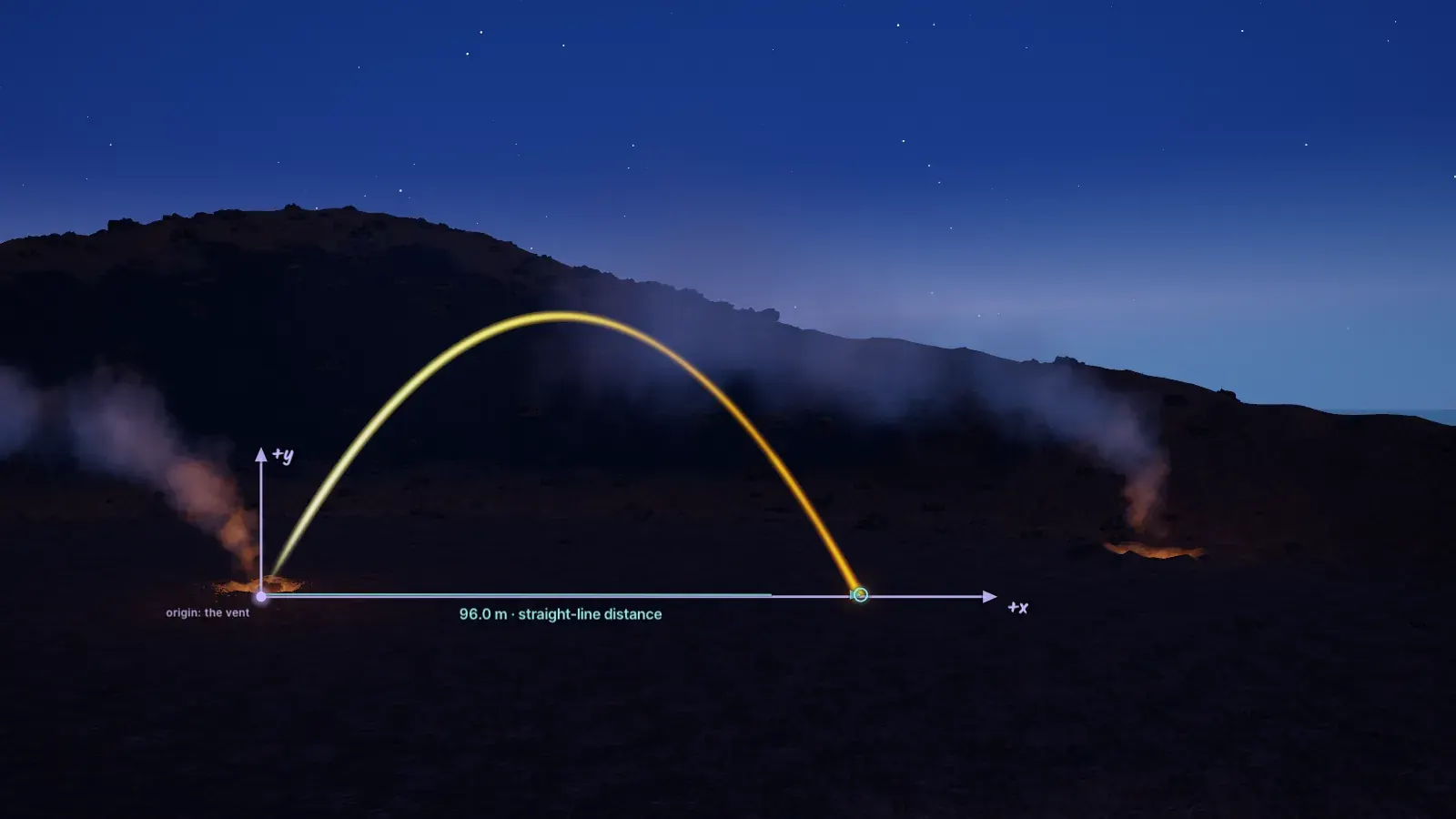
Let’s leave the record for a minute and go somewhere a lot louder. This is Stromboli, off the north coast of Sicily, erupting almost nonstop for at least two thousand years. Let’s follow one glowing rock. With the origin at the vent, one clock runs both of its coordinates.
x of t equals sixteen t meters across and y of t equals thirty t minus five t squared meters up. It leaves the vent at thirty-four meters a second and lands six seconds later, ninety-six meters away.
I’ll freeze it a second and a half into the flight. Take a tiny slice of time, delta t. The rock moves across about x prime times delta t, and x prime is its sixteen meters a second. It also rises about y prime times delta t, and those are the two legs of a little right triangle again.
Its hypotenuse is the piece of path the rock covers, the square root of x prime squared plus y prime squared, times delta t. That root is path per second, which makes it the rock’s speed. That means the length of the path is the rock’s speed added up over the whole flight, and you can watch the string grow as it goes.
Now you take the rock. Drag it along its flight and find the spot where its string grows most slowly. On the way down, y prime turns negative, and squaring it keeps every bit of that motion adding length.
On the board it’s the same chord as before, except this time I pull out delta t instead of delta x. In the limit the sum becomes an integral over t, from t equals a to t equals b, of the square root of d x d t squared plus d y d t squared, d t. When the parameter is time, that integrand is the speed, so this is the rule you know from motion along a line, distance traveled is the integral of speed.
We can check the formula on a curve we know, x equals two cosine t and y equals two sine t, which traces half a circle of radius two as t runs from zero to pi. Before we use the formula, how long should half a circle of radius two be?
Now the formula. The derivatives are negative two sine t and two cosine t, and when we square them and add, sine squared plus cosine squared is one, so we get four. The speed is the square root of four, two, the whole way, so the length is two times pi, two pi, exactly what we predicted. The straight line between its ends is only four, while the integral measures the whole trip, and if t kept going all the way to four pi, it would count both laps, eight pi.
One more connection, and I love this one. A graph y equals f of x is just a parametric curve where x of t is t. Then d x d t is one, and the formula becomes the square root of one plus f prime squared. That one was d x d t all along.
Back to our rock. It lands ninety-six meters from the vent, but how far does it actually travel along its path? Use the calculator for the integral, to three decimal places.
The groove, measured
Now we’re ready for the record. The cutter starts a hundred forty-six millimeters from the center, and every time the record turns once, it creeps a tenth of a millimeter closer to the center. One turn is two pi radians, so a tenth of a millimeter a turn is a tenth over two pi for every radian, one over twenty pi millimeters. After the record turns through theta, the groove sits at r equals a hundred forty-six minus theta over twenty pi. This side plays twenty-four minutes at thirty-three and a third turns a minute, eight hundred turns, so theta runs from zero to eight hundred times two pi, sixteen hundred pi.
Let’s go back to the magnifier and look at one tiny step of groove in the record’s own directions. When the record turns through a tiny angle, delta theta, the groove moves around by r times delta theta, like any arc of a circle, and it creeps inward by delta theta over twenty pi. Those two moves are at right angles, so the tiny piece of groove is a hypotenuse again.
Pull out the delta theta, and each tiny piece is the square root of r squared plus one over twenty pi squared, times delta theta. The inward step is tiny next to the step around, so almost all of the groove’s length comes from going around, and hardly any from creeping in. That makes the groove’s length the integral from zero to sixteen hundred pi of that square root, d theta, in millimeters.
Now evaluate it. The integrand is already in your calculator, with x standing in for theta, so put in the bounds. The integral comes out in millimeters, so give the groove’s length in meters, to three decimal places.
Let’s see it for real. This rail runs from the edge of the record out the window and down the street, with a flag every hundred meters. Put the flag where your integral says the groove will end, and then we’ll pull the whole thing straight.
Here it comes, the whole side of the record, every song, one turn after another, pouring out the window and down the street. You can hold this disc in two hands, and it carries about a third of a mile of groove. Pulled straight, those five hundred thirty-three meters land right where your integral said they would.
If you guessed about five hundred meters at the start, your gut was right, and if you took precalc with us, you’ve now proved the half kilometer I promised you there. The cutter itself only moved eight centimeters toward the center to cut all of that.
Now cut a record of your own, between the same two edges. Pick how many minutes of music your side holds, then plant the flag where you think its groove will end.
How the exam asks it
Let’s finish with how the exam asks about this. Sometimes they hand you an integral like this one and ask what it means. The answer that earns the point names the graph and the interval, the length of the graph of g from x equals zero to x equals four. If you write only the distance, a reader can’t tell which curve you measured, or where you started and stopped. The area under g is a different integral altogether.
When they ask how far a particle travels, write the whole integral with both derivatives squared and the time bounds, then the value to three decimals, with units. If they ask you to explain it, one sentence does it. The integrand is the ember’s speed, so integrating it over the time interval gives the total distance traveled.
What you can do now
Both formulas add up tiny hypotenuses. For a path, the integrand is the square root of x prime squared plus y prime squared, and when t is time, that’s the speed. For a graph, x is its own clock, so the step across is one. You came in not knowing how long this groove was, and now you can measure it, along with any smooth curve anyone hands you, by adding up tiny hypotenuses with an integral.