
Topic 9.9 key terms
- area of a slice of a circle
- A slice (sector) of a circle with radius and angle in radians has area .
- polar area formula
- The area of the region swept by the ray from to out to the curve is .
- trace the region once
- Choose limits so the ray sweeps the region exactly once; the integral counts every wedge it sweeps, even twice. Endpoints are often where .
- cardioid
- A heart-shaped polar curve such as ; the ideal cardioid microphone's pickup pattern is .
- area between two polar curves
- If on , the area between them is : outer squared minus inner squared, never the gap squared.
- intersection of polar curves
- Points shared by both curves. For nonnegative radii on the same rays, solve and check the pole separately; if negative radii occur, also check the equivalent point .
- splitting at intersections
- When the boundary of a region changes from one curve to another, split the integral at the intersection angles and integrate each piece with its own radius.
Transcript
1,449 words · 3 parts
Between two curves
Let’s leave the theater for a city bus, stopped at a red light at midnight in pouring rain. The driver can barely see a thing, until the wiper sweeps across and the street snaps into focus.
That clean band of glass is a polar region too. The pivot is the pole, and the blade swings through an angle of a hundred and twenty degrees, which is two pi over three radians. The blade is point six meters long, with its inner end point one meters from the pivot and its outer end point seven meters out, so the inner end traces a small arc and the outer end traces a big one. The clear glass lives between those two curves.
Suppose we slide the same blade twenty centimeters farther out along the arm, so it runs from point three meters to point nine, with the same swing. What happens to the clear glass?
It clears fifty percent more glass! Sliding out, the blade gives up this thin sliver near the pivot, but it gains this big band out at the top. Both strips are twenty centimeters wide, and the outer one is four times bigger, because out there the arcs are so much longer.
So how do we measure a band like this? It’s a big slice of a circle, out to the blade’s outer end. Then we cut a small slice out of the middle, out to its inner end.
The big slice is one half capital R squared delta theta, and the small one is one half little r squared delta theta. Subtract them, and the band is one half, times R squared minus r squared, times delta theta. It’s really tempting to square the gap instead, the blade’s length, and write one half times R minus r, squared.
But the gap is sixty centimeters wherever the blade sits, so that formula says sliding it out changes nothing, and the bus just showed us it does. For the blade from point three to point nine meters, point nine squared minus point three squared is point seven two. Times one half, times two pi over three, that’s point two four pi, about point seven five four square meters.
So the same blade clears one and a half times as much glass, just as those two strips predicted. When the two edges are curves instead of circles, the idea stays the same. We just go one ray at a time. On each ray, take the outer radius squared minus the inner radius squared, and the area is one half the integral of that from alpha to beta.
Now you take over the wiper. Put the blade’s inner end at a, so its outer end is at a plus point six, and work out where a should be so that one stroke clears point two pi square meters, about point six three. Then slide the blade there and let the wiper check your answer.
Curves that cross
Now let’s try one where both edges really are curves. Take the cardioid r equals one plus cosine theta, which is our microphone’s heart doubled, twice as far out on every ray. Doubling the radius makes the area four times bigger, so its area is four times three pi over eight, which is three pi over two. Now add the circle r equals one, and let’s find the area that’s inside the cardioid but outside the circle.
First, where do they cross? Set the radii equal, one plus cosine theta equals one, so cosine theta is zero, and theta is plus or minus pi over two. This next sentence is the reason the setup is right, so it’s worth writing down. Between negative pi over two and pi over two, cosine theta is positive, so one plus cosine theta is bigger than one.
That means the cardioid is the outer boundary on every ray there, and the circle is the inner one. So the area is one half the integral from negative pi over two to pi over two of one plus cosine theta, squared, minus one squared. The ones cancel and leave two cosine theta plus cosine squared theta. The region is symmetric, so I’ll integrate from zero to pi over two and double it, and that two cancels the one half.
The two cosine theta term gives two sine theta, which is two at pi over two. For cosine squared we use the same identity as the heart, and over this quarter turn the wave adds up to zero, so the constant half gives one half times pi over two, which is pi over four.
The area is two plus pi over four, about two point seven eight five. Let’s check that against the whole cardioid. Our piece has to fit inside its area of three pi over two, and it does.
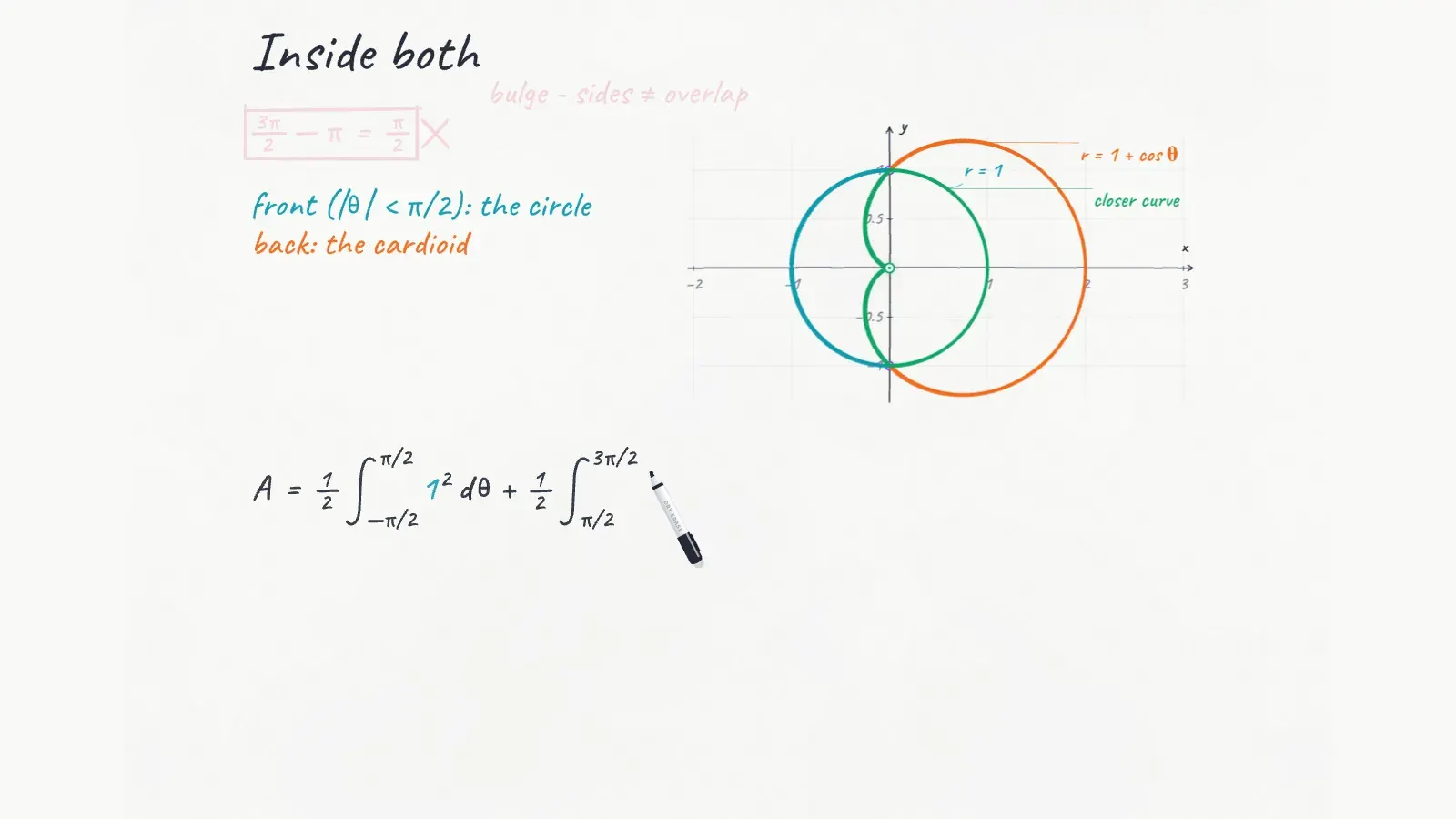
Let’s flip the question around and ask for the area inside both curves. You might want to subtract the whole circle from the whole cardioid, but that gives pi over two, which is the cardioid’s bulge minus the circle’s sides, not the overlap. Think one ray at a time. A ray inside both curves stops at whichever curve it hits first. Toward the front, that’s the circle, and toward the back, past pi over two, it’s the cardioid.
The boundary switches where the curves cross, so we split the integral there. Across the front, it’s one half the integral of one squared. Across the back, from pi over two to three pi over two, it’s one half the integral of the cardioid squared.
Use your calculator to evaluate that, and give the area to three decimal places. Most calculators want x instead of theta, and that’s fine, because the letter doesn’t matter.
Put the overlap back together with the bulge we measured before, and their areas add up to three pi over two, the whole cardioid, so we counted every piece exactly once. When you use a calculator on the exam, write the definite integral before the decimal. Your setup shows which rays you used and which radius bounds each piece, and then you give the area to three decimal places.
Showtime
Back to the show, because now we can keep the promise. The roar this microphone throws away is the region between the circle and the heart, and the heart sits inside the circle on every ray. So it’s one half the integral of one squared minus the heart’s radius squared, all the way around, which is pi minus three pi over eight, five pi over eight.
In our flat model, the mic throws away five eighths of the roar, and that’s a big part of why you can hear her voice. In a real room, noise comes from above and below too, and if it arrives evenly from every direction, a cardioid keeps about a third of it and throws away about two thirds.
The exam has asked one more kind of question before. It asks for the ray that splits a region into two equal areas. Our version is a cone of stage light, centered on the front of the mic.
Drag the edge of the cone to where you think it lights exactly half of the heart’s area. Then let go, and the stage will tell you how close you got.
On the exam you’d write the lit area first. That’s one half the integral from negative k to k of the radius squared, and you set it equal to half of three pi over eight. The two sides of the cone are mirror images, so that’s the integral from zero to k equaling three pi over sixteen. Then the calculator finds k, about point six two eight.
Why is the cone so narrow? By the Fundamental Theorem of Calculus, the area piles up at a rate of one half r squared for every radian the ray turns. Straight ahead that’s one half, but out to the side, where the radius is one half, it’s only one eighth, four times slower. So the front of the heart holds most of its area.
A thin slice of a circle has area one half r squared delta theta, so a polar region’s area is one half the integral of r squared d theta, with limits that trace it once. Between two curves, it’s outer radius squared minus inner radius squared, ray by ray, and you split the integral where the curves cross.
Now you can look at a microphone’s heart and say how much of the roar it keeps and how much it shuts out. That’s a big part of how one voice carries over a whole theater of screaming fans.