
Topic 10.1 key terms
- infinite series
- A sum with infinitely many terms, a₁ + a₂ + a₃ + ⋯, written . We add the terms one at a time and watch the running totals; if those partial sums approach one finite number, that number is the sum.
- term
- A term is one number in the sum; we write the nth term as . The ball's trips 2, 2, 1, 1/2, ... are the terms of its distance series.
- nth partial sum
- , the sum of the first n terms: the running total after n terms.
- converges
- A series converges to S when the limit of its sequence of partial sums exists and equals S; S is then the sum of the series.
- diverges
- A series diverges when its partial sums have no limit, either by growing without bound () or by never settling ().
- geometric series
- A series with a constant ratio between successive terms: .
- common ratio
- Multiply a term by r to get the next term. To find r, divide a term by the previous nonzero term; r can be negative.
- sum of a geometric series
- If , , where a is the first term; if (and ) the series diverges.
Transcript
820 words · 2 parts
Four seconds, infinitely many bounces
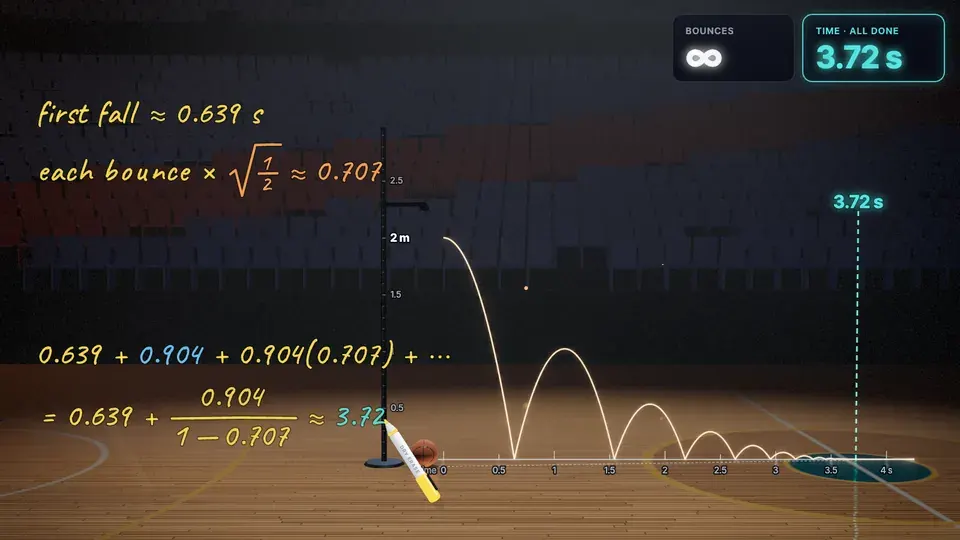
Hold a ball two meters above a hard floor, let it go, and just listen for a few seconds. You’ve heard that sound your whole life, the bounces coming faster and faster until they blur into a rattle, and then, in less than four seconds, the ball is completely still. How many times do you think it bounced? Ten times, maybe twenty?
In the simplest model of a bounce, where every bounce reaches half the height of the one before, that ball bounces infinitely many times. Every single one of those bounces happens before four seconds are up. Twenty-five centuries ago, a philosopher named Zeno argued that you could never finish infinitely many steps, and in our model, this ball does it every time you drop it.
Every bounce is a trip up and back down, and there are infinitely many of them, so how far does this ball travel in total? By the end of this lesson, you’ll be able to add up every one of those infinitely many trips and get one exact number. Then you’ll design your own ball, choosing how bouncy it is, so its whole endless trip comes out to the distance you pick.
Adding forever
Let’s slow this ball way down and follow it one trip at a time. It starts two meters up, so the first trip is the fall itself, two meters straight down to the floor. Then it bounces back up to half that height, one meter, and falls that meter back down. That first bounce adds two more meters, one going up and one coming down.
Every bounce is half as high as the one before, so every round trip is half as long as the one before it. That’s one meter, then half a meter, then a quarter of a meter. Let’s keep a running total as we go. After the drop it’s two meters, then four, then five, then five and a half, and now five and three quarters.
If the ball keeps bouncing forever and we keep adding trips forever, what do you think happens to that running total? Before we lay the trips out, drag the flag to where you think the total ends up, or past the end if you think it never stops.
Let’s lay every trip end to end along the floor and watch where the total goes. Now look at how far each total is from six meters. It’s four, then two, then one, then a half, so every new trip covers half of the gap that’s left.
The gap keeps getting cut in half forever, so the total gets as close to six meters as you like, and it never goes past. That means the ball travels six meters in total. But nobody can actually add up infinitely many numbers, so what do we really mean when we say the total is six?
Let’s write the trips as a list with plus signs between them, two plus two plus one plus a half plus a quarter, going on forever. We call a sum that never ends like this an infinite series. Each number in it is a term, and we write the nth term as a sub n.
We can’t add all the terms at once, so we do what the ball did. We add them one at a time and keep a running total. That running total has a name. After n terms we call it the nth partial sum, S sub n, and it’s simply the sum of the first n terms.
That gives us two lists to watch. The terms shrink toward zero, while the partial sums climb toward six and never get past it. Let’s make sure the two lists are clear. For the ball’s series, what is S sub three, the third partial sum?
That’s what the sum of an infinite series really means. The partial sums have a limit, and that limit is six, so we say the series converges, and its sum is six. In general, a series converges to a number S when the limit of its partial sums exists and equals S. If the partial sums don’t have a limit, the series diverges.
Notice that those two limits aren’t the same. The terms go to zero, but the sum is six, so the sum of a series is the limit of its partial sums, and not the limit of its terms.
Not every series has a sum. If every term is one, the partial sums go one, two, three, four, and they grow without any limit at all, so that series diverges. This next one is sneakier, one minus one plus one minus one, forever.
Does this series converge, and if it does, what’s its sum? What made the ball’s series behave so nicely is that every round trip was half of the one before. Let’s look at that same pattern somewhere completely different.