
Topic 10.2 key terms
- infinite series
- A sum with infinitely many terms, a₁ + a₂ + a₃ + ⋯, written . We add the terms one at a time and watch the running totals; if those partial sums approach one finite number, that number is the sum.
- term
- A term is one number in the sum; we write the nth term as . The ball's trips 2, 2, 1, 1/2, ... are the terms of its distance series.
- nth partial sum
- , the sum of the first n terms: the running total after n terms.
- converges
- A series converges to S when the limit of its sequence of partial sums exists and equals S; S is then the sum of the series.
- diverges
- A series diverges when its partial sums have no limit, either by growing without bound () or by never settling ().
- geometric series
- A series with a constant ratio between successive terms: .
- common ratio
- Multiply a term by r to get the next term. To find r, divide a term by the previous nonzero term; r can be negative.
- sum of a geometric series
- If , , where a is the first term; if (and ) the series diverges.
Transcript
1,903 words · 5 parts
Same ratio, every time
If you took precalculus with us, you’ve met this sheet of paper before, the one that reaches the Moon in forty-two folds. Tonight we’re going to cut it instead. Cut it in half and lay one half down inside the outline of the whole sheet, and that piece covers half of it.
Then cut the half that’s still in your hand in half again, lay one of those pieces down, and do it again. Every piece is half the size of the one before it. The A-series paper sizes follow this same pattern. Half of an A four sheet is A five, half of that is A six, then A seven, and so on down.
The area we’ve covered, one half plus a quarter plus an eighth, is a partial sum of this series. The empty part of the outline is always the same size as the paper still in your hand.
Take the scissors yourself and keep cutting until you’ve covered ninety-nine point nine percent of the sheet, and keep an eye on how many pieces it takes. Keep going to twenty pieces and the gap is smaller than a grain of salt, and it keeps halving forever, without ever closing. That’s the same thing the ball did. The partial sums close in on one, so one half plus a quarter plus an eighth, forever, converges, and its sum is exactly one whole sheet.
Now let’s fold the sheet instead, the way we did in precalculus. Each fold adds a layer as thick as the whole stack, point one millimeter, then point two, then point four, doubling every time. Add those layers to the original tenth-of-a-millimeter sheet and the stack passes the Moon at fold forty-two, and it never settles down, so the series of layers diverges. The same sheet gave us pieces whose areas shrink by half and layers whose thicknesses double, and that one multiplier decided everything.
When every term is the one before it times the same number, we call the series a geometric series. We call the first term a, and the number we keep multiplying by is r, the common ratio. With a sigma, we write the whole series as the sum from n equals zero to infinity of a r to the n. Starting at n equals zero makes the first term a times r to the zero, which is just a.
To find r, divide any term by the term right before it, as long as that term isn’t zero, and in a geometric series you get the same answer wherever you look. The ball’s round trips start at two with a ratio of one half. The paper starts at one half with the same ratio, and the folds start at point one with a ratio of two.
The ratio can even be negative. In eight minus four plus two minus one, each term is negative one half times the one before it, so the signs keep flipping back and forth. In precalculus, exponential functions couldn’t have a negative base, but here n only takes whole number values, so a negative ratio is perfectly fine.
Where a over one minus r comes from
Let’s find a formula that tells us whether a geometric series converges and what its sum is. It comes from one of my favorite tricks in algebra. Start with the nth partial sum, the first n terms. The first term is a times r to the zero, so the nth term is a times r to the n minus one.
Now multiply every term by r. Each term turns into the next term in the list, so the whole list slides over by one place. Only the very last term, a r to the n, is new.
Subtract the second line from the first and watch almost everything cancel. Every middle term shows up in both lines, so all that’s left is the first term, a, minus a r to the n. Factor both sides and divide by one minus r, and we have an exact formula for every partial sum, as long as r isn’t one.
As n goes to infinity, a and r stay put, so whether the series converges comes down to one piece, r to the n. If r to the n shrinks to zero, the partial sums close in on a times one minus zero, over one minus r, which is just a over one minus r.
Before we look, make a prediction. For which values of r do you think the series one plus r plus r squared plus r cubed, and so on forever, converges?
With r equal to one half, r to the n goes a half, a quarter, an eighth, heading to zero, and the partial sums close in on their limit. With negative one half they zigzag, but they still close in. At r equals one, every term is the same, so the partial sums grow by the same amount every time and never stop. At negative one, they flip between one and zero forever, just like our one minus one series.
Once r is bigger than one, r to the n explodes, and the partial sums explode right along with it. That’s the whole story of geometric series. If the absolute value of r is less than one, r to the n goes to zero, so the series converges and its sum is a over one minus r.
If the absolute value of r is one or more, the series diverges, as long as its first term isn’t zero. Be careful, though, because the formula will hand you an answer even when it shouldn’t.
Put r equals two into it for one plus two plus four plus eight and you get negative one. A sum of positive numbers can’t be negative, so always check the size of r before you use the formula.
Let’s test the formula on our ball. The first drop of two meters stands on its own, and after it come the round trips, two plus one plus a half and so on. The round trips are a geometric series with first term two and ratio one half. A half is less than one, so they add up to two over one minus a half, which is four.
Add the first drop and we get six meters, exactly what we watched the trips close in on. We can even settle one of the internet’s favorite arguments. Point nine repeating is the series point nine plus point oh nine plus point oh oh nine and so on. That’s a geometric series with first term nine tenths and ratio one tenth.
A tenth is less than one, so its sum is nine tenths over one minus a tenth, which is nine tenths over nine tenths, exactly one. The partial sums never reach one, but the sum of a series is the limit of its partial sums, and that limit is one.
The AP way
Let’s do one the way the AP exam asks it. Find the sum of the series from n equals zero to infinity of six times negative one half to the n, or show that it diverges.
The first thing I always do is write out a few terms, because the first term isn’t always the number in front. At n equals zero we get six, then negative three, then three halves, then negative three quarters.
If this sum started at n equals one, the first term would be negative three, and not six. Each term is negative one half times the one before it, so the first term is six and the ratio is negative one half. A full-credit answer names the series, its first term, its ratio and the condition before it gives the sum.
This is a geometric series with first term six and ratio negative one half. The absolute value of negative one half is less than one, so the series converges, and its sum is six over one minus negative one half, which is four. A quick sanity check helps here. The partial sums go six, three, four and a half, three and three quarters, zigzagging around four and closing in, so four makes sense.
Now you try one. Find the sum of the series from n equals two to infinity of three times two fifths to the n.
A real tennis ball
Let’s try it with some real numbers. Before the International Tennis Federation approves a standard medium-speed tennis ball, testers drop it from two hundred fifty-four centimeters onto a rigid block. It has to bounce back up to somewhere between one hundred thirty-five and one hundred forty-seven centimeters. Let’s take a ball that bounces right in the middle of that range, to a hundred forty-one centimeters. Then let’s suppose every bounce reaches that same fraction of the height before it, about point five five five.
Two hundred fifty-four centimeters is two point five four meters, and that first drop counts once. Every rebound counts twice, once going up and once coming down, so the total is two point five four plus twice the sum of the rebound heights. Use your calculator to find the total distance this ball travels in our model, correct to three decimal places.
Design your own ball
It’s time to design your own ball. We’ll keep the two-meter drop, and you get to choose how far it travels in total. Pick a distance, six, ten or eighteen meters, and set the bounciness r so the ball’s whole endless trip adds up to exactly that, then drop it and see.
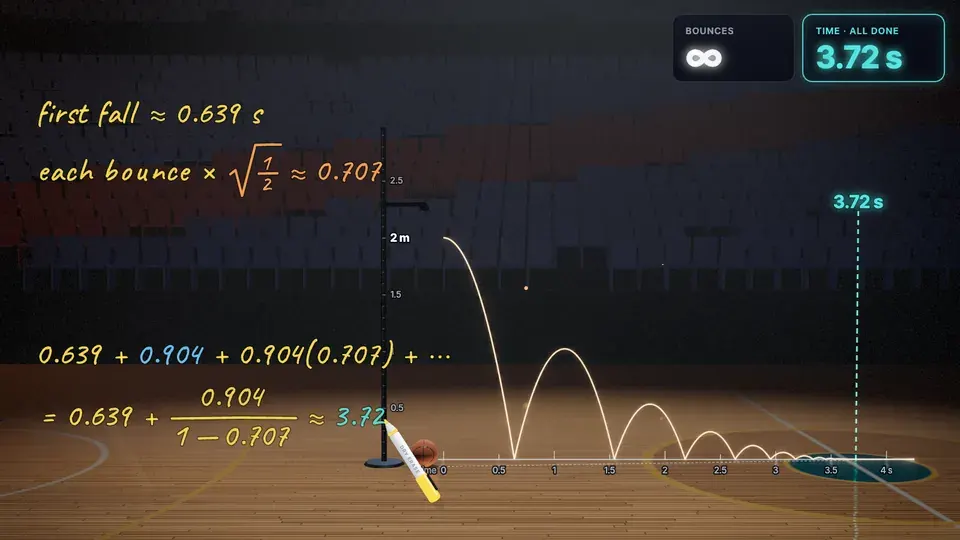
Let’s drop the ten-meter ball and watch every trip land on the end of the one before, closing in on exactly ten meters. I still owe you the four seconds from the start. The first fall, two meters straight down, takes about point six four seconds. A bounce half as high doesn’t take half as long. It takes the square root of a half as long, about point seven one.
So the first bounce, up and back down, takes about point nine seconds, and each bounce after it takes point seven one of the one before. That makes the bounce times a geometric series, so the total is the first fall plus the first bounce over one minus the ratio, which comes to about three point seven two seconds.
That’s infinitely many bounces finishing in under four seconds, the very thing Zeno thought was impossible. At the start I promised you’d be able to add up infinitely many trips and get one exact number. You’ve now done it for three different balls, six meters for the basketball, about eight point eight eight for the tennis ball, and the distance you picked for the ball you designed.
A partial sum adds up the first n terms, and a series converges when its partial sums have a limit, which is its sum. A geometric series multiplies by the same ratio every time. If the absolute value of r is less than one, it converges to a over one minus r. Otherwise it diverges, as long as its first term isn’t zero. On the exam, name the series, give its ratio and check the condition before you give the sum.
I’ll leave you with one question. The terms of one plus a half plus a third plus a quarter shrink to zero too, but there’s no common ratio. Does it converge at all? That’s where we’ll start next time.