
Topic 10.15 key terms
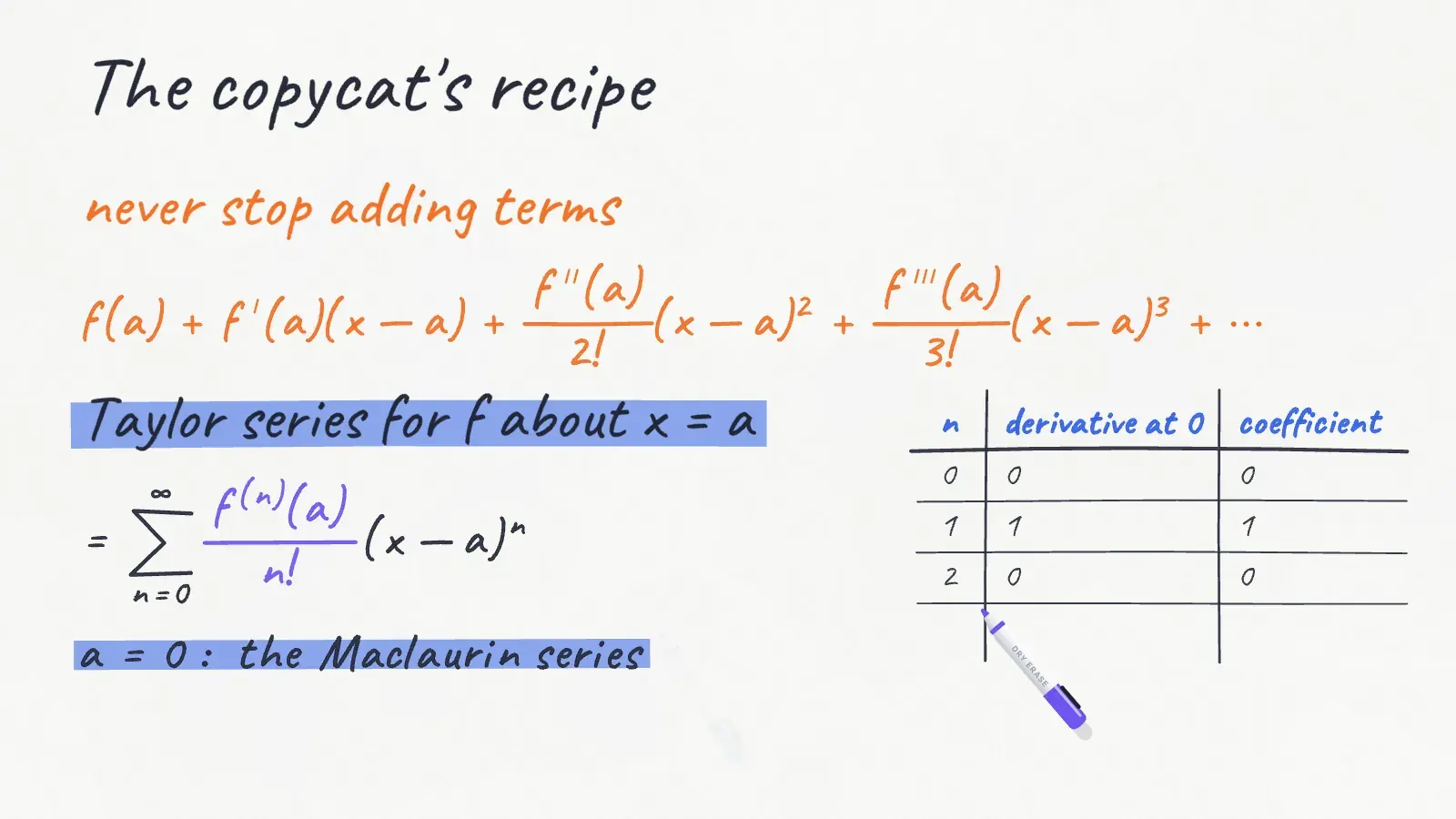
- Taylor series
- For f about x = a: the series Σ f⁽ⁿ⁾(a)(x − a)ⁿ/n!, n = 0 to ∞. Each coefficient is a derivative at the center divided by a factorial; its partial sums are the Taylor polynomials.
- Maclaurin series
- A Taylor series centered at a = 0: the sum of f⁽ⁿ⁾(0)xⁿ/n!.
- partial sum
- The sum of the first terms of a series. A Taylor polynomial is a partial sum of the Taylor series, which is why it only approximates f.
- term-by-term differentiation
- Differentiating a power series one term at a time inside its interval of convergence. The radius stays the same; endpoints must be re-checked. Example: differentiating sine's series gives cosine's.
- interval of convergence
- The inputs x for which a series converges. The geometric series 1 + x + x² + ⋯ equals 1/(1 − x) only for −1 < x < 1.
- substitution
- Building a new series by replacing the input of a known one with a whole expression, e.g. u = −x² in eᵘ. Every power applies to the whole expression, and the interval changes with it.
- term-by-term integration
- Integrating a power series one term at a time inside its interval of convergence: xⁿ becomes xⁿ⁺¹/(n + 1), and the constant comes from the value at the center.
Transcript
1,665 words · 4 parts
Build, don’t differentiate
Suppose you need the Maclaurin series of e to the minus x squared, the heart of the bell curve. You could take derivatives, but the product rule and the chain rule pile up so fast that by the third one you’re already buried. Look at it differently, though. It’s just e to the something, with minus x squared sitting in the box where the input used to be.
Put minus x squared everywhere you see u on this card, and keep it inside parentheses while you raise it to each power. Minus x squared, squared, is x to the fourth, and minus x squared, cubed, is minus x to the sixth. Because e to the u’s card works for every u, this series works for every x, and it took one line instead of a page.
The mistake to watch for is putting the two in front instead of inside, so you’d write two x squared over two factorial, when the whole two x has to be squared, which gives four x squared over two. Let’s watch that trap happen on the wheel. This teal lamp turns at two theta, twice as fast as the bucket, so a copycat chasing it needs the sine and cosine of two theta.
Here are two recipes, so let’s run recipe B first, with the two out in front. The copycat keeps the bucket’s old speed, but its circle grows twice as large and carries it away from the rim.
Now it’s your turn to fix it. Switch the copycat to the recipe with the two inside every power, and send it after the teal lamp.
That’s the substitution rule in motion, because the whole two theta has to go inside every power, and that’s what lets the copycat follow a lamp twice as fast as the bucket. Now you try one with cosine’s card. What are the first three nonzero terms of the Maclaurin series for cosine of two x?
The coefficients in a series remember the derivatives that made them. Each one is the nth derivative at zero over n factorial, so multiply a coefficient by n factorial and you get that derivative back. Let’s try that on something ridiculous, the hundredth derivative of cosine of two x at zero, and read it straight off one coefficient, without writing a single derivative in between.
Setting two n equal to a hundred gives n equals fifty, so the x to the hundredth term is two x, all to the hundredth, over a hundred factorial, and its coefficient is two to the hundredth over a hundred factorial. When we multiply by a hundred factorial it cancels, so the hundredth derivative is two to the hundredth, a number thirty-one digits long, in one line. The ninety-ninth is even easier, because there’s no x to the ninety-ninth term at all, so that derivative is zero.
Try this one with cosine’s card, and use the calculator if you want it. What’s the eighth derivative of cosine of x squared at zero?
Dividing works too. Sine of x over x is awkward at zero, so we define it to be one there. Divide every term of sine’s series by x and you get one minus x squared over three factorial plus x to the fourth over five factorial. A classic AP question asks whether a function like this has a relative maximum, a relative minimum, or neither at zero, and the series answers it without a single quotient rule.
There’s no x term, so the first derivative at zero is zero. The x squared coefficient is minus a sixth, so the second derivative is two factorial times minus a sixth, which is minus a third.
A full-credit answer ties both derivative facts to the conclusion, and it’s good practice to name the test too. Because f prime of zero is zero and f double prime of zero is minus a third, which is negative, f has a relative maximum at x equals zero by the Second Derivative Test. Saying the slope is zero isn’t enough on its own, because a zero slope could be a max, a min, or neither.
One term at a time
Last lesson you integrated the arch’s series one term at a time and got arctangent, and the same move works on our cards, so let’s do one together. Put minus t into the geometric card, and one over one plus t becomes one minus t plus t squared minus t cubed, for t between minus one and one. Integrate both sides from zero to x.
The left side is the natural log of one plus x. On the right, we raise each power of t by one and divide by the new power, so we get x minus x squared over two plus x cubed over three. Without limits you’d add a C and find it by plugging in zero, where both sides are zero, so C is zero.
Integrating never changes the radius, so it’s still one, but the endpoints can change, so we test them again. At x equals one we get the alternating harmonic series, which converges by the alternating series test, to the log of two in fact. At minus one we get minus the harmonic series, which diverges, so this series works from minus one to one, including one but not minus one.
Now you do one, using the series for cosine of t squared that you built a few minutes ago. What are the first three nonzero terms of the integral from zero to x of cosine of t squared?
The bell curve
Remember this arch from last lesson? It’s one over one plus x squared, and its series gives up at x equals one, because of those two hidden peaks. Now watch it turn into a curve that looks almost the same, e to the minus x squared over two, which is the bell curve.
Its series comes from e to the u’s card with minus x squared over two in the box, and that card works for every input. As we add terms, the thread hugs the bell further and further down the road, with no wall anywhere. Scaled so the whole area under it is one, this bell describes things that pile up around an average, like people’s heights. The area between minus one and one, one standard deviation either side of the middle, is the famous sixty-eight percent.
There’s one problem. Nobody can write down an antiderivative of e to the minus x squared over two using the functions you know, and mathematicians proved back in the nineteenth century that no such formula exists. We can still integrate every power of x in its series, so let’s work out the area on the board.
On the board, the area we want is one over the square root of two pi, times the integral from minus one to one of e to the minus x squared over two, d x. The one over root two pi is that scaling, the one that makes the whole area one. The curve is symmetric, so that’s twice the integral from zero to one, and that’s the part we’ll build.
Let’s take the first move slowly, because the half is easy to lose. Put minus x squared over two into e to the u’s card, in parentheses, everywhere you see u. We square the half as well, which gives a quarter, and over two factorial that’s an eighth, and cubing the half gives an eighth, and over three factorial that’s a forty-eighth.
That makes e to the minus x squared over two equal to one minus x squared over two plus x to the fourth over eight minus x to the sixth over forty-eight, and so on. Integrate every term from zero to one. Each power goes up by one and divides by its new power, so x squared over two becomes x cubed over three times two, which is six.
x to the fourth over eight becomes x to the fifth over five times eight, which is forty, and x to the sixth over forty-eight becomes x to the seventh over seven times forty-eight, which is three hundred thirty-six. At x equals one, that’s one minus a sixth plus a fortieth minus one over three hundred thirty-six plus one over three thousand four hundred fifty-six, and so on.
Add up just the first four of those terms on the calculator, and give me their sum to three decimal places. Now double it and divide by the square root of two pi, and we get about zero point six eight two five, which is sixty-eight percent, right there, from four fractions.
How do we know the sixty-eight percent is right? The series alternates and its terms keep shrinking toward zero, so the integral is off by less than the first term we left out, one over three thousand four hundred fifty-six. That’s less than three ten-thousandths, far too small to move the sixty-eight percent.
Back on the salt flat, watch the glowing area as the terms come in, overshooting, then undershooting, by less and less, until it locks onto sixty-eight point two seven percent. Before you touch the posts, make a prediction. How far out do you think they have to go to take in ninety-five percent? Now test your prediction. Drag the gold posts outward until the area reads ninety-five percent.
Building from four cards
Let’s finish back at the mill, because everything today came out of these four cards, sine, cosine, e to the x and one over one minus x. From them you built new series by plugging in, dividing, differentiating and integrating, and you kept track of the interval every time.
You read a hundredth derivative straight off a coefficient, and you found the bell curve’s sixty-eight percent with four fractions, which is exactly what I promised you at the start. The copycat only ever knew how to add and multiply, and with enough terms, that was all it ever needed.