
Topic 10.14 key terms
- Taylor series
- For f about x = a: the series Σ f⁽ⁿ⁾(a)(x − a)ⁿ/n!, n = 0 to ∞. Each coefficient is a derivative at the center divided by a factorial; its partial sums are the Taylor polynomials.
- Maclaurin series
- A Taylor series centered at a = 0: the sum of f⁽ⁿ⁾(0)xⁿ/n!.
- partial sum
- The sum of the first terms of a series. A Taylor polynomial is a partial sum of the Taylor series, which is why it only approximates f.
- term-by-term differentiation
- Differentiating a power series one term at a time inside its interval of convergence. The radius stays the same; endpoints must be re-checked. Example: differentiating sine's series gives cosine's.
- interval of convergence
- The inputs x for which a series converges. The geometric series 1 + x + x² + ⋯ equals 1/(1 − x) only for −1 < x < 1.
- substitution
- Building a new series by replacing the input of a known one with a whole expression, e.g. u = −x² in eᵘ. Every power applies to the whole expression, and the interval changes with it.
- term-by-term integration
- Integrating a power series one term at a time inside its interval of convergence: xⁿ becomes xⁿ⁺¹/(n + 1), and the constant comes from the value at the center.
Transcript
1,341 words · 3 parts
The copycat
It’s late afternoon at the mill, and the old wheel is still making one slow turn every ten seconds. Pick one bucket and measure its height above the axle in wheel radii, and you get the most famous wave in all of math, the sine of the angle it has turned.
The only functions you can work out with nothing but adding and multiplying are polynomials. A polynomial can never go round in circles, because sooner or later every one that isn’t just a constant grows without bound. Meet the copycat, a glowing copy of the bucket that’s only allowed to add and multiply, and with one term in its recipe it shoots straight up off the wheel.
Give it a second term in its recipe and it rides an eighth of a turn before it peels away, and every new term after that carries it a little further round the rim. Give it enough terms and the copycat stays glued to the real bucket all the way around, and it still hasn’t done anything but add and multiply.
By the end of this lesson, you’ll be able to build recipes like the copycat’s yourself, and you’ll use one to find an area that no ordinary antiderivative formula can give you, the area under the bell curve, which is where the famous sixty-eight percent comes from. Sine, cosine and e to the x can each be built by adding powers of x forever, so let’s start by working out how the copycat knows which terms to use.
The copycat’s recipe
Let’s stop the wheel with our bucket right here, level with the axle, at an angle of zero, where its height is the sine of zero, which is zero. When we found the derivative of sine, we lit a lamp a quarter turn ahead of the bucket, and its height was always how fast the bucket climbs per radian of turn. Right now that lamp sits at the very top, so the first derivative of sine at zero is one.
Every derivative turns you another quarter turn ahead, so the second derivative is the height half a turn away, zero, and the third is the height three quarters of the way round, minus one. One more quarter turn brings you back to the bucket itself, so the derivatives of sine at zero just cycle forever, zero, one, zero, minus one, and round again. Let’s see if the wheel makes sense to you. What do you think the fifth derivative of sine is at zero?
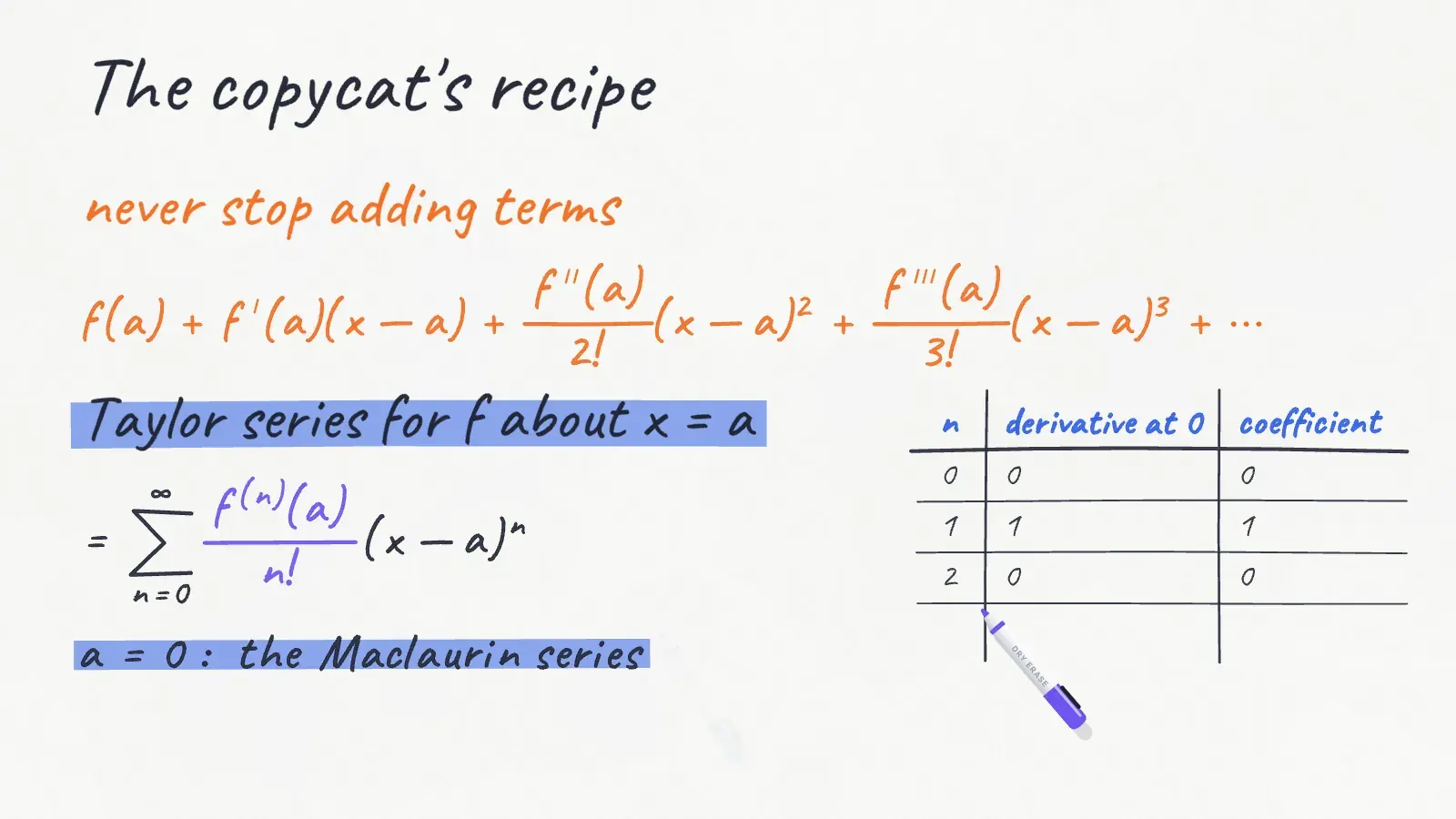
Now let’s turn those numbers into the copycat’s polynomial. You’ve built Taylor polynomials before, and the recipe is exactly the same, except this time we never stop adding terms. Each term takes one derivative at the center a, divides it by a factorial, and multiplies by a power of x minus a. Keep going forever and you get the Taylor series for f about x equals a.
In sigma notation it’s the sum from n equals zero to infinity of f’s nth derivative at a, over n factorial, times x minus a to the n. When the center is zero, we call it the Maclaurin series. For sine at zero the derivatives are the wheel’s numbers, zero, one, zero, minus one, and dividing each by n factorial gives zero, one, zero, minus one over three factorial, so every even power drops out, and the odd ones take turns being positive and negative.
That gives us x, minus x cubed over three factorial, plus x to the fifth over five factorial, minus x to the seventh over seven factorial, and it keeps going like that forever. With a sigma, that’s minus one to the n, times x to the two n plus one, over two n plus one factorial. Two n plus one counts through the odd numbers, one, three, five, and the minus one to the n flips the sign every term.
On a graph you can watch the copycat’s trick, because the line x hugs sine near zero, and each new term bends the polynomial back onto the curve for a little longer before it peels away. A Taylor polynomial is just a partial sum of the Taylor series, the sum you get when you stop after a few terms, and that’s why it’s only approximately equal to the function.
The copycat with three terms runs x minus x cubed over six plus x to the fifth over a hundred twenty, which has three nonzero terms but degree five, and exam questions care about that difference. Let’s put that to work back on the wheel, where the copycat runs this sine recipe for its height and a matching cosine recipe, which we’ll write down in a minute, for its sideways position.
Before you build one yourself, make a guess. How many nonzero terms do you think the copycat needs to ride the wheel for one complete turn? Now it’s your turn to build the copycat. Pick a number of terms, send it round, and keep adjusting until it makes it all the way around the wheel.
Let’s see what happens if ten terms keep going. About thirty degrees into the second lap, it peels away again. Two full turns take eighteen terms, three turns take twenty-seven, and with every term of the series, the copycat rides every turn there is. That’s what it means for the series to equal sine for every real number. Pick any x you like, and the error left over after N terms shrinks all the way to zero as N grows.
Four cards
Sine is the first of four series you’ll use for everything else today, so let’s put it on a card and go and collect the other three. For cosine we could go back to the wheel and take derivatives all over again, but there’s a faster way. Cosine is the derivative of sine, so let’s differentiate sine’s series one term at a time.
The x becomes one, and x cubed over three factorial becomes three x squared over three factorial, which is x squared over two factorial, because three factorial is just three times two factorial. Every term does the same thing, so cosine is one minus x squared over two factorial plus x to the fourth over four factorial, and so on.
The third card is the easiest one of all. Every derivative of e to the x is e to the x, so at zero every one of them is one. That makes the series one plus x plus x squared over two factorial plus x cubed over three factorial, forever.
Put in x equals one and you’re adding one plus one plus a half plus a sixth, and look how fast the partial sums climb toward e, two point seven one eight. Now differentiate e to the x’s series term by term, the same way we did for sine. What series do you get?
The fourth card isn’t new at all. It’s the geometric series from the very start of this unit, one plus x plus x squared plus x cubed, with first term one and ratio x, and it adds up to one over one minus x. The Taylor recipe agrees, because the function and its derivatives at zero come out one, one, two, six, twenty-four, which are the factorials, so every coefficient is n factorial over n factorial, which is one.
This card comes with a catch. The geometric series only converges when x is strictly between minus one and one, and beyond that its partial sums grow without bound, even where the function has a perfectly good value.
These four cards are the whole toolkit, and from here on we won’t take a single new derivative, we’ll build everything else out of them. We can center a Taylor series somewhere other than zero, and exam questions often do. Centered at two, every derivative of e to the x at two equals e squared, so every term carries an e squared and a power of x minus two.