
Topic 9.7 key terms
- polar to Cartesian
- A point r out along the ray at angle θ has x = r cos θ and y = r sin θ. With r = f(θ), both are functions of θ, so a polar curve is a parametric curve with θ as the parameter.
- dr/dθ
- How fast the signed distance from the pole changes per radian: the light sliding along the bar. It is not the slope of the curve.
- dx/dθ and dy/dθ
- By the product rule, dx/dθ = r′ cos θ − r sin θ and dy/dθ = r′ sin θ + r cos θ: one piece from the slide along the bar, one from the turn.
- slope of a polar curve
- dy/dx = (dy/dθ)/(dx/dθ) = (r′ sin θ + r cos θ)/(r′ cos θ − r sin θ), wherever dx/dθ ≠ 0.
- horizontal tangent
- dy/dθ = 0 and dx/dθ ≠ 0 at that θ. If both are 0, look closer: the quotient says nothing yet.
- vertical tangent
- dx/dθ = 0 and dy/dθ ≠ 0 at that θ.
- farthest point vs highest point
- Distance from the pole is |r|. On petal one r ≥ 0, so the farthest point maximizes r, while the highest point maximizes y = r sin θ; compare critical points and endpoints for each. On r = sin 2θ (0 ≤ θ ≤ π/2) the tip is 0.707 m high and the top 0.770 m.
- second derivative of a polar curve
- d²y/dx² = (d/dθ of dy/dx) ÷ (dx/dθ): differentiate the slope with respect to θ, then divide by dx/dθ. Not y″/x″.
Transcript
2,550 words · 8 parts
The laser that cut the flower
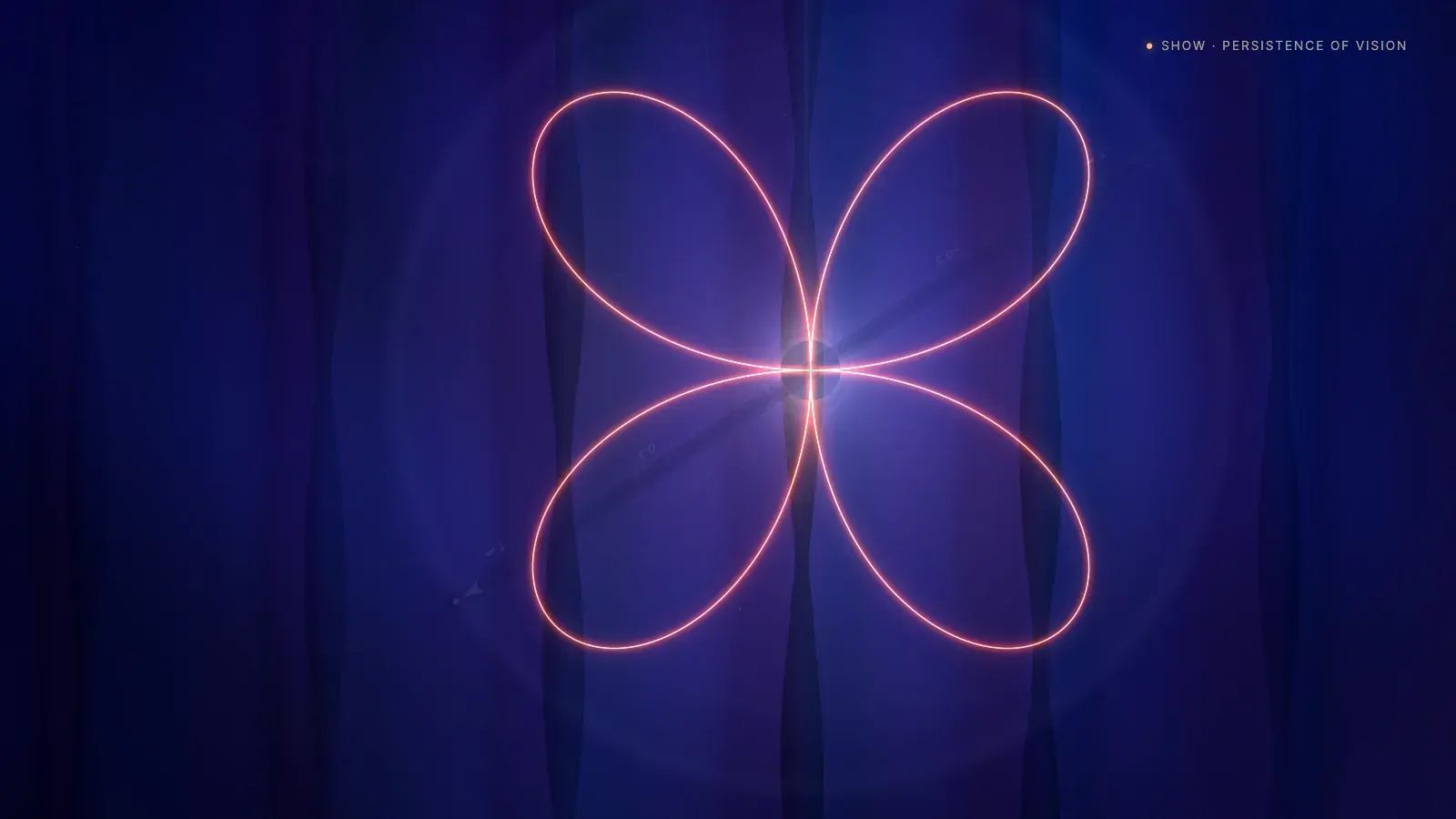
One spinning bar of LEDs paints this flower above the band. It flashes each light at just the right moment, and your eyes blend the flashes into those petals. For the encore, the lighting designer wants a laser beam to skim right across the top of the flower, just kissing it without cutting into it. The highest-looking points are the tips of the two top petals, so the designer measures them, about seventy-one centimeters above the center, and sets the laser at that height.
The beam slices straight through both petals, and if you look closely, you can see the petal rising above it, right past the tip. The tip is the point farthest from the center, so it looks like the top, but the real top of the petal is somewhere else, and you can’t see where just by looking.
By the end of this lesson, you’ll be able to take this flower’s equation, find exactly where its real top is, and put that laser right on it, so it kisses the flower instead of cutting it. To do that, we need to know which way the light is moving at every instant, so let’s slow the bar way down and watch it.
Two ways to move
Let’s slow the same bar down until you can follow one light at a time. The rule r equals sine of two theta tells us how far along the bar that light sits, in meters. Watch the lit spot closely, because it’s doing two things at the same time.
First, it slides along the bar, because a light a little farther out keeps switching on. How fast it slides is d r d theta, in meters along the bar per radian of turn. Second, the turning bar carries the light around. One radian of turn sweeps an arc as long as the radius, so every radian carries the light a distance of r.
Add those two arrows, and you get the light’s actual motion. The new arrow points along the curve, so it gives us the direction of the tangent. While d r d theta is positive, the light moves away from the center. Watch the slide shrink near the tip, because the light gets no farther out than that, and just past the tip d r d theta turns negative.
Here’s the light at the very tip, as far out on the bar as it gets. Which way is it moving right now? Just past the tip, d r d theta is negative while r is still positive. Is the light moving toward the hub or away from it?
A circle makes this even clearer. Let’s switch the fan to a circle, where the same light stays lit the whole way round, so d r d theta is zero the entire time, and yet the direction of travel swings through every direction there is. d r d theta on its own can’t tell us which way a polar curve is going, so for the real slope, dy by dx, let’s go to the board and build it from those two motions.
From the bar to the slope
First, where is the light? If the bar points at angle theta and the light is r meters out, then x equals r cosine theta and y equals r sine theta, just like in precalc. Here r depends on theta, it’s sine of two theta for our flower, so both coordinates are really functions of theta alone.
That makes the flower a parametric curve, with theta playing the part of time. We already know the slope of a parametric curve, dy by d theta divided by dx by d theta. On the circle, d r d theta stays at zero while the slope keeps changing, so the slope has to come from x and y, and not from r alone.
Let’s differentiate x equals r cosine theta. Both pieces change as theta changes, the distance r and the cosine, so this is a job for the product rule. The derivative of x is r prime cosine theta, minus r sine theta.
The slide arrow is r prime long and points along the bar, so its sideways part is r prime cosine theta. The turn arrow is r long and points across the bar, so its sideways part is minus r sine theta. The same thing happens for y, where dy by d theta is r prime sine theta plus r cosine theta, one piece from the slide and one from the turn.
Divide one by the other and you’ve got the slope of any polar curve, as long as dx by d theta isn’t zero. You can rebuild this fraction whenever you need it. Start with x equals r cosine theta and y equals r sine theta, use the product rule on each, and divide. Let’s cross out one trap, because the slope is not d r d theta. Students mix these two up all the time, and the circle already showed us why it can’t be.
Tangent lines: I do, we do, you do
Let’s find the tangent line at the tip of the petal, at theta equals pi over four, the moment the fan froze on. At pi over four, r is sine of pi over two, which is one. r prime is two cosine two theta, so here it’s two cosine of pi over two, which is zero, because the light isn’t sliding.
With r prime at zero only the turn pieces are left, so dx by d theta is negative root two over two, and dy by d theta is positive root two over two. Divide them, and the slope is negative one. Those signs say what the fan showed us, because x is decreasing and y is increasing, so the light moves left and up, still climbing.
Point-slope form uses Cartesian coordinates, so let’s convert the polar pair one, pi over four. We get root two over two for both x and y. Point-slope form gives y minus root two over two equals negative one times x minus root two over two, which tidies up to x plus y equals root two. Let’s sanity-check it. The bar lies along y equals x, with slope one, so our tangent is perpendicular to the bar, just as the turn arrow said.
You just found that the slope at the tip is negative one, so let’s aim a real laser with it. Turn the laser until its slope reads negative one, and watch the second spark.
That’s the line x plus y equals root two. It heads the way the flower heads at the tip. The whole flower stays on one side, so the beam touches only the tip. The designer’s flat beam cut straight through.
Let’s work through the cardioid r equals one plus cosine theta together, at theta equals pi over two. Here r is one, and r prime, which is negative sine theta, is negative one, so this time both pieces matter.
Try the first piece yourself, using dx by d theta equals r prime cosine theta minus r sine theta. What is dx by d theta at pi over two?
Then dy by d theta is negative one too, so the slope is one. The point is zero, one, so the tangent line is y equals x plus one, and the curve’s own tangent lands right on it.
Try one on your own. Find the tangent slope for r equals two sine theta at theta equals pi over three, and give your answer to the nearest hundredth.
Straight across, straight up
The most useful points are often where the tangent is flat or straight up. It’s horizontal when dy by d theta is zero and dx by d theta isn’t, because then the light moves sideways only. It’s vertical when dx by d theta is zero and dy by d theta isn’t. If both are zero, the fraction is zero over zero and tells you nothing yet, like at the cardioid’s pointy cusp, so you’d have to look closer.
You might remember this harbor light from related rates. Its lamp turns steadily, and its spot runs along a straight sea wall a hundred meters away. Put the lamp at the origin, and measure theta from the line straight out to the wall. This time x points at the wall, and y runs along it. The wall stays a hundred meters out, so r cosine theta is always a hundred, which makes r a hundred secant theta.
As the lamp turns, the beam gets longer fast. Its d r d theta is a hundred secant theta tangent theta, about a hundred and forty-one meters per radian at pi over four, and that’s the slide.
The turn carries the spot across the beam at r, also about a hundred and forty-one. Add the two arrows, and they point straight along the wall, with no drift in x. Which of these shows that the spot’s path has a vertical tangent at pi over four?
Back on the board, the slide piece is a hundred tangent theta and the turn piece is minus a hundred tangent theta, so they cancel, at every angle. The exam likes to add time. If the lamp turns at pi over fifteen radians per second, the chain rule gives d r d t equals d r d theta times d theta d t, about twenty-nine point six meters per second.
The real top of the flower
Now let’s fix the designer’s laser. The top of the petal is a horizontal tangent, where the light stops climbing and starts to fall, so it’s where dy by d theta is zero. Let’s put a little bubble level on the arrow. At the tip, the bubble says the light is still climbing, so the climb levels off somewhere past it. Turn the bar yourself, and stop it right where the light moves exactly sideways.
Let’s prove it the way the exam wants. The light’s height is y equals r sine theta, which here is sine two theta times sine theta. Its derivative is r prime sine theta plus r cosine theta, two cosine two theta sine theta, plus sine two theta cosine theta, in meters per radian.
Solving that by hand gets messy, so this is calculator work, like the calculator-active polar questions on the exam. Between the ends of the petal, the graph crosses zero once, at theta about zero point nine five five. dx by d theta there is about negative one point one five, not zero, so it really is a horizontal tangent.
Let’s compare the height at both ends of the petal with the height at our critical point. At both ends the light is at the hub, height zero. At the critical angle the light is about zero point seven seven meters up, while the tip only reaches about zero point seven one.
To earn the justification point, we need to explain why our comparison covers the whole petal. Because y is continuous on the interval from zero to pi over two, its greatest value happens at a critical point or an endpoint. Our three candidates have heights zero, about zero point seven seven meters, and zero, so the greatest height is about zero point seven seven meters, at theta about zero point nine five five.
The designer’s mistake was maximizing r, the distance from the center, when the question was about y, the height. On the 2025 AP exam this exact function was a curve’s x, and the answer was this same zero point nine five five. Some students tested r instead, the designer’s mistake.
Now the laser is yours. Raise it from the tips’ height until it just kisses the top of the flower. Six centimeters above the tips, the beam finally kisses the flower, right at the top our justification found.
How the curve bends
The slope itself changes as the light goes round, so it’s a function of theta too, and we’ll call it m. How m changes with x is the second derivative, and it tells us how the curve bends.
Differentiate m with respect to theta to find how fast the slope changes per radian. Dividing by dx by d theta converts that into slope change per unit of x. It’s the same move you made for parametric curves.
Let’s try the circle r equals two. Here r prime is zero, so dx by d theta is negative two sine theta, dy by d theta is two cosine theta, and the slope m is negative cotangent theta.
Before we compute, watch the tangent slide across the top of the circle from left to right. Its slope starts positive, passes zero at the top, and turns negative, so the slope keeps falling as x grows, which is what concave down means. Since m is negative cotangent theta, its derivative is cosecant squared theta, which still measures the slope’s change per radian.
Now divide by dx by d theta, which is negative two sine theta. That gives negative one over two sine cubed theta, the slope’s change per unit of x. At the top of the circle, where theta is pi over two, that’s negative one half, and negative means concave down, which is what the top of a circle should do. The top of our petal is concave down too. That’s why a flat beam can kiss it there.
If you stop at cosecant squared, you’ve only found the change per radian, so you still need to divide by dx by d theta. Taking y double prime over x double prime also fails, because differentiating a quotient doesn’t mean differentiating its top and bottom separately. Keep the circle r equals two, and find its second derivative with respect to x at theta equals pi over six.
Encore
For the encore the designer wants one more laser, a vertical beam that kisses the right side of the flower, so we need the point farthest to the right. On petal one, the light’s distance to the right is x equals r cosine theta, which is sine two theta times cosine theta.
Use the calculator to graph dx by d theta and find where it crosses zero on petal one. What is theta, to three decimal places? It’s the same zero point seven seven oh as the top, because the flower is symmetric across the line y equals x, so the rightmost point is just the top point reflected.
Now slide the laser until it just kisses the flower. There’s the encore, with both lasers kissing the flower right where the calculus said they would. Everything today came from two motions. d r d theta is only the slide, and the slope is dy by d theta over dx by d theta.
Those coordinate rates found the tangents, the highest point where dy by d theta is zero, and the rightmost point where dx by d theta is zero. To measure bending, we differentiated the slope with respect to theta and then divided by dx by d theta. And multiplying by d theta d t turns any of these into a rate per second.
You started this lesson watching a laser cut straight through a flower, and now you can take its equation and put the laser right where it kisses. Next time, we’ll find out how much area curves like this enclose, petals and all.