
Topic 9.6 key terms
- position vector
- r(t) = ⟨x(t), y(t)⟩: the arrow from the origin to the moving object at time t.
- derivative of a vector-valued function
- r′(t) = ⟨x′(t), y′(t)⟩: differentiate one component at a time; every derivative rule (chain rule included) works on each component.
- velocity vector
- v(t) = r′(t). It sits on the object and points the way it is moving; its components are how fast x and y are changing.
- acceleration vector
- a(t) = v′(t) = r″(t): how the velocity is changing, in size or in direction. Moving in a circle at constant speed still has acceleration, toward the center.
- speed
- The length of the velocity: |v(t)| = √(x′(t)² + y′(t)²). A number, never negative; speed is not a vector.
- initial condition
- One known value (a position or a velocity at one time) that fixes the constants of integration, one per component.
- particular solution
- The one position function with the given velocity that passes through the known point: r(t) = r(t₀) + ∫ from t₀ to t of v(u) du.
- displacement
- ∫ from a to b of v(t) dt = r(b) − r(a): the net change in position over [a, b], a vector (how far and which way).
- total distance traveled
- ∫ from a to b of |v(t)| dt = ∫ from a to b of √(x′(t)² + y′(t)²) dt (a ≤ b): the integral of the speed, the length of the path actually traveled.
Transcript
1,305 words · 4 parts
How far did it really go?
Integrals of velocity also answer a simple-sounding question, how far something went. Let’s mark where the pod is at t equals zero and let it ride exactly one turn. Before it goes, what do you think the integral of the velocity will come out to over that one turn?
The dashed arrow from the mark to the pod is the integral of the velocity so far, and the glowing string is the distance the pod has actually ridden. Halfway around, the arrow is two hundred meters long, and then it shrinks back to nothing, while the string keeps growing to about six hundred twenty-eight meters.
Those are two different integrals of the same motion. The integral of the velocity is the displacement, a vector that says how far and which way the object ended up from its start. For the distance actually traveled you integrate the speed, the square root of x prime squared plus y prime squared, which is the same integral as arc length, and since a speed is never negative, that integral only adds up.
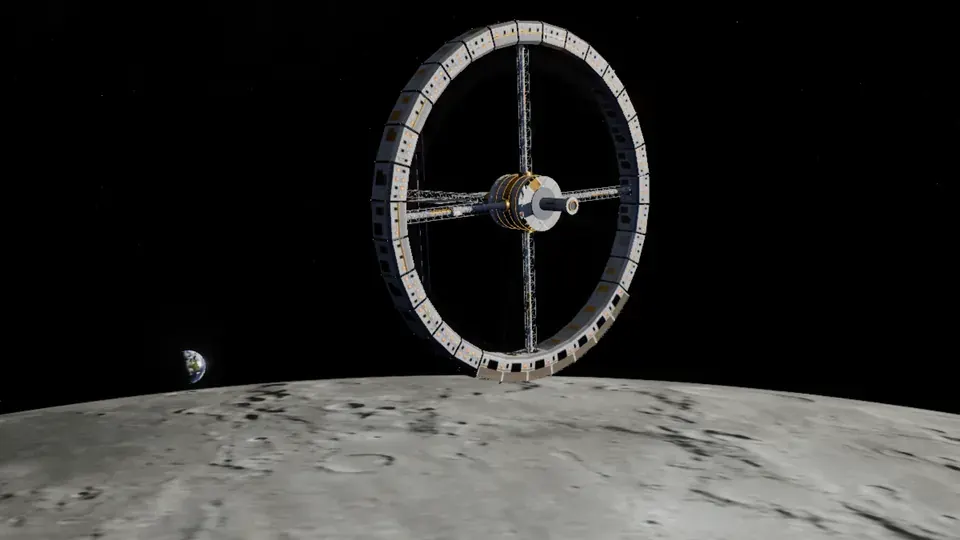
On the station the speed is always thirty, and one turn takes two pi over point three, which is twenty pi over three seconds. Thirty times that is two hundred pi, about six hundred twenty-eight meters, the whole circumference of the ring, while the displacement is zero, zero. Don’t integrate the components and then take the length, because that only gives the straight-line distance from start to end, which here is zero.
The rock shows the same split. Its arrow from the vent ends at about ninety-eight meters, while the string along its arc comes to about a hundred and forty. That’s the integral of the speed over the flight, and you’d find it with a calculator, which is where the AP exam takes these problems.
On the exam
On the AP exam this shows up in the calculator section. A survey drone flies over the crater, and y is its height above the rim, so a negative y means it has dipped inside the crater. The problem gives its velocity as these two components, x prime and y prime. The exam often writes them as d x d t and d y d t, and at t equals zero the drone is at zero, four.
Part a asks for the speed and the acceleration vector at t equals two. Speed is the length of the velocity, so I write the setup first, the square root of x prime of two squared plus y prime of two squared. Then the calculator gives ten point oh oh three meters per second.
For the acceleration, I differentiate each velocity component at t equals two, and the calculator gives two point one six one and point three eight five meters per second squared. Both are positive, so the velocity is changing toward the right and upward. Graders want that setup written down, not just a number from the calculator, and they want three decimal places.
Part b asks where the drone is at t equals four, and this is where people lose points by forgetting the starting point. For x, we start at zero and add the change from zero to four, the integral of x prime, which puts the drone about thirty point four meters to the right.
For y, we start four meters above the rim, and the integral of y prime adds a drop of about six point eight five meters, so we finish about two point eight five meters below the rim. Part c is all yours, so find the total distance the drone travels from t equals zero to four, to three decimal places.
Part d asks for a reason, and these are worth learning to write just right. At t equals four, is the drone moving toward the level of the rim, or away from it? Our answer to part b puts the drone below the rim, because y of four is negative. Its vertical velocity, y prime of four, is positive, about six meters per second, so its height is increasing toward zero, toward the rim.
This is the sentence I’d write on the exam. At t equals four the drone is moving toward the rim’s level, because y of four is negative, so it’s below the rim, and y prime of four is positive, so its height is increasing. Lots of students write only the second half, and that loses the point, because a drone above the rim with a positive y prime would be moving away from it.
Gravity from a circle
Now we can finally go back to that hallway. An acceleration bent the rock’s path into an arch, and the pod’s path bends too, all the way around in a circle. Take the pod’s velocity at two moments one second apart. Both arrows are thirty meters per second long, so the speed hasn’t changed, but the direction has.
Slide the second velocity arrow, without turning it, until both arrows start at the same point, and see which way the change in velocity points. Now shrink that second toward zero, and the change in velocity divided by the time settles on the acceleration, aimed right at the hub.
Let’s confirm it with the formula. When we differentiate the velocity, the chain rule pulls out another point three, so negative thirty sine becomes negative nine cosine and thirty cosine becomes negative nine sine.
Look at what’s hiding inside. A hundred cosine, a hundred sine is r of t itself, so the acceleration is negative point oh nine times the position, always pointing straight back toward the hub. Its length is the square root of eighty-one cosine squared plus eighty-one sine squared, and since sine squared plus cosine squared is one, that’s nine meters per second squared, at every moment.
To keep anything riding the rim on its circle, something has to accelerate it toward the hub at nine meters per second squared. In this hallway, the floor does that by pushing on their feet. A push like that through your feet feels exactly like weight, and nine is about nine-tenths of Earth’s nine point eight, so if you guessed Earth, you were very close.
Watch what happens when one of them lets go of a ball. From inside, it drops to the floor just like it would at home. Before we look from outside, make a call about what that ball is really doing, seen by a camera that doesn’t spin with the wheel.
Now watch from a camera that stays with the hub but doesn’t turn with the wheel. From there, the ball never falls at all. Once it leaves that hand nothing pushes on it, so it keeps the velocity it had and flies in a straight line while the floor swings around to meet it.
The same two derivatives work for any wheel spinning steadily. A radius R turning at omega radians per second gives an acceleration of R omega squared, and for us that’s a hundred times point oh nine, which is nine.
Now you design the station. Turn the spin dial until the people in that hallway feel exactly Earth’s gravity, nine point eight meters per second squared.
What you can do now
Let’s put it all together. Differentiate a position one component at a time to get the velocity, and again to get the acceleration. To run it backwards you integrate, and every integration needs one known starting fact to pin down its constants.
The length of the velocity is the speed, the integral of the velocity is the displacement, and the integral of the speed is the distance you actually traveled. You started with nothing but the formula for where that floor is, took two derivatives, and found the gravity in that hallway, nine meters per second squared, about nine-tenths of what you feel at home.