
Topic 9.8 key terms
- area of a slice of a circle
- A slice (sector) of a circle with radius and angle in radians has area .
- polar area formula
- The area of the region swept by the ray from to out to the curve is .
- trace the region once
- Choose limits so the ray sweeps the region exactly once; the integral counts every wedge it sweeps, even twice. Endpoints are often where .
- cardioid
- A heart-shaped polar curve such as ; the ideal cardioid microphone's pickup pattern is .
- area between two polar curves
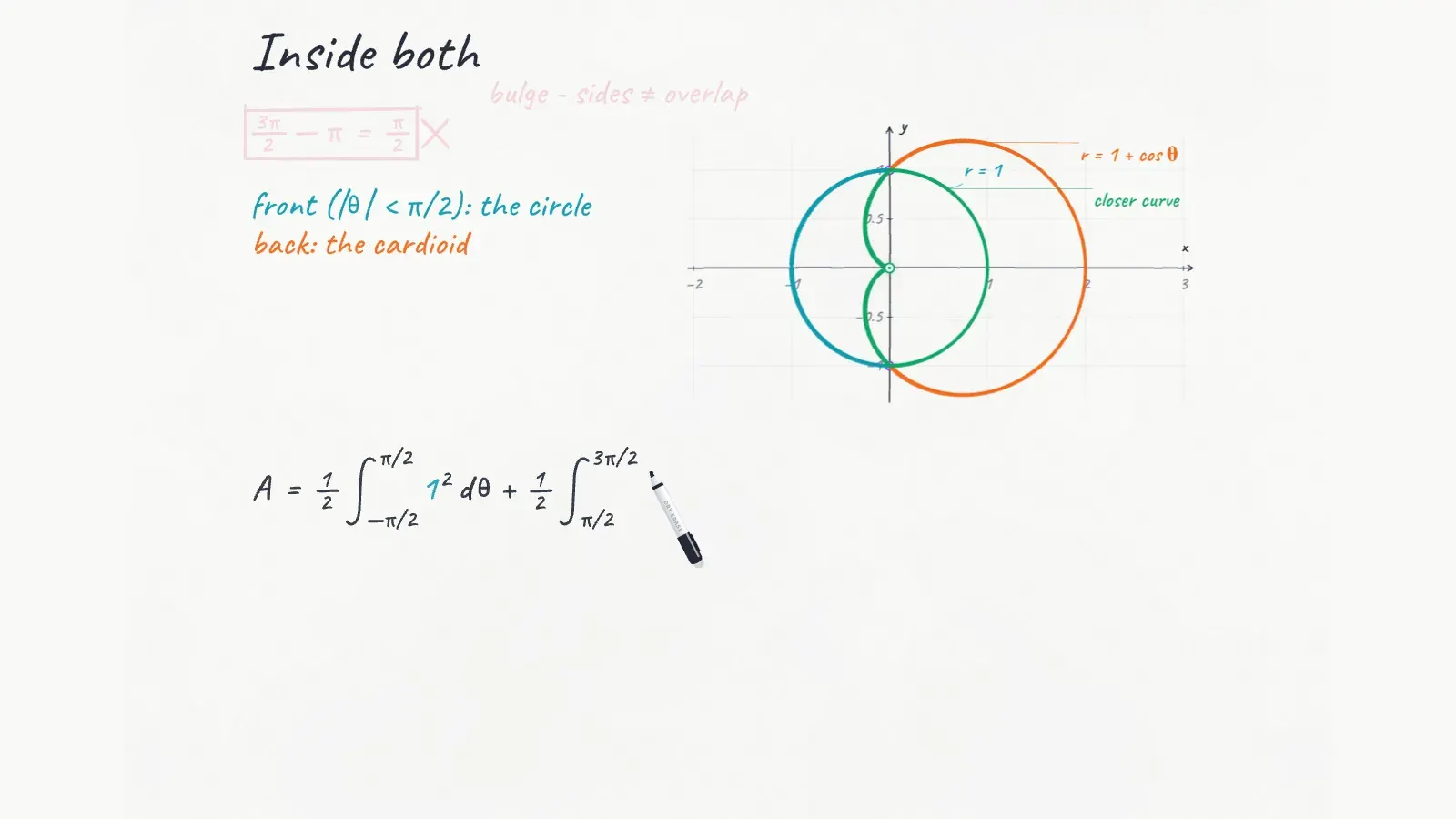
- If on , the area between them is : outer squared minus inner squared, never the gap squared.
- intersection of polar curves
- Points shared by both curves. For nonnegative radii on the same rays, solve and check the pole separately; if negative radii occur, also check the equivalent point .
- splitting at intersections
- When the boundary of a region changes from one curve to another, split the integral at the intersection angles and integrate each piece with its own radius.
Transcript
1,382 words · 4 parts
One voice through the roar
Every seat in this theater is full tonight, and listen to that crowd. The roar bounces off the walls, the balcony and the ceiling, so it reaches the stage from every direction at once. And yet when the singer leans into this one microphone, you hear her voice, clean and clear, right over the top of all of it.
You might remember this shape from precalc. It shows how strongly the mic responds to sound from each direction, so it hears everything in front of it, where she’s singing, and almost nothing from behind, where the crowd is. A plain microphone that hears every direction equally would draw this circle instead. Picture that roar reaching the mic equally from every direction across the stage.
Then the room inside each shape tells you how much of it the mic picks up. The smaller the heart is next to the circle, the more of the crowd it shuts out. By the end of this lesson, you’ll be able to measure the area inside this heart exactly. Then you’ll work out how much of that roar the microphone throws away.
Before we measure anything, make a guess. The heart reaches all the way out to the circle in front, so how much of the circle do you think it fills?
So far in calculus, every area came from slicing a region into thin rectangles, and a heart that curls around a point doesn’t slice neatly into rectangles. So we need a new kind of slice. The best place to look for one is a shape whose area you already know, the circle.
A slice of a circle
Take a circle of radius r. Its whole area is pi r squared, and that’s what you get when you go all the way around, through an angle of two pi. Now cut out a slice with a small angle, delta theta. The slice is just a fraction of the circle, delta theta out of the full two pi, so its area is that fraction times pi r squared. The pis cancel and leave a two on the bottom, so the area of a slice is just one half r squared delta theta.
Let’s make sure it behaves. Go all the way around, delta theta equals two pi, and you get pi r squared back. Notice that we square the radius. If you double the radius and keep the angle, the slice gets four times bigger, not twice as big. Forgetting that square was the most common mistake on the 2025 AP exam’s polar area question.
See if you can do one on your own. A slice of a circle has a radius of three and an angle of pi over three, so what’s its area, to three decimal places?
Let’s go back to the heart. It’s a mirror image top and bottom, so let’s measure just the top half first, from the front of the mic, at theta equals zero, around to the back, at theta equals pi.
We’ll fill it with slices of a circle. Each wedge of light starts on a ray and takes its radius from the heart on that ray, so every wedge is a perfect slice of a circle. Let’s lift one out and look at it. It has a radius r and a little angle delta theta, so its area is one half r squared delta theta, the formula we just found.
The wedges don’t fit perfectly. Each one pokes out a little past the heart, because the heart keeps shrinking as we go around, so adding up all six gives about point seven two, which is a bit too big.
So let’s cut thinner wedges. With twelve, the sum drops to about point six five, and with twenty-four it’s about point six two. Every time we double the wedges, the part that pokes out gets cut in half.
Now you hold the knife. Drag the number of wedges until the part that pokes out adds up to less than one hundredth, and see how many wedges that takes.
The stage knows the true area, so it shows how far over we are. With ninety-six, the wedges hug the heart so tightly you can barely see them poke out, and the sum is closing in on one number, about point five eight nine. That number is the area of the top half, so let’s write down what we just did the way calculus writes it.
Each wedge gives us one half, times the heart’s radius on its ray squared, times delta theta, and we add them all up. Then we let the wedges get infinitely thin, and the sum becomes an integral. The area equals one half the integral from alpha to beta of r of theta, squared, d theta.
Alpha and beta are the rays where the region starts and stops, and the integral sweeps the ray from one to the other, adding up wedges as it goes. It’s the same plan you used for area under a curve, slicing, adding and taking the limit, and the only thing that changed is the slice, a thin wedge instead of a thin rectangle. Before we use it, which of these integrals gives the area of the heart’s top half?
Measuring the heart
Now let’s measure the whole heart. As theta goes once around, from zero to two pi, the ray traces the heart exactly once, so those are our limits. The radius is one plus cosine theta, over two, which is one straight ahead and zero at the back. Squaring the radius puts a four on the bottom, which joins the one half to make one eighth, and on top we expand one plus cosine theta, squared.
Over one full turn, the one integrates to two pi, and two cosine theta integrates to zero, because cosine spends as much of the turn negative as positive. Cosine squared needs an identity you’ve seen before. Cosine squared theta is one half plus half of cosine two theta, so it’s one half plus half a cosine wave. Over a full turn the wave adds up to zero, so only the one half counts, and one half times two pi is pi.
That’s one eighth of two pi plus zero plus pi, so the area of the heart is three pi over eight, about one point one seven eight. That matches the wedges, because twice the top half’s point five eight nine is one point one seven eight. And it’s less than half of pi, the area of the radius-one circle, so if you guessed less than half, you were right. There are no units here, because the mic’s radius is a ratio.
Let’s watch the heart fill up. The light sweeps once around, the area climbs to one point one seven eight, and compared with the circle’s pi, that’s three eighths, only thirty-seven and a half percent. So if the roar came equally from every direction across the stage, this mic would pick up three eighths of what a plain microphone would. The r squared in our formula is why that works, because the power a microphone picks up goes with the square of its sensitivity.
Trace it exactly once
The limits are where a lot of mistakes happen, so let’s try a curve that looks completely innocent, r equals sine theta. As theta goes from zero to pi, the ray draws this little circle. Suppose we use zero to two pi, the way we did for the heart. Then one half the integral of sine squared, from zero to two pi, works out to pi over two.
This circle has a radius of one half. Is pi over two really its area? So we stop at pi, where the circle closes up. One half the integral from zero to pi gives pi over four, which matches the geometry.
The integral can’t tell that it’s painting over itself, so that part is your job. Find where the curve starts and stops, which is often where r equals zero, and pick limits that trace the region exactly once.
Let’s practice on a four-petal flower, r equals cosine two theta. Each petal starts and ends at the pole, where r is zero. Find the area of one petal of r equals cosine two theta, to three decimal places.