
Topic 9.4 key terms
- position vector
- r(t) = ⟨x(t), y(t)⟩: the arrow from the origin to the moving object at time t.
- derivative of a vector-valued function
- r′(t) = ⟨x′(t), y′(t)⟩: differentiate one component at a time; every derivative rule (chain rule included) works on each component.
- velocity vector
- v(t) = r′(t). It sits on the object and points the way it is moving; its components are how fast x and y are changing.
- acceleration vector
- a(t) = v′(t) = r″(t): how the velocity is changing, in size or in direction. Moving in a circle at constant speed still has acceleration, toward the center.
- speed
- The length of the velocity: |v(t)| = √(x′(t)² + y′(t)²). A number, never negative; speed is not a vector.
- initial condition
- One known value (a position or a velocity at one time) that fixes the constants of integration, one per component.
- particular solution
- The one position function with the given velocity that passes through the known point: r(t) = r(t₀) + ∫ from t₀ to t of v(u) du.
- displacement
- ∫ from a to b of v(t) dt = r(b) − r(a): the net change in position over [a, b], a vector (how far and which way).
- total distance traveled
- ∫ from a to b of |v(t)| dt = ∫ from a to b of √(x′(t)² + y′(t)²) dt (a ≤ b): the integral of the speed, the length of the path actually traveled.
Transcript
831 words · 2 parts
Nothing weighs anything up here
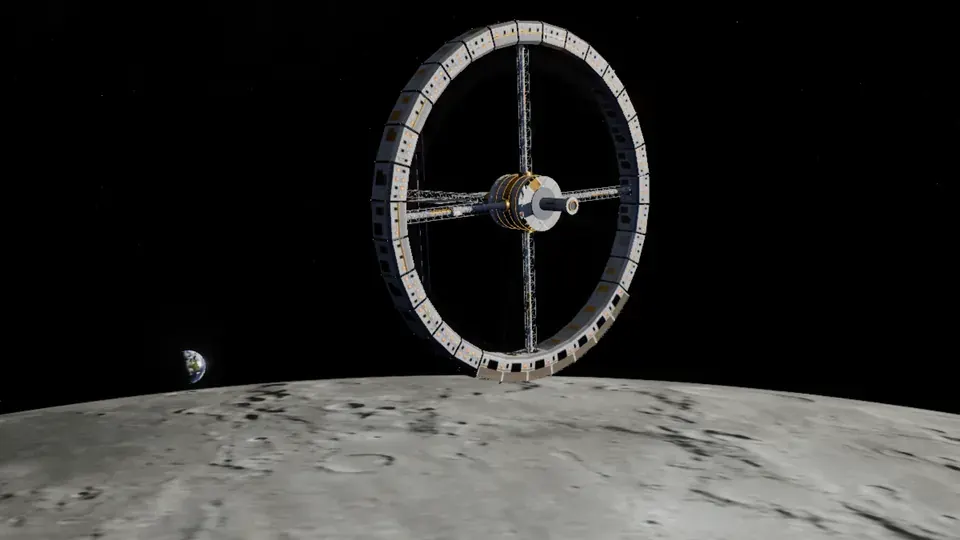
Picture a space station a hundred kilometers above the Moon, a wheel two hundred meters across that turns all the way around about once every twenty-one seconds. Up here the station and everything floating near it are falling around the Moon together, so anything drifting out here feels no weight at all. Now look at these two people. They’re standing on the floor and walking around like it’s a school hallway, even though there’s no planet anywhere under their feet.
Their floor is pushing on them every second they’re in there, and the only reason it pushes is that the wheel turns. It’s the same reason the ships in Interstellar and The Martian spin. By the end of this lesson, you’ll be able to start from nothing but the formula for where this floor is, take two derivatives, and work out exactly how strong the gravity in that hallway is.
Before we do a single derivative, I want your gut feeling about which world’s gravity that floor feels the most like. To get there we need to know how this floor moves, so let’s start with the cargo pod riding on its rim, and freeze it right here.
Where it’s going
If you took precalc with us, you’ve met this pod. The origin sits at the hub, and the arrow from the hub out to the pod is its position vector, r of t. For this station, r of t is a hundred cosine of point three t, a hundred sine of point three t, in meters, and right now that’s sixty, eighty.
In precalc I also handed you its velocity, negative thirty sine of point three t, thirty cosine of point three t, and promised that calculus would explain where it comes from. Back then we watched the pod for a short time h, took its change in position, r of t plus h minus r of t, and divided by h.
As h shrinks toward zero that arrow settles on the velocity, and a limit like that, a change over h as h goes to zero, is a derivative. Velocity is the derivative of position, which is great news, because you already know how to take it. Let’s write that change as two components. When we divide the vector by h, we divide both components by h, so each coordinate gets its own familiar difference quotient.
The limit splits into two ordinary derivatives you’ve taken a hundred times, so you differentiate a vector-valued function one component at a time. It’s the parametric x of t and y of t you already know, packed into one arrow. That’s the velocity, v of t. Differentiate it once more and you get the acceleration, a of t, which tells you how the velocity itself is changing.
Let’s start with something friendly. Say a particle’s position is t squared, three t, in meters, so its path curves up and to the right. The derivative of t squared is two t and the derivative of three t is three, so the velocity is two t, three. Differentiate again and the acceleration is two, zero. At t equals two it sits at four, six, and its velocity is four, three, so at that instant it’s moving four meters per second to the right and three up.
Notice where that arrow lives. To show where the particle is heading, I draw the velocity starting right on the particle, at four, six, not at the origin, because it tells you which way the particle moves from where it is. The speed is the length of that arrow, the square root of four squared plus three squared, which is five meters per second.
Now let’s do the station together. What’s the derivative of its x part, a hundred cosine of point three t? The derivative of cosine is negative sine, and the chain rule makes us multiply by the derivative of the inside, point three, so we get negative thirty sine of point three t. The y part works the same way, so a hundred sine of point three t gives thirty cosine of point three t.
That’s the very formula I gave you in precalc, and its thirty is a hundred meters times point three radians per second, straight out of the chain rule. At our frozen moment the cosine is point six and the sine is point eight, so the velocity is negative twenty-four, eighteen, the same arrow the shrinking window found. Its length is thirty meters per second at every moment, because sine squared plus cosine squared is always one.
Now try one yourself. A particle’s position is four sine of pi t, t cubed minus two t, in meters. What’s its velocity at t equals one?
Back on the station, the velocity’s first component, x prime of t, tells you how fast the pod’s x coordinate is changing right now. Drag the pod around the ring and find the moment its x coordinate is shrinking the fastest.