
AP Chemistry Cheat Sheet
Updated · For the May 2027 AP exam · Free PDFs
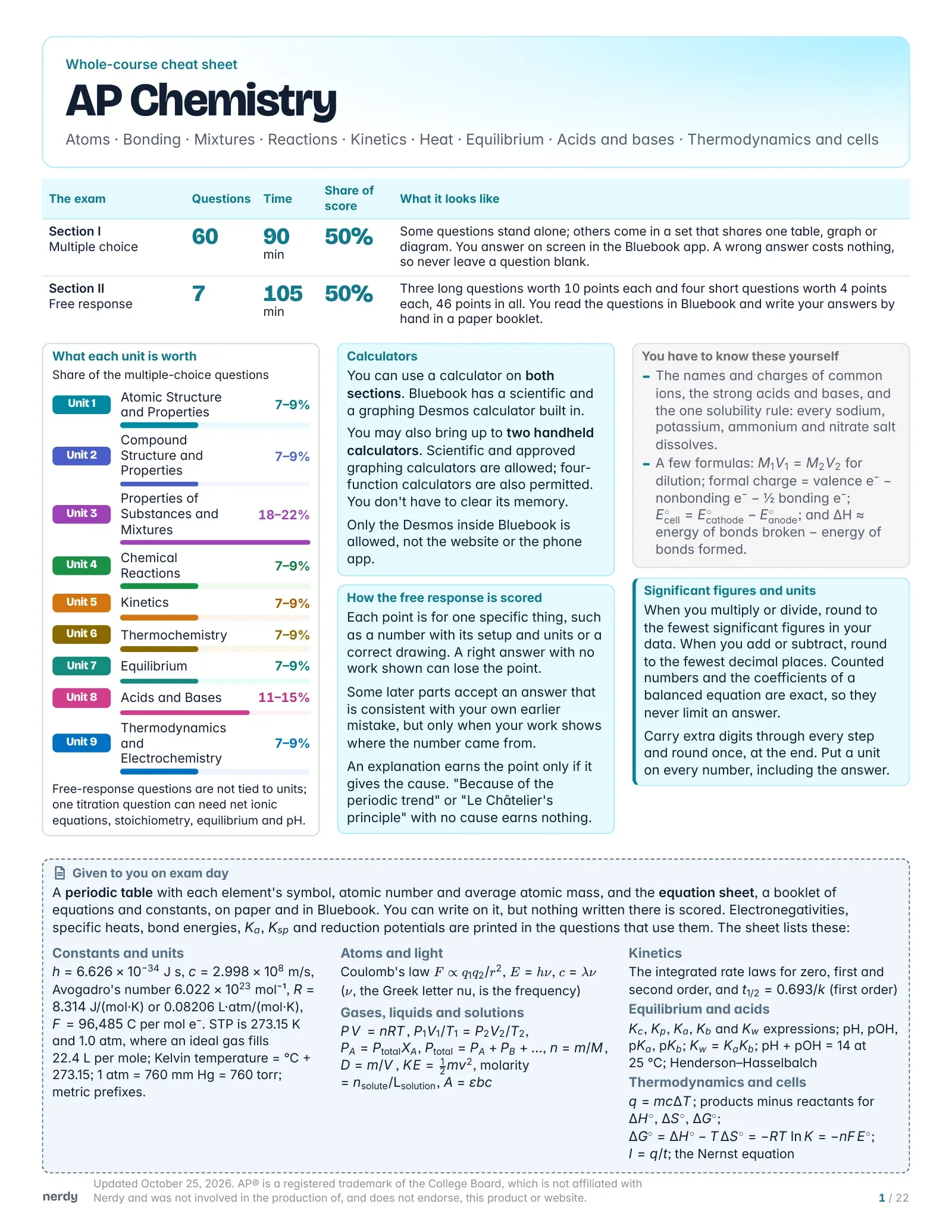
The whole course · 22 pages · 2.2 MB
AP Chemistry Cheat Sheet: The Whole Course
All nine AP Chemistry units in course order, topic by topic: the key ideas, the formulas and whether the exam's equation sheet prints them, the common mistakes and short worked examples, plus the exam's format and what earns free-response points.
Download PDF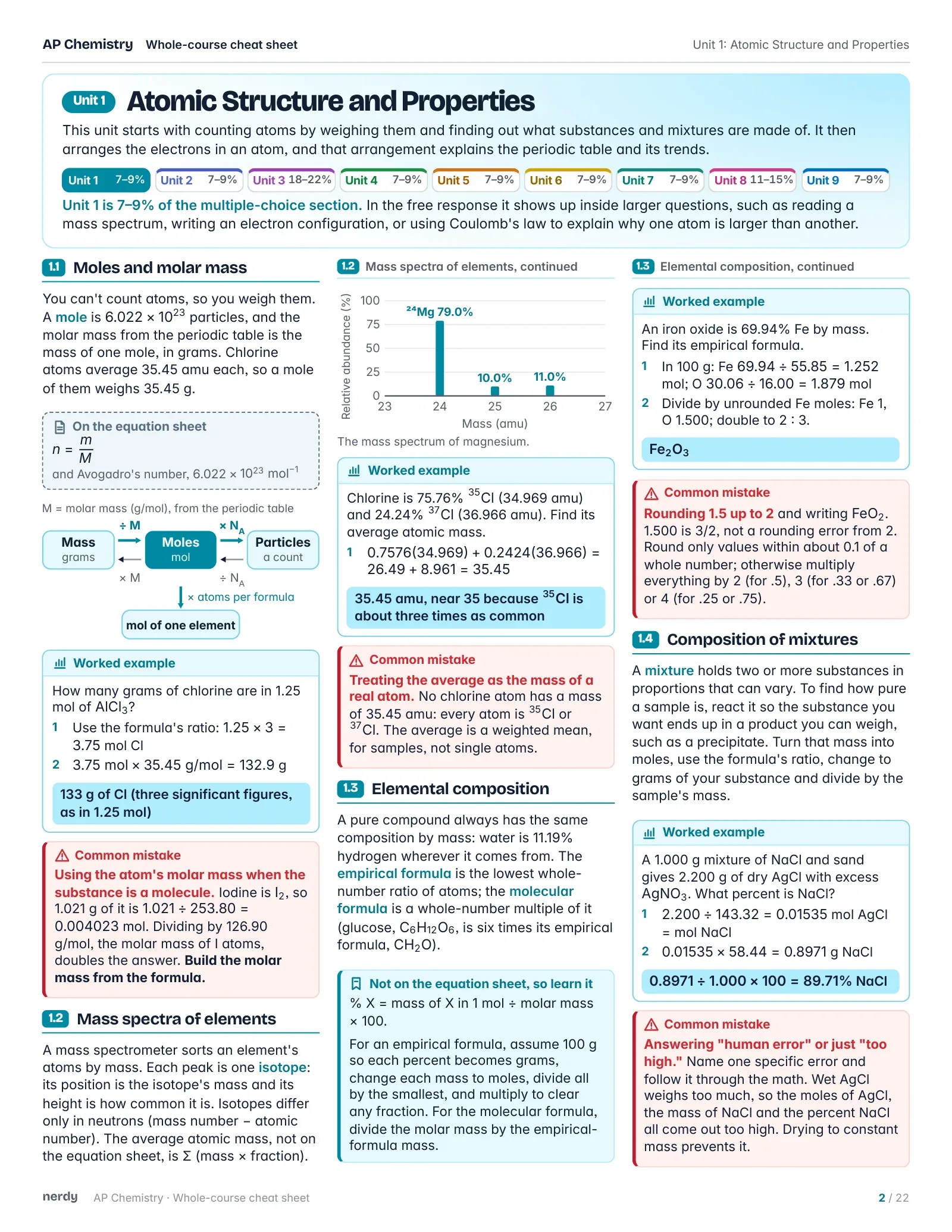
Every unit, in more depth

Unit 1
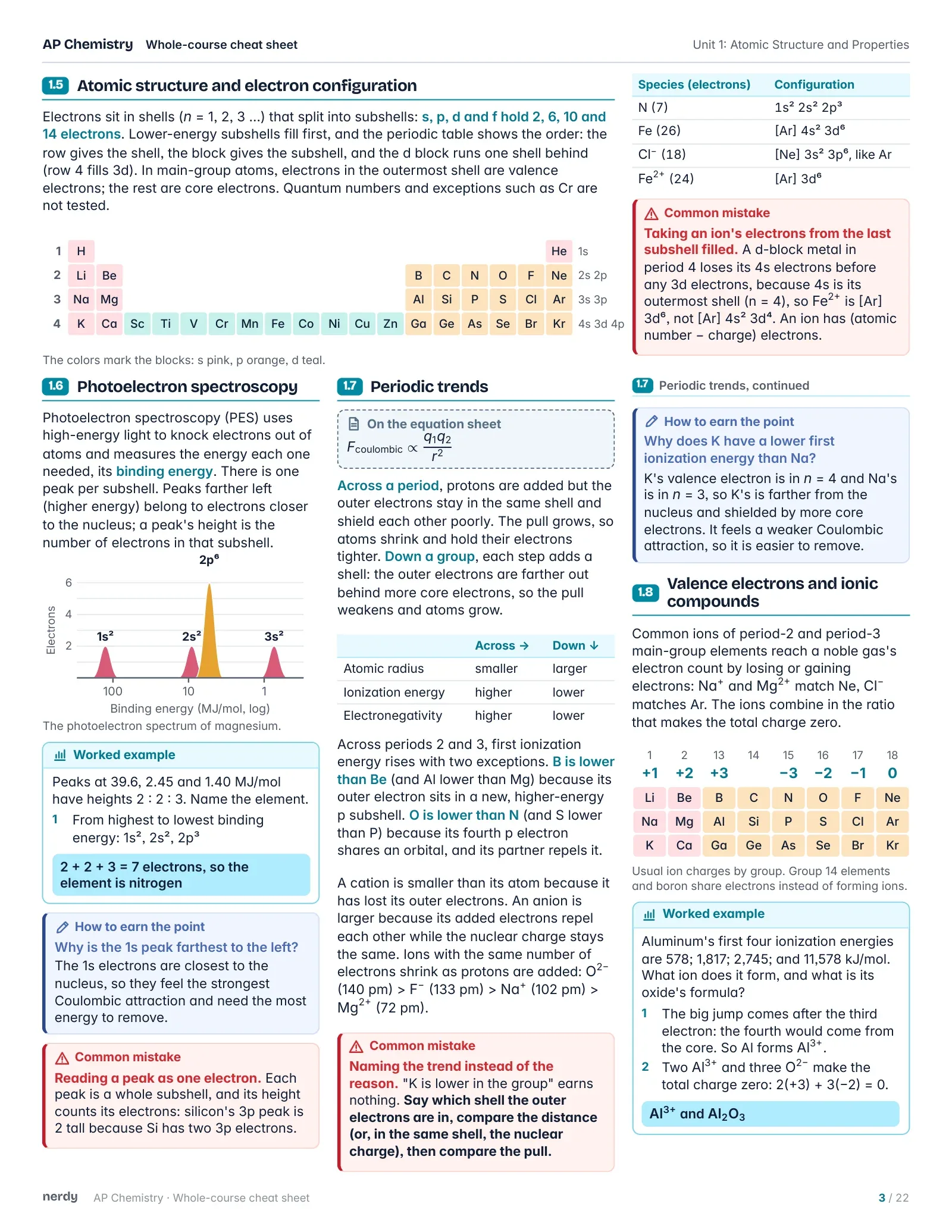
Atomic Structure and Properties
Moles, mass spectra, empirical formulas, mixtures, electron configurations, photoelectron spectra, periodic trends and ion charges, with the explanations and traps the AP exam scores.
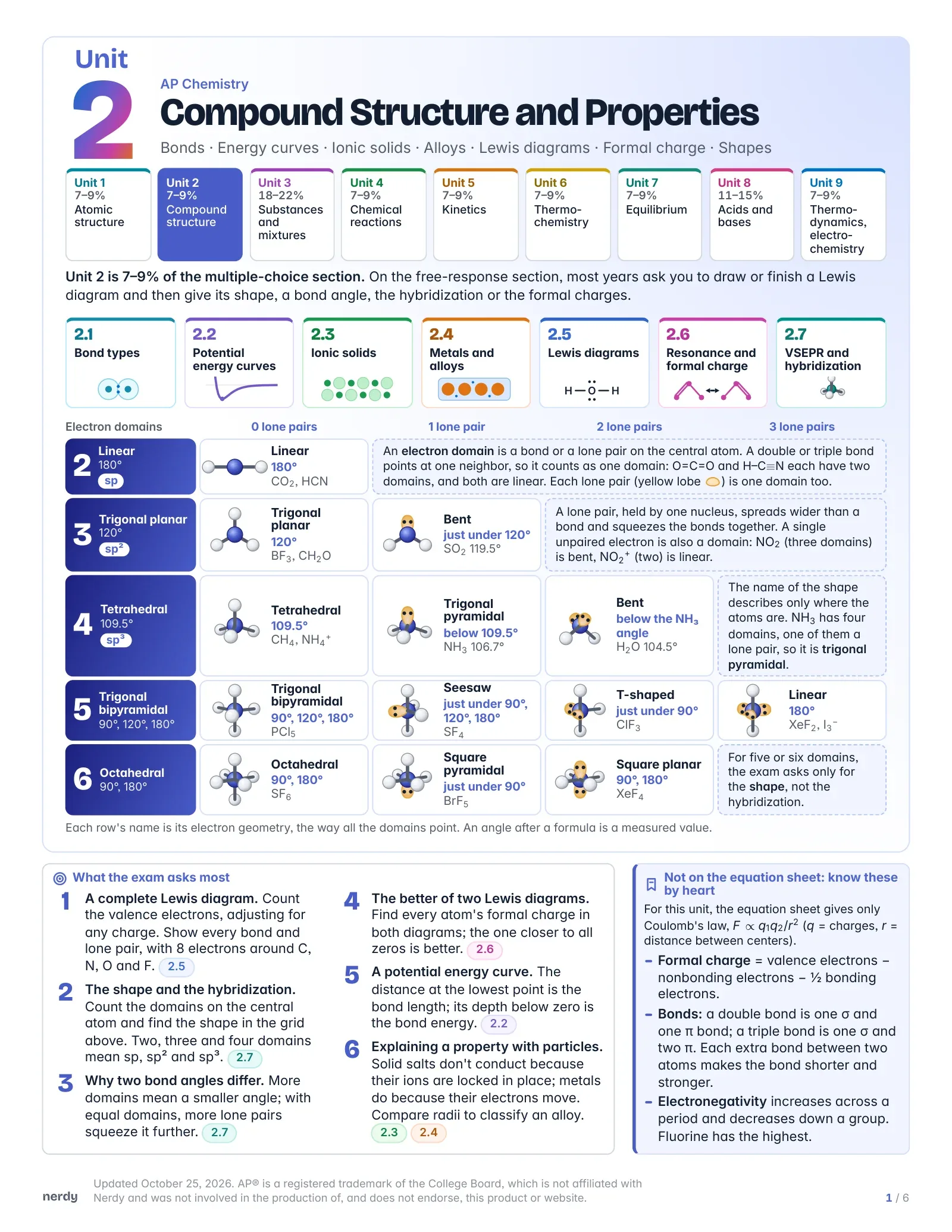
Unit 2
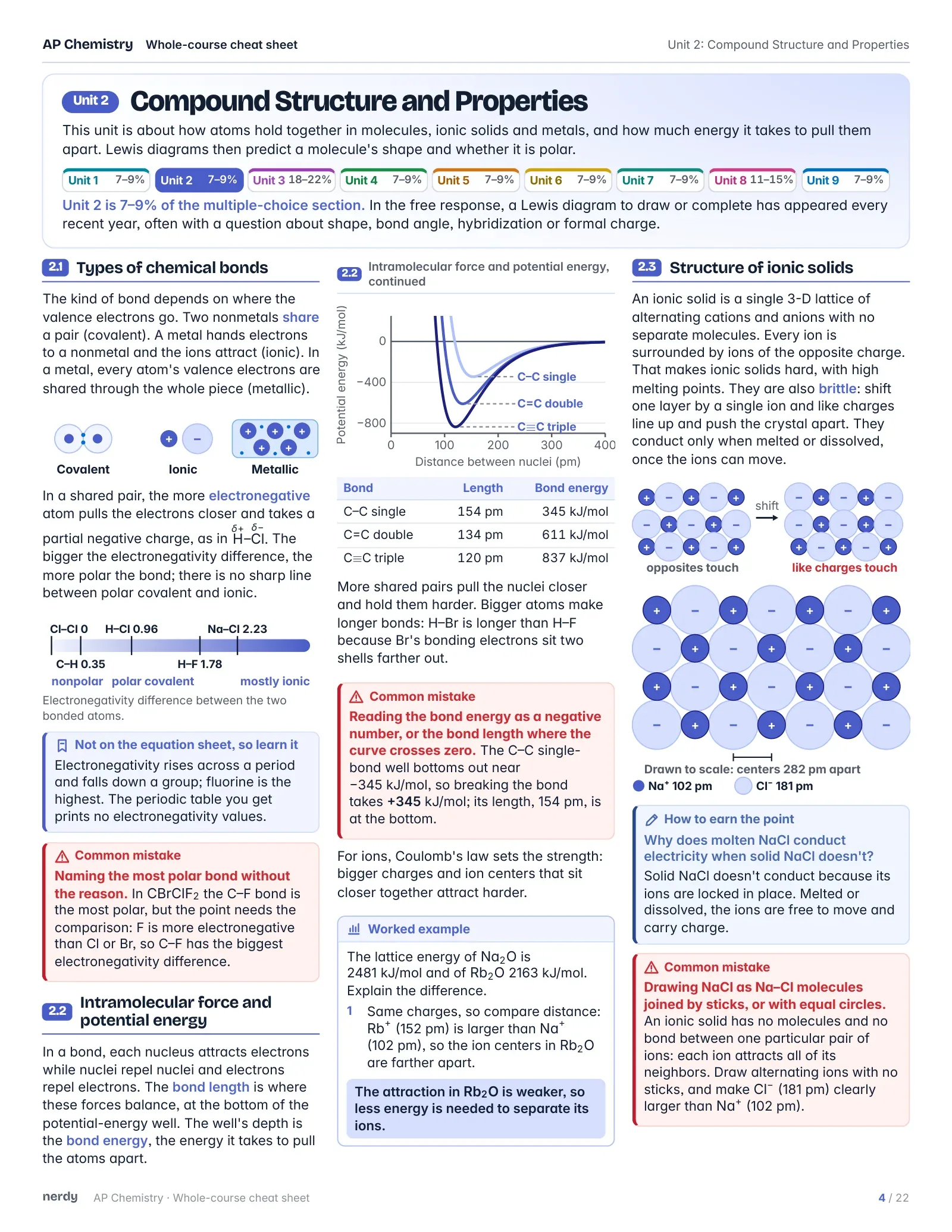
Compound Structure and Properties
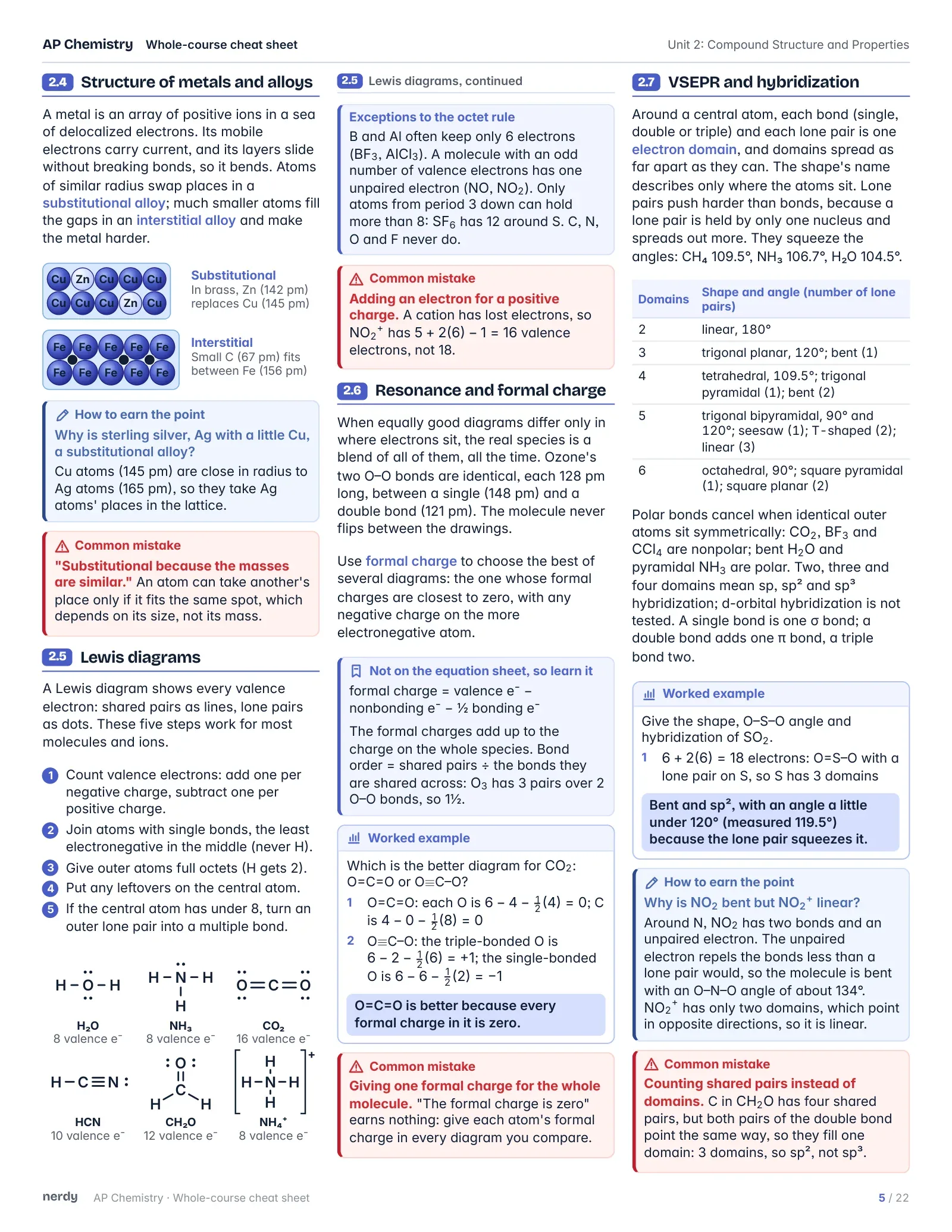
Bond types, potential energy curves, ionic solids, metals and alloys, Lewis diagrams, formal charge, resonance, VSEPR shapes and hybridization, with the explanations and traps the AP exam scores.

Unit 3
Properties of Substances and Mixtures
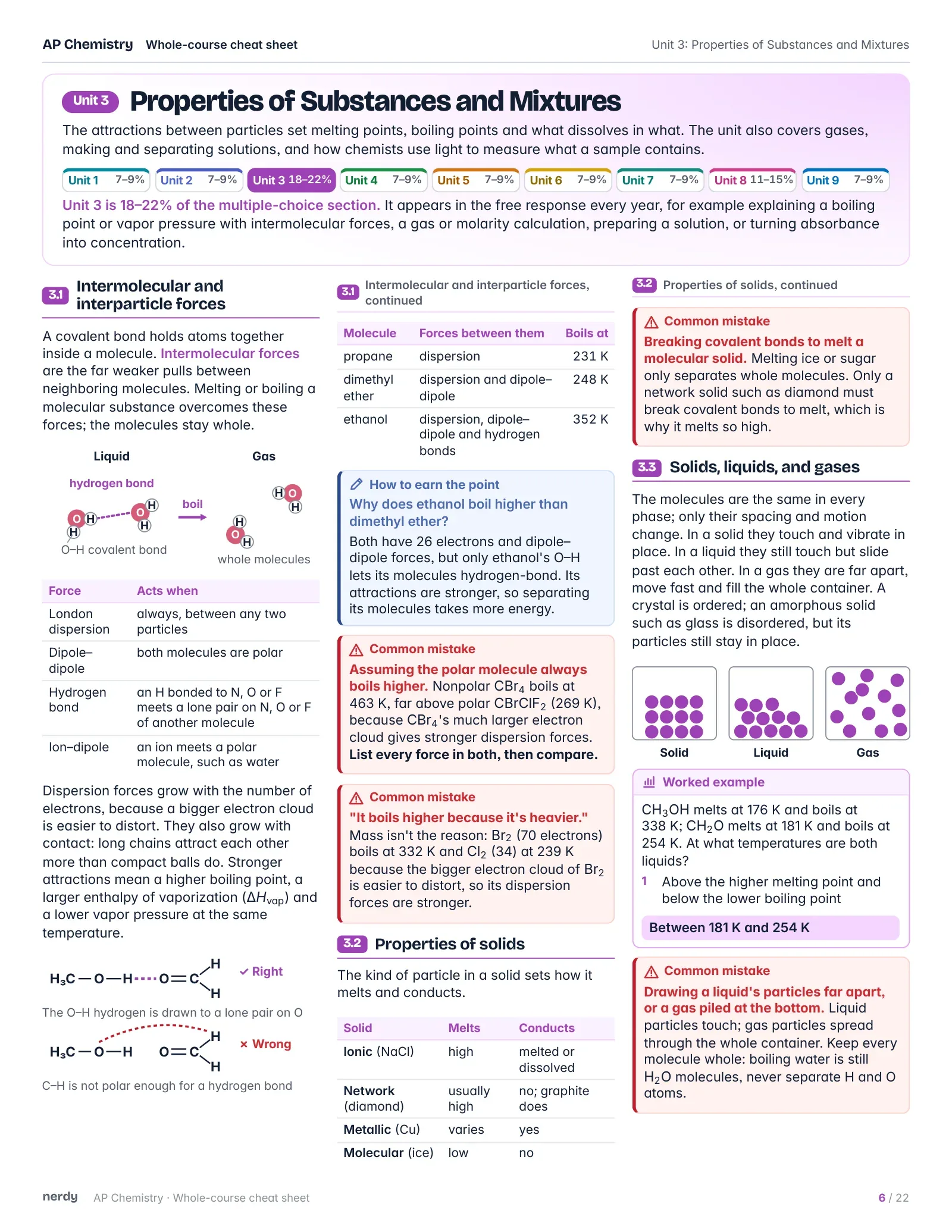
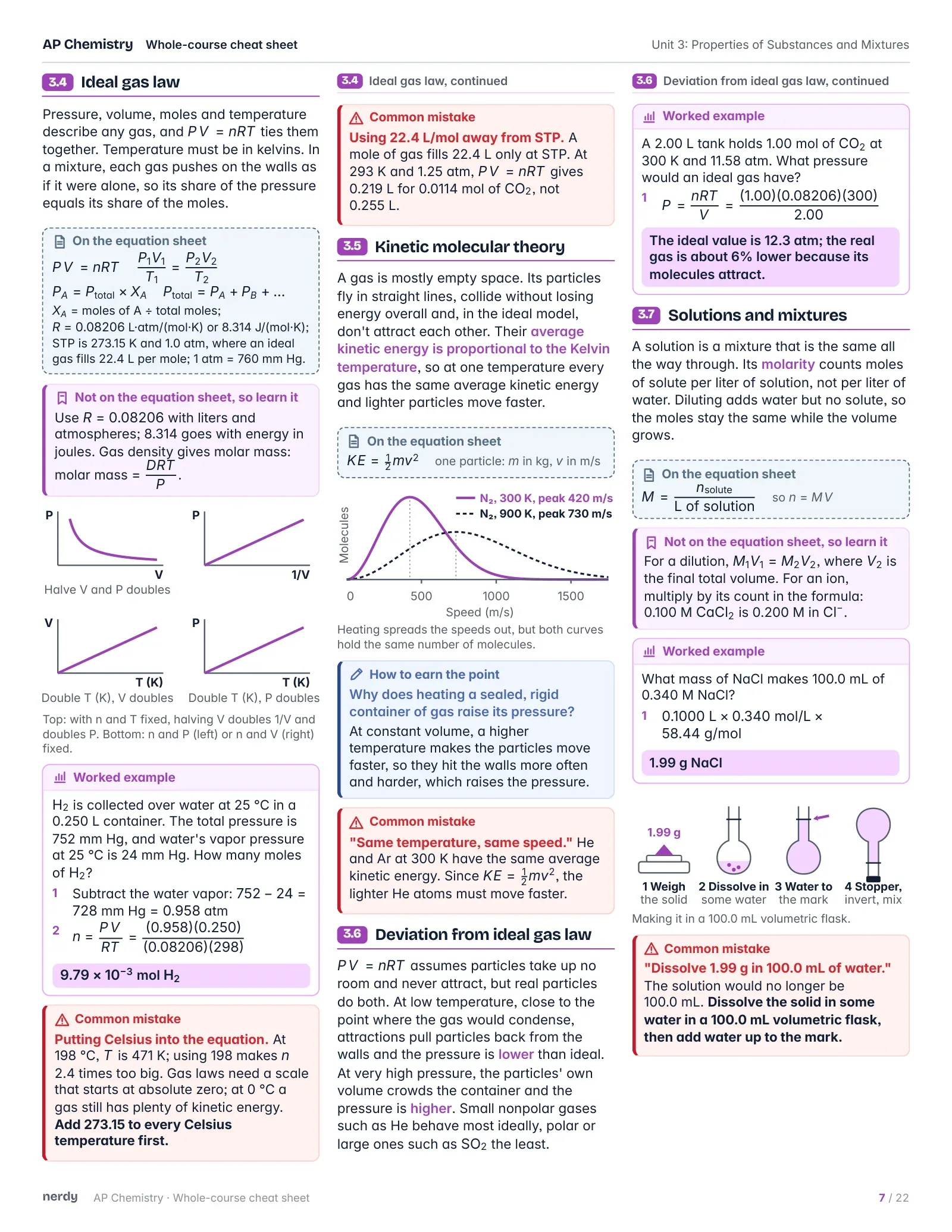
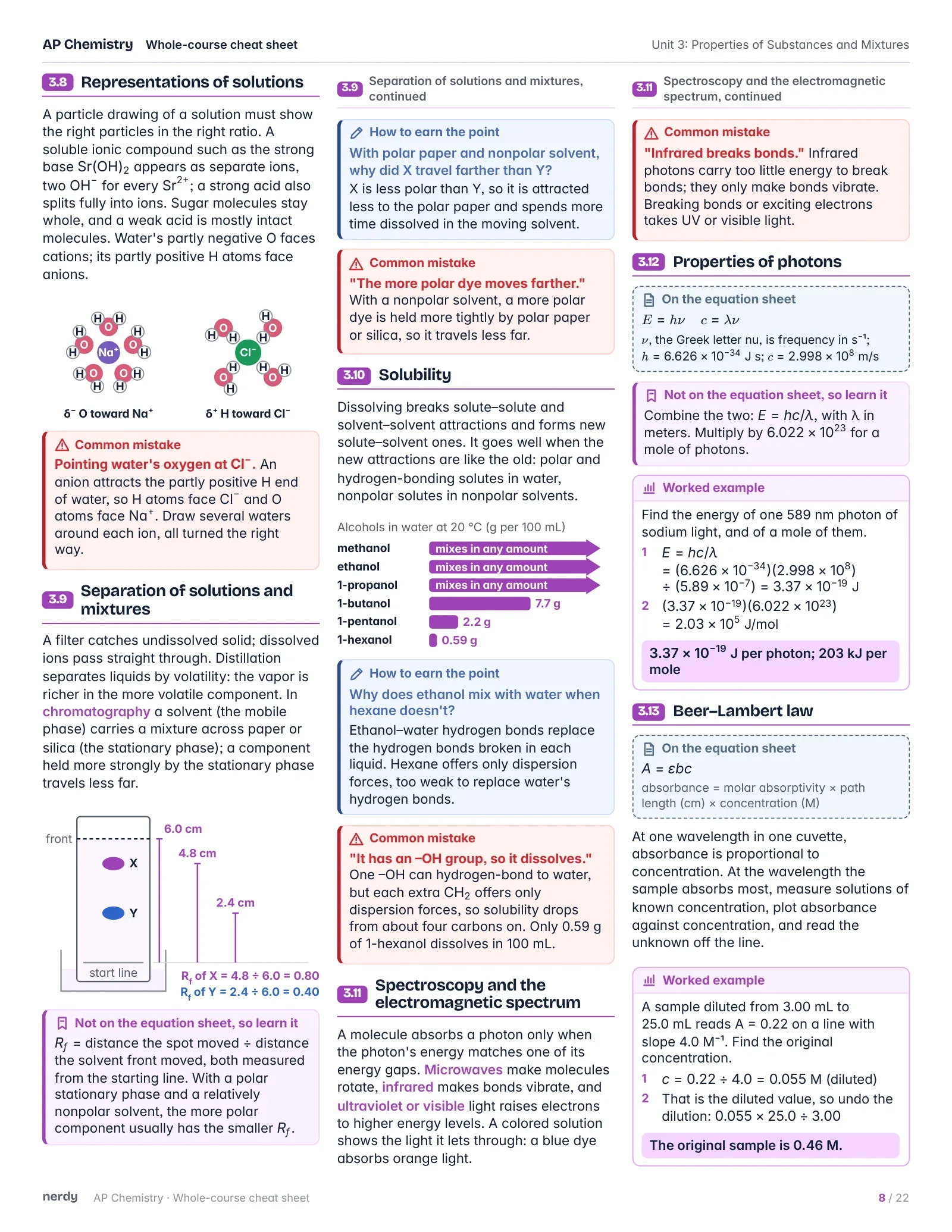
Intermolecular forces, solids, liquids and gases, the ideal gas law, kinetic molecular theory, real gases, molarity and dilution, particle diagrams, chromatography, solubility, spectroscopy, photons and Beer's law, with the explanations and traps the AP exam scores.

Unit 4
Chemical Reactions
Net ionic equations, particle diagrams, stoichiometry and limiting reactants, titration, reaction types, acid–base pairs and redox half-reactions, with the moves and traps the AP exam scores.
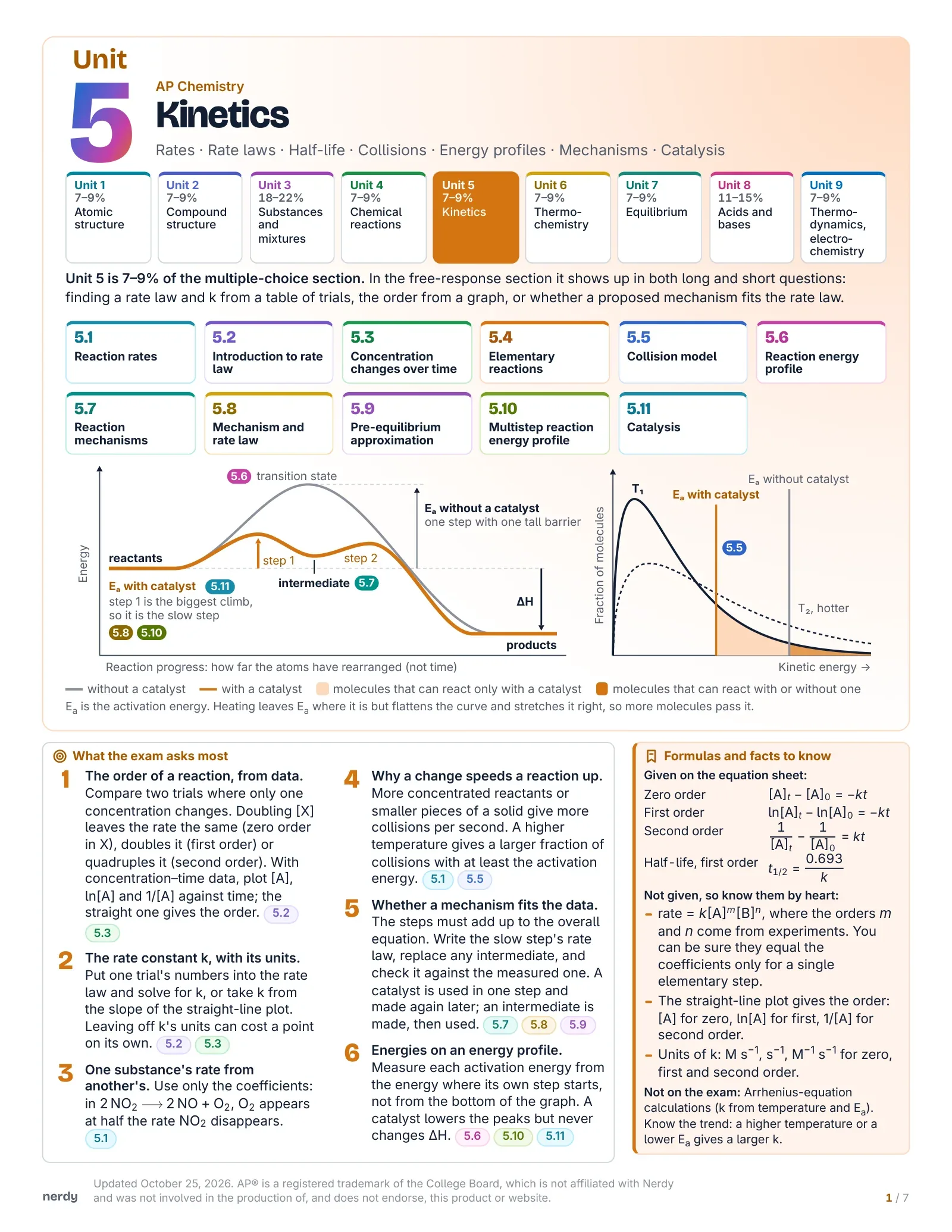
Unit 5
Kinetics
Reaction rates, rate laws from data, integrated rate laws and half-life, collisions, energy profiles, mechanisms, pre-equilibrium and catalysis, with the explanations that earn points on the AP exam and the mistakes that lose them.

Unit 6
Thermochemistry
Endothermic and exothermic processes, energy diagrams, heat transfer, calorimetry, phase changes, enthalpy of reaction, bond enthalpies, formation enthalpies and Hess's law, with the worked numbers, sign rules and traps the AP exam scores.

Unit 7
Equilibrium
Dynamic equilibrium, K and Q expressions, calculating K, ICE tables, particle diagrams, Le Châtelier's principle, Ksp and the common-ion effect, with the explanations and traps the AP exam scores.
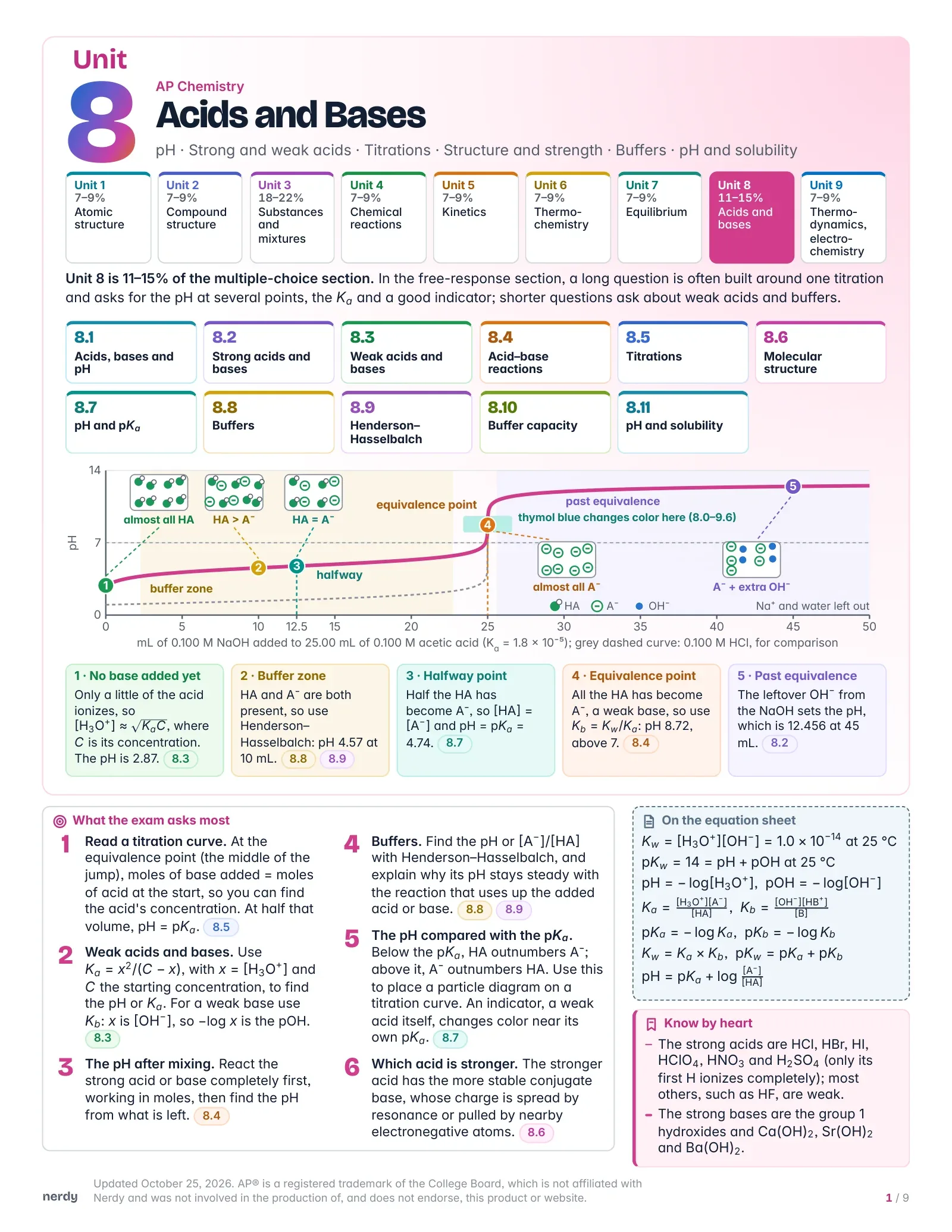
Unit 8
Acids and Bases
pH and pOH, strong and weak acids and bases, mixing and titration curves, acid strength from structure, pKa and indicators, buffers, Henderson–Hasselbalch, buffer capacity and pH-dependent solubility, with worked examples and the mistakes students most often make on the AP exam.

Unit 9
Thermodynamics and Electrochemistry
Entropy, Gibbs free energy, kinetic control, free energy and K, dissolution, coupled reactions, galvanic and electrolytic cells, cell potential, the Nernst equation and Faraday's law, with the explanations and traps the AP exam scores.