
The 2026 free-response questions
College Board has released the 2026 questions and their scoring guidelines. Keep the questions open as you read: the graphs, particle diagrams and Lewis structures are in that PDF, and the data below are summarized from it. Each answer here is ours, written for this page and checked against the guidelines.
| Question | Points | What it asked about | Units |
|---|---|---|---|
| 1 (long) | 10 | KCl: the K⁺ configuration and size, calorimetry and ΔH of solution, Ksp and a common ion | 1, 6, 7 |
| 2 (long) | 10 | Chromate and dichromate: VSEPR and resonance, net ionic equation, ΔG° from E°, electroplating, first-order kinetics | 2, 4, 5, 9 |
| 3 (long) | 10 | Nitrous acid: pH and Ka, Ka and temperature, a titration curve, combining K’s, choosing an indicator | 4, 7, 8 |
| 4 (short) | 4 | P₄ ⇌ 2 P₂: bond length, Kp, ΔS° and ΔG° against temperature | 2, 7, 9 |
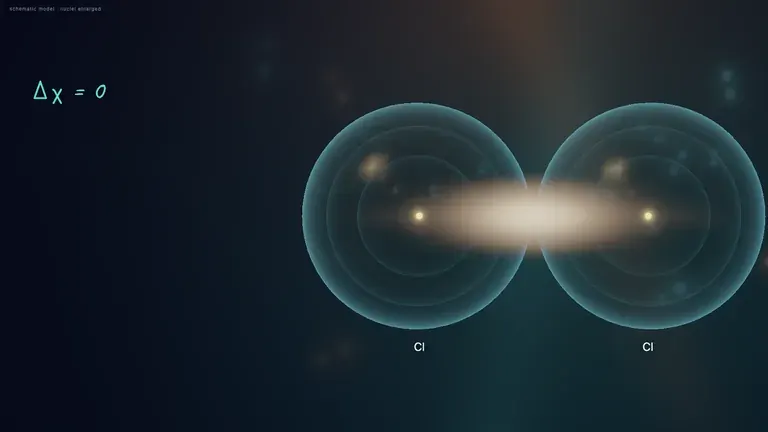
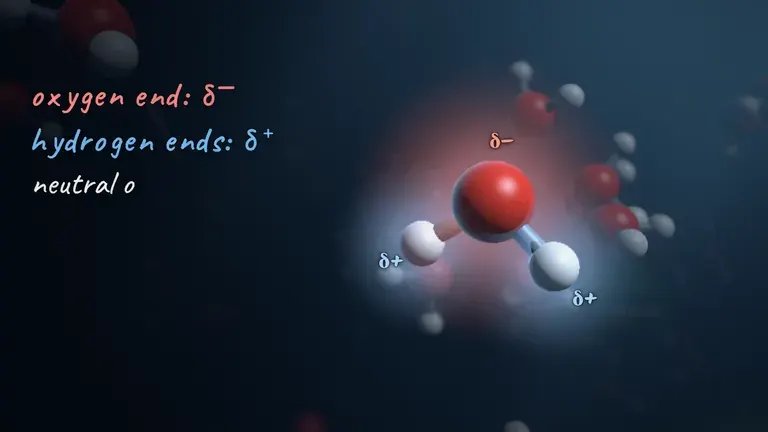
| 5 (short) | 4 | CBrClF₂: bond polarity, bond angles, intermolecular forces and boiling point | 2, 3 |
| 6 (short) | 4 | V²⁺ spectrophotometry: a calibration curve, a particle diagram, dilution, an error claim | 3 |
| 7 (short) | 4 | Na₂O: from a reaction enthalpy, limiting reactant and heat, lattice enthalpy | 2, 4, 6 |
The 2026 Chief Reader report and the mean score on each question aren’t out yet. Until they are, the traps noted under each question come from the 2023–2025 reports, which tested the same skills. The FRQ guide has the means for those years and the full list of common mistakes.
Question 1: potassium chloride (10 points)
A calorimetry experiment wrapped in atomic structure at the start and solubility at the end. Parts C and D carry the same skills, and the same significant-figure trap, as 2025 Question 3, the question that produced the lowest-scoring point of that exam.
What it asked
- A. (i) Write the complete ground-state electron configuration of K⁺. (ii) Which is larger, K⁺ or K? Explain with atomic structure.
- A student dissolves 6.80 g of KCl(s) in 97.5 g of water in a calorimeter, stirring and recording the temperature, which falls from 24.5 °C to 21.1 °C.
- B. Describe how the temperature readings show when the KCl has finished dissolving.
- C. (i) Calculate the magnitude of q, in joules, taking the solution’s specific heat as 3.95 J/(g·°C). (ii) Calculate of KCl in kJ/mol, with its sign, given that 0.0912 mol dissolved.
- D. The calorimeter isn’t perfectly insulated. Is the calculated magnitude of greater than, less than or equal to the accepted value? Justify.
- E. The same mass of RbCl, whose molar is about the same as KCl’s, replaces the KCl in the same mass of water. Is the magnitude of ΔT greater, less or equal? Justify.
- F. RbCl has Ksp = 57 at 20 °C. (i) Write the net ionic equation for its dissolving. (ii) Calculate its molar solubility. (iii) Is its molar solubility in 1.0 M KCl greater, less or equal? Justify.
A (i). 1s² 2s² 2p⁶ 3s² 3p⁶
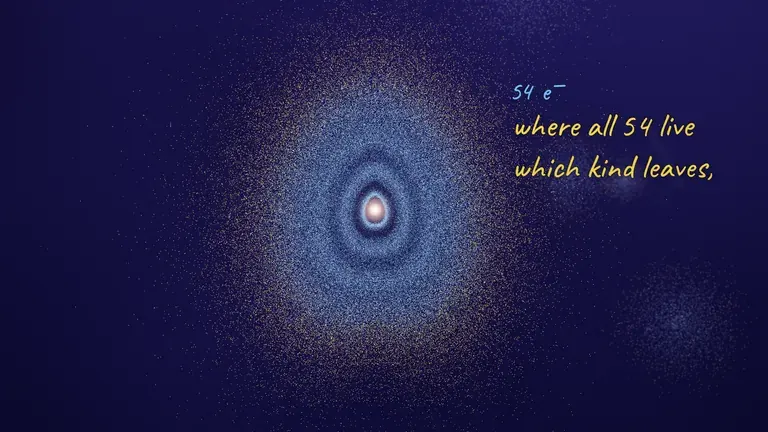
A (ii). The K atom is larger. Both have 19 protons, but the atom’s outermost electron is in the 4s subshell (n = 4). K⁺ has lost that electron, so its outermost electrons are in n = 3, closer to the nucleus.
B. Dissolving KCl absorbs heat, so the temperature falls while the solid dissolves. When the temperature stops falling, reaching its lowest reading and then holding steady or starting to rise, the KCl has finished dissolving.
C (i). Everything that changes temperature is the solution: 97.5 g + 6.80 g = 104.3 g. ΔT = 21.1 °C − 24.5 °C = −3.4 °C. = (104.3 g)(3.95 J g⁻¹ °C⁻¹)(−3.4 °C) = −1.4 × 10³ J. The magnitude is 1.4 × 10³ J, with two significant figures because ΔT has two.
C (ii). The solution lost the heat, so the dissolving absorbed it: q = +1.4 × 10³ J. = +1.5 × 10⁴ J/mol = +15 kJ/mol. The positive sign says dissolving KCl is endothermic, which matches the falling temperature.
D. Less than. The solution was colder than the room, so heat leaked in through the calorimeter while the KCl dissolved. The temperature fell less than it should have, so the calculated q, and with it the magnitude of , comes out too small.
E. Less than. RbCl’s molar mass (120.92 g/mol) is larger than KCl’s (74.55 g/mol), so 6.80 g of RbCl is only 0.0562 mol, against 0.0912 mol of KCl. With about the same ΔH per mole, fewer moles absorb less heat, and the same mass of solution cools by less.
F (i). RbCl(s) ⇌ Rb⁺(aq) + Cl⁻(aq)
F (ii). , so .
F (iii). Less than. The 1.0 M KCl already contains Cl⁻, a common ion, so less RbCl dissolves before [Rb⁺][Cl⁻] reaches Ksp. Solving s(1.0 + s) = 57 gives s = 7.1 M, below 7.5 M. Ksp is so large that you can’t treat s as small next to 1.0 here.
How it scores
| A (i): configuration (1 point) | 1/1 | The full configuration, or [Ne] 3s² 3p⁶. A bare “[Ar]” isn’t among the guideline’s examples, so write it out. |
|---|---|---|
| A (ii): which is larger (1 point) | 1/1 | K, explained by the extra occupied shell (n = 4 against n = 3) or by the same nuclear charge holding one more electron. It must agree with A (i). |
| B: end of dissolving (1 point) | 1/1 | The temperature stops falling, or starts to rise from its minimum. |
| C (i): q with significant figures (1 point) | 1/1 | 1.4 × 10³ J (the guideline writes 1400 J). The sign isn’t required here; the two significant figures are. |
| C (ii): (1 point) | 1/1 | +15 kJ/mol, consistent with C (i). The positive sign is required. |
| D: insulation (1 point) | 1/1 | Less than, because heat entering from outside made the observed temperature change too small. |
| E: RbCl (1 point) | 1/1 | Less than, because the larger molar mass means fewer moles and less heat. |
| F (i): net ionic equation (1 point) | 1/1 | RbCl(s) ⇌ Rb⁺ + Cl⁻; state symbols aren’t required. |
| F (ii): molar solubility (1 point) | 1/1 | 7.5 M from s² = 57. |
| F (iii): in 1.0 M KCl (1 point) | 1/1 | Less than, from the common-ion effect or from calculating 7.1 M. |
Why it works
- The mass in q = mcΔT is the solution’s, water plus salt. Using only the 97.5 g of water gives 1.3 × 10³ J, which doesn’t match the guideline’s value.
- ΔT has two significant figures, so q does too. In 2025 the same trap left only 6% of students with the point.
- Watch the two signs. The solution’s q is negative and the dissolving’s ΔH is positive. The guideline checks the sign in C (ii) only, but a wrong sign there costs the point.
- In D, start from the measurement. The 2024 report found that answers which only restated the claim (“heat was lost, so ΔH is lower”) missed the point. The reader wants to know what happened to the temperature change.
Question 2: chromate and dichromate (10 points)
This one runs through four units: structure, a net ionic equation, electrochemistry and kinetics. The calculations are friendly. The points that slip are the drawing in part A and the wording in part E.
What it asked
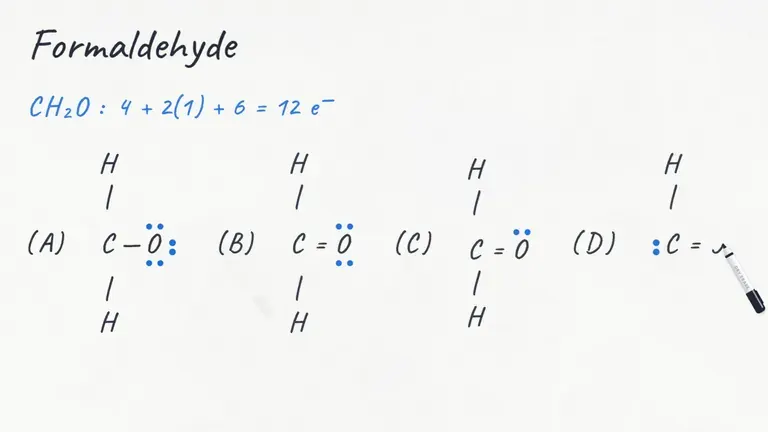
- A. A Lewis diagram of CrO₄²⁻ shows Cr joined to four O atoms by single bonds. (i) Predict the ion’s geometry with VSEPR. (ii) Draw a resonance structure with the same number of valence electrons in which two O atoms have a formal charge of 0 and the other two have −1.
- B. With a strong acid such as HNO₃, CrO₄²⁻ turns reversibly into Cr₂O₇²⁻ and water. (i) Write the balanced net ionic equation. (ii) Is it a redox reaction? Justify with the oxidation number of Cr.
- In acid, Cr₂O₇²⁻ goes on to form CrO₃(aq), which can be electrolyzed to plate chromium: CrO₃(aq) + 6 H⁺(aq) + 6 e⁻ → Cr(s) + 3 H₂O(l), E° = −1.32 V.
- C. Is that reaction thermodynamically favorable under standard conditions? Justify with a calculated ΔG°.
- D. Calculate the grams of Cr plated onto a steel rod by a current of 15.0 A flowing for 3250 s.
- E. In another experiment an iron wire sits in 0.50 M Cr₂O₇²⁻ at pH 1.99, and a graph shows [Cr₂O₇²⁻] falling over 48 minutes. Explain how the graph shows the reaction is first order in Cr₂O₇²⁻.
- F. A straight-line plot of ln[Cr₂O₇²⁻] against time runs from about −0.70 at 0 minutes to −1.20 at 15 minutes. Calculate k in min⁻¹.
- G. On the same axes, draw the line for a second trial that starts at 0.25 M. Its first point, at −1.40, is already plotted.
A (i). Tetrahedral. Cr has four electron domains around it and no lone pairs.
A (ii). Keep the four O atoms around Cr. Draw double bonds from Cr to two of them and single bonds to the other two. Give each double-bonded O two lone pairs (formal charge 0) and each single-bonded O three (formal charge −1). Cr ends with a formal charge of 0, the charges add to −2, and the electron count stays at 32. Keep the brackets and the 2− charge.
B (i). 2 CrO₄²⁻(aq) + 2 H⁺(aq) ⇌ Cr₂O₇²⁻(aq) + H₂O(l). Nitrate is a spectator, so it stays out. Writing H₃O⁺ instead of H⁺ also works, with 3 H₂O on the right.
B (ii). No. Cr is +6 on both sides: in CrO₄²⁻, x + 4(−2) = −2 gives x = +6, and in Cr₂O₇²⁻, 2x + 7(−2) = −2 gives x = +6. Nothing is oxidized or reduced.
C. Unfavorable. ΔG° = −nFE° = −(6 mol e⁻)(96,485 C/mol e⁻)(−1.32 V) = +7.64 × 10⁵ J = +764 kJ per mole of reaction. ΔG° is positive, so the reaction won’t run on its own; the electrolysis current has to drive it.
D. The charge is (15.0 C/s)(3250 s) = 48,750 C, and 48,750 C ÷ 96,485 C/mol e⁻ = 0.505 mol e⁻. Then 0.505 mol e⁻ × = 4.38 g Cr.
E. The half-life is constant. [Cr₂O₇²⁻] falls from 0.50 M to 0.25 M in the first 20 minutes and from 0.25 M to about 0.125 M in the next 20. Only a first-order reaction takes the same time to halve the concentration wherever it starts.
F. For a first-order reaction, ln[A] = ln[A]₀ − kt, so the slope of the line is −k. , so . The half-life agrees: 0.693 ÷ 20 min = 0.035 min⁻¹.
G. A straight line from (0, −1.40) parallel to the first one, because k and so the slope don’t change. It falls about 0.033 per minute and ends near (18, −2.00).
How it scores
| A (i): geometry (1 point) | 1/1 | Tetrahedral. |
|---|---|---|
| A (ii): resonance structure (1 point) | 1/1 | Two Cr=O double bonds, two Cr–O single bonds and the right lone pairs on every O. |
| B (i): net ionic equation (1 point) | 1/1 | Balanced for atoms and charge, with H⁺ or H₃O⁺. State symbols aren’t required. |
| B (ii): not redox (1 point) | 1/1 | No, with Cr at +6 in both ions. |
| C: favorability (1 point) | 1/1 | Unfavorable, backed by a correctly calculated positive ΔG° of about +764 kJ/mol of reaction. |
| D: mass of chromium (2 points) | 2/2 | One point for 0.505 mol of electrons (it can sit inside a single chain of conversions) and one for 4.38 g of Cr. |
| E: first order (1 point) | 1/1 | A constant half-life of 20 minutes. |
| F: rate constant (1 point) | 1/1 | About 0.033 min⁻¹ from the slope or the integrated rate law; 0.035 min⁻¹ from the half-life also counts. |
| G: second trial (1 point) | 1/1 | A line from (0, −1.40) parallel to the original. |
Why it works
- In A (ii), count before you draw. The electron count is fixed at the original structure’s 32, and adding or dropping a lone pair to make the formal charges work loses the point. Chromium can hold more than eight electrons, so six bonds to Cr is fine.
- In E, name the feature that only first order has. “The concentration decreases” describes every order. The 2024 report flagged rate answers that didn’t state a feature specific to the order and to the graph given.
- In G, the line moves down; it doesn’t get steeper. A lower starting concentration changes ln[A]₀, not k.
- E° is intensive. Nothing multiplies E° by 6; the 6 appears only as n in ΔG° = −nFE°.

Question 3: nitrous acid (10 points)
Acid–base chemistry from start to finish. Most points are routine if you keep [H₃O⁺], Ka and pKa straight. The indicator in part H is the one to think about.
What it asked
- HNO₂ ionizes in water: HNO₂ + H₂O ⇌ NO₂⁻ + H₃O⁺, with Ka = 5.6 × 10⁻⁴ at 298 K.
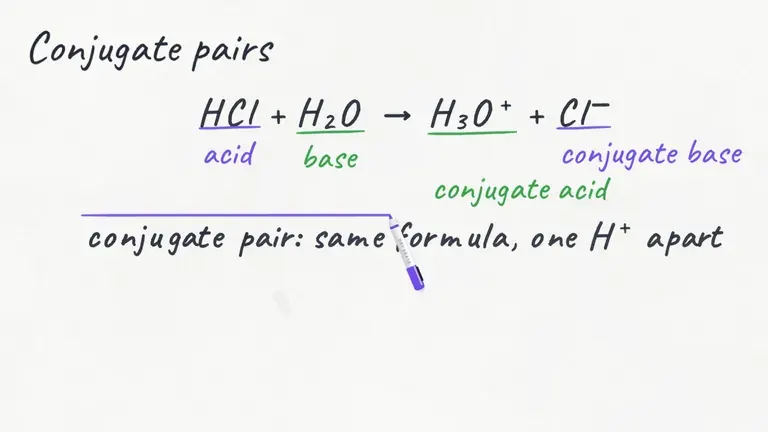
- A. Identify a conjugate acid–base pair, labelling which is the acid and which the base.
- B. A 0.125 M HNO₂ solution has a pH of 2.09. (i) Calculate [H₃O⁺]. (ii) Calculate [HNO₂] at equilibrium.
- C. Heated to 333 K, the solution has [HNO₂] = 0.114 M and [NO₂⁻] = [H₃O⁺] = 0.0109 M. (i) Calculate Ka at 333 K. (ii) Is the ionization endothermic or exothermic? Justify by comparing the two Ka values.
- A student titrates 35.0 mL of HNO₂ of unknown concentration with 0.16 M NaOH. The curve starts near pH 2, rises slowly, jumps steeply at 50 mL and levels off above pH 12.
- D. Identify the pH at the equivalence point. E. Calculate the molarity of the HNO₂. F. Mark an X on the curve where [HNO₂] > [NO₂⁻].
- G. Calculate K for HNO₂ + OH⁻ → NO₂⁻ + H₂O at 298 K, given Ka and Kw = 1.0 × 10⁻¹⁴.
- H. The student repeats the titration with methyl orange (red below pH 3.1, yellow above 4.4) and stops at the color change. The other choices were thymol blue (8.0–9.6) and Clayton yellow (12.2–13.2). The student claims methyl orange was the best choice. Agree or disagree? Justify.
A. HNO₂ is the acid and NO₂⁻ is its conjugate base. (H₂O as the base with H₃O⁺ as its conjugate acid is also correct.)
B (i). = 8.1 × 10⁻³ M
B (ii). Each HNO₂ that ionizes makes one H₃O⁺, so [HNO₂] = 0.125 M − 0.0081 M = 0.117 M. Ka gives the same: (0.0081)² ÷ (5.6 × 10⁻⁴) = 0.117 M.
C (i). = 1.04 × 10⁻³
C (ii). Endothermic. Ka rose from 5.6 × 10⁻⁴ at 298 K to 1.04 × 10⁻³ at 333 K. Heating shifts an endothermic equilibrium toward products, which makes K larger; an exothermic one would have a smaller K at the higher temperature.
D. About pH 8, the middle of the steep rise at 50 mL. It’s above 7 because at the equivalence point the solution holds NO₂⁻, a weak base.
E. The equivalence point is at 50.0 mL. (0.0500 L)(0.16 mol/L) = 0.0080 mol NaOH, which reacts 1 : 1 with 0.0080 mol HNO₂. = 0.23 M
F. Put the X on the curve anywhere before 25 mL, half the equivalence volume; 10 mL works. Until the half-equivalence point, less than half the acid has been converted, so HNO₂ still outnumbers NO₂⁻.
G. Add the acid ionization (Ka) to the reverse of water’s autoionization, H₃O⁺ + OH⁻ ⇌ 2 H₂O (1/Kw). The sum is HNO₂ + OH⁻ ⇌ NO₂⁻ + H₂O, and K’s multiply when reactions add.
H. Disagree. Methyl orange changes color between pH 3.1 and 4.4, and this titration passes through that range in the buffer region, well before the equivalence point at about pH 8. The student would stop too early, add too little NaOH and underestimate the HNO₂ concentration. Thymol blue, which changes between 8.0 and 9.6, matches the equivalence point.
How it scores
| A: conjugate pair (1 point) | 1/1 | Either pair, with the acid and base labelled. |
|---|---|---|
| B (i): [H₃O⁺] (1 point) | 1/1 | 8.1 × 10⁻³ M. |
| B (ii): [HNO₂] (1 point) | 1/1 | 0.117 M, or about 0.12 M, consistent with B (i). |
| C (i): Ka at 333 K (1 point) | 1/1 | 1.04 × 10⁻³. |
| C (ii): endothermic (1 point) | 1/1 | Endothermic, because Ka grows with temperature; consistent with C (i). |
| D: equivalence pH (1 point) | 1/1 | pH 8; the guideline accepts a value above 7 and up to 10. |
| E: molarity (1 point) | 1/1 | 0.23 M, consistent with the equivalence point you identified in D. |
| F: the X (1 point) | 1/1 | Anywhere before 25 mL. |
| G: combined K (1 point) | 1/1 | 5.6 × 10¹⁰. |
| H: indicator (1 point) | 1/1 | Disagree, because methyl orange’s range misses the equivalence pH. Naming thymol blue as the better choice also works. |
Why it works
- pH runs on base 10. Use 10ˣ, not eˣ. Using ln or eˣ to undo a log cost a point in 2025 Question 2.
- pKa sits at the half-equivalence point, not the equivalence point. On this curve that is 25 mL, at about pH 3.2, which matches pKa = −log(5.6 × 10⁻⁴) = 3.25. Students read pKa at the equivalence point in both 2024 and 2025.
- F asks for “greater than,” not “equal to.” The half-equivalence point is where the two are equal, so an X exactly at 25 mL doesn’t answer the question.
- In H, follow the error to the number. Too early an endpoint means too little NaOH, which means too low a concentration.
Question 4: phosphorus vapor (4 points)
A short question with one calculation between two explanations. Part C is the same kind of favorability argument as 2024 Question 2 and 2025 Question 3.
What it asked
- P₄(g) ⇌ 2 P₂(g). The Lewis diagrams show P₄ as a tetrahedron of P–P single bonds and P₂ with a triple bond.
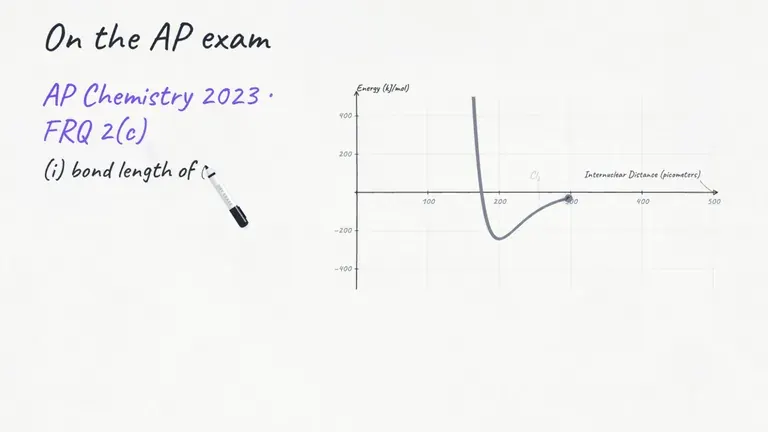
- A. The average bond length is 221 pm in P₄ and 189 pm in P₂. Explain why it is longer in P₄.
- B. Solid P₄ in a sealed, rigid container is heated to 1600 K, where P₄(g) starts at 0.470 atm. At equilibrium the partial pressure of P₂ is 0.630 atm. Calculate Kp.
- C. The reaction is thermodynamically favorable under standard conditions only above 1500 K. A student says it must therefore be endothermic. Agree or disagree? Justify with ΔS° and ΔG°.
A. The P atoms in P₄ are joined by single bonds and the two in P₂ by a triple bond. A triple bond puts more shared electrons between the two nuclei, which pulls them closer together, so the triple bond is shorter.
B. Each atmosphere of P₄ that reacts makes two of P₂, so 0.630 atm of P₂ used up 0.315 atm of P₄, leaving 0.470 − 0.315 = 0.155 atm.
C. Agree. One mole of gas becomes two, so ΔS° is positive. In ΔG° = ΔH° − TΔS°, a positive ΔS° makes the −TΔS° term more negative as the temperature rises. If ΔH° were negative as well, ΔG° would be negative at every temperature. The reaction is favorable only above 1500 K, so ΔH° must be positive: below that temperature ΔH° outweighs TΔS° and ΔG° is positive, and above it the TΔS° term wins. The reaction is endothermic.
How it scores
| A: bond length (1 point) | 1/1 | Single bonds in P₄ against a triple bond in P₂. |
|---|---|---|
| B: equilibrium pressure of P₄ (1 point) | 1/1 | 0.155 atm, from the 2 : 1 ratio. |
| B: Kp (1 point) | 1/1 | 2.56, consistent with your pressure of P₄. |
| C: endothermic (1 point) | 1/1 | Agree, with ΔS° > 0 from more moles of gas and the argument that ΔH° must be positive for ΔG° to turn negative only at high temperature. |
Why it works
- Don’t put 0.470 atm into Kp. That’s the starting pressure, not the equilibrium one; the 2 : 1 ratio gets you from one to the other.
- Use both signs in C. The 2024 report saw favorability answers that cited only ΔS° or only ΔH°. The argument needs both and how they combine in ΔG°.
- Say which moles are gas. In 2024, “more moles of product” without saying they were gas molecules didn’t earn the entropy point.
Question 5: CBrClF₂ (4 points)
Bond polarity, bond angles and intermolecular forces in one molecule, then a boiling-point comparison where the nonpolar compound wins. That last part is the one to get right.
What it asked
- A. Which bond in CBrClF₂ (C–Br, C–Cl or C–F) is the most polar? Justify.
- B. The F–C–F angle is 106.8° and the Br–C–Cl angle is 112.3°. Explain the difference using atomic structure and VSEPR.
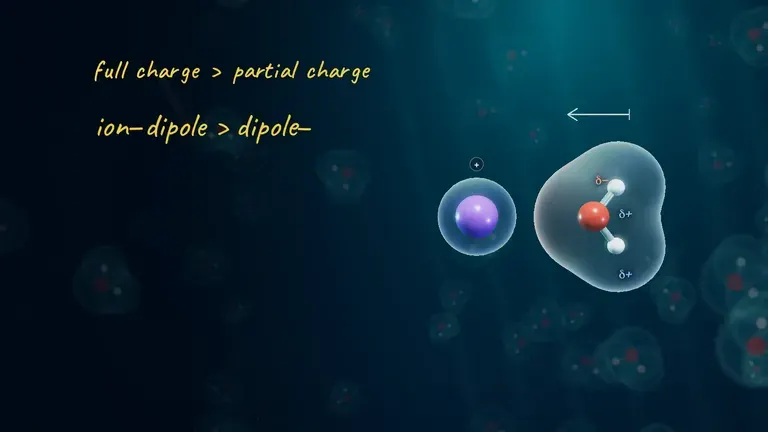
- C. CBr₄ boils at 463 K and CBrClF₂ at 269 K. (i) Identify all the intermolecular forces in each liquid. (ii) Explain why CBr₄ boils higher, in terms of the relative strengths of all the forces.
A. C–F. Fluorine is the most electronegative of the three halogens, so the electronegativity difference between C and F is the largest of the three bonds.
B. Carbon has four bonding domains and no lone pairs, so the shape is tetrahedral, with angles near 109.5°. Br and Cl are larger atoms than F, with more occupied electron shells, so the electron clouds of the C–Br and C–Cl bonds are bigger and repel the other bonding domains more. That pushes the Br–C–Cl angle open and squeezes the F–C–F angle closed.
C (i). CBr₄: London dispersion forces only, because the molecule is a symmetric tetrahedron whose bond dipoles cancel. CBrClF₂: London dispersion forces and dipole–dipole forces, because its different halogens leave it polar.
C (ii). CBr₄ has 146 electrons against 76 in CBrClF₂, so its electron cloud is much larger and more polarizable. Its dispersion forces are strong enough to outweigh the dispersion and dipole–dipole forces of CBrClF₂ combined, so more energy is needed to separate CBr₄ molecules and it boils higher.
How it scores
| A: most polar bond (1 point) | 1/1 | C–F, from the largest electronegativity difference. |
|---|---|---|
| B: bond angles (1 point) | 1/1 | The larger electron clouds of Br and Cl repel more, widening the Br–C–Cl angle. |
| C (i): the forces (1 point) | 1/1 | Dispersion only for CBr₄; dispersion and dipole–dipole for CBrClF₂. |
| C (ii): boiling points (1 point) | 1/1 | CBr₄’s larger, more polarizable electron cloud gives dispersion forces stronger than CBrClF₂’s dispersion and dipole–dipole forces together. |
Why it works
- Molar mass isn’t the reason. In 2025, answers that said stronger dispersion forces came from a larger molar mass didn’t earn the point. Talk about electrons and polarizability.
- “All” means all. Every molecule has dispersion forces. Leaving them off the polar molecule, or leaving dipole–dipole off a polar one, misses the point; the 2023 report said dipole–dipole forces in HBr were the usual omission.
- Polar doesn’t guarantee a higher boiling point. Here the nonpolar compound boils almost 200 K higher, because the difference in electron count is so large.
Question 6: V²⁺ spectrophotometry (4 points)
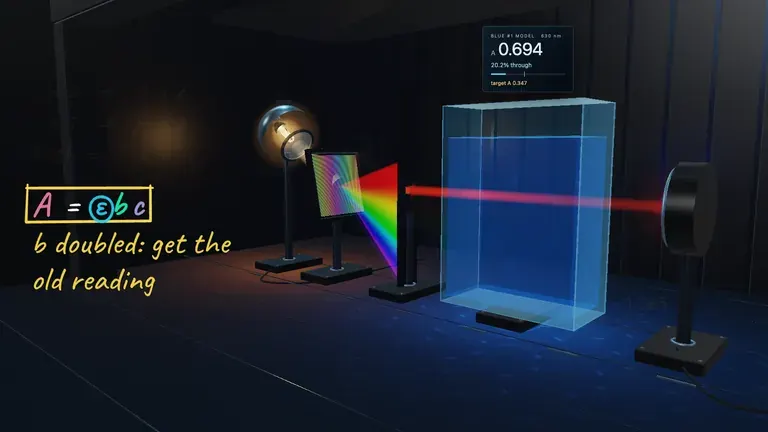
A calibration curve, a particle diagram and a dilution. Every part rests on one idea: absorbance is proportional to concentration.
What it asked
- A calibration curve for V²⁺(aq) is a straight line through the origin that reaches an absorbance of 0.36 at 0.090 M.
- A. A particle diagram shows eight V²⁺ ions in a solution with an absorbance of 0.32. Draw the number of ions in the same volume of a solution with an absorbance of 0.08.
- B. A solution reads above 0.36, so the student dilutes 3.00 mL of it to 25.0 mL in a volumetric flask. The diluted solution reads 0.22. (i) Determine the molarity of the diluted solution. (ii) Calculate the molarity of the original.
- C. The calculated original concentration is lower than the true one. The student blames filling the flask past the mark. Agree or disagree? Justify.
A. Two ions. Absorbance is proportional to concentration (A = εbc), and 0.08 is a quarter of 0.32, so the diagram needs a quarter of the eight ions.
B (i). The line’s slope is 0.36 ÷ 0.090 M = 4.0 M⁻¹, so c = 0.22 ÷ 4.0 M⁻¹ = 0.055 M.
B (ii). , so
C. Agree. Water past the mark makes the diluted solution more dilute than intended, so its absorbance and calculated molarity come out low. The back-calculation still assumes 25.0 mL, so the original concentration comes out low too.
How it scores
| A: particle diagram (1 point) | 1/1 | Two particles. |
|---|---|---|
| B (i): diluted molarity (1 point) | 1/1 | 0.055 M; the guideline accepts 0.053 to 0.057 M read from the graph. |
| B (ii): original molarity (1 point) | 1/1 | 0.46 M, consistent with B (i). |
| C: error claim (1 point) | 1/1 | Agree, following the extra water through the absorbance to the low result. |
Why it works
- V₂ is the total volume. The 2025 report warned against using the volume of water added in M₁V₁ = M₂V₂. Here V₂ is the full 25.0 mL.
- Follow an error to the final number. Overfilled flask, lower absorbance, lower diluted molarity, lower original molarity: each link is part of the justification.
- Particle diagrams are quantitative. Count what’s drawn, then scale it.
Question 7: sodium oxide (4 points)
Thermochemistry and stoichiometry, then Coulomb’s law. The limiting-reactant step in part B and the word “distance” in part C carry the points most likely to slip.
What it asked
- 4 Na(s) + O₂(g) → 2 Na₂O(s), = −828 kJ/mol of reaction.
- A. Calculate of Na₂O(s).
- B. 18.4 g of Na reacts with 12.8 g of O₂. Calculate the total heat released, in kJ.
- C. Lattice enthalpy is the energy needed to separate an ionic solid into gaseous ions. Na₂O and Rb₂O have similar crystal structures, with lattice enthalpies of 2481 and 2163 kJ/mol. Use Coulomb’s law to explain why Rb₂O’s is smaller.
A. Na(s) and O₂(g) are elements in their standard states, so their values are 0. −828 kJ = 2 × (Na₂O) − 0, so = −414 kJ/mol.
B. Na: 18.4 g ÷ 22.99 g/mol = 0.800 mol. O₂: 12.8 g ÷ 32.00 g/mol = 0.400 mol. The reaction uses 4 mol of Na per mole of O₂, so 0.400 mol of O₂ would need 1.60 mol of Na; with only 0.800 mol, Na is the limiting reactant. That is 0.800 ÷ 4 = 0.200 mol of reaction, and (0.200 mol)(828 kJ/mol) = 166 kJ released.
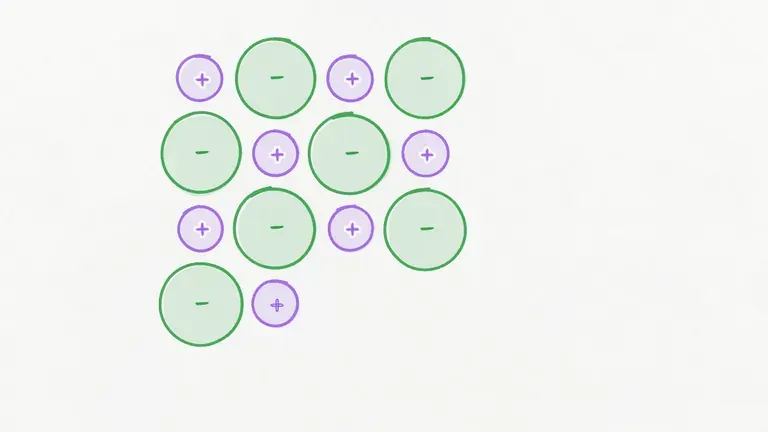
C. By Coulomb’s law, the attraction between two ions grows with their charges and falls as the distance between their centers grows. Na⁺ and Rb⁺ have the same +1 charge and pair with the same O²⁻ ion. Rb⁺ has more occupied electron shells, so it is larger, and the distance between ion centers is greater in Rb₂O. The attraction is weaker, so less energy is needed to separate the ions.
How it scores
| A: (1 point) | 1/1 | −414 kJ/mol. |
|---|---|---|
| B: limiting reactant (1 point) | 1/1 | Na identified as limiting; this can be implicit in the setup. |
| B: heat released (1 point) | 1/1 | 166 kJ, consistent with the moles of limiting reactant. |
| C: lattice enthalpy (1 point) | 1/1 | Rb⁺ is larger, so the ions are farther apart and the Coulombic attraction is weaker. |
Why it works
- In Coulomb’s law, r is the distance between centers, not the size of one ion. In 2025 Question 1, 89% of students missed the point, and the Chief Reader flagged that slip among the errors.
- Compare moles, not grams. 18.4 g of Na looks like more than 12.8 g of O₂, but the 4 : 1 ratio decides which runs out.
- Per mole of what? −828 kJ is per mole of reaction as written, which makes 2 mol of Na₂O. Dividing by 2 is the whole of part A.
What the 2026 questions say about May 2027
Lay the 2026 set beside the three exams before it and the same skills keep returning, often in the same form.
- Calorimetry, every year: 2023 Question 3, 2024 Questions 1 and 4, 2025 Question 3 and 2026 Question 1. Expect q = mcΔT with a lab data table, the sign of ΔH, and often a question about how an experimental error changes the result.
- A significant-figure point on a calorimetry heat, two years running (2025 Question 3 and 2026 Question 1). Both times the subtraction in ΔT set the number of figures.
- Electrochemistry, every year: 2023 Question 1, 2024 Question 3, 2025 Question 6 and 2026 Question 2, built from half-reactions, , ΔG° = −nFE° and, in 2024 and 2026, Faraday’s-law calculations for plating a metal.
- A titration curve in 2024, 2025 and 2026, each time asking you to read the equivalence point or the half-equivalence point off the graph.
- Coulomb’s law inside an explanation: ion–water attraction in 2025 Question 1, lattice enthalpy in 2026 Question 7. In both, r is the distance between centers.
- Intermolecular-force explanations: 2023 Question 6, 2025 Questions 4 and 5, and 2026 Question 5. The point goes to naming the forces and comparing their strengths, not to bond strength or molar mass.
None of this predicts the 2027 questions. It does show which skills the exam returns to, and those are the ones to practice until they come without thinking. The FRQ guide has the official mean for every question since 2023 and the mistakes the Chief Readers see most often.
Practicing with the 2026 set
- Do the whole section in 1 hour 45 minutes. Print the 2026 questions and work with a calculator and the equations and constants, writing on paper. Our formula sheet guide explains each equation on it.
- Score it point by point with the scoring guidelines. If the thing a point asks for isn’t on your page, it’s a zero, even if you knew it.
- Find each lost point above and name the slip: a sign, significant figures, a missing reason, a misread graph.
- Redo the missed parts a week later without looking at the answers.
Earlier exams, with Chief Reader reports and scored student answers, are on AP Central. For the content behind the questions, the AP Chemistry cheat sheets cover each unit.
Sources
- 2026 AP Chemistry Free-Response Questions (PDF)
- 2026 AP Chemistry Scoring Guidelines (PDF)
- AP Chemistry past exam questions (AP Central)
- AP Chemistry Exam: format and timing (AP Central)
- AP Chemistry equations and constants (PDF)
- 2025 AP Chemistry Chief Reader Report (PDF)
- 2024 AP Chemistry Chief Reader Report (PDF)
- 2023 AP Chemistry Chief Reader Report (PDF)