
What the free-response section looks like
Section II is the second half of the AP Chemistry exam: seven questions in 1 hour 45 minutes, worth 50% of your score. On exam day you read the questions in the Bluebook app and write your answers by hand in a paper booklet, and the booklet is all that gets scored.
| What to expect | |
|---|---|
| Questions | Seven: three long (Questions 1–3) and four short (Questions 4–7) |
| Points | 10 for each long question and 4 for each short one, 46 in all |
| Time | 1 hour 45 minutes for all seven. College Board suggests about 23 minutes for each long question and 9 for each short one |
| Weight | 50% of the exam score. Multiple choice is the other 50% |
| Calculator | Allowed: a four-function, scientific or graphing calculator, or the one built into Bluebook |
| Reference sheet | The periodic table and the equations and constants, on paper and in Bluebook, for the whole section |
| Where answers go | Handwritten in the free-response booklet. Work on scratch paper isn’t scored |
That weighting makes each point expensive. Section II’s 46 points carry half the exam, so one point is worth about 1.1% of the total, against about 0.8% for each of the 60 multiple-choice questions. A free-response point counts for about as much as 1.3 multiple-choice questions, and it is often one line of work.
The long questions (1–3)
A long question follows one chemical system through six to eight lettered parts and ten points, and it crosses units as it goes. In 2026, Question 1 opened with the electron configuration of K⁺, moved to a calorimetry experiment with KCl, and finished with the solubility of RbCl. Expect a lab setup with a data table or a graph, two or three calculations, and several parts that ask you to explain or justify a claim.
The parts are linked. A value you calculate in one part often feeds the next, and the scoring guideline lets you carry your own answer forward, so one slip doesn’t have to cost you the rest of the question.
The short questions (4–7)
A short question stays on one idea for three or four parts and four points. The 2026 set asked about the equilibrium between P₄ and P₂, the bonds and boiling point of CBrClF₂, a spectrophotometry experiment with V²⁺ ions, and the heat released when sodium reacts with oxygen.
Short doesn’t mean easy. From 2023 to 2025 the short questions averaged between about a third and two-thirds of their points, and the lowest share on any question in those three years, 1.34 out of 4, came on a short one: 2025 Question 6, a galvanic cell.
How a point is earned
Every free-response question has a scoring guideline, a list of its points and exactly what earns each one, and College Board posts each year’s guidelines on AP Central next to the questions. A point is one specific thing: a value, an equation, a drawing, or a claim with its reason. Readers look for that thing. A page of correct chemistry that never states it earns nothing, and two clear lines that do state it earn the point.
The guidelines follow the same rules year after year. These are the ones that decide the most points.
- Show the setup. The exam’s directions say it in one line: “You must show your work to receive credit for your answer.” The 2023 Chief Reader reported many correct answers that readers couldn’t credit because no setup was shown.
- An early mistake doesn’t sink the parts after it. Many points go to a value “consistent with” an earlier part, so a wrong number used correctly in the next step still earns that step. In 2023, a student who subtracted the wrong masses in one part could still earn the next two parts by working correctly from that number.
- Significant figures are scored on particular points. In 2023, 2025 and 2026 one point each year required a calculated value with the correct number of significant figures, and in 2025 and 2026 it was the heat from a calorimetry experiment. You can’t tell in advance which point will check, so get them right every time.
- Signs and units can be points of their own. In 2025 the negative sign on a ΔH earned a separate point from its value, and the units of a rate constant earned a separate point from the number.
- Check whether state symbols are required. The released equations discussed here accept answers without (s), (aq) or (g); follow the prompt and the scoring guideline for the question you are doing. A solid written as separate ions, or a spectator ion left in, still loses the point.
- Give one answer. When the question wants one geometry or one value, give one. In 2025, “tetrahedral pyramidal” and answers listing two geometries both lost the point.
- Write in the right place. Only the booklet is scored, and the directions ask you to put each answer in the space for its part and to label the sub-parts (i, ii, iii).
What the question words ask for
Free-response questions use a short list of verbs, each defined in the Course and Exam Description. The verb tells you what the reader will be looking for, and the gap between identify and justify is a whole sentence of reasoning.
| Verb | What the reader needs to see | A 2026 example |
|---|---|---|
| Calculate | The setup with numbers substituted, the answer, its units and sensible significant figures. A bare number usually earns nothing. | Grams of chromium plated by a current (Question 2, part D) |
| Determine | A value or a decision, reached by reasoning or a calculation. Some determine points accept a value read straight off a graph. | The molarity of a diluted solution from a calibration line (Question 6, part B (i)) |
| Explain | How or why it happens, from cause to effect, in terms of particles, charges or energy. Naming a principle isn’t explaining it. | Why CBr₄ boils higher than CBrClF₂ (Question 5, part C (ii)) |
| Justify | Evidence for your claim and the reasoning that connects them. It usually follows “agree or disagree” or “greater than, less than, or equal to.” | Whether a reaction that is favorable only above 1500 K must be endothermic (Question 4, part C) |
| Describe | The relevant features, in words. | How the temperature readings show the KCl has dissolved (Question 1, part B) |
| Identify | One answer, stated plainly. No reasoning is needed unless the question also says justify or explain. | The pH at the equivalence point (Question 3, part D) |
| Draw or represent | A diagram, graph or equation that follows the conventions exactly: every lone pair, the charge, whole-number coefficients, a line that starts at the right point. | A resonance structure of CrO₄²⁻ (Question 2, part A (ii)) |
How students scored, question by question
College Board publishes the mean score on every free-response question, and the Chief Reader, the college professor who leads the scoring, writes a report on what students did well and badly. These are the official means for the three latest exams with published scoring statistics. AP Central had not listed 2026 scoring statistics or a Chief Reader report as of October 24, 2026.
| Question | What it asked about | Mean | Share of points |
|---|---|---|---|
| 2023 Q1 | Manganese: electron configuration, an empirical formula from lab data, a battery’s E° and ΔG° | 5.38/10 | 54% |
| 2023 Q2 | AlCl₃: Hess’s law, a potential-energy curve, VSEPR and formal charge, Kp | 5.22/10 | 52% |
| 2023 Q3 | CaCO₃ with HCl: net ionic equation, surface area and rate, reaction order, leftover HCl, calorimetry | 4.51/10 | 45% |
| 2023 Q4 | A methylamine buffer: mass to weigh out, buret technique, buffer pH | 1.66/4 | 42% |
| 2023 Q5 | HCl gas: ideal gas law, a particle drawing of a solution, weak and strong acids | 2.54/4 | 64% |
| 2023 Q6 | HF and HBr: intermolecular forces, energy to vaporize, bond length | 1.95/4 | 49% |
| 2023 Q7 | Sr(OH)₂: a particle diagram, Ksp from concentrations, the common-ion effect | 2.23/4 | 56% |
| 2024 Q1 | Lactic acid: a titration curve, pKa, particle diagrams of the mixture, calorimetry | 4.43/10 | 44% |
| 2024 Q2 | Maleic acid and baking soda: moles and gas volume, surface area and rate, entropy and favorability, Henderson–Hasselbalch | 5.84/10 | 58% |
| 2024 Q3 | Sterling silver: alloys and atomic radius, stoichiometry, cell potential, electroplating time | 4.42/10 | 44% |
| 2024 Q4 | An unknown metal in a calorimeter: reading a thermometer, particle speed, specific heat | 2.60/4 | 65% |
| 2024 Q5 | H₂ + I₂ ⇌ 2 HI: Kc, particle diagrams, Le Châtelier | 2.07/4 | 52% |
| 2024 Q6 | NO₂ decomposition: second-order graphs, relative rates, the Lewis structure and bond angle of NO₂⁺ | 2.26/4 | 57% |
| 2024 Q7 | Chromatography: making a NaCl solution, separating a mixture | 2.03/4 | 51% |
| 2025 Q1 | Magnesium: a mass spectrum, ion–water attraction, pH of a strong base, dilution, Q against Ksp | 4.78/10 | 48% |
| 2025 Q2 | Ascorbic acid: empirical formula, a titration and Henderson–Hasselbalch, a rate law and k, ion–dipole forces | 4.29/10 | 43% |
| 2025 Q3 | White phosphorus: Lewis diagram, entropy and favorability, calorimetry, Hess’s law, Kp from particles | 3.61/10 | 36% |
| 2025 Q4 | Methanol and formaldehyde: hybridization, hydrogen bonding, energy to condense | 2.32/4 | 58% |
| 2025 Q5 | tert-Butyl alcohol and a silanol: geometry, dispersion forces, vapor pressure, ideal gas law | 1.88/4 | 47% |
| 2025 Q6 | A zinc–aluminum galvanic cell: half-reactions, change in electrode mass, maximum voltage | 1.34/4 | 34% |
| 2025 Q7 | Glycolate: acid structure, Kb from concentrations, Ka from Kb, a catalyst in a mechanism | 2.00/4 | 50% |
| 2026 Q1 | KCl: the K⁺ configuration and size, calorimetry and ΔH of solution, Ksp and a common ion | –/10 | Not yet out |
| 2026 Q2 | Chromate and dichromate: VSEPR and resonance, net ionic equation, ΔG° from E°, electroplating, first-order kinetics | –/10 | Not yet out |
| 2026 Q3 | Nitrous acid: pH and Ka, Ka and temperature, a titration curve, combining K’s, choosing an indicator | –/10 | Not yet out |
| 2026 Q4 | P₄ ⇌ 2 P₂: bond length, Kp, ΔS° and ΔG° against temperature | –/4 | Not yet out |
| 2026 Q5 | CBrClF₂: bond polarity, bond angles, intermolecular forces and boiling point | –/4 | Not yet out |
| 2026 Q6 | V²⁺ spectrophotometry: a calibration curve, a particle diagram, dilution, an error claim | –/4 | Not yet out |
| 2026 Q7 | Na₂O: from a reaction enthalpy, limiting reactant and heat, lattice enthalpy | –/4 | Not yet out |
Add up a year’s seven means and you get the average Section II score: about 23.5 of 46 in 2023, 23.7 in 2024 and 20.2 in 2025. The typical student earns about half the points or a little less, so the reliable points (a setup, a value read from a graph, a balanced equation) are worth collecting every time, and each one you miss puts you behind before the hard parts start. To turn a practice total into a likely AP score, try the score calculator.
The hardest single points of 2025
The 2025 report goes one step further and gives the mean on every individual point. For a one-point item, that mean is simply the share of students who earned it. These are the eight lowest.
| Question and part | What it asked for | Students who earned it |
|---|---|---|
| Q3, C (i) | The heat released in a calorimetry run, with the right significant figures | 6% |
| Q6, C | Which electrode’s mass changed more in a galvanic cell, shown with a calculation | 10% |
| Q1, B (ii) | Why Na⁺ attracts water less strongly than Mg²⁺, from ion size and Coulomb’s law | 11% |
| Q2, D | A force between I₃⁻ and water that I₂ doesn’t have (ion–dipole) | 15% |
| Q5, B | Why one compound has stronger dispersion forces than another | 16% |
| Q1, F | How adding acid changes the amount of undissolved Mg(OH)₂ | 17% |
| Q6, D | The largest voltage possible with a zinc half-cell | 23% |
| Q3, B (i) | Why entropy decreases, explained at the particle level | 25% |
Two of those are habits you can fix in an afternoon: significant figures, and answering in the quantity the question asks for. Four are explanations that stopped short, usually at a label (“bigger radius”, “heavier”, “less disorder”) instead of saying what the particles, charges and distances do. The next two sections take both kinds in turn.
The mistakes that cost the most points
Every item here comes from a Chief Reader report from 2023 to 2025, put in our own words, with the year and question so you can find the original.
Significant figures hide in the subtraction
In 2025 Question 3, students found the heat from a calorimetry run in which the temperature rose from 22.00 °C to 22.38 °C. Most set up q = mcΔT correctly, yet only 6% earned the point, and the Chief Reader said the usual reason was the significant figures rather than the chemistry.
The trap is the subtraction. Both temperatures have four significant figures, but their difference has only two, because subtraction keeps decimal places, not significant figures. The heat is 0.16 kJ, not 0.159 kJ. The 2026 exam set the same trap in Question 1, where a fall from 24.5 °C to 21.1 °C is a change of 3.4 °C, so the heat has two significant figures: 1.4 × 10³ J.
Units, signs and the right constant
- The units of a rate constant. In 2025 Question 2, two-thirds of students lost the point for the units of k. The rate law was first order in each of two reactants, so k had units of M⁻¹ s⁻¹; the usual wrong answers were M/s or no units at all.
- The wrong R. With pressure in atmospheres, R is 0.08206 L atm mol⁻¹ K⁻¹. Using 8.314 J mol⁻¹ K⁻¹ with atmospheres, or leaving the temperature in °C, cost points in 2024 Question 2 and 2025 Question 5.
- Joules and kilojoules. ΔG° = −nFE° comes out in joules. In 2023 Question 1, answers like −275,947 kJ were off by a factor of 1000.
- The sign of ΔH. If the solution warms up, the reaction released heat and ΔH is negative. Leaving off the sign, or calling a temperature rise endothermic, cost points in 2023 Question 3 and 2024 Question 1.
- E° doesn’t multiply. Cell potential is an intensive property, so you never multiply E° by the coefficients you used to balance electrons. Students did it in 2024 Question 3 and 2025 Question 6, and the 2023 report warned against it too.
- The final temperature isn’t ΔT. Plugging the final reading into q = mcΔT cost points in 2023 Question 3 and 2024 Question 1.
- The mass in q = mcΔT is the solution’s. It’s everything that changes temperature. Answers that used only the 0.100 g of solid in 2025 Question 3 were wrong, and so were 2024 Question 1 answers that added up the masses of the dissolved solutes instead of using the mass of the solution.
Explanations without particles
When a question says explain, the readers want the mechanism: what the particles, charges or electrons are doing. A correct claim with a textbook label for a reason usually earns nothing.
- “Disorder” isn’t an explanation. “Less disorder” or “more order” with no particle-level reasoning failed in 2025 Question 3, and “gases are more random” failed in 2024 Question 2. What earned the point: gas particles are spread through the whole container and have far more possible arrangements (microstates) than particles in a solid, so turning gas into solid lowers the entropy.
- In Coulomb’s law, r is a distance. In 2025 Question 1, students said Na⁺ attracts water weakly because its radius is bigger. The point went to answers that said the bigger ion keeps the water molecule farther from its center, and the greater distance weakens the attraction. 89% missed it. See intramolecular force and potential energy.
- Heavier isn’t a reason. “Larger molar mass” as the reason for stronger dispersion forces didn’t earn the 2025 Question 5 point. More electrons in a larger, more polarizable electron cloud did. See intermolecular forces.
- Boiling doesn’t break bonds. A phase change overcomes the forces between molecules, and the covalent bonds inside them stay intact. Answers about bond strength or breaking bonds cost points in 2023 Question 6 and 2025 Question 5.
- Surface area needs collisions. In 2023 Question 3 and 2024 Question 2, “smaller pieces have more surface area” stopped halfway. The answer had to finish the thought: more exposed surface means more collisions per second, so the reaction goes faster.
- A hydrogen bond needs the right hydrogen. In 2025 Question 4, students drew it to a hydrogen on carbon, or between two identical molecules when the question asked for one between two different ones. The hydrogen has to be bonded to N, O or F in one molecule and attracted to N, O or F in the other.
Answering a question nobody asked
- Moles when the question asked about mass. In 2025 Question 6, 90% missed the point. Three moles of zinc form for every two moles of aluminum consumed, but the question asked which electrode’s mass changed more, so the answer needed molar masses too.
- pOH reported as pH for a strong base (2025 Question 1), or p used in the weak-base form of Henderson–Hasselbalch to find pOH, without converting that pOH to pH (2023 Question 4).
- pKa read at the equivalence point instead of at the half-equivalence point (2024 Question 1 and 2025 Question 2).
- A geometry when the question asked for hybridization (2025 Question 4). Bond counts and orbital diagrams didn’t count either.
- Catalyst or intermediate. A catalyst is used up in one step of a mechanism and made again in a later one; an intermediate is made first and used up later. In 2025 Question 7, many students called hydronium a spectator ion because it appeared on both sides of the overall equation. The Chief Reader’s note: the overall equation is only there to check the mechanism.
- Electrons removed from the wrong subshell. Manganese loses its 4s electrons before its 3d electrons (2023 Question 1); in general, remove the outermost ns electrons before the (n−1)d electrons.
- Copying the equation sheet. In 2025 Question 3, some students wrote out every thermodynamics equation on the sheet and never answered the question.
- Repeating the claim in an error question. In 2024 Question 1, “the enthalpy is lower because heat was lost” restated the prompt. The point needed the measurement: losing heat makes the temperature change smaller, so q comes out smaller.
Misreading the stimulus
- The axis scale. On the 2025 mass spectrum, students misread the y-axis gridlines and drew the two peaks at the wrong height.
- Instrument marks. On the 2024 thermometer, each mark between 30 and 40 °C stood for 1 °C, and many students read the marks as 0.1 °C.
- Vague references to the data. When a question says to use the data, name the trials and the numbers. In 2025 Question 2, a rate-order justification that didn’t name trials 1 and 3, or didn’t say [I₃⁻] stayed constant, earned nothing.
- Dropped zeros. The 2023 report warned that 0.043 became 0.43 when students copied it from the question.
- Diagrams first. The 2025 report suggests looking at every diagram before reading the prompt, so the question lands on a picture you already understand.
Writing an explanation that earns the point
Argumentation carries 15% to 24% of the free-response section, more than any skill except mathematical routines. It lives in the explain and justify parts, which follow a pattern the Chief Reader reports keep recommending: a claim, the evidence for it, and the reasoning that connects the two.
- Claim first, in the question’s terms. “Less than.” “I disagree.” “The C–F bond.” Put it in the first words of your answer; the 2023 report advises writing “I agree” or “I disagree”, preferably at the start.
- Evidence from the question. A number from the table, a feature of the graph, a fact about the particles. Name the trial, the substance, the value.
- Reasoning that connects them. Use the principle the question points to, such as Coulomb’s law, Le Châtelier’s principle or ΔG° = ΔH° − TΔS°, and say what it does in this case.
| Question | Earns nothing | Earns the point |
|---|---|---|
| Why is ΔS° negative for 2 SO₂(g) + O₂(g) → 2 SO₃(g)? | “The products are more ordered.” | “Three moles of gas become two. Fewer gas particles have fewer possible arrangements (microstates), so the entropy decreases.” |
| Why is the lattice enthalpy of KF smaller than that of NaF? | “K⁺ has a bigger radius.” | “K⁺ has one more occupied shell than Na⁺, so it is larger and the distance between the centers of K⁺ and F⁻ is greater. By Coulomb’s law the attraction is weaker, so less energy separates the ions.” |
| Why does Br₂ boil at a higher temperature than Cl₂? | “Br₂ has a larger molar mass.” | “Br₂ has more electrons in a larger, more polarizable electron cloud, so the dispersion forces between Br₂ molecules are stronger and take more energy to overcome.” |
| Heat escaped from a calorimeter during an exothermic reaction. Is the calculated magnitude of ΔH too high, too low or unaffected? | “Too low, because heat was lost.” | “Too low. The escaping heat made the temperature rise smaller than it should have been, so the calculated q, and with it the magnitude of ΔH, comes out too small.” |
A long question, scored point by point
2025 Question 3 had the lowest average of that year’s long questions: 3.61 out of 10. Many of the traps above show up in it, which makes it a good long question to learn from. The full question is on pages 8–10 of College Board’s 2025 free-response PDF. Here is what it asked, in our words, followed by a full-credit answer written for this page.
What it asked
- A. White phosphorus is made of tetrahedral P₄ molecules in which each P atom bonds to the other three. Complete the Lewis diagram by drawing the nonbonding electrons.
- B. P₄(s) + 5 O₂(g) → P₄O₁₀(s) is favorable at 298 K, and both ΔS° and ΔH° are negative. (i) Explain at the particle level why entropy decreases. (ii) A student says the reaction is driven by enthalpy, not entropy. Is that right? Justify with the relationship between ΔG°, ΔH° and ΔS°.
- C. 0.100 g of P₄O₁₀ (283.9 g/mol) reacts with 100.0 g of water in a calorimeter (P₄O₁₀ + 6 H₂O → 4 H₃PO₄), and the temperature rises from 22.00 °C to 22.38 °C. Take the specific heat as 4.18 J/(g·°C). (i) Calculate the heat released, in kJ. (ii) Calculate in kJ per mole of reaction, with its sign.
- D. In a second trial some of the solid sticks to the weighing paper. P₄O₁₀ is the limiting reactant. Is ΔT greater than, less than or equal to the first trial’s? Justify.
- E. Given P₄(s) + 6 Cl₂(g) → 4 PCl₃(g), ΔH° = −1148 kJ/mol, and PCl₃(g) + Cl₂(g) ⇌ PCl₅(g), ΔH° = −88 kJ/mol, calculate of PCl₅(g).
- F. A particle diagram of the PCl₅ equilibrium at 546 K shows 4 PCl₅, 2 PCl₃ and 6 Cl₂, each particle standing for 1.00 atm. (i) Calculate Kp. (ii) Does Kp increase, decrease or stay the same at 596 K? Justify with ΔH°.
A. Each P atom already has three single bonds, so it needs one lone pair to complete its octet. Add one pair of dots to each of the four P atoms (20 valence electrons in all).
B (i). The reactants include 5 mol of O₂ gas and the only product is a solid. Gas molecules spread through the whole container and can take far more positions and energies (microstates) than particles fixed in a solid. Turning the gas into a solid reduces that dispersal, so the entropy decreases.
B (ii). Yes. A reaction is favorable when ΔG° = ΔH° − TΔS° is negative. ΔH° < 0 makes ΔG° more negative, so enthalpy favors the reaction. ΔS° < 0 makes −TΔS° positive, which works against it. ΔG° is negative only because the enthalpy term outweighs the entropy term, so the reaction is driven by enthalpy.
C (i). The solution is the water plus the solid, 100.1 g, and ΔT = 22.38 °C − 22.00 °C = 0.38 °C. = (100.1 g)(4.18 J g⁻¹ °C⁻¹)(0.38 °C) = 1.6 × 10² J = 0.16 kJ. Two significant figures, because ΔT has two.
C (ii). The water gained 0.16 kJ, so the reaction released it: . The moles of P₄O₁₀ are 0.100 g ÷ 283.9 g/mol = 3.52 × 10⁻⁴ mol, which is also the moles of reaction. = −450 kJ per mole of reaction.
D. Less than. P₄O₁₀ is the limiting reactant, so less of it means fewer moles of reaction and less heat released into the same 100.0 g of water. The temperature rises less.
E. Divide the first equation by 4 and add the second: ¼ P₄(s) + 5/2 Cl₂(g) → PCl₅(g), which is the formation reaction. = −287 − 88 = −375 kJ/mol
F (i). The partial pressures are 4.00 atm for PCl₅, 2.00 atm for PCl₃ and 6.00 atm for Cl₂.
F (ii). Decreases. ΔH° is negative, so the forward reaction is exothermic. Raising the temperature favors the endothermic direction, the reverse reaction, so the equilibrium shifts toward PCl₃ and Cl₂ and Kp falls.
How it scores
| A: Lewis diagram (1 point) | 1/1 | One lone pair on each P. 73% earned it; the usual miss was leaving the pair off the P atom in the middle of the diagram. |
|---|---|---|
| B (i): entropy at the particle level (1 point) | 1/1 | Gas against solid, in terms of dispersal or microstates. 25% earned it. “Less disorder” didn’t count, and neither did counting moles without saying which ones are gases. |
| B (ii): driven by enthalpy (1 point) | 1/1 | Yes, with what each sign does in ΔG° = ΔH° − TΔS°. 35% earned it; saying that both ΔH° and ΔS° help was the common error. |
| C (i): heat, with significant figures (1 point) | 1/1 | 0.16 kJ to two significant figures. 6% earned it, the lowest share of any point on the 2025 exam. |
| C (ii): value of (1 point) | 1/1 | −450 kJ/mol of reaction from q and the moles of P₄O₁₀, consistent with your answer to C (i). 28% earned it. |
| C (ii): the sign (1 point) | 1/1 | A separate point for the negative sign: the water warmed, so the reaction released heat. 38% earned it. |
| D: smaller temperature change (1 point) | 1/1 | Less than, because less limiting reactant releases less heat. 31% earned it; many wrote as if the warm solid itself had heated the water. |
| E: Hess’s law (1 point) | 1/1 | −375 kJ/mol. 52% earned it; adding the two ΔH° values without dividing the first by 4 was the usual miss. |
| F (i): Kp from particles (1 point) | 1/1 | 0.333. 43% earned it. Miscounting the particles and setting up Kp wrong were the misses, and the most common wrong answer was 1 atm. |
| F (ii): temperature and Kp (1 point) | 1/1 | Decreases, because the reaction is exothermic. 31% earned it; some argued from the gas laws (hotter gas, higher pressure) instead of from the equilibrium. |
Why it works
- The four explanations averaged about 30%, and the most routine calculation on the page, q = mcΔT, scored 6% because of significant figures. Neither problem is about hard chemistry.
- Only C (ii) leans on an earlier answer, and even there a student who missed C (i) could still earn C (ii) by using their own value correctly. A later part is never a lost cause.
- College Board’s scored student answers to this question are in the 2025 Question 3 samples.
A short question, scored point by point
2025 Question 6 averaged 1.34 out of 4, the lowest share of points on any free-response question from 2023 to 2025. It has four parts, and each one is a classic electrochemistry move.
What it asked
- A galvanic cell has a zinc electrode in 1.0 M Zn(NO₃)₂ and an aluminum electrode in 1.0 M Al(NO₃)₃, joined by a salt bridge. As it runs, the zinc electrode gains mass, the aluminum electrode loses mass and the voltmeter reads 0.90 V. Standard reduction potentials: Zn²⁺/Zn −0.76 V and Al³⁺/Al −1.66 V.
- A. Write the oxidation half-reaction at the anode.
- B. Write the balanced net ionic equation for the cell.
- C. Both electrodes started at 50.0 g. Which electrode’s mass changed the most? Justify with a calculation.
- D. Keeping the zinc half-cell and choosing one other from a table (Au³⁺/Au +1.50 V, Mn²⁺/Mn −1.19 V, Al³⁺/Al −1.66 V, Be²⁺/Be −1.85 V), what is the largest standard voltage possible?
A. Al(s) → Al³⁺(aq) + 3 e⁻
B. Double the aluminum half-reaction and triple the zinc reduction so that six electrons cancel: 2 Al(s) + 3 Zn²⁺(aq) → 2 Al³⁺(aq) + 3 Zn(s)
C. The zinc electrode. For every 2 mol of Al that dissolve, 3 mol of Zn plate out. In grams: 2 mol × 26.98 g/mol = 53.96 g of Al lost, and 3 mol × 65.38 g/mol = 196.1 g of Zn gained. However far the reaction runs, the zinc electrode gains about 3.6 times as much mass as the aluminum electrode loses.
D. 2.26 V. Zinc doesn’t have to be the cathode. Pair it with gold, which has the most positive reduction potential, and zinc becomes the anode: = 1.50 V − (−0.76 V) = 2.26 V
How it scores
| A: oxidation half-reaction (1 point) | 1/1 | Aluminum losing three electrons, with the electrons on the product side. 49% earned it; writing the reduction instead, or leaving the electrons out, were the misses. |
|---|---|---|
| B: balanced net ionic equation (1 point) | 1/1 | Balanced for atoms and charge, with whole-number coefficients and no electrons or nitrate left in. 52% earned it. |
| C: mass comparison (1 point) | 1/1 | Zinc, shown with both the 3 : 2 mole ratio and the molar masses. 10% earned it. Most answers stopped at the mole ratio, and the question asked about mass. |
| D: maximum voltage (1 point) | 1/1 | 2.26 V. 23% earned it. Many kept zinc as the cathode and paired it with beryllium for 1.09 V; others multiplied E° values by coefficients, which is never allowed. |
Why it works
- Part C is the lesson of the question: read the noun. “Which electrode’s mass” needs grams, and grams need molar masses.
- Part D rewards stepping back from parts A–C. The question fixed the zinc half-cell, not zinc’s role in it.
- College Board’s scored student answers are in the 2025 Question 6 samples.

Spending the 105 minutes
College Board’s suggestion, printed in the directions, is about 23 minutes for each long question and 9 for each short one. That adds up to exactly 105 minutes (69 + 36), so the suggestion has no slack in it. A few habits keep you inside it and keep your points readable.
- Bank the reliable points first. Within each question, the calculations from given data and the values read off a graph are the most dependable points. If a part stalls you, leave space, move on and come back; you can move between questions until time runs out.
- Keep your own eye on the clock. It turns red with 5 minutes left, and the proctor won’t announce time.
- Cross out; don’t erase. Booklets are scanned for scoring, and the 2024 report said erasures are hard to read on the scans. Strike through work you don’t want scored, and box or circle your final answer so the reader finds it.
- Label every part (A, B, C) and sub-part (i, ii) in the space the booklet gives it.
- Use the reference sheet, but don’t copy it. The periodic table and the equations and constants are there for the whole section. They won’t tell you which equation fits, and copying them out earns nothing on its own. The AP Chemistry formula sheet guide goes through what’s on it and what you have to know without it.
Past free-response questions by unit
College Board’s unit weights describe the multiple-choice section, and the free-response section doesn’t follow them: one long question can touch four units. This index shows which 2023–2026 questions drew on each unit, by our reading of the topics each question covered. Use it when your class finishes a unit and you want real practice on it.
| Unit | Multiple-choice weight | Questions that used it | Count |
|---|---|---|---|
| 1. Atomic Structure and Properties | 7–9% | 2023: Q1, Q4; 2024: Q2, Q3; 2025: Q1, Q2; 2026: Q1 | 7 |
| 2. Compound Structure and Properties | 7–9% | 2023: Q2, Q6; 2024: Q3, Q6; 2025: Q3, Q4, Q5; 2026: Q2, Q4, Q5, Q7 | 11 |
| 3. Properties of Substances and Mixtures | 18–22% | 2023: Q3, Q4, Q5, Q6, Q7; 2024: Q1, Q2, Q4, Q7; 2025: Q1, Q2, Q4, Q5; 2026: Q5, Q6 | 15 |
| 4. Chemical Reactions | 7–9% | 2023: Q2, Q3, Q7; 2024: Q2, Q3; 2025: Q2, Q6; 2026: Q1, Q2, Q3, Q7 | 11 |
| 5. Kinetics | 7–9% | 2023: Q3; 2024: Q2, Q6; 2025: Q2, Q7; 2026: Q2 | 6 |
| 6. Thermochemistry | 7–9% | 2023: Q2, Q3, Q6; 2024: Q1, Q4; 2025: Q3, Q4; 2026: Q1, Q7 | 9 |
| 7. Equilibrium | 7–9% | 2023: Q2, Q7; 2024: Q5; 2025: Q1, Q3, Q7; 2026: Q1, Q3, Q4 | 9 |
| 8. Acids and Bases | 11–15% | 2023: Q4, Q5; 2024: Q1, Q2; 2025: Q1, Q2, Q7; 2026: Q3 | 8 |
| 9. Thermodynamics and Electrochemistry | 7–9% | 2023: Q1; 2024: Q2, Q3; 2025: Q3, Q6; 2026: Q2, Q4 | 7 |
Two units stand out against their weight. Unit 2, with 7–9% of the multiple choice, turned up in 11 of the 28 questions, most often as a Lewis diagram, a geometry or a bond-angle explanation inside a bigger question. Unit 6 turned up in 9, because every exam from 2023 to 2026 had a calorimetry experiment. Unit 3 leads both lists, with 15 appearances.
If your class has covered the first four units, these lessons line up with the parts of past questions that come up most:
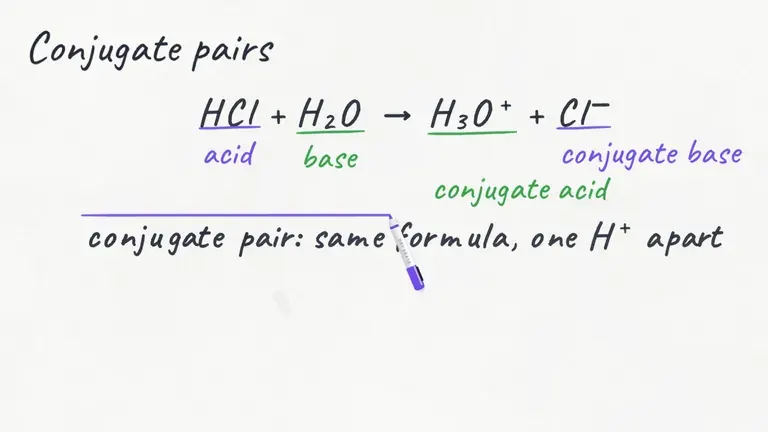
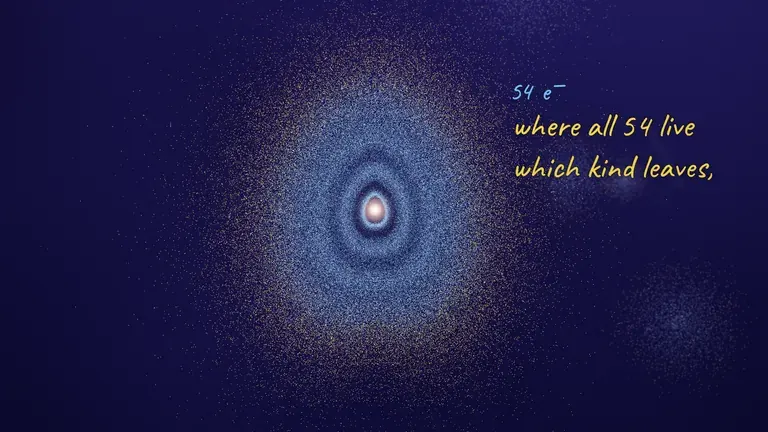 Topic 1.521 minAtomic Structure and Electron Configuration
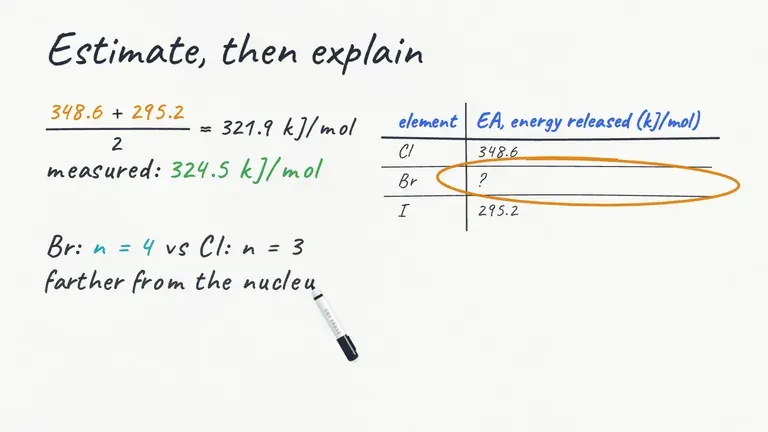 Topic 1.719 minPeriodic Trends
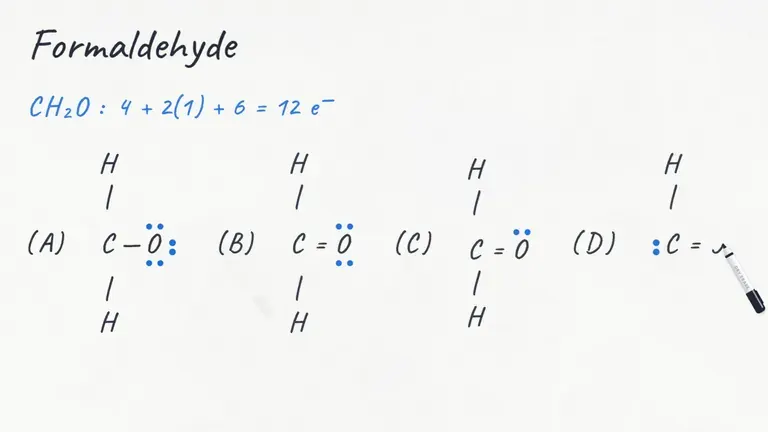 Topic 2.520 minLewis Diagrams
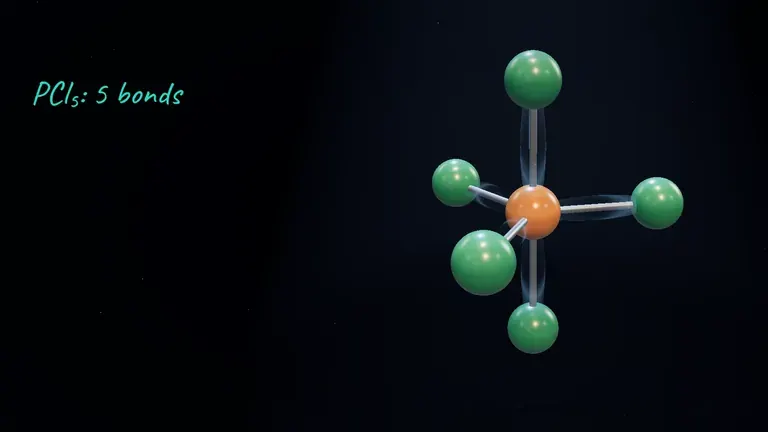 Topic 2.721 minVSEPR and Hybridization
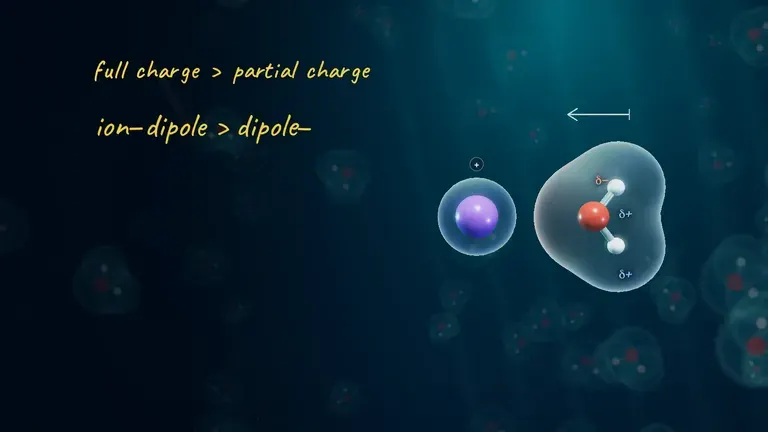 Topic 3.126 minIntermolecular and Interparticle Forces
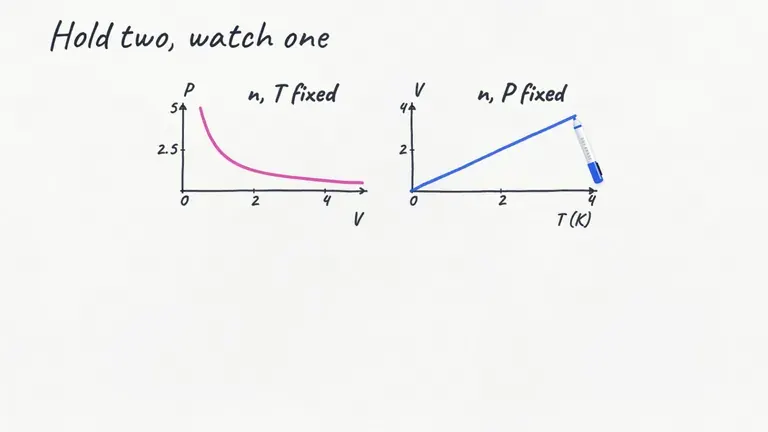 Topic 3.420 minIdeal Gas Law
 Topics 4.1–4.224 minIntroduction for Reactions · Net Ionic Equations
 Topics 4.6–4.724 minIntroduction to Titration · Types of Chemical Reactions
Practicing with released questions
College Board keeps recent free-response questions on AP Central with their scoring guidelines, and for 2023–2025 also the Chief Reader reports, the scoring statistics and real student answers scored by readers. This is the best practice material you can get.
- Do one question at a time, timed. Give a long question 23 minutes and a short one 9, with a calculator and the reference sheet, writing on paper.
- Score it the way a reader would. Go through the scoring guideline point by point. If the thing a point asks for isn’t on your page, it’s a zero, even if you knew it.
- Read the scored samples for that question (2023–2025) and find an answer that lost the point you lost.
- Read that question’s part of the Chief Reader report. It names the exact slips, usually in a few lines.
- Fix the habit, not the answer. If significant figures cost you a point, check every calculation in the next question for them.
| Exam | Questions | Scoring | Chief Reader report |
|---|---|---|---|
| 2026 | Questions | Scoring guidelines | Not yet published. Our worked answers |
| 2025 | Questions | Scoring guidelines | Report |
| 2024 | Questions | Scoring guidelines | Report |
| 2023 | Questions | Scoring guidelines | Report |
For the content behind the questions, the AP Chemistry cheat sheets cover each unit, and the 2026 worked answers take the most recent exam part by part.
Sources
- AP Chemistry Course and Exam Description: exam format, unit weights, skill weights and task verbs (PDF)
- AP Chemistry Exam: format and timing (AP Central)
- AP Chemistry past exam questions, 2023–2026 (AP Central)
- 2026 AP Chemistry Free-Response Questions (PDF)
- 2026 AP Chemistry Scoring Guidelines (PDF)
- 2025 AP Chemistry Free-Response Questions (PDF)
- 2025 AP Chemistry Scoring Guidelines (PDF)
- 2025 AP Chemistry Chief Reader Report, with the mean on every point (PDF)
- 2025 AP Chemistry Scoring Statistics (PDF)
- 2024 AP Chemistry Chief Reader Report (PDF)
- 2024 AP Chemistry Scoring Statistics (PDF)
- 2023 AP Chemistry Chief Reader Report (PDF)
- 2023 AP Chemistry Scoring Statistics (PDF)
- 2023 AP Chemistry Scoring Guidelines (PDF)
- AP Chemistry equations and constants (PDF)