
What you get on exam day
College Board gives every AP Chemistry student two pieces of reference information for the whole exam, multiple choice and free response alike: a periodic table, and two pages titled “AP Chemistry Equations and Constants.” Those two pages are what everyone means by the formula sheet.
| What to expect | |
|---|---|
| Where | A printed booklet on your desk, and the same pages in the Bluebook app |
| Sections | Both: the 60 multiple-choice questions and the 7 free-response questions |
| Contents | Unit symbols, conversions and metric prefixes, then five boxes of equations with their constants: atomic structure; gases, liquids and solutions; kinetics; equilibrium; thermodynamics and electrochemistry |
| Periodic table | Atomic number, symbol and average atomic mass for each element, and nothing else |
| Writing on it | Allowed. Nothing written there is scored, and the booklet stays in the room |
| Your own copy | Not allowed. Only the reference information College Board provides can be used |
| Calculator | Scientific or graphing on both sections; Desmos is built into Bluebook, and you may bring up to two approved handheld calculators |
| Version | The booklet posted for the May 2027 exam is dated © 2025 and matches the course description’s appendix marked “Effective 2025” |
Page 1 of the booklet holds the units, the atomic-structure box and the gases-and-solutions box. Page 2 holds kinetics, equilibrium, and thermodynamics with electrochemistry. In every box the equations sit on the left, and the right side says what each symbol stands for, with the constants that box needs. The same pages are in Bluebook’s test preview, and the PDF is free on AP Central: AP Chemistry Exam Reference Information. Work with the real one all year, so you know where each equation sits before May.
The periodic table isn’t in that PDF. The course and exam description (CED) promises it, the 2026 exam’s directions list it as part of the reference information, and the CED’s first appendix shows it: AP Chemistry CED, Appendix 1.
Letters that mean two things
The sheet reuses letters, and each box’s key only covers that box. These are the ones that catch people.
| Symbol | What it stands for, and where |
|---|---|
| Charge in coulombs, in Coulomb’s law and in . Heat in joules, in . | |
| The speed of light in . Concentration in . Specific heat capacity in . | |
| , | Plain is molarity, in . Bold is molar mass, in . As a prefix, M is mega. |
| Moles, in and . Moles of electrons transferred, in and the Nernst equation. | |
| , | Italic is velocity, in . The Greek letter (nu) is frequency, in and . |
| Force, in Coulomb’s law. Faraday’s constant, 96,485 coulombs per mole of electrons, in the electrochemistry equations. | |
| The energy of a photon, in . Cell potential in volts, in and . | |
| The kelvin, as a unit. An equilibrium constant: , , , , , . | |
| Volume, in the gas laws. The volt, as a unit. |
Capital is temperature, and inside , and anything with it must be in kelvins. Lowercase is time.
Unit symbols, conversions and prefixes
The top of page 1 is three small tables. The unit symbols need no study. The conversions and prefixes are where easy points leak away.
| Conversion | When it matters |
|---|---|
| 1 atm = 760 mm Hg = 760 torr | Before with , which needs atmospheres. Divide a pressure in mm Hg or torr by 760. |
| K = °C + 273.15 | Every temperature inside , , and the Nernst equation. A temperature change is the same size in both scales, so in can stay in °C. |
| 1 volt = 1 joule / 1 coulomb | The reason comes out in joules: coulombs per mole times joules per coulomb. Divide by 1000 for kJ. |
| 1 ampere = 1 coulomb / 1 second | Amps times seconds gives coulombs, the first step of every electroplating problem. |
| 1 hertz = 1 s⁻¹ | Frequency in has to be in s⁻¹ for the energy to come out in joules. |
The prefix table runs from giga () down to pico (). Two of them cost points. Nano, when a wavelength arrives in nanometers and has to go into in meters. And kilo, when is in kJ/mol and is in J/(mol·K) in the same calculation.
Atomic structure
Three equations and three constants: two of the equations are about light, and the third, Coulomb’s law, explains more of Units 1 and 2 than anything else on the sheet.
Photons
is the energy of one photon in joules, its frequency in s⁻¹ and its wavelength in meters. The box gives you Planck’s constant, J s, and the speed of light, m s⁻¹. Reach for this pair whenever light is absorbed or given off: an electron changing energy levels, a line in a spectrum, a photon with enough energy to break a bond. Given a wavelength, combine them into . The sheet files them under atomic structure, but the course teaches them in Topic 3.12, Properties of Photons.
Two slips are common. Leaving in nanometers: 500 nm is m, and dropping the makes the energy a billion times too small. And forgetting that is the energy of one photon; for a mole of photons, multiply by Avogadro’s number.
Light at 500 nm: J per photon, or 239 kJ for a mole of photons.
Coulomb’s law
The force between two charged particles grows with the size of each charge and falls with the square of the distance between them. The sheet prints it as a proportionality with no constant, and that tells you how the exam uses it: to compare two cases, never to calculate a force. It is the reason behind ionization energy, atomic and ionic radius, electronegativity, why MgO holds together far more strongly than NaCl, and why a small, highly charged ion holds water molecules tightly (Topic 1.5, Topic 1.7, Topic 2.2).
A full answer runs like this: Mg²⁺ carries twice the charge of Na⁺, and because it is smaller, a water molecule’s oxygen can get closer to its center. Larger charge and smaller separation both make the Coulombic attraction stronger. The 2026 scoring guidelines used the same reasoning for Rb⁺ against Na⁺, in so many words: a larger ionic radius gives a greater separation.
Avogadro’s number
The bridge between moles and particles (Topic 1.1). Multiply moles by it to count particles; divide a particle count by it to get moles. The slip is counting the wrong particle: 0.250 mol of H₂O is molecules but atoms, because each molecule has three.
Gases, liquids and solutions
This is the longest box on page 1, and nearly all of it is Unit 3. These equations rarely get a question to themselves. In 2024, Question 2 dropped the ideal gas law into the middle of a stoichiometry problem, and Question 1 opened a titration with a molarity.
The ideal gas law
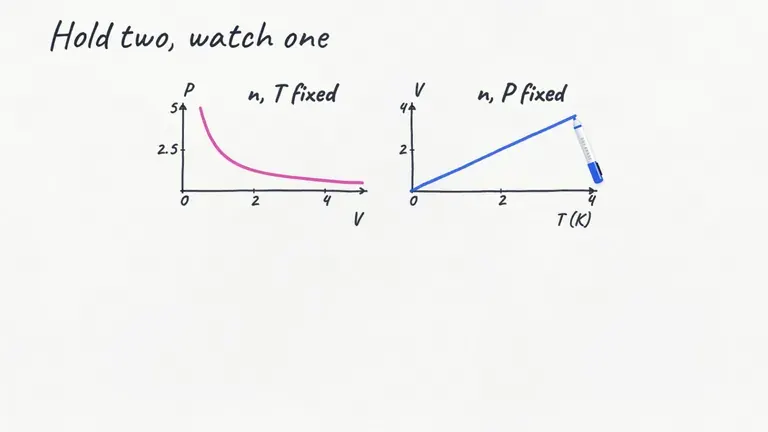
in atm, in liters, in moles, in kelvins, and L atm mol⁻¹ K⁻¹. The sheet’s other value, J mol⁻¹ K⁻¹, works in energy equations such as and also in with Pa and m³, or kPa and liters. Match the pressure and volume units to R. Use for any gas sample when you know three of the four quantities (Topic 3.4).
The combined gas law
One sample of gas, the same number of moles, before and after a change. Cross out whatever stays constant and solve for what’s left. In a rigid container cancels, so pressure is proportional to kelvin temperature.
2023 Question 5 did exactly that: a rigid 6.00 L tank of HCl at 7.45 atm and 296 K, cooled to 271 K, so atm. The Chief Reader saw students write instead, which sends the pressure up as the gas cools. Before you move on, check the direction: a colder gas in a fixed box pushes less.
Partial pressures
Each gas in a mixture pushes as if it were alone, so its share of the pressure is its share of the moles. Mole fraction is moles over total moles, never grams over total grams. Particle diagrams count as data here: if a box at 2.0 atm shows 6 red particles and 2 blue ones, red’s mole fraction is 0.75 and its partial pressure is 1.5 atm.
Moles from mass
Grams divided by molar mass, which you add up from the periodic table. This is the bold ; the plain a few lines down is molarity. For NaOH, g/mol, so 10.22 g is 0.2555 mol.
Density
Two jobs on this exam. In calorimetry it turns a volume of solution into a mass: 2024 Question 1 said to assume 1.00 g/mL, so 200.0 mL of mixed solution was 200.0 g. For a gas, combine it with to get the molar mass, . A gas with a density of 1.25 g/L at 273.15 K and 1.00 atm has a molar mass of 28.0 g/mol. Keep the units straight: g/mL for liquids, g/L for gases.
Kinetic energy
The kinetic energy of one moving particle. You’ll rarely put numbers into it; it’s there for arguments from kinetic molecular theory. The average kinetic energy of the particles depends only on the kelvin temperature, so at the same temperature every gas has the same average kinetic energy, and lighter molecules have to move faster to have it. O₂ molecules are 16 times heavier than H₂, so at the same temperature H₂ moves about four times faster on average. Same temperature means same average kinetic energy, not same speed.
Molarity
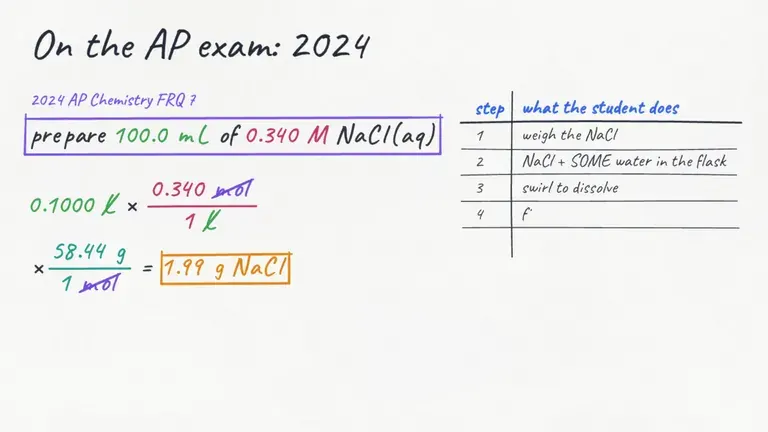
Moles of solute per liter of the whole solution, not per liter of water added (Topic 3.7). 2024 Question 1 dissolved 10.22 g of NaOH to make 500. mL of solution: M. For that one line, the Chief Reader’s list of errors was milliliters not converted to liters, and multiplying where the setup needed a division.
The same line handles dilution and mixing. Adding water doesn’t change the moles of solute, so , which isn’t printed but falls straight out of this definition. When two solutions are mixed, divide by the total volume: in 2025 Question 1, students who divided the moles of Mg²⁺ by the volume of only one of the two solutions lost the point.
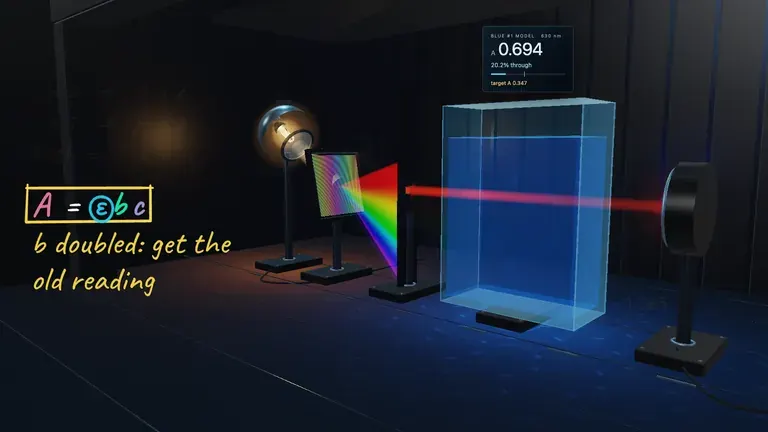
The Beer–Lambert law
Absorbance equals molar absorptivity (how strongly the species absorbs at that wavelength, in M⁻¹ cm⁻¹) times path length in cm times concentration in M (Topic 3.13). With the same cuvette and wavelength, absorbance is proportional to concentration, so a calibration line turns a measured absorbance into a concentration. Here is concentration, not the speed of light.
2026 Question 6 put it together with dilution. The calibration line had a slope of 4.0 M⁻¹, so an absorbance of 0.22 meant 0.055 M. That sample had been made by diluting 3.00 mL of the unknown to 25.0 mL, so the original was M. Absorbance gives you the concentration of what was in the cuvette; undo any dilution afterward.
The constants in this box
That 22.4 L/mol holds only at STP. At 20 °C, at 25 °C or at any pressure other than 1 atm, use .
Kinetics
Four equations, all about how a reactant’s concentration falls over time. The rate law itself, rate = , isn’t on the sheet; it’s in the list of what the sheet leaves off, further down.
is the starting concentration, the concentration at time , and the rate constant. The sheet prints these with no labels, so you have to know which is which: the first is zero order, the second first order, the third second order. And is true only for a first-order reaction, the one kind whose half-life doesn’t depend on how much you start with. Only the first-order half-life formula is supplied. The zero- and second-order integrated laws still let you find the time for a concentration to halve.
| Order | Straight-line plot | Slope | Units of k |
|---|---|---|---|
| Zero | [A] against time | −k | M s⁻¹ |
| First | ln[A] against time | −k | s⁻¹ |
| Second | 1/[A] against time | +k | M⁻¹ s⁻¹ |
Whichever plot comes out straight tells you the order, and its slope gives . Watch the sign: for zero and first order the slope is negative, and is its size. A first-order reaction with a half-life of 20. minutes has min⁻¹, and after three half-lives, 60 minutes, one-eighth of the reactant is left. Those are the numbers from 2026 Question 2, worked in full below.
Equilibrium
This is the biggest box on the sheet. It serves Units 7 and 8, equilibrium and acids and bases, which together carry 18–24% of the multiple-choice section.
K expressions
Products over reactants, each raised to the power of its coefficient. uses molar concentrations and uses partial pressures. The same form with the amounts present at any moment gives , the reaction quotient; comparing with tells you which way a reaction will go. Pure solids and pure liquids never appear: for CaCO₃(s) ⇌ CaO(s) + CO₂(g), .
2026 Question 4 is the model. For P₄(g) ⇌ 2 P₂(g), P₄ started at 0.470 atm and P₂ reached 0.630 atm at equilibrium. Each 2 P₂ uses up 1 P₄, so P₄ fell by 0.315 to 0.155 atm, and . The coefficient 2 became an exponent; it never multiplies the pressure inside the expression.
Converting between and isn’t tested, but the CED says to pay attention to which one a question uses (Topic 7.3).
Water
Both lines end with “at 25 °C”, and that’s not decoration. changes with temperature, so at another temperature use the value of for that temperature: neutral pH is ½p, and pH + pOH = p.
pH, pOH, Ka and Kb
Here log means base 10. The sheet doesn’t print the way back, . A smaller p means a larger and a stronger acid.
For a weak acid at starting concentration , let at equilibrium. Then , and when the acid ionizes only slightly, . A 0.20 M acid with gives M, a pH of 2.72, and just under 1% of the acid ionized. For a weak base the same algebra gives , so you get pOH first and then pH.
Conjugate pairs
These link an acid to its own conjugate base and nothing else. for NH₃ is , so for NH₄⁺ is . In 2025 Question 7 the Chief Reader reported students taking as , or as . It’s a division of by : not a reciprocal, not a subtraction.
Henderson–Hasselbalch
For a buffer: a weak acid and its conjugate base, both present in real amounts. Two readings of it carry a lot of points. When the log term is zero and pH = p, which is why the pH at the half-equivalence point of a weak-acid titration is the p. And when the pH is below the p the acid form dominates; above it, the base form.
Two things here are officially off the exam (Topic 8.9): deriving the equation, and calculating how much the pH changes when acid or base is added to a buffer. Using it to find a buffer’s pH, or a ratio from a pH, is very much on it.
Thermodynamics and electrochemistry
The last box on page 2 covers Units 6 and 9: heat, enthalpy, entropy, free energy and electrochemical cells.
Calorimetry
Heat in joules equals mass in grams, times specific heat capacity in J/(g·°C), times the temperature change, final minus initial. The mass is whatever changes temperature, which in a coffee-cup calorimeter is the whole solution: the water plus the dissolved solid, or both solutions after mixing. The question supplies . In 2025 it was 4.18 J/(g·°C); in 2026, 3.95.
The sheet stops at . Getting a molar enthalpy takes two steps it doesn’t print: flip the sign, because heat gained by the solution is heat lost by the reaction, and divide by moles. In 2026 Question 1, KCl dissolved in water and the temperature fell by 3.4 °C: J for the solution, so dissolving the salt absorbed 1.4 kJ, and with 0.0912 mol of KCl, kJ/mol. A temperature drop means an endothermic process, so the sign is positive. In 2024 the Chief Reader called this step the least accessible point on Question 1: wrong moles and wrong signs.
Products minus reactants
Multiply each table value by its coefficient before you add. An element in its standard state has and , but its is not zero: entropies are absolute values, so O₂(g) has an of its own. Watch the units too. Tables give in kJ/mol and in J/(mol·K).
2026 Question 7 ran the first equation backward. For 4 Na(s) + O₂(g) → 2 Na₂O(s), kJ/mol, and both elements are zero, so and kJ/mol. Bond enthalpies work the other way round, bonds broken minus bonds formed, and that rule isn’t on the sheet.
Free energy
One line ties free energy to enthalpy and entropy, to the equilibrium constant and to cell potential. Use whichever pair the question hands you. The signs all agree: a negative means a thermodynamically favored process under standard conditions, a greater than 1 and, for a cell, a positive .
Take a reaction with kJ/mol and J/(mol·K), close to the values for making ammonia. At 298 K, kJ/mol, so it is favored under standard conditions, and . Because both and are negative, it stays favored under standard conditions only below about K. 2026 Question 4 asked that logic in reverse: a reaction favorable only above 1500 K, making two moles of gas from one, has a positive , so its must be positive too.
Current and charge
Current in amperes is charge in coulombs per second. Here is charge, not heat. Electrolysis problems follow a fixed chain, and only the first link is printed: amps times seconds gives coulombs; coulombs divided by 96,485 gives moles of electrons; divide by the electrons each ion needs to get moles of metal; multiply by the molar mass to get grams. Run 2.00 A for 965 s through a Cu²⁺ solution: 1930 C, 0.0200 mol of electrons, 0.0100 mol of Cu, 0.636 g.
The Nernst equation
Some prep sites list it as missing; it’s at the bottom of page 2. What the course wants from it is mostly reasoning, not number-crunching: the CED says algorithmic Nernst calculations aren’t enough to show understanding, and asks students to reason about how concentration changes a cell’s voltage (Topic 9.10).
The reasoning goes like this. At standard conditions , and . Make smaller than 1, with more reactant ions or fewer product ions, and the voltage rises above ; make larger and it falls. At equilibrium and : the cell can do no more work. In a zinc–copper cell, Zn + Cu²⁺ → Zn²⁺ + Cu, V and , so adding Cu²⁺ raises the voltage.
The periodic table you get
The AP table is plain on purpose. Each box has the atomic number, the symbol and the average atomic mass, mostly to two decimal places (hydrogen gets three, 1.008; lead gets one, 207.2). Groups are numbered 1–18, with the lanthanoids and actinoids in two rows underneath. A few boxes have no mass at all: Tc, Pm, Po through Ac, and everything after U.
What it doesn’t show: element names, electronegativity, ionization energy, radius, electron configuration, ion charge, or a line between metals and nonmetals. Position lets you predict trends from the row and column, typical main-group ion charges from the group, and configurations from the block; it does not give you numerical electronegativities, ionization energies or radii (Topic 1.7, Topic 1.8).
Use the masses exactly as printed. College Board’s own answers do: the 2026 scoring guidelines used 52.00 g/mol for chromium and 22.99 for sodium, straight off this table.
Since names aren’t printed, learn the symbols that don’t match their English names: Na (sodium), K (potassium), Fe (iron), Cu (copper), Ag (silver), Sn (tin), Sb (antimony), W (tungsten), Au (gold), Hg (mercury) and Pb (lead). On the free-response questions from 2023 to 2026, compounds and ions named in words came with their formulas (sodium bicarbonate, NaHCO₃; the chromate ion, CrO₄²⁻), but you still have to find each element on the table to reason about it.
The sheet on a real question
2026 Question 2 shows what the reference pages can and can’t do for you. Its second half is about chromium plating and how fast dichromate ions disappear, and six of its ten points rest on lines from the sheet and one number from the periodic table. Below is our worked answer to those parts, scored against the official guidelines. The 2026 questions and scoring guidelines are on AP Central.
Chromium plates out of solution by the half-reaction CrO₃(aq) + 6 H⁺(aq) + 6 e⁻ → Cr(s) + 3 H₂O(l), with V. C: Is this reaction thermodynamically favorable under standard conditions? Justify with . D: How many grams of Cr plate onto a steel rod when 15.0 A runs for 3250 s? E: In a separate experiment, a graph shows [Cr₂O₇²⁻] falling from 0.50 M, through 0.25 M at 20 minutes, to about 0.125 M at 40 minutes. Explain how the data show the reaction is first order. F: A plot of ln[Cr₂O₇²⁻] against time is a straight line from −0.70 at time zero to −1.20 at 15 minutes. Find in min⁻¹. G: Sketch the ln plot for a second trial that starts at 0.25 M. (Paraphrased; the official wording and graphs are in the PDF.)
C. Unfavorable. J/mol kJ/mol. A positive means the reaction isn’t thermodynamically favored, so plating needs an outside source of electrical energy.
D. Charge: C. Electrons: mol e⁻. Six electrons per chromium atom: mol Cr. Mass: g Cr.
E. The concentration halves every 20 minutes, from 0.50 to 0.25 M and then to about 0.125 M. A constant half-life that doesn’t depend on concentration is the mark of a first-order reaction.
F. The ln plot is straight, so the reaction is first order and min⁻¹. (From the half-life, min⁻¹.)
G. Start at and draw a straight line parallel to the first: same , same slope, shifted down.
How it scores
| C: favorability from ΔG° (1 point) | 1/1 | The claim plus a correctly calculated : from the half-reaction, from the sheet, joules converted to kilojoules, and a positive sign that matches “unfavorable.” |
|---|---|---|
| D: moles of electrons (1 point) | 1/1 | Amps times seconds, divided by Faraday’s constant. The guidelines allow this step to be implicit. |
| D: mass of chromium (1 point) | 1/1 | Six electrons per chromium from the half-reaction, then 52.00 g/mol from the periodic table. |
| E: first order (1 point) | 1/1 | The guidelines’ answer is a constant half-life of 20 minutes. |
| F: rate constant (1 point) | 1/1 | The guidelines accepted the integrated rate law, the slope of the ln plot (0.033 min⁻¹) or the half-life (0.035 min⁻¹). |
| G: second trial (1 point) | 1/1 | The line starts at (0, −1.40) and runs parallel to the original, because doesn’t depend on the starting concentration. |
Why it works
- Five lines of the sheet did the heavy lifting: , Faraday’s constant, , the first-order integrated rate law and . The periodic table supplied 52.00.
- The sheet did not supply the six electrons per chromium, the fact that a constant half-life means first order, or what a positive means. Those came from knowing the course.
- Every number carried its unit, which is how a missing factor of 1000 between J and kJ gets caught before it costs the point.
Parts A and B of the same question, a Lewis diagram with formal charges and a net ionic equation, use nothing from the sheet at all. That’s the other half of the story, and it’s the next section.
What the sheet leaves off
Everything in this section is part of the course and none of it is printed. Some of it is one line of algebra away from the sheet; the rest you simply have to know. The list follows the CED topic by topic and leaves out anything the exam doesn’t test.
| What | The relationship | Topic |
|---|---|---|
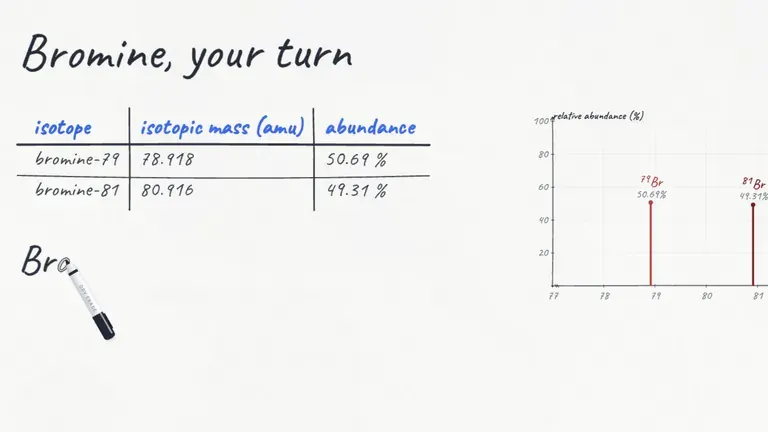
| Average atomic mass | Σ (isotope mass × fractional abundance). For chlorine, 0.7576 × 34.97 + 0.2424 × 36.97 = 35.45 | 1.2 |
| Empirical formula | Grams of each element → moles → divide by the smallest → whole-number ratio | 1.3 |
| Mass percent and purity | 100 × mass of the part ÷ mass of the whole | 1.4 |
| Formal charge | Valence electrons − nonbonding electrons − ½ bonding electrons. A singly bonded O with three lone pairs: 6 − 6 − 1 = −1 | 2.6 |
| Dilution and mixing | ; after mixing, divide moles by the total volume | 3.7 |
| Photon energy from wavelength | , two sheet equations combined; for a mole of photons, multiply by | 3.12 |
| Rate law | rate ; the exponents come from experiment, not from the coefficients; overall order | 5.2 |
| Relative rates | Rates of disappearance and appearance are in the ratio of the coefficients | 5.1 |
| Mechanisms | An elementary step’s rate law follows its own coefficients; a slow first step sets the overall rate law; a catalyst is used up and then regenerated, an intermediate is made and then used up | 5.4, 5.7, 5.8, 5.11 |
| Heat of a phase change | of fusion or vaporization | 6.5 |
| Molar enthalpy from calorimetry | moles that reacted | 6.4, 6.6 |
| Bond enthalpies | (bonds broken) (bonds formed) | 6.7 |
| Hess’s law | Reverse a reaction: flip the sign of . Multiply it: multiply . Add reactions: add the values | 6.9 |
| Changing K | Reverse a reaction: . Multiply coefficients by : . Add reactions: multiply the values | 7.6 |
| Q against K | : net forward. : net reverse. : at equilibrium. Only a temperature change changes | 7.7, 7.10 |
| Ksp and molar solubility | For a 1:1 salt, ; for a 1:2 salt, (no other source of either ion). A common ion lowers | 7.11, 7.12 |
| Strong acid or base | For a strong monoprotic acid, [H₃O⁺] ≈ its concentration; for dissolved strong hydroxides, [OH⁻] ≈ the group 1 concentration or twice the group 2 concentration. These shortcuts neglect water’s autoionization | 8.2 |
| Percent ionization | 100 × [H₃O⁺] at equilibrium ÷ starting [HA] | 8.3 |
| Half-equivalence point | For a weak monoprotic acid titrated with strong base, pH ≈ p; for a weak base titrated with strong acid, pOH ≈ p | 8.5 |
| Indicator choice | Pick an indicator whose p is close to the pH at the equivalence point | 8.7 |
| Entropy direction | for melting and vaporization; a reaction that makes more moles of gas usually has | 9.1 |
| Favorability from signs | Using and for standard conditions: negative H, positive S means favored at all T; positive H, negative S means never. Both negative: low T. Both positive: high T. Treat H and S as constant over the temperature range | 9.3 |
| Standard cell potential | , using reduction potentials, never multiplied by coefficients | 9.9 |
| Electrolysis | Coulombs ; moles of e⁻ ; then electrons per ion and molar mass | 9.11 |
Facts to know cold
- Strong acids. The CED names six: HCl, HBr, HI, HClO₄, H₂SO₄ and HNO₃ (Topics 8.2 and 8.6). Only H₂SO₄’s first ionization is treated as complete; its second uses an equilibrium. Carboxylic acids, such as acetic acid, are the common weak acids.
- Strong bases. Dissolved group 1 hydroxides and the soluble portion of strong group 2 hydroxides dissociate completely. A strong group 2 hydroxide such as Ba(OH)₂ gives two OH⁻ per dissolved formula unit; this does not mean every group 2 hydroxide is highly soluble. Ammonia, other nitrogen bases and carboxylate ions are the common weak bases.
- The one solubility rule. All sodium, potassium, ammonium and nitrate salts are soluble in water. The CED says memorizing any other solubility rules won’t be assessed (Topic 4.7).
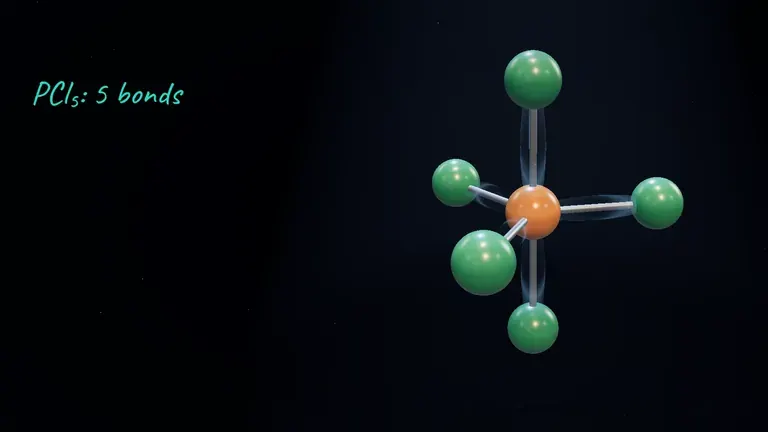
- Shapes and angles. The VSEPR shapes for two to six electron domains (linear, trigonal planar, tetrahedral, trigonal bipyramidal, octahedral) and the shapes lone pairs make from them (bent, trigonal pyramidal, seesaw, T-shaped, square pyramidal, square planar). sp, sp² and sp³ go with ideal electron-domain angles of 180°, 120° and 109.5°; lone pairs can change the molecular bond angles (Topic 2.7).
- Sigma and pi. A single bond is one sigma bond, a double bond is one sigma and one pi, and a triple bond is one sigma and two pi.
- Light and molecules. Microwaves change how molecules rotate, infrared changes how they vibrate, and ultraviolet and visible light move electrons between energy levels (Topic 3.11).
- Cells. Oxidation happens at the anode and reduction at the cathode, and electrons flow through the wire from anode to cathode (Topic 9.8).
- Polyatomic ions. The CED has no list to memorize. Its required facts name ammonium and nitrate salts and group 1 and 2 hydroxides, so know NH₄⁺, NO₃⁻ and OH⁻ at the very least, plus the ions your class uses.

What College Board says it won’t test
The CED marks 24 things as off the exam, each in an “exclusion statement” under its topic. Most sit inside topics you still have to study, so the last column says what stays in. One statement appears under both 5.7 and 5.8, and it’s listed once here.
| Topic | Won’t be assessed | Still fair game |
|---|---|---|
| 1.2 | Mass spectra of samples with more than one element, or with peaks from anything other than singly charged ions of single atoms | Reading a one-element spectrum for its isotopes, their abundances and the average atomic mass |
| 1.5 | Assigning quantum numbers to electrons | Ground-state electron configurations of atoms and ions |
| 1.7 | Configurations of elements that break the aufbau pattern, such as chromium and copper | Ordinary configurations, and periodic trends explained with Coulomb’s law |
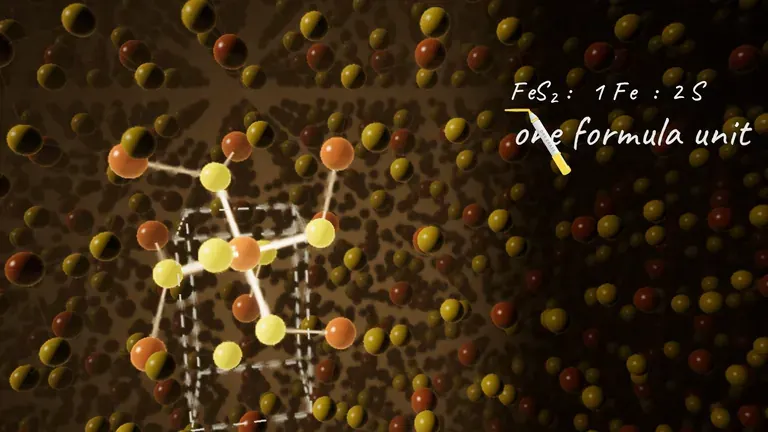
| 2.3 | Specific crystal structures | A particle model of an ionic solid: alternating cations and anions |
| 2.7 | Deriving or drawing hybrid orbitals | The labels sp, sp² and sp³, sigma and pi bonds, and VSEPR shapes |
| 2.7 | Hybridization involving d orbitals | The shape of a molecule with five or six electron domains |
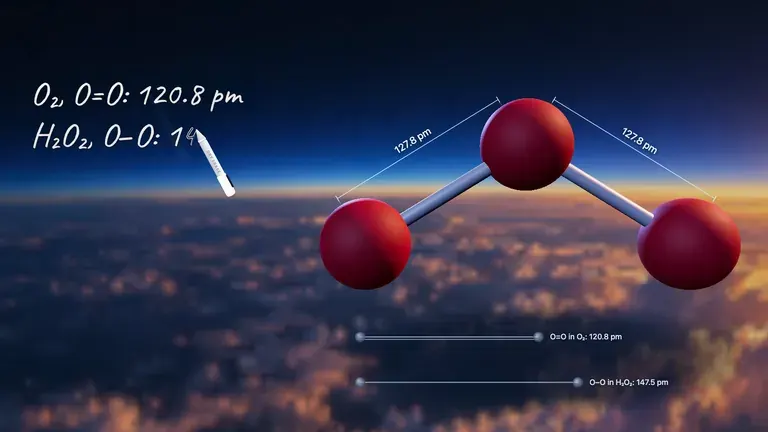
| 2.7 | Molecular orbital diagrams, filling them, and bonding, nonbonding and antibonding orbitals | Bond order, bond length and bond energy from Lewis diagrams |
| 3.3 | Reading or interpreting phase diagrams | Particle pictures of solids, liquids and gases |
| 3.8 | Colligative properties | Particle drawings of solutions and their concentrations |
| 3.8 | Calculating molality, percent by mass or percent by volume of a solution | Molarity, and the mass percent of an element in a compound or a mixture (Topics 1.3 and 1.4) |
| 4.7 | The terms “oxidizing agent” and “reducing agent” | Which species is oxidized and which is reduced, from oxidation numbers |
| 4.7 | Memorizing solubility rules beyond the one above | Sodium, potassium, ammonium and nitrate salts are all soluble |
| 4.8 | Lewis acid–base ideas | Brønsted–Lowry acids, bases and conjugate pairs |
| 5.6 | Calculations with the Arrhenius equation | Why rates rise with temperature, and activation energy on an energy profile |
| 5.7, 5.8 | Collecting data to detect a reaction intermediate | Spotting intermediates and catalysts in a mechanism, and the rate law from the slow step |
| 6.6 | The technical difference between enthalpy and internal energy | ΔH as the heat of a reaction at constant pressure |
| 6.9 | The idea of state functions | Hess’s law itself: reverse, scale and add |
| 7.3 | Converting between and | Writing either one, and noticing which one a question uses |
| 7.3 | Equilibrium calculations for a dissolved substance in equilibrium with its own gas | Ordinary and calculations |
| 8.5 | The concentration of every species along a titration curve for a polyprotic acid | The same calculations for monoprotic acids, and which species dominate at each stage of a polyprotic titration |
| 8.9 | Calculating how much the pH changes when acid or base is added to a buffer | Buffer pH from Henderson–Hasselbalch, and explaining why a buffer resists change |
| 8.9 | Deriving the Henderson–Hasselbalch equation | Using it |
| 8.11 | Calculating solubility as a function of pH | Explaining with Le Châtelier’s principle why pH changes the solubility of salts like hydroxides |
| 9.8 | Labeling an electrode as positive or negative | Anode and cathode, the direction of electron flow, and ion flow in the salt bridge |
Two cautions. An exclusion removes a task, not a topic: you won’t convert to , but you will be expected to notice which one you’ve been given. And your class may teach some of these anyway; the CED itself recommends molecular orbital theory for the insight it gives. Learn what your teacher tests. Just don’t spend April on it.
Quick answers
Do you get a formula sheet on the AP Chemistry exam?
Yes. Every student gets the equations and constants and a periodic table, in print and in Bluebook, for both sections.
Is the Nernst equation on the AP Chemistry formula sheet?
Yes: , at the bottom of page 2. The exam mostly asks you to reason with it rather than plug numbers in.
Is Ksp on the formula sheet?
No. Write it like any other K: the ion concentrations raised to their coefficients, with the solid left out.
Is the Arrhenius equation on the formula sheet?
No, and calculations with it aren’t tested (Topic 5.6). You still need to explain why a higher temperature speeds a reaction up.
Can I write on the formula sheet?
Yes. The booklet’s blank space is meant for scratch work, nothing written there is scored, and the proctor collects it at the end.
Can my calculator store formulas?
Yes. College Board’s calculator policy allows calculators with built-in constants and chemistry formulas, and their memories don’t need to be cleared. You can bring up to two approved handheld calculators, and Bluebook has scientific and graphing Desmos built in. Calculators can’t be shared.
Has the formula sheet changed for 2027?
Not as of October 24, 2026. The booklet College Board posted for the 2027 exam is dated © 2025 and matches the CED’s appendix marked “Effective 2025.” Any change will appear on AP Central’s reference-information page.
Where can I get a printable copy?
College Board’s official PDF is the one to print, since it’s exactly what you’ll get. For a summary of the whole course on a few pages, see the AP Chemistry cheat sheet.
Sources
- AP Chemistry Exam Reference Information: Equations and Constants, © 2025, posted for the 2027 exam (PDF)
- AP Chemistry Course and Exam Description, effective fall 2024: periodic table (Appendix 1), equations (Appendix 2), exclusion statements (PDF)
- Reference Information for Specific AP Exams (AP Central)
- AP Chemistry Exam (AP Central)
- AP Exams Calculator Policy (AP Central)
- 2026 AP Chemistry Free-Response Questions (PDF)
- 2026 AP Chemistry Scoring Guidelines (PDF)
- 2025 AP Chemistry Free-Response Questions (PDF)
- Chief Reader Report: 2025 AP Chemistry Free-Response Questions (PDF)
- Chief Reader Report: 2024 AP Chemistry Free-Response Questions (PDF)
- Chief Reader Report: 2023 AP Chemistry Free-Response Questions (PDF)