
Topic 4.8 key terms
- Brønsted–Lowry acid
- A proton (H+) donor: the species that gives a proton away in a reaction.
- Brønsted–Lowry base
- A proton acceptor: the species that takes the proton, using a lone pair of electrons. It does not need an OH group (NH₃ and (CH₃)₃N are bases).
- hydronium ion
- H3O+, a water molecule that has accepted a proton. In water, H+(aq) is shorthand for it.
- conjugate acid–base pair
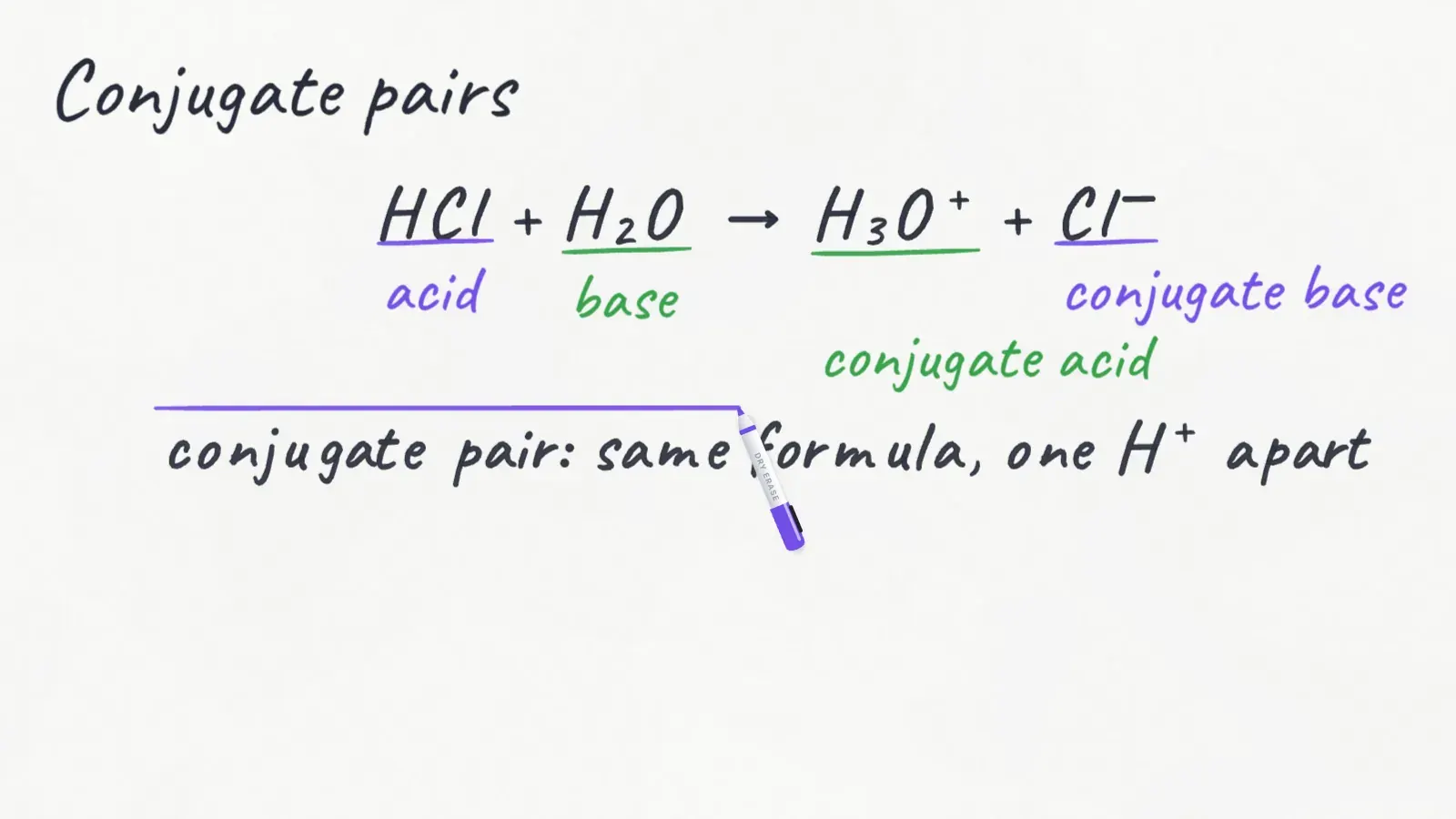
- Two species whose formulas differ by exactly one H+ (and so by one unit of charge), such as HCl/Cl⁻ or H₃O⁺/H₂O. Every Brønsted–Lowry reaction has two pairs.
- amphiprotic
- Able to act as either a Brønsted–Lowry acid or a base, depending on its partner. Water is the classic example.
- strong acid / weak acid
- A strong acid gives essentially all of its protons to water (one-way arrow); a weak acid gives only a fraction of them (double arrow). The stronger the acid, the weaker its conjugate base.
- aqua regia
- A mixture of concentrated nitric and hydrochloric acids that dissolves gold: nitrate takes the electrons and chloride holds the gold as AuCl4-.
Transcript
1,620 words · 4 parts
Acid–base reactions: who hands over the proton
On the morning of April 9th, 1940, German troops crossed the border into Denmark, and in a physics institute in Copenhagen, a chemist named George de Hevesy had two Nobel Prize medals that he needed to make disappear. They belonged to two German physicists, Max von Laue and James Franck, who had sent them to Niels Bohr’s institute to keep them away from the Nazis.
Sending gold out of Germany was a serious crime, and each medal had its owner’s name engraved on it, so anyone who found one would know exactly whose it was. Hevesy’s first idea was to bury them, but Bohr didn’t like that, because anything you bury can be dug back up.
So Hevesy did something only a chemist would think of. He wrote about it later, “While the invading forces marched in the streets of Copenhagen, I was busy dissolving Laue’s and also James Franck’s medals.” He lowered them into a mixture of two acids called aqua regia, and slowly the engraving softened and the gold wore away, until all that was left was a bottle of orange liquid.
Then he put the bottle on a shelf, right in among all the other bottles in the lab. And there it sat. Three years later, Hevesy had to escape to Sweden, and German soldiers occupied the institute itself, but the medals were never found, because as far as anyone could tell, they didn’t exist anymore.
But the gold was right there the whole time, every single atom of it, sitting in this bottle, just not as metal anymore. And this is the part I find really strange, because hydrochloric acid on its own does nothing to gold, and nitric acid on its own barely touches it.
But mix the two together and the gold dissolves, which means “acid eats metal” can’t be the whole story. So what did those two acids actually do in there, and what didn’t they do? We’ll find out, and we’ll write the reaction that made two Nobel medals vanish, and then a reaction that can bring the gold back out of the bottle.
To get there, we need to know what really happened in that bottle, because two completely different things were going on in there, and the first one is about protons. So let’s go into the liquid, down past the glass, until we can see the particles themselves. Most of what’s in here is water, so let’s replay the moment hydrochloric acid gets made, when a molecule of HCl first meets water.
Keep your eye on the hydrogen. The chlorine lets go of it, and the water catches it with a spare pair of electrons on its oxygen. The chlorine keeps the electrons it used to share with the hydrogen.
So the water has turned into H3O plus, called hydronium, and the chlorine is left as a chloride ion, C L minus. The only thing that moved was a proton, the hydrogen’s nucleus, which chemists write as H plus.
On paper, HCl plus water gives hydronium plus chloride, with the proton going from the HCl to the water. An acid, the way chemists use the word, is a proton donor, and a base is a proton acceptor, so HCl is the acid here because it gave the proton away, and water is the base because it took it. This is called the Brønsted–Lowry definition, and it means you don’t need a list to spot the acid in a reaction, because you just follow the proton, and that one habit is what AP acid–base questions are really testing.
The other acid in Hevesy’s bottle was nitric acid, HNO3, and it does the very same thing to water. So in this reaction, which particle is acting as the Brønsted–Lowry base?
Conjugate pairs: one proton apart
Let’s go back to HCl and look at what each particle turns into. HCl gives away its proton and becomes chloride, so HCl and chloride are really the same particle, before and after, one proton apart. And water takes a proton and becomes hydronium, so water and hydronium are a pair too.
These are called conjugate acid–base pairs, so chloride is the conjugate base of HCl, what’s left after the acid gives its proton away, and hydronium is the conjugate acid of water, what water becomes after it takes one. So the test for a conjugate pair is really simple, because the two formulas are identical except for one H plus, and that means their charges always differ by exactly one.
And this is a classic AP question. On the 2026 exam, students got this exact equation, with nitrous acid, and writing one conjugate pair from it, with the acid and the base labeled, was worth a whole point.
You find its pairs exactly the same way, even with the double arrow, which we’ll come back to a little later. The mistake almost everybody makes at first is pairing up the two particles that collided, here nitrous acid and water, but those are two completely different particles, so they can’t be a pair. If that still feels slippery, think of each pair as the same particle photographed twice, once before it moved a proton and once after, and every acid–base reaction gives you two of those pairs.
Which of these is a conjugate acid–base pair? So far water has always taken the proton, but it can give one away too, and to see that we need a base, one you’ve almost certainly smelled.
Water plays both sides
This is the Tsukiji Outer Market in Tokyo, early in the morning, when the grills are already going and the stalls are full of fish on ice. Fish starts to smell fishy as it gets older, and most of that smell comes from one molecule, called trimethylamine. Let’s zoom in on the thin layer of water on this fish. This is trimethylamine, a nitrogen with three C H three groups on it, and it boils at about three degrees Celsius, so it drifts right off the fish and into your nose.
Trimethylamine is a base, even though there isn’t an O H anywhere in it, because its nitrogen has a spare pair of electrons that can grab a proton. Let’s start with its simpler cousin, ammonia, which has three hydrogens where trimethylamine has three C H three groups. And this time it’s the water that gives up a proton. Ammonia takes it and becomes ammonium, NH4 plus, and the water is left behind as hydroxide, O H minus.
And the pairs work the same way, ammonia with ammonium, and water with hydroxide. Now let’s keep this exact water molecule and swap its partner for the HCl from before, and this time the water takes the proton instead. So the same water molecule is a base with HCl and an acid with ammonia, and chemists call something that can go either way amphiprotic.
Water can do it because it has hydrogens to give and spare electrons on its oxygen to catch one with. Which brings us back to the fish, and the reason people squeeze lemon on it. Lemon juice is full of acids, mostly citric acid, and they hand protons to the water on the fish and make hydronium. So now hydronium meets trimethylamine, and I want you to make this one happen yourself.
Grab the proton that’s going to move, and put it where it ends up. And that’s why lemon helps, because now it’s an ion, so water molecules crowd around it, and it stays in the water on the fish instead of floating off into the air. It won’t make old fish any fresher, but one proton per molecule keeps a lot of the smell on the plate.
On paper, trimethylamine plus hydronium gives trimethylammonium plus water, and you find the pairs the same way as always. And it’s worth crossing out one old idea, that a base has to have O H in it, because ammonia and trimethylamine don’t, and they both take protons perfectly well. In which of these reactions is water acting as an acid?
Strong acid, weak conjugate base
Lemon juice and Hevesy’s hydrochloric acid are both acids, but they aren’t equally good at giving protons away, so let’s compare hydrochloric acid with acetic acid, the acid in vinegar, at the same concentration. In the hydrochloric acid, essentially every single HCl has given its proton to water. But in the acetic acid, only about one molecule in seventy-five has done it, and all the others are still holding on to their protons. Now watch the conjugate bases. Every so often an acetate ion grabs a proton right back, but a chloride ion basically never does.
So hydrochloric acid is a strong acid, and acetic acid is a weak one, and that’s what the two kinds of arrow are telling you, one arrow when the reaction goes essentially all the way, and a double arrow when it runs both ways, and only part of the acid ends up giving its proton away.
So the stronger the acid, the weaker its conjugate base, and that makes sense, because an acid that lets go of its proton really easily leaves behind a base that doesn’t want it back. Be careful with this one, because it’s tempting to say a weak acid must have a strong conjugate base. Acetate is a stronger base than chloride, but it’s still a weak base, so all we can really say is which one is stronger.
Both samples have the same concentration, so strength is about what fraction of the acid gives its protons away, and that’s a separate question from how much acid there is. Hydrofluoric acid is a much stronger acid than hydrogen cyanide, so which of these is the stronger base?