
Topic 4.3 key terms
- particulate representation
- A drawing of a sample in which each circle is an atom and joined circles are one molecule or polyatomic ion. It must show every atom of every element, the right units, ion charges, and the phase.
- formula unit
- The simplest ratio of ions in an ionic compound, such as one Na⁺ and one N₃⁻ in NaN₃. Ionic solids are extended arrays of ions, not separate molecules.
- coefficient vs subscript
- A coefficient counts whole units (2 CO is two units). A subscript is part of the unit itself (CO₂ is a different substance).
- leftover (excess) reactant
- Reactant that remains after the reaction is complete. A final-mixture picture must still include it.
- polyatomic ion
- A charged group of covalently bonded atoms, such as N₃⁻, OH⁻ or NO₃⁻. It stays one unit when its salt dissolves.
Transcript
1,271 words · 3 parts
Representations of reactions: atom by atom
This is a crash-test hall, and that car at the far end is about to slam into a concrete wall, on purpose. All these lights are for the high-speed cameras, because what we’re here to see happens way too fast for your eyes. When the car hits, a sensor fires, and the airbag has to be completely full before the driver’s head gets there.
So here it is, slowed way down. In real life that bag goes from folded flat to completely full in less than a twentieth of a second, which is faster than you can blink. Front airbags like this one have saved more than fifty thousand lives in the United States since 1987. But there’s something strange about this bag, because there’s no tank of gas hidden anywhere in that steering wheel.
For decades, a little stack of pellets like these filled a lot of airbags. This one’s a legacy sodium-azide inflator, an older design. A spark sets the pellets off and turns the solid into nitrogen gas, the same gas that makes up most of the air you’re breathing. So the gas in that bag wasn’t stored anywhere, and a split second before it caught the dummy’s head, it was a solid.
By the end of this lesson, you’ll be able to draw what’s inside one of these pellets and follow every single atom when it goes off, and you’ll be able to say which part of that blink was a chemical change and which part wasn’t, and prove it, bond by bond. So let’s wind the clock back to the instant the spark reaches the pellets, and go inside one.
We’re shrinking down past the surface of one pellet, smaller and smaller, until we can see the particles it’s built from. Sodium azide is an ionic solid, so it’s built from sodium ions, each with a plus one charge, and azide ions, which are three nitrogen atoms stuck together in a line, carrying a minus one charge.
There’s no such thing as one little sodium azide molecule in here, just ions, packed in layers that go on and on. Now the spark heats it up, the azide ions come apart, the nitrogen atoms grab each other in pairs and fly off as nitrogen gas, and the sodium gets left behind as sodium metal.
Here’s the equation for that step. To see what it really means, let’s take just a tiny piece of the crystal, six sodium ions and six azide ions, which is six formula units of sodium azide, each one a sodium ion and an azide ion. The two in front of NaN₃ means two whole formula units, and the three in front of N₂ means three whole molecules, each one a pair of nitrogen atoms. So our six units are just that recipe, run three times.
Reading coefficients as whole units like this is exactly what AP questions about particle pictures are testing. Real inflators also packed a second ingredient that reacts with that sodium, to keep it out of the bag, but the step that makes the gas is this one. The six azide ions in our box have just come apart, and I’ll let you finish the job.
Snap the eighteen nitrogen atoms together into the molecules the equation says form. Now let’s flatten that into the kind of picture you’ll draw on paper, with the same particles in the same places.
Whenever you turn an equation into a particle picture, start with the legend so you know which circle is which, then let the coefficients count whole units, while the subscripts tell you what’s inside each unit. Next, check that every element has the same count on both sides, six sodium before and six after, eighteen nitrogen before and eighteen after, and the charges add up to zero both times. And last, draw the right units in the right phase, so nitrogen goes in as pairs spread out the way a gas should be, and the sodium azide we started with sits packed together, the way a solid should be.
A lot of students draw the after box with eighteen loose nitrogen atoms. Every atom adds up, and it’s still wrong, because the equation says the nitrogen leaves as N₂ molecules. Let’s count particles this time, instead of formula units. Each formula unit is two particles, one sodium ion and one azide ion. That means our six units make twelve particles.
After the spark there are six sodium atoms and nine N₂ molecules, fifteen particles. The number of particles changed, but the atoms of each element didn’t. And this flat box is exactly how those AP questions about particle pictures look, where they hand you the equation and ask for the picture, or hand you the picture and ask for the equation.
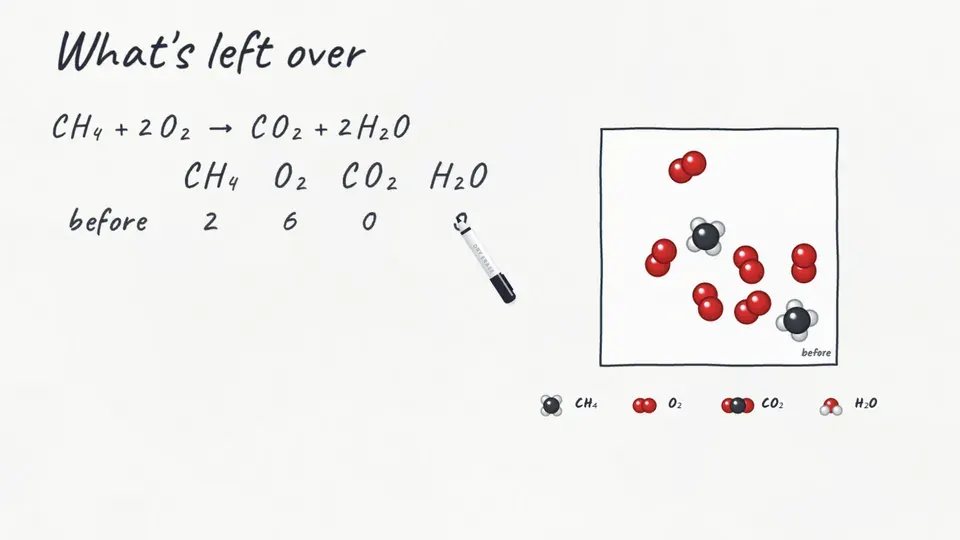
What’s left over
Let’s warm up with one tiny picture. Two CO means two separate units, each with one carbon and one oxygen, while CO₂ is a single unit with two oxygens attached to one carbon. So a coefficient makes copies of a whole unit, and a subscript changes what the unit is, which is why you can never fix a particle picture by changing a subscript.
Here’s methane burning, and here’s a box that starts with two methane molecules and six oxygen molecules. The question is what’s in the box once the reaction is over. Let’s keep track with a before, change and after table. Before the reaction, we’ve got two methane, six oxygen molecules and no products at all.
Each methane needs two oxygen molecules, so two methane use up four of them, and they make two carbon dioxide and four water. That leaves some oxygen that never got to react, so I’ll let you pick the box that shows how it ends. Which box shows what’s there after the reaction goes all the way to completion? So anything that doesn’t react stays in the picture, and AP questions love to test exactly that.
Same reaction with a new box, and this one starts with three methane and eight oxygen molecules. When the reaction’s complete, how many oxygen molecules are left over? Methane is the main part of natural gas, the blue flame on a gas stove, so hang on to this picture, because a candle is coming later.
Ions, and the gas in the bag
You can also write equations in ionic form, like the ones from last lesson, and this one is sodium azide dissolving in water. In the picture the sodium ions and azide ions drift apart, but every azide ion stays whole, three nitrogens in a line. Each ion keeps its charge in the drawing, and the charges still add up to zero.
Now you try one, with strontium hydroxide dissolving in water and the water molecules left out of the pictures. Which picture fits this equation?
Let’s draw one more kind of process, and it’s happening inside the bag. The nitrogen rushes in through little ports in the inflator, spreads out to fill the whole bag, and cools down as it goes.
Keep an eye on our nine ringed molecules, because they’re the very same N₂ molecules as before, just much farther apart. A moment later, the gas has spread out and cooled. Which picture shows our nitrogen now?
So look at our two pictures side by side. In the pellet, atoms changed partners, because nitrogen atoms that were stuck in azide ions ended up paired in N₂ molecules. In the bag nothing changed partners, and the same molecules just got new neighbors, farther away. That difference, partners versus neighbors, is exactly how chemists tell a chemical change from a physical one.