
Topic 4.9 key terms
- oxidation / reduction
- Oxidation is a loss of electrons (oxidation number goes up); reduction is a gain of electrons (oxidation number goes down). They always happen together.
- half-reaction
- One half of a redox reaction, showing either the electrons lost (oxidation, e⁻ on the product side) or the electrons gained (reduction, e⁻ on the reactant side).
Transcript
1,678 words · 5 parts
Redox: splitting a reaction into half-reactions
Trimethylamine turned positive because it gained a proton. But the gold in Hevesy’s bottle turned positive too, so did the gold pick up protons? Let’s set up two beakers of hydrochloric acid on a bench like Hevesy’s. Here’s a strip of magnesium in the first one, and it fizzes like crazy, until the metal is just gone. And here’s a piece of gold in the very same acid, and absolutely nothing happens to it.
The magnesium ends up as M G two plus, but it didn’t gain any protons to get that charge. It lost two electrons, and since electrons are negative, losing two of them leaves it two plus. You can count them, because ammonia and ammonium both have ten electrons, but magnesium goes from twelve to ten. So a plus sign alone can’t tell you whether something gained a proton or lost electrons, and the only way to know is to follow the particle that moved.
When electrons move from one particle to another, it’s a redox reaction, and oxidation numbers show it, the way they did when we sorted reactions into types. Magnesium goes from zero to plus two, and hydrogen goes from plus one to zero. Magnesium lost electrons, so we say it was oxidized, and the hydrogen ions gained them, so they were reduced.
And there’s something sneaky in this one. The hydrogen ions here aren’t acting as a Brønsted–Lowry acid at all, because they didn’t hand a proton to anything. They took electrons, and that makes it redox. Here are two reactions that both happen in acid. Which of them, if either, is a redox reaction?
Now, the cleanest way to handle a redox reaction is to split it into two halves, called half-reactions, one that shows the electrons being lost, and one that shows the electrons being gained. Magnesium turns into M G two plus and two electrons, so in this half the electrons are on the product side, because they’re being lost. And two hydrogen ions pick up those two electrons to make one hydrogen molecule, so here the electrons are on the reactant side, because they’re being gained.
The electrons lost have to equal the electrons gained, because electrons can’t pile up in the beaker, and every single one that leaves a magnesium atom has to land somewhere. So we add the two halves together, the two electrons on each side cancel out, and we get magnesium plus two hydrogen ions gives magnesium ion plus hydrogen gas. In redox equations, H plus is just shorthand for the hydronium ions we met earlier.
When the electrons don’t match
That one was easy, because two electrons out matched two electrons in. Aluminum is trickier. Each aluminum atom loses three electrons, but making one hydrogen molecule only takes two. So how do we get the electrons to match? We need a number that both three and two go into, and the smallest one is six.
Two aluminum atoms give us six electrons, and notice that I’m doubling everything in that half-reaction, the aluminum and the ions as well as the electrons. Six hydrogen ions take six electrons and make three hydrogen molecules, so the whole hydrogen half gets multiplied by three. Now six electrons out and six electrons in cancel each other, and we get two aluminum plus six hydrogen ions gives two aluminum ions plus three hydrogen molecules.
Let’s check it. There are two aluminums on each side and six hydrogens on each side, and the charge is plus six on the left and plus six on the right. The charge doesn’t have to be zero, it just has to be the same on both sides, because charge can’t appear out of nowhere or disappear.
And never fix the electrons by changing a formula, like writing A L two, because that’s a different substance, so the only numbers you’re allowed to change are the ones in front. Here’s a new pair, aluminum giving its electrons to copper ions. What are the smallest whole numbers you’d multiply each half by?
Balancing in acid: how the medals dissolved
Now we’re ready for the gold. Let’s go back into Hevesy’s bottle, down to what’s left of one of the medals, where the metal meets the liquid. This is the surface of the gold, with its atoms packed in perfect rows, and all around it are the ions that the two acids made, chloride, nitrate and hydronium.
Let’s follow one gold atom. It gives up three electrons, and three nitrate ions each take one of them, and with protons from the hydronium, each nitrate turns into a molecule of nitrogen dioxide, that orange-brown gas, plus a water. Then four chloride ions close in around the gold ion, and they hold it as A U C L four minus, which floats away into the orange liquid.
That chloride is the reason it takes both acids. Nitric acid on its own dissolves only a tiny, almost undetectable amount of gold, but chloride grabs each gold ion as soon as it forms and pulls it out of the way, so the reaction keeps going, atom after atom.
Let’s write the gold’s half-reaction. One gold atom and four chloride ions become A U C L four minus and three electrons. Inside that ion, each chloride counts as minus one and the whole ion is minus one, so the gold has to be plus three, which matches the three electrons it lost, even though the ion itself is negative. The nitrate half is more interesting, because we have to build it ourselves. We know nitrate turns into nitrogen dioxide, and the nitrogens already match.
There are three oxygens on the left and two on the right, and in acid we fix oxygen with water, so one water goes on the right. That water brings two hydrogens with it, so we add two H plus on the left, and in an acid there’s plenty of H plus around. The atoms balance now, so let’s look at the charge. The left side is minus one plus two, which is plus one, and the right side is zero.
So how many electrons do we need, and which side do they go on? And it checks out, because nitrogen goes from plus five in nitrate to plus four in nitrogen dioxide, which is exactly one electron gained.
Gold loses three electrons and each nitrate takes only one, so we multiply the whole nitrate half by three, add the two halves and cancel the three electrons, and there it is, the reaction that made two Nobel medals disappear. One gold, four chlorines, three nitrogens, nine oxygens and six hydrogens on each side, and a charge of minus one on both sides. Aqua regia is a messy mixture, so chemists write this a few ways, and this is one honest version.
So now we can say what the acids actually did, because the six H plus came from the protons they handed to water, and the chloride holding the gold is hydrochloric acid’s own conjugate base. So nitrate takes the electrons, chloride keeps the gold dissolved, and that’s why it takes both acids.
Bring the gold back
When the war ended, the bottle was still sitting on its shelf. And the gold came back out of it. Nobody wrote down exactly how the gold was recovered, but one way chemists pull gold out of a solution like this today is with sulfur dioxide, SO2, so that’s what we’ll use.
To turn the gold ions back into metal, they have to take their three electrons back, so we need the same half-reaction we wrote before, running the other way. Flipping a half-reaction is easy, because you just swap the two sides, and the electrons go with them, so now the three electrons are on the left, being gained.
And the AP exam loves this move. In 2024 it gave students two half-reactions for plating rhodium, both written with electrons being gained, and you had to flip one of them to combine them. Sulfur dioxide becomes sulfate, SO4 two minus, by giving up electrons, and you’ve seen how to build one of these in acid, oxygen first with water, then hydrogen with H plus, then the charge with electrons, so this one’s yours.
Which of these is the balanced half-reaction for sulfur dioxide turning into sulfate in acid? If we try one of each, one gold ion needs three electrons but one sulfur dioxide only gives two, so the gold is left one electron short. Set the smallest whole-number multipliers that make the electrons match, and bring the gold back.
And out it comes. The orange fades, and the gold falls out of the liquid as a fine brown powder, which is what gold looks like in tiny pieces, until someone melts it back together.
Double the gold half, so two A U C L four minus take six electrons, triple the sulfur half, so three sulfur dioxides give six electrons, and the six electrons cancel. On paper, two A U C L four minus plus three sulfur dioxides plus six waters give two gold atoms, eight chlorides, three sulfates and twelve hydrogen ions. And let’s do the charge check, because on the AP exam this balanced line is what earns the point.
The left side is minus two, and the right side is minus eight, minus six, plus twelve, which is also minus two, so the atoms and the charges both balance. The recovered gold went back to Stockholm, and the Nobel Foundation presented von Laue and Franck with new medals, and James Franck received his at the University of Chicago, on January 31st, 1952.
Recap: follow the particle that moved
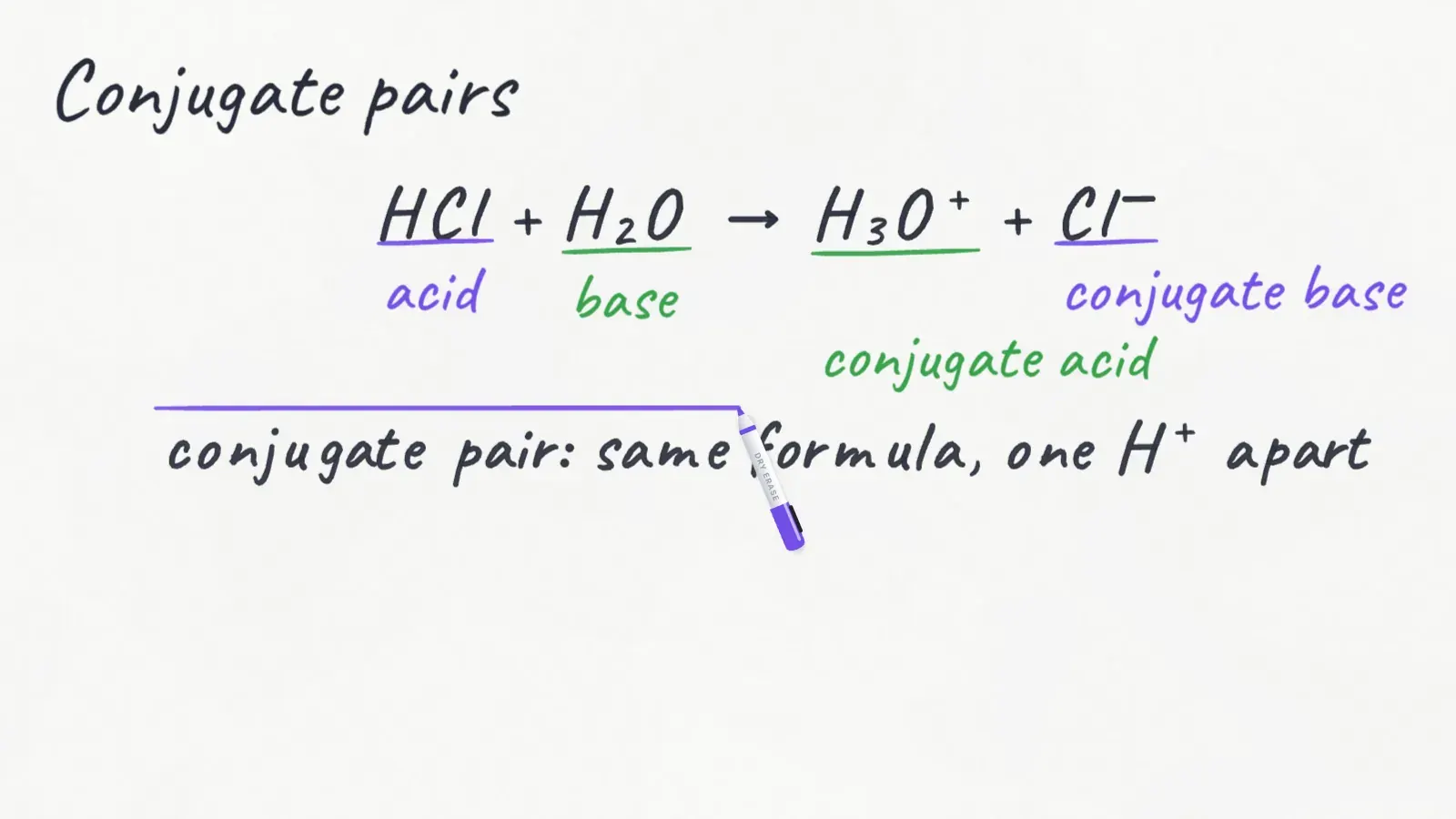
So two different things happened in that bottle. The acids handed protons to water, and every one of those reactions has an acid, a base and two conjugate pairs. And the gold handed electrons to nitrate, which we write as two half-reactions with the electrons matched. So whenever you see something turn more positive, ask which particle moved, a proton or electrons, because that tells you what kind of reaction you’re looking at, and how to write it.