
Topic 4.1 key terms
- physical change
- A change in a substance's properties (state, shape, mixing) without a change in its composition. Phase changes and forming or separating mixtures are physical changes.
- chemical change
- A change in which substances are transformed into new substances, typically with different compositions.
- possible evidence
- Heat or light, a gas forming, a precipitate forming, or a color change suggest a chemical change, but each can also happen without a new substance. The deciding question is whether a new substance formed.
- precipitate
- A solid that forms out of a solution, such as silver chloride forming when silver nitrate and sodium chloride solutions are mixed.
Transcript
1,448 words · 5 parts
Reactions: chemical or physical change?
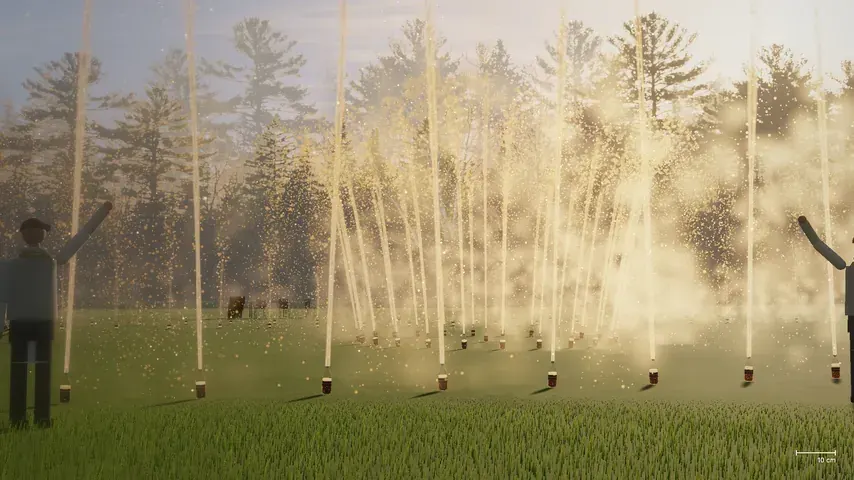
Imagine standing right in the middle of this, with soda raining down all around you on a spring day in Maine. In April of 2006, two friends in Buckfield, Maine, named Fritz Grobe and Stephen Voltz lined up a hundred and one big bottles of Diet Coke in a field, and dropped Mentos into them, one bottle after another. They choreographed it like the famous fountains in Las Vegas, with five hundred and twenty-four Mentos, and they shot the whole thing in one take.
And honestly, just look at this thing. So let me freeze it right here and ask you one question. Is this a chemical reaction? It fizzes and foams and shoots into the sky, so it sure looks like one, but a chemical reaction means something new got made, and finding out whether that happened here is a lot trickier than it looks.
By the end of this lesson, you’ll be able to say whether anything new actually formed in these bottles, and back it up with an experiment you run yourself. And you’ll be able to write this entire show, all hundred and one bottles of it, as one short equation that leaves out everything that didn’t change. To get there we need to know exactly what something new means, so let’s start with the most ordinary substance in the world, which is water.
Here’s an ice cube. Leave it out and it melts into a puddle, boil the puddle and it turns into steam, and those three look and behave completely differently. But look at the molecules. In the ice, the puddle and the steam, every single one is still H₂O, two hydrogens hanging on to one oxygen, and all that changed is how they’re arranged and how fast they move.
So the properties changed but the composition didn’t, and that’s what chemists call a physical change. It looks different, but it’s still the same stuff. When water boils, what’s actually inside those big bubbles?
Mixtures work the same way. Stir sugar into tea and the crystals disappear, but every sugar molecule is still whole, just spread out between the water molecules. Or stir gray iron filings into yellow sulfur powder. It looks like some new speckled powder, but a magnet pulls the iron right back out, because the iron is still iron and the sulfur is still sulfur. So putting a mixture together or pulling it apart is physical too, as long as nothing new forms.
The first trap is thinking that anything that looks different must be a new substance, because looks aren’t the test, and what matters is whether the substance itself changed. Deciding whether the substance itself changed is a classic AP question, and on the exam the credit goes to what the evidence actually lets you conclude, so that’s how we’ll argue every case from here on.
Something new
Now let’s heat that same iron and sulfur. Once it’s hot enough, a glow creeps through the powder all by itself, and when it’s done, the gray and the yellow are gone and there’s one black solid. That’s iron sulfide, a brand-new substance with its own properties, and a magnet can’t simply pull the iron back out anymore. So a chemical change turns substances into new substances, usually with a different composition, and the question that matters is whether something new got made.
In a lab you can’t see molecules, so chemists look for clues, like heat or light, a gas forming, a solid forming out of a solution, which we call a precipitate, or a change in color. But every one of these is only possible evidence, because each one can show up when nothing new forms at all. An old light bulb’s wire glows white-hot every time you flip the switch, and when it cools it’s still the same tungsten, so light can lie, and our fountain is about to show us how a gas can lie too.
Inside the bottle
Let’s go back to the frozen field. What kind of change is this, really? We’ll pick a bottle that hasn’t gone off yet and go right through the plastic, down into the soda, smaller and smaller, until we can see the molecules. Most of these are water molecules, and the straight ones are carbon dioxide, which the bottling plant forced in under pressure, so it’s been sitting here dissolved, as single molecules, ever since the cap went on.
Now here comes the Mentos, and up close its surface is covered in tiny pits and bumps, which turns out to be most of the secret. Dissolved carbon dioxide needs somewhere to start a bubble, and every pit is a perfect spot, so bubbles grow in tens of thousands of places at once, and the foam shoves the soda up and out of the bottle.
Let’s follow one carbon dioxide molecule. It slips into a bubble, rides up the bottle and flies out into the air, still exactly the same molecule, so it went from dissolved to gas and nothing new got made.
So what drives the fountain is a physical change. The gas was already in the bottle, and the Mentos just gave it somewhere to turn into bubbles. Now compare a classic demo called elephant’s toothpaste, where foam shoots out of a tall cylinder. It’s hydrogen peroxide with a catalyst and a little soap, and from the outside it looks a lot like our fountain.
But inside, something completely different is happening. The peroxide molecules come apart and their atoms join up again as water and oxygen, so these oxygen molecules didn’t exist a moment ago. Here’s one bubble from each, and from the outside they look exactly the same, but one of them is holding something that was just made.
Tap the molecules in both bubbles and find one that didn’t exist before the bubbling started. So our model says the fountain’s gas was already there, but a model isn’t proof, so we’ll come back at the very end of the lesson and test it.
Clues that lie
Let’s turn the gas clue into a worked example. When soda fizzes in a glass, that’s dissolved carbon dioxide becoming carbon dioxide gas. Pour baking soda into vinegar and it fizzes like crazy too. On a test they’d give you this equation, and look, the gas is carbon dioxide again.
Both make the exact same gas, so if the clue were the whole story, they’d be the same kind of change. But ask where the carbon dioxide came from. In the vinegar cup the carbon started out locked inside the baking soda, so the CO₂ is new and that’s chemical, while in the soda it was already there, which makes it physical.
These two sentences answer almost any evidence question. If something new formed, say what it is, and if a clue could have another cause, name that cause. For the vinegar cup, the new substance is carbon dioxide, made from the baking soda. Now let’s try one together.
A clear liquid starts bubbling as you warm it. From that observation alone, what can you conclude? A solid can lie too, because rock-candy crystals growing out of sugary syrup are the same sugar that had dissolved in it, so that’s physical. And when food coloring turns a glass of water pink, the dye molecules have only spread out, so that color change is physical.
People also say that if you can undo a change, it was physical, but some chemical changes run backward too, so that isn’t the test either. So here’s one for you. These blue crystals are copper sulfate with water built into the crystal, five waters per copper sulfate. Heat them and they crumble into white copper sulfate while water collects at the top of the tube. Then drip water back on, and the powder turns blue again and gets warm. Which claim about heating the blue crystals is best supported?
A solid out of clear water
Now let’s give the precipitate clue one more try, with two clear liquids, silver nitrate and sodium chloride, which is just salt water. Watch what happens where they meet. A white cloud of solid blooms right out of the clear water. That’s silver chloride, and this time the clue tells the truth, because silver chloride wasn’t in either liquid, so this is a chemical change.
Pour it through filter paper and the white solid stays behind while clear liquid drips through. Filtering only separates a solid that already exists, so that step is physical. So we know something new formed, and now we can be much more precise about which particles joined that solid and which stayed in the water, and how to write it down without losing a single atom.