
Topic 3.13 key terms
- absorbance
- A = b c (Beer-Lambert law); no units. ε: molar absorptivity, b: path length, c: concentration.
- calibration line
- Absorbance of standards of known concentration at fixed b and λ; an unknown's absorbance is read off it.
Transcript
946 words · 3 parts
Beer-Lambert: how much light gets through
How bright that star gets depends on how many sodium atoms sit in the beam’s path, because more atoms take more photons out of the beam. Chemists turn that idea around, shining one color through a liquid and measuring how much gets out, to work out how much of the absorbing stuff is dissolved in it.
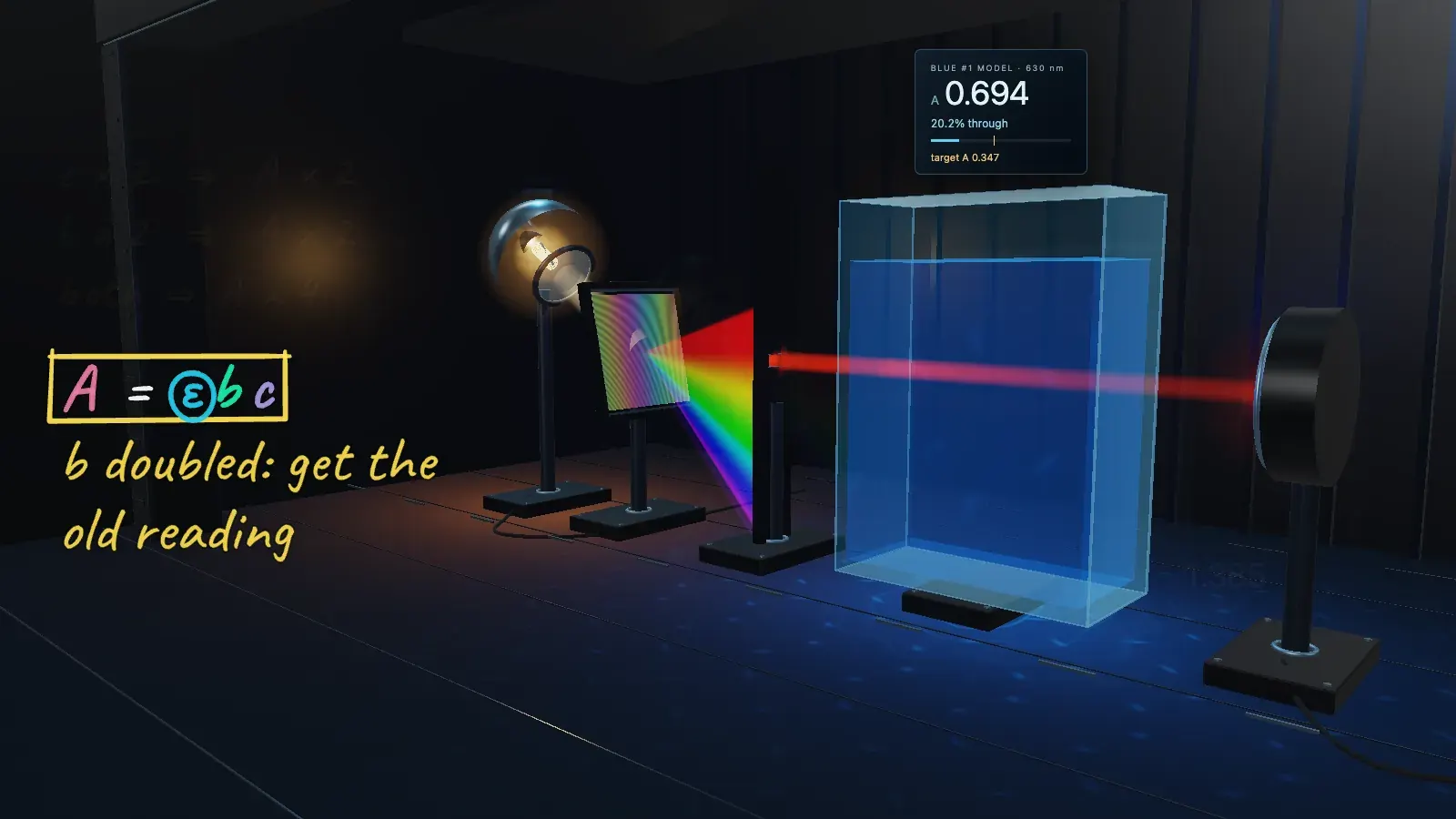
So let’s pour a blue sports drink into a small clear box called a cuvette, and shrink down inside a spectrophotometer, the machine that makes that measurement. A lamp makes white light, a grating spreads it into a rainbow, a slit picks out just the orange-red at six hundred thirty nanometers that the dye absorbs best, and a detector measures how much of it gets through the drink.
Inside the drink, dye molecules absorb the orange-red photons, and the energy ends up as a tiny bit of heat, while in white light the blue photons mostly sail straight through, which is why the drink looks blue. Now split the drink into equal slices, and notice that each slice takes out the same fraction of the light that reaches it, so a thousand photons become five hundred, then two hundred fifty, then a hundred twenty-five.
So chemists use absorbance, A, which goes up by the same amount for every slice, about point three each time. That’s why it’s so useful, because it turns all that halving into simple adding. Double the concentration of dye and the absorbance doubles, and these are real measurements, about point three five going to point six nine.
Make the box twice as long instead and the absorbance doubles too, because the light meets twice as many dye molecules on its way through. Double both and it’s four times as much, and that’s the Beer-Lambert law, A equals epsilon b c, where epsilon, the molar absorptivity, says how strongly this dye absorbs this particular color. The light now has to cross twice as much drink. Change the concentration so the detector reads exactly what it did before.
Epsilon depends on the color, so watch the absorbance as the slit slides along the rainbow. In the blue the dye barely absorbs at all, and in the orange-red it absorbs the most. A big molecule like this one has so many steps packed close together that it takes in a whole band of colors, just not all of them equally. Set the wavelength that makes this measurement as sensitive as it can possibly be.
Measure the blue in a sports drink
Here’s the law with its units. The path length is how far the light travels through the liquid, in centimeters, not how full the cuvette is, and absorbance has no units at all. A company that makes these classroom instruments checked its own dye solution this way. Its example reads point eight oh in a one-centimeter cuvette, and this dye’s epsilon is one point three oh times ten to the fifth per molar per centimeter.
So we divide the absorbance by epsilon times b, and the centimeters cancel. That’s six point two times ten to the minus sixth molar, with two significant figures like the absorbance, tiny, because this dye absorbs so strongly that a few millionths of a mole per liter turns water deep blue. In a real lab you hold the path length and wavelength fixed, so absorbance depends only on concentration, and you build your own line from solutions you already know.
Here are eight real ones, each measured at six hundred thirty nanometers, and they land almost perfectly on a straight line. Their line has a slope of one point one four times ten to the fifth, which is epsilon times b, and that’s a bit less than the one point three oh times ten to the fifth we just used, which is exactly why chemists calibrate.
The first sports drink reads point two oh eight four, so take away that tiny intercept, divide by the slope, and try it. That’s one point eight oh times ten to the minus sixth molar. It lands inside the range of the standards, where we can trust the line, and a whole bottle of that drink holds less than a milligram of dye. Now you do the second sports drink, which reads point three oh nine one. What’s its concentration of blue dye?
The sentence that earns the point
Here’s how the AP exam asked about this in 2021. A student made a calibration line for copper two sulfate, but there were still a few drops of water in the cuvette when they measured the unknown.
So, how does that change the concentration the student calculates for the unknown? And this is the sentence that earns the point. The water dilutes the solution, so fewer copper ions sit in the light’s path, the absorbance is lower, and so the calculated concentration is lower than the real one. It follows the cause all the way from the water to the number you calculate. That chain, step by step, is what the graders are looking for.
So the kind of light tells you the kind of change inside a molecule. Microwaves make it spin, infrared makes its bonds vibrate, and visible and ultraviolet light move an electron up a level. A molecule only takes a photon whose energy, h nu, matches one of its steps exactly. A photon’s energy is always positive, and a brighter beam of one color just means more photons.
And counting how much light goes missing tells you how much stuff is there. Fix the path length and the wavelength, and read it off a calibration line. And that’s how four yellow beams make stars over the Atacama, with the one color the sodium up there can take.