
Topic 3.8 key terms
- partial charge
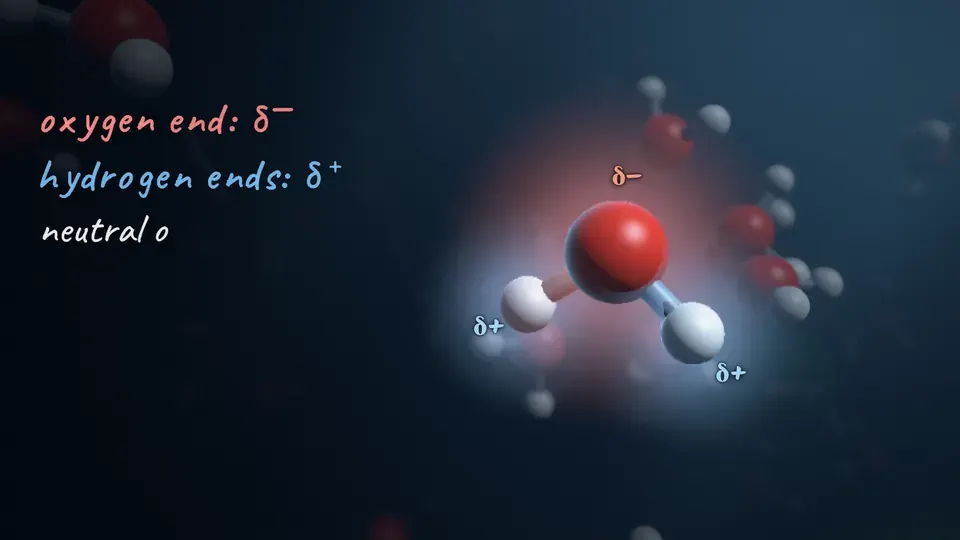
- A fraction of a charge on part of a polar molecule: water's oxygen end is slightly negative (δ−) and its hydrogen ends slightly positive (δ+); the molecule as a whole is neutral.
- particulate representation of a solution
- A drawing of the particles in a solution that shows the relative amounts of each component (in the formula's ratio, per volume) and/or the attractions between them.
- charge balance
- In a particle drawing of an ionic solution, the positive and negative charges add up to zero, e.g. 4 Ca²⁺ and 8 Cl⁻: 4(+2) + 8(−1) = 0.
- concentration
- Amount of solute per volume of solution; in a particle drawing, the number of solute particles divided by the volume the drawing represents.
Transcript
1,070 words · 3 parts
Representations of solutions: a lake under the sea
About a kilometer under the Gulf of Mexico, it’s cold and completely dark, and the only light down here is the light a robot brings with it. So it’s a strange moment when the robot’s lights find a shoreline, packed with mussels, and beyond it a lake, with a surface and slow little waves, sitting on the floor of the ocean. In 2015, a team on the research ship Nautilus flew their robot, Hercules, to the edge of this lake and tried to drive it in.
Hercules had to push down hard with its thrusters to get under the surface. The lake is so loaded with salt that it’s denser than the ocean around it, so the robot kept wanting to bob back up.
When the team measured the brine, it was two to three times as salty as seawater, and it kills the animals that wander in, so it got a nickname, the Hot Tub of Despair. Let’s fill two bottles, one with ocean water from just above the shore and one from the lake. Hold them up to the light, and you can’t tell them apart.
By the end of this lesson, you’ll be able to draw what’s really inside each bottle, down to which way every water molecule turns, pull apart mixtures that slip straight through a filter, and predict what will dissolve in what. And at the very end, you’ll be able to explain why this lake hasn’t simply mixed into the ocean around it, even though it absolutely could.
So let’s shrink ourselves down into a single drop from the lake’s bottle. Here we are inside one drop of the brine, and almost everything you see is water, one oxygen and two hydrogens in this little bent shape.
The salt in this lake came from rock salt buried under the seafloor, and water takes it apart, crowding around an ion on the corner and tugging it loose, then the next one, and the next. And sodium and chloride don’t leave together, because each ion floats off on its own, wrapped in its own crowd of water.
Water grabs onto ions because its oxygen pulls the shared electrons toward itself, so its oxygen end is slightly negative and its hydrogen ends are slightly positive, even though the molecule as a whole is neutral. Around a positive sodium ion, the waters turn their oxygen ends inward, and around a negative chloride ion they flip around and point a hydrogen at it instead.
That’s the heart of this chapter, so let me say it one more time. Water turns its slightly negative end toward a positive ion and its slightly positive end toward a negative ion, so opposite charges always end up side by side. The waters keep trading places. But the ones right next to an ion mostly face it the right way.
And this exact picture is a real AP question. On the 2023 exam, students had to draw three waters around a chloride ion, and the point went to everyone who pointed a hydrogen from each water at the chloride.
Now I want you to try it, so turn each of these three water molecules until it’s attracted to the chloride ion. Not everything that dissolves comes apart into ions, though. This sugar molecule leaves its crystal in one piece, all forty-five atoms of it, with water holding on to its O–H groups through hydrogen bonds. So now, let’s turn what we just saw into a drawing.
One drawing, two jobs
A drawing of a solution can do two jobs. It can show who’s attracted to whom, by drawing the waters, oxygens in around the sodium and a hydrogen in around the chloride, or it can show how much is there, by leaving the water out, saying so, and drawing only the ions so you can count them. Either way, the ions are drawn apart with their charges, in the formula’s ratio, molecules and polyatomic ions stay whole, and salt water drawn full of little sodium chloride pairs gets crossed out.
Let’s draw one point oh oh liters of point one oh oh molar calcium chloride, where each symbol stands for point oh two five oh moles, which is the drawing’s key, like the scale on a map. Molarity times volume gives point one oh oh moles of calcium chloride, once the liters cancel.
Now look at that little two, because every formula unit gives one calcium ion and two chloride ions, so that’s point one oh oh moles of calcium and point two oh oh moles of chloride, and at point oh two five oh moles per symbol, we draw four calciums and eight chlorides. To check any ionic drawing, add up the charges, so four times plus two and eight times minus one come to zero, just like they have to.
Now one for you, modeled on that same 2023 exam, where students had to say what was wrong with a drawing of strontium hydroxide in water. Look at the formula and the charges, and decide what’s wrong with this one.
More salt isn’t saltier
Back at the lake, picture the same small volume from each bottle, with the water left out. In our model the ocean sample has four sodium and four chloride ions and the lake has twelve of each, so the same volume holds three times as much salt. Now Hercules fills a small chamber and a big one with twice the volume, both from the same lake.
Which one do you think is more concentrated? The big one has twenty-four of each ion, twice as many, but in twice the volume, so it’s exactly as concentrated, because concentration is how much there is in each bit of volume.
Same idea on paper, with three boxes of salt water, drawn with only the sodium ions and the same key, where box C holds two liters. B and C both have six symbols, but they don’t tie, because counting alone ignores the volume. Box A has four symbols, point one oh oh moles, in one liter, so it’s point one oh oh molar, and box B has six in one liter, so it’s point one five oh molar.
Now you work out box C, in moles per liter. So now we can draw what’s dissolved in that lake, and how much. Can we get it back out again? For that, let’s leave the sea for a mountainside in Utah.