
Topic 3.10 key terms
- ion–dipole attraction
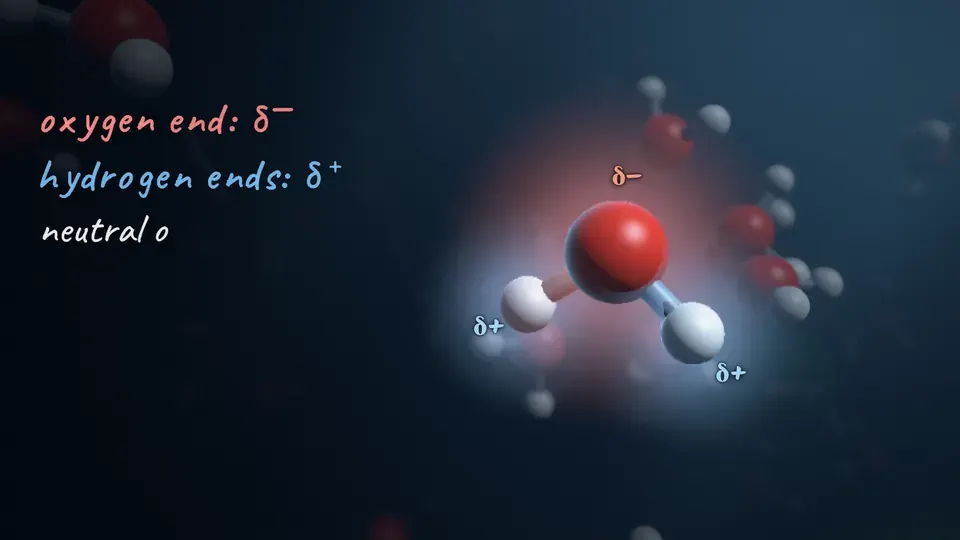
- The attraction between an ion and the oppositely charged end of a polar molecule, such as Na⁺ and water's δ− oxygen.
- miscible
- Describes liquids that mix in any proportion to form one solution, such as ethanol and water.
- like dissolves like
- Shorthand for the idea that substances with similar intermolecular interactions tend to be miscible or soluble in one another. “Like” means similar attractions, not similar appearance.
Transcript
1,120 words · 4 parts
Solubility: the foam water can’t touch
This is a street of electronics shops in Tokyo on a rainy night, and a new TV usually comes packed in foam like this, which is almost entirely air. Water dissolves salt and sugar and half the things in your kitchen, and it does absolutely nothing to foam. But bend a piece of orange peel, and that spray of mist is mostly an oil called limonene, and a tank of it makes the same foam slump, fizz as its air rushes out, and vanish.
In the late 1990s, Sony ran a recycling system in Tokyo on exactly this trick, shrinking foam to a fiftieth or even a hundredth of its volume, and the plastic wasn’t destroyed, because they got it back out, along with the orange oil. So let’s follow the plastic, through the glass, past tiny bubbles of air and into a thin plastic wall, where polystyrene turns out to be long, tangled chains, each one an enormous molecule, and we’ll light one up.
Limonene molecules slip in between the chains, and the gold chain lets go of its neighbors and drifts off into the liquid, still in one piece. That’s what dissolving is, the same molecule with new neighbors.
Put water in the same spot, and its molecules hold each other with hydrogen bonds, which they’d have to give up to get between the chains, and the chains have nothing as good to offer, so the water stays out. I sped this up and gave the tank glass walls. The chemistry, though, is exactly this.
Think of dissolving as a trade. The solute lets go of itself, and the solvent makes room by letting go of some of its neighbors, and in return, the solute and the solvent attract each other. When the new attractions are about as good as the old ones, the solute tends to dissolve, helped along by the particles’ natural tendency to spread out and mix.
That’s why substances with similar intermolecular attractions tend to be soluble in each other, or miscible, if they’re liquids that mix in any amounts. So like dissolves like doesn’t mean looks alike, because water and limonene are both clear and won’t mix, and like means similar attractions between the particles.
Back at the edge of the lake’s salt crystal, each water turns a partly charged end toward an ion, a full charge pulling on a partial charge, which is called an ion–dipole attraction. Swap the water for hexane, which is only carbon and hydrogen, and since it has no partly charged ends to offer, only weak attractions, nothing leaves the crystal.
On paper it’s the drawing from the start of the lesson, and those ion–dipole attractions nearly pay for pulling the ions out of the crystal. Here’s potassium bromide. Pick the statement with the right prediction and the reason that actually explains it.
One honest warning, though, because being ionic doesn’t guarantee dissolving. Chalk, calcium carbonate, is ionic and barely dissolves in water, and you’ll put numbers on that in Unit 7.
Molecules with two personalities
Now for molecules, starting with ethanol, two carbons with an O–H on the end, next to a water molecule. Ethanol’s hydrogen can be attracted to water’s oxygen, and water’s hydrogen to ethanol’s oxygen, and we draw each hydrogen bond as a dotted line between the molecules, never from a hydrogen on carbon, and never solid.
Both liquids already hold themselves together with hydrogen bonds and can make them with each other, so ethanol and water are miscible. Now you tell me about hexane, which has no O–H and no polar part at all. It can only offer water weak attractions and no hydrogen bonds, so the water keeps its own hydrogen bonds, and you get two layers.
Now keep the O–H and grow the carbon chain. Methanol, ethanol and propanol mix with water in any amount, but only about seven point seven grams of butanol dissolve in a hundred milliliters of water, and hexanol barely more than half a gram, about thirteen times less. So one O–H isn’t a free pass, because every carbon we add grows the part that can’t hydrogen bond.
The foam, AP style
So let’s explain the foam the way the AP exam wants, by asking what holds the solute to itself, what holds the solvent to itself, and what the two can form together. Polystyrene and limonene are both nonpolar, and both are held together by London dispersion forces, while water is held together by hydrogen bonds, which polystyrene can’t form.
If this came up on the AP exam, this is the sentence that earns the point. Polystyrene and limonene attract each other through London dispersion forces, similar to the forces inside each pure substance, but polystyrene can’t form hydrogen bonds with water, so it can’t replace the hydrogen bonds between water molecules, and it doesn’t dissolve. Notice that it names the particles, names the attraction and compares them, and that’s the habit that earns points on every solubility question.
Let’s put it to the test in Tokyo, with three tanks, water, ethanol and limonene, and think hard about ethanol, because it’s part greasy tail and part O–H. Here’s a block of foam. Drag it into the tank you think will dissolve it. To get the plastic back, you heat the solution so the limonene boils off and you can condense it and reuse it, which is distillation one more time, and the polystyrene is left behind for new plastic, including the chain we followed.
Why the lake stays a lake
And now we can answer the question from the very start. Hercules has two jars, one with lake brine under seawater and one with limonene floating on water, and both of them have a line between two liquids.
If Hercules shakes both jars hard, which one will still be mixed a minute later? The brine and the seawater swirl into one clear solution and stay that way, while the limonene breaks into droplets that float right back up into a layer.
Brine and seawater are the same particles, water and ions, held by the same attractions, so they’re miscible, and limonene can’t offer water anything like its hydrogen bonds. So the lake’s surface comes from density, because the brine is so much denser that it settles under the seawater, mixing across that calm boundary is very slow, and water seeping through the buried salt keeps feeding the lake from below.
And now those two clear bottles don’t look the same at all. You can draw what’s inside them, you know how to get it back out, and you know why there’s a lake on the floor of the ocean. It’s a kilometer down in the dark, lapping at its shoreline of mussels, and now you know exactly what’s in it.